

 AR
AR
 NL
NL
 FR
FR
 DE
DE
 ES
ES
 IT
IT
 PL
PL
 SV
SV
 PT
PT


Most traders who chase next level funding don’t fail because their setup is bad. They fail because they pick the wrong account path, trade too aggressively under firm rules, or treat execution like an afterthought. If you want a funded account that lasts, you need an operating system, not a burst of motivation.
This guide is written from the practical side of prop trading. The focus is simple: choose the right path, stay inside the rules, build a plan you can repeat, and use the platform well enough that your edge survives contact with the market. Trading involves risk of loss, and this is educational only, not financial advice.
Choosing Your MyFundedCapital Funding Path
A lot of traders make the same early mistake. They choose a funding model based on account size or price, then try to force their trading style into it.
That’s backwards.
Your path into next level funding should match how you trade under pressure. A trader with a calm, low-drawdown process usually needs a different route than a trader who performs well with defined targets and a short evaluation window.
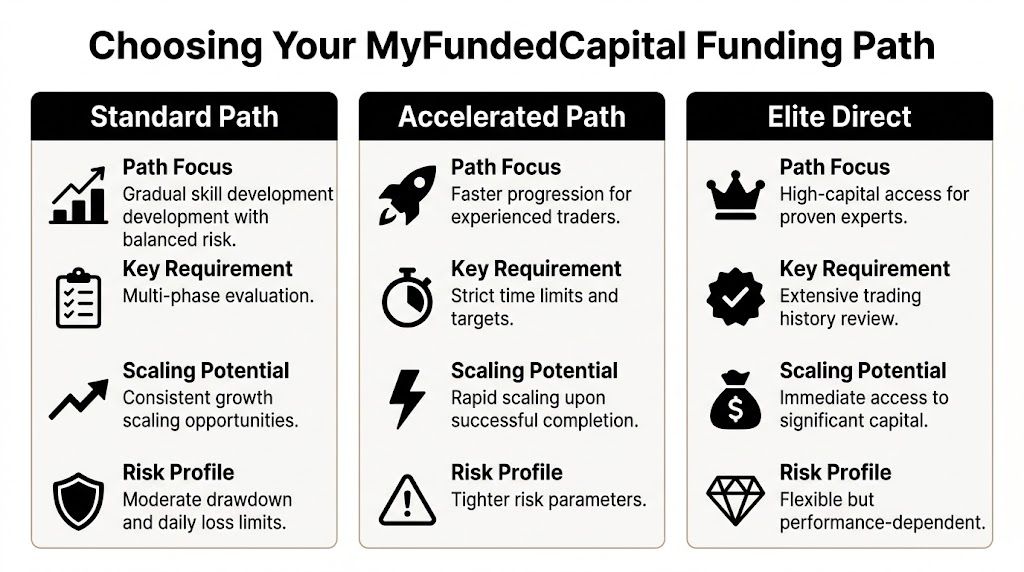
Match the model to your behavior
Here’s the practical split.
| Funding path | Best fit | Main trade-off |
|---|---|---|
| Instant funding | Traders with a proven, conservative process | Less room for sloppy adaptation |
| 1-Step challenge | Traders who can focus on one clean objective | Pressure can push overtrading |
| 2-Step challenge | Traders who prefer a slower proving process | More patience required |
If you’ve already built a strategy that produces steady results and keeps drawdown contained, instant-style access can make sense. The key requirement is discipline. You can’t rely on one oversized trade to dig yourself out of trouble.
If you tend to perform better with a clear target and a defined testing phase, a challenge model often fits better. It gives structure, but that structure cuts both ways. Good traders use it to stay selective. Impatient traders use it as an excuse to force setups.
When the 1-Step path makes sense
The 1-Step route is attractive for one reason. It reduces complexity.
You’re solving one performance problem instead of juggling multiple evaluation phases. For traders who already know their setup and can execute without drifting into revenge trading, that simplicity matters. In one cited example, MyFundedCapital’s 1-Step Challenge has shown a 28% pass rate for traders aiming for $100K accounts through focused, disciplined execution, as referenced in this search result citation.
Practical rule: If your edge depends on frequent discretion changes, a simpler challenge format often exposes that weakness quickly.
That doesn’t mean 1-Step is “easier.” It means the account path is more honest. You either execute your process or you don’t.
A trader who can sit on their hands, wait for two or three high-quality opportunities, and accept flat days usually fits this path better than the trader who needs constant action.
When a slower route is the better call
Some traders don’t need speed. They need emotional stability.
If your biggest issue is forcing targets, the slower evaluation path can help because it reduces the urge to sprint. You still need consistency, but the mental framing is different. Instead of trying to finish fast, you focus on surviving first and building performance second.
That’s often the better route for traders who are:
- Still refining execution: Your entries are decent, but exits and sizing still vary too much.
- Recovering from bad habits: You’ve had issues with tilt, rule breaches, or overtrading after losses.
- Transitioning from personal accounts: You know your setup, but you haven’t yet adapted it to prop-style limits.
A fast self-audit before you choose
Use this checklist before you buy any evaluation:
- Review your last month of trades: Did you win by process or by a few outsized trades?
- Look at your bad days: Did losses come from normal variance or from breaking your own rules?
- Check your pace: Are you comfortable waiting, or do you need frequent setups to stay engaged?
- Measure your emotional leaks: If a missed trade wrecks your focus, choose the path with the least pressure.
- Study account rules first: Read a practical guide on how to get a funded trading account before deciding, so your account choice matches the way evaluations function.
A funded account should fit your operating habits. If it doesn’t, every rule will feel restrictive, and that friction usually shows up in the equity curve.
Mastering MFC’s Core Risk and Trading Rules
Most failed evaluations don’t blow up because the trader lacked entries. They blow up because the trader treated risk rules like background details.
That’s why next level funding starts with one skill above everything else. Survival.

Industry benchmark data is blunt. Only 5-10% of traders pass prop firm challenges on their first attempt, and up to 40% of instant failures come from breaching the daily loss limit, according to QuantVPS prop firm statistics. That lines up with what experienced prop traders already know. The market doesn’t need to beat you if your rule management does it first.
Translate the limits into hard numbers
A flat 5% daily loss limit and 10% maximum drawdown sound simple. They aren’t, unless you convert them into numbers you can trade around before the session starts.
On a $50K account, that means:
- Daily loss limit: $2,500
- Maximum drawdown: $5,000
Those numbers aren’t your working risk budget. They’re your absolute emergency boundary.
A trader trying to use the full daily loss limit as normal capacity is already too close to failure. The smart move is to define a smaller internal cap for the day and stop well before the rule stops you.
Here’s a cleaner operating model:
| Account metric | Rule limit | Safer internal approach |
|---|---|---|
| Daily loss | Firm maximum | Stop trading well before the hard cutoff |
| Overall drawdown | Firm maximum | Treat it as disaster protection, not available room |
| Per-trade risk | Your choice | Keep it small enough that a losing streak stays manageable |
If your system needs emotional heroics after two losses, the sizing is wrong.
Make breaches mathematically difficult
Good risk control isn’t motivational. It’s mechanical.
Build your day so a breach is hard to reach unless you actively ignore your own process. That means defining your stop count, your per-trade risk, and your session cutoff before the first order goes in.
A practical routine looks like this:
- Set the daily stop in cash terms. Don’t think in percentages once the session begins.
- Cap risk per trade. If one trade can do meaningful damage to your day, size is too large.
- Limit the number of attempts. Three poor decisions in a row usually signal market mismatch or mental drift.
- Stop after a sharp emotional change. Frustration changes trade quality faster than most traders admit.
A hard rule beats a good intention every time. If your platform lets you keep clicking after your mental state breaks down, your written plan has to step in.
Build a pre-trade risk checklist
Most traders only review charts. Professionals review conditions and exposure.
Use a short checklist before every session:
- Session context: Is this a trend day, range day, event-heavy day, or low-liquidity day?
- Instrument selection: Are you trading one market cleanly or jumping between symbols out of boredom?
- Stop placement: Is the stop based on structure, or is it just the largest size you want to trade?
- Correlation check: Are multiple positions inadvertently stacking the same directional risk?
- Exit condition: Do you know where the trade is wrong before entry?
This matters even more if you’re adapting to prop rules for the first time. A lot of traders understand market analysis but don’t understand drawdown management as an execution skill. If you need a firmer grip on the mechanics, review what trailing drawdown means in prop trading and compare it with the flat-limit structure you’re trading under.
What works and what usually fails
What works:
- Trading a narrow watchlist
- Predefining daily shutdown conditions
- Risking small enough that a losing run stays boring
- Taking only setups you can describe in one sentence
- Ending the session when your process quality drops
What usually fails:
- Increasing size to “catch up”
- Trading after a daily drawdown hit feels close
- Switching strategy mid-session
- Adding correlated positions because each one looks small on its own
- Treating funded-account rules like a side note
A practical example on a $50K account
Suppose you’re trading a $50K account with a $2,500 daily loss boundary and a $5,000 overall drawdown ceiling.
A disciplined trader won’t plan the day around losing $2,500. They might define a much smaller daily stop, keep position size modest, and allow the strategy enough room to play out without putting the account in danger after one bad sequence.
That shift matters. You stop trading like a gambler managing hope, and start trading like an operator managing inventory.
Building Your Repeatable Trading Plan for Scale
You don’t reach next level funding with one hot streak. You get there by running the same process often enough that good statistics can show up.
Most traders get exposed. They have ideas, not a plan. They know entries, but they can’t explain how they’ll repeat them across a funded account, a payout cycle, and eventually a larger allocation.
Manual traders need a small playbook
If you trade manually, your goal isn’t to know every setup. It’s to know your setups well enough that execution becomes boring.
Keep a playbook with two or three recurring patterns. That’s enough. Each setup should include market condition, entry trigger, invalidation, and the reason you usually have an edge there.
For manual traders, the structure should be simple:
- Primary setup: The pattern you trust most in your best session window.
- Secondary setup: A backup pattern for different market structure, not just a weaker version of the first.
- No-trade condition: The filter that keeps you out when the market isn’t offering either.
A lot of newer traders skip the third one. That’s why they trade junk.
Desk note: If you can’t explain why a setup fits today’s structure, you’re probably trading because you want action, not because you have a signal.
Journaling matters here, but not in the vague “write your feelings” sense. Log screenshots, entry reason, stop logic, and whether you followed plan or improvised. The review should tell you which setup makes money and which setup only feels productive.
EA traders need to optimize for compliance first
Algorithmic traders often make the same mistake discretionary traders do. They optimize for return and only later ask whether the system fits prop conditions.
That order should be reversed.
If you’re running an EA, test for:
- Drawdown behavior: Not just net result
- Loss clustering: How the system behaves during bad runs
- Session dependency: Whether it collapses outside a narrow time window
- Execution sensitivity: Slippage, spread changes, and fast markets
- Rule compatibility: News, holding periods, and stop logic
A prop-friendly EA is usually less exciting on paper than a social-media backtest. That’s fine. The account rewards compliance and durability, not flashy curves.
Copy traders need provider screening, not hope
Copy trading can work, but only if you vet the source like a risk manager. Most traders do the opposite. They look at win rate first, then ignore drawdown behavior, trade frequency, and style drift.
That’s exactly how copied strategies wreck funded accounts.
Screen signal providers with these questions:
- How do they lose? Fast and deep losses are more dangerous than a lower win rate.
- Do they average down? If yes, understand the account-risk implications immediately.
- Is their size stable? Random position jumps usually signal poor process.
- Can you explain the strategy type? If not, you’re outsourcing blindly.
- Does the style fit the account rules? A strategy can be profitable and still be unusable in a prop setting.
Choose one execution lane and stick to it
One strength of modern prop environments is flexibility. MyFundedCapital supports manual, algorithmic, and copy trading across over 350+ instruments, which gives traders room to build around their actual edge, as outlined on the MyFundedCapital platform page.
That flexibility is useful only if you don’t abuse it.
A common mistake is mixing all three styles without clear boundaries. Manual entries drift into copied ideas. EA trades run while discretionary positions are layered on top. Risk stacks up, and no one really knows what generated the result.
A plan you can scale
A scalable trading plan should answer these points clearly:
| Plan component | What good looks like |
|---|---|
| Setups | Limited, defined, repeatable |
| Risk model | Small, stable, preplanned |
| Review process | Screenshot-based and honest |
| Execution style | Manual, EA, or copy with clear boundaries |
| Adaptation rule | Changes made after review, not mid-session |
The best plans feel almost too plain. That’s usually a good sign.
If your process needs constant reinvention to stay interesting, it probably won’t survive a funded environment. A scalable trader protects consistency first, then earns the right to scale.
Optimizing Your Strategy for DXtrade and cTrader
A workable strategy can still fail if your platform workflow is messy. Bad chart layout, slow order handling, unclear risk display, and inconsistent templates create errors you’ll blame on the market.
That’s why platform optimization matters. It’s part of execution, not decoration.
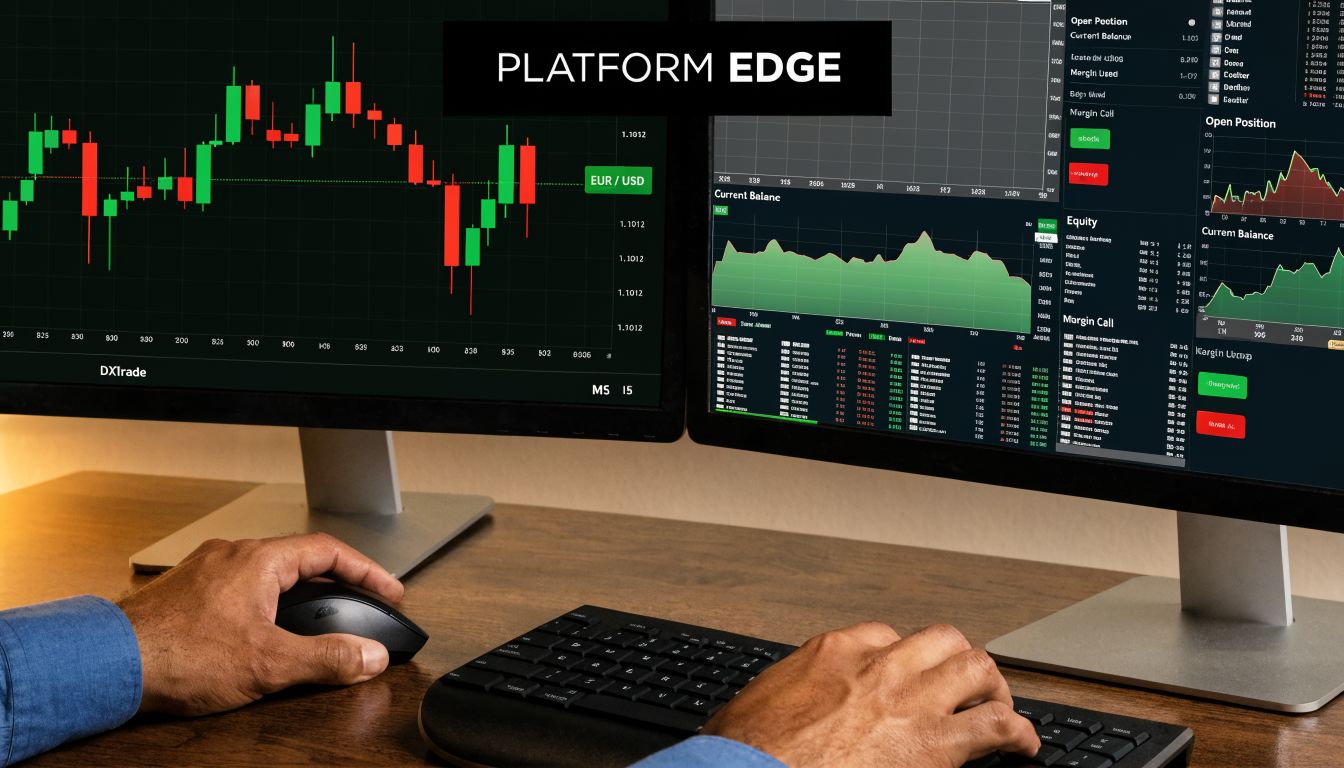
Make DXtrade fast and clean
DXtrade works best when the workspace is stripped down to what you use. Most traders overload it with too many symbols and too many panels, then miss the one thing that matters, current exposure.
A better setup usually includes:
- One core watchlist: Only the instruments you trade regularly
- Clear order panel placement: So size and stop logic are visible before execution
- Risk-first chart layout: Price, key levels, and open-position visibility
- Session-specific templates: Different views for scalp, intraday, or swing workflow
If you trade fast markets, reduce clicks. Anything that makes you hesitate at entry or fumble at exit needs to be removed.
Use cTrader for precision and review
cTrader tends to suit traders who want more refined charting and order control. That matters if your edge depends on exact execution, layered entries, or detailed trade review after the fact.
Use it well by focusing on:
- Saved templates: Keep the same structure across instruments so you’re not reinterpreting charts
- Advanced order planning: Place stops and targets with intent, not as an afterthought
- Post-session analytics: Review execution quality, not just P and L
- Clean indicator use: Only keep tools that directly affect decisions
A lot of traders say they have a platform preference when what they really have is a habit. Test both the workflow and the review process. The better platform is the one that helps you make fewer operational mistakes.
If you’re comparing interfaces and execution style in more detail, a guide to the best FX trading platform options can help narrow what fits your process.
Optional add-ons should match your strategy
News trading and weekend holding are useful only for the right trader. They’re not badges. They’re tools.
Consider them if your strategy depends on:
- Event-driven entries: You intentionally trade scheduled macro releases
- Swing structure: Your setup often needs time beyond the trading week
- Position trades across catalysts: You plan for broader thematic moves, not random holds
Skip them if you mainly day trade, flatten risk quickly, or don’t have tested behavior around event volatility.
Paying for flexibility you don’t use is just another form of poor risk management.
The same applies to platform features. Don’t choose a tool because it looks advanced. Choose it because it supports the exact way you enter, manage, and review trades.
The Path to $500K Scaling Splits and Payouts
Passing an evaluation is only the first checkpoint. True next level funding starts after that, when you have to prove you can protect capital, repeat your edge, and operate like someone who deserves more size.
That’s what separates short-term challenge passers from traders who build a real prop income stream.

Scaling only works when your process stays stable
Accounts that scale toward $500K reward a specific kind of trader. Not the trader who can hit one target fast, but the trader who can produce acceptable performance without changing personality as size increases.
That means:
- Your risk process must still work when the dollar swings feel bigger.
- Your setups must remain selective at larger notional exposure.
- Your payout behavior must stay businesslike, not emotional.
A lot of traders sabotage the scaling phase by treating each milestone like a finish line. They increase size too aggressively, widen discretion, or start experimenting because the account feels “safe” after a few wins.
It isn’t safe. It’s just larger.
Profit splits matter, but consistency matters first
A high split looks attractive, but it only has value if you can hold the account long enough to use it. Traders often obsess over the split before they’ve solved the basics: consistent execution, low rule friction, and operational discipline.
Still, the structure matters once you’re stable. MyFundedCapital offers payouts on average in just 24 hours, available on-demand or every 7-14 days via bank transfer or crypto, and cites 95% trader satisfaction on payouts on the firm’s payout information. Operational reliability like that matters more than most traders think because inconsistent payout handling changes trader behavior fast.
When payouts are predictable, you can plan:
- how often to withdraw,
- how much to leave for business continuity,
- and how to avoid forcing trades right before a payout window.
Think like an account manager, not a challenge taker
Once you’re funded, your job changes.
You’re no longer trying to prove you can hit a target. You’re managing a capital allocation under constraints. That means your routine should look more like account management than challenge grinding.
Use a framework like this:
| Operating area | Good funded-account behavior |
|---|---|
| Risk | Stable sizing, no emotional spikes |
| Performance | Boring consistency over dramatic weeks |
| Payouts | Scheduled, planned, documented |
| Scaling | Earned through process, not forced through size |
The traders who keep larger accounts usually don’t look aggressive from the outside. They look patient, repetitive, and slightly stubborn about rules.
That’s a compliment in prop trading.
How to stay ready for larger capital
Before you think about scaling, check whether your current process can survive more scrutiny:
- Can you trade the same way after a winning week?
- Do you know exactly why your last losing day happened?
- Are your withdrawals planned, or do they depend on mood?
- Can you explain your strategy to someone else in plain language?
If the answer to those questions is shaky, more capital won’t fix it. It will magnify it.
The traders who make the most of larger account paths and upgraded splits are usually the ones who stop chasing excitement early. They build a process that can survive months, not just a challenge cycle.
Frequently Asked Questions About Next Level Funding
What’s the biggest reason traders fail before reaching next level funding
For most traders, it’s rule failure, not chart failure.
They may have a decent entry model, but they don’t operate with firm-style discipline. That shows up as oversized positions, revenge trading after a stop-out, or taking low-quality setups just to stay active. If you want to last, your first job is staying inside the boundaries every day.
Should beginners choose instant funding or a challenge model
That depends less on experience level and more on control.
A trader with fewer months in the market but strong discipline may do better with a structured challenge than a more experienced trader who still forces trades. If you haven’t proven that you can follow a plan for a sustained sample of trades, a challenge model usually gives cleaner feedback because it exposes your habits quickly.
How many setups should I trade in a funded environment
Fewer than you think.
Most traders improve when they narrow down to a small playbook. If you’re trading too many patterns, you’ll struggle to review performance accurately because results get blurred. A tight set of repeatable setups is easier to execute, easier to journal, and easier to scale.
Is copy trading a shortcut to funded-account consistency
No. It can reduce workload, but it doesn’t remove responsibility.
You still need to understand the provider’s risk behavior, style, and compatibility with account rules. If you can’t explain how the copied strategy behaves in a bad stretch, you’re not managing risk. You’re renting uncertainty.
Do faster payouts actually matter for traders
Yes, because operations shape behavior.
When payout timing is clear and reliable, traders are less likely to make poor decisions around withdrawal windows. They can separate trading performance from cash-flow stress. That doesn’t create an edge by itself, but it reduces one of the hidden pressures that often causes avoidable mistakes.
Can I scale if my strategy is profitable but inconsistent
Not for long.
Scaling rewards consistency more than occasional strong performance. If your good weeks depend on aggressive sizing or a handful of outlier trades, larger capital will usually expose the weak structure underneath. Clean execution, steady risk, and a repeatable process are what support scale.
If you want a cleaner path into funded trading, review the account options at MyFundedCapital, compare the challenge models against your actual trading style, and start with the path that gives your process the best chance to stay disciplined. Trading involves risk of loss, and funded trading should be approached as skill assessment, not guaranteed income.
