

 AR
AR
 NL
NL
 FR
FR
 DE
DE
 ES
ES
 PT
PT
 IT
IT
 PL
PL
 SV
SV


Facing a prop firm challenge can feel overwhelming, but it's a direct path to trading with serious capital. This guide breaks down the 1-Step challenge into practical, actionable steps, showing you how to manage risk, hit your targets, and get funded. Let's cut through the hype and focus on a realistic plan for success.
Trading involves substantial risk of loss and is not suitable for every investor. This content is for educational purposes only and is not financial advice.
Understanding the 1-Step Challenge Framework
Think of the 1-Step challenge as a straightforward performance review, not a multi-stage gauntlet. It's designed for traders who have a proven strategy and want to secure a funded account quickly. The core question is simple: can you generate profit while adhering to strict, professional risk management rules?
You'll be given a simulated account with a clear set of objectives. Your job is to hit the profit target without violating the drawdown limits.
The Core Objective: Profit Within Limits
A 1-Step challenge strips away complexity. It’s a pure test of your discipline and your system. It's not about hitting one lucky trade; it’s about demonstrating a repeatable process that works within a non-negotiable risk framework.
- Profit Target: A single, clear goal to aim for.
- Risk Limits: Firm rules on how much you can lose in a day or overall.
- Result: Pass and get funded, or fail and learn from the experience.
This single-phase evaluation provides a clear, singular objective, making it a favorite for traders who are confident and ready to perform.
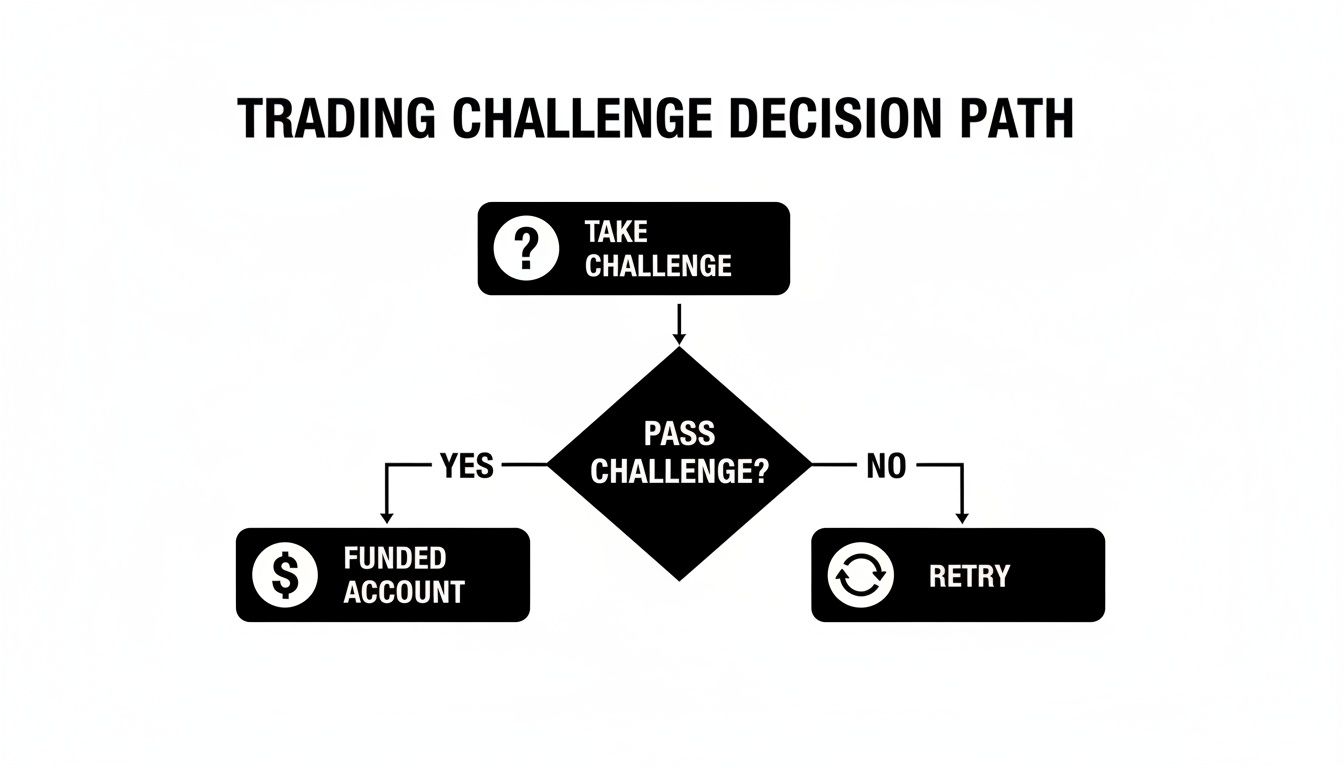
The 1-Step challenge offers a direct path for skilled traders to secure funded accounts, starting at $100K. With the global FX market's daily turnover projected to hit $9.6 trillion in April 2026—a 28% jump from 2022—the opportunity for disciplined traders is immense. For more details on this trend, see the report on global FX market trends on bis.org.
The Two Rules That Define Your Success
Before placing a single trade, you must internalize the rules. They aren’t arbitrary obstacles; they are the guardrails designed to keep you focused and manage risk effectively. The entire evaluation boils down to one thing: can you hit the profit goal without breaking the two most important rules?
Profit Targets and Drawdown Limits: A Practical Breakdown
Many traders get tripped up by drawdown rules, but ours are designed for clarity. Forget complex trailing drawdowns. In our 1-Step Challenge, you only have two key limits to watch.
- Daily Loss Limit: You cannot lose more than 5% of your starting balance for the day. This is a fixed number based on your initial balance, so it doesn't trail your profits. For a $100K account, this is a $5,000 daily loss limit.
- Maximum Drawdown: This is your overall risk limit for the challenge, set at 10% of your initial account balance. For a $100K account, this means your equity cannot drop below $90,000.
Your mission is to prove you can operate within this professional risk framework while aiming for the profit goal. Violating these rules—even by a dollar—means the challenge is over. This isn't a "get rich quick" scheme; it’s a test of professional discipline.
Why Do These Rules Exist?
A 2026 report from ION Group highlights that discipline is a key separator for successful traders. The 1-Step rules, like the flat 5% daily and 10% max loss limits, are designed to identify traders who possess this critical trait. We aren't looking for someone who can hit one lucky home run; we're looking for consistent, controlled performance.
The profit target is the goal, but it should never be your sole focus. The fastest way to fail is to chase that target recklessly. Instead, break it down into manageable daily or weekly goals that align with your strategy.
Crafting Your Game Plan for the Step 1 Challenge

Passing the Step 1 challenge isn't about luck; it's about discipline and process. A solid trading plan is what separates professional trading from gambling. It removes emotion and forces you to think like a risk manager first and a trader second.
Protect Your Capital Before Chasing Profit
Your number one job is survival. Your entire plan must be built around respecting the drawdown rules. This is non-negotiable.
A simple but effective rule is to risk no more than 1% of your account on any single trade. On a $100K account, that's a $1,000 risk. This keeps you far from the 5% ($5,000) daily loss limit and gives you breathing room to take a few consecutive losses without failing the challenge.
Your position size must always be calculated based on this risk limit and where your stop-loss needs to be. For a more detailed guide, see our trading plan template.
Checklist for a Rock-Solid Step 1 Plan
Your plan should answer all critical questions before you enter a trade. Use this checklist to build your personal rulebook.
- Instruments: What are you trading? Stick to 1-3 pairs or indices you know inside and out.
- Session Focus: When will you trade? Align your strategy with a specific market session (e.g., London, New York).
- Trade Setups: What are your exact entry criteria? Define the specific price action, indicator confluence, or pattern.
- Risk Per Trade: Define your maximum risk per trade (e.g., 0.5% or 1%) and stick to it.
- Daily Stop-Loss: When will you walk away? Decide on a personal daily loss limit (e.g., two straight losses or a 2% total drawdown) that is well below the firm's limit.
- Losing Streak Protocol: What's the plan after three or more losing trades? (e.g., Take a 24-hour break, cut risk in half).
Modern tools can help. Consider using AI-powered strategy and goal setting tools to formalize your rules and monitor performance against your plan.
Comparing Funding Models: 1-Step vs. 2-Step
One of the first decisions you'll face is choosing between a 1-Step or a 2-Step evaluation. There’s no single “best” answer; the right path depends on your trading style, confidence, and how you handle pressure.
The 1-Step Advantage: Speed and Simplicity
The 1-Step challenge is a sprint. It’s for confident traders who want the most direct path to a funded account. You get one set of rules, one profit target, and one finish line.
The beauty of this model is its straightforward nature. You hit the profit target while respecting the drawdown rules, and you pass. This directness is the core appeal we explore in any good step 1 breakdown.
The 2-Step Approach: A Phased Verification
A 2-Step challenge is more like a qualifying event followed by a final. It breaks the evaluation into two stages. The first phase usually has a higher profit target to test your ability to generate returns, while the second has a lower target to confirm your consistency.
This model often clicks with traders who prefer a more structured, methodical process. It takes longer to get funded, but many find the lower profit target in the second phase less stressful. Learn more about how a 2-Step challenge works in our detailed guide.
Funding Model Comparison: 1-Step vs 2-Step Challenge
| Feature | 1-Step Challenge | 2-Step Challenge |
|---|---|---|
| Phases | One single phase | Two consecutive phases |
| Speed | Faster path to funding | Slower, multi-stage process |
| Profit Target | One moderate target (e.g., 10%) | Two targets (e.g., 8% then 5%) |
| Complexity | Simple and direct | More complex with changing goals |
| Best For | Confident, decisive traders | Methodical, patient traders |
Ultimately, the choice comes down to self-awareness. Are you a sprinter who wants the fastest route, or a marathoner who prefers a more paced approach?
Common Mistakes That Cause Traders to Fail

Many skilled traders fail their challenge not because of a flawed strategy, but because of preventable mistakes in discipline and risk management. Success is as much about avoiding big mistakes as it is about making great trades.
Ignoring the Drawdown Until It’s Too Late
The number one account-killer is treating drawdown limits as an afterthought. A professional's mindset is different. On a $100,000 account with a $5,000 daily loss limit, they don't wait until they're down $4,900 to panic. They set a personal hard-stop for the day—at 2% or 3%—and walk away the second they hit it.
Treat the daily drawdown limit as a cliff edge to stay far away from. A disciplined trader stops trading long before the firm forces them to.
Revenge Trading and Over-leveraging
One bad trade rarely blows an account; it's the emotional reaction after the loss that does the real damage. This is revenge trading—the impulsive need to jump back in and "win back" what you lost. It leads directly to over-leveraging and bigger losses.
This behavior shows up in predictable ways:
- Forcing Trades: Seeing "setups" that aren't really there.
- Increasing Size: Throwing your 1% risk rule out the window for a 3% or 4% gamble.
- Ignoring Stop Losses: Moving your stop because you're convinced the market has to turn around.
The only defense is discipline. After a loss, walk away. Clear your head, then come back to your plan. You can dig deeper into these psychological traps by reading about common mistakes to avoid in forex trading.
Frequently Asked Questions (FAQ)
What's the main difference between the 1-Step and 2-Step challenge profit targets?
In a 1-Step challenge, you have a single, higher profit target to reach, typically around 10%. In a 2-Step challenge, the process is split: Phase 1 usually requires an 8% profit target, and Phase 2 follows with a lower confirmation target of 5%. The 1-Step is faster but demands more in a single phase, while the 2-Step breaks the goal into smaller, more manageable pieces.
What happens if I break a rule by just a few dollars?
A rule breach is a rule breach, regardless of the amount. Whether your daily loss limit is exceeded by $1 or $1,000, the result is the same: the challenge account is closed. This isn’t about being harsh; it reflects the strict, black-and-white reality of professional risk management. The system is automated to ensure this is enforced objectively for everyone.
How quickly can I get a payout after passing the challenge?
Once you pass the challenge, we move quickly. After a brief review of your trading history, you can expect to receive your funded account credentials within 24 hours. You can typically request your first payout after just 7-14 days of profitable trading on the funded account. Our goal is to get your earned profits to you without delay.
Can I try again if I fail the challenge?
Yes. Failing a challenge is a learning opportunity, not a permanent dead end. Many successful funded traders didn't pass on their first attempt. We encourage you to analyze what went wrong, refine your strategy and risk management, and try again when you are ready.
Ready to prove your skills and trade without capital constraints? MyFundedCapital provides the platform and support for disciplined traders to succeed.
Compare our funding programs and start your challenge today!
