

 AR
AR
 NL
NL
 FR
FR
 DE
DE
 ES
ES
 PT
PT
 IT
IT
 PL
PL
 SV
SV

Feeling that pit in your stomach as a market skyrockets without you? That's FOMO—the Fear of Missing Out—and it's one of the most destructive emotions a trader can face. This guide will give you practical, actionable steps to understand what FOMO is and build a system to conquer it.
What FOMO in Trading Really Means
Picture this: you see a huge crowd suddenly start running down the street. You have no idea why, but an instinctual part of your brain screams, "I need to be with them! I might miss something incredible!"
That's FOMO in the markets. You see a massive green candle ripping higher, and you're overcome with a visceral need to jump in. The fear of missing a huge opportunity feels so real that it hijacks your decision-making, causing you to abandon your plan and chase the price—often with disastrous results.
How FOMO Distorts Your Trading Decisions
FOMO isn't just a bad feeling; it systematically wrecks the discipline needed for profitable trading. It encourages you to make the wrong moves at the worst times, which can drain your account with alarming speed—especially if you're managing a funded account from a prop firm like MyFundedCapital where rule violations are costly.
Here’s the typical downward spiral of a FOMO-driven trade:
- You Abandon Your Strategy: Instead of waiting for your proven setup, you enter a trade simply because the price is moving fast, ignoring your entry criteria.
- You Break Your Risk Rules: The fear of missing the move becomes greater than the fear of losing money, leading to oversized positions or trading without a stop-loss. For example, risking 5% of your account instead of your planned 1%.
- You Chase the Price: You end up buying at the absolute peak of a rally or selling at the bottom of a sell-off, essentially providing the exit liquidity for the smart money that started the move.
This behavior turns the core logic of trading—buy low, sell high—on its head. FOMO pushes you to buy high, hoping to sell even higher, a notoriously low-probability gamble.
Recognizing FOMO as an emotional impulse, not a valid trading signal, is the first step to beating it. Once you can label the feeling, you can start to separate it from your actions.
FOMO vs. Disciplined Trading at a Glance
The difference between a trader acting on impulse and one following a plan is night and day.
| Aspect | FOMO-Driven Trader | Disciplined Trader |
|---|---|---|
| Trigger | Reacts to sudden, fast price moves | Acts on pre-defined setups and confluences |
| Decision-Making | Impulsive, emotional, and rushed | Deliberate, logical, and patient |
| Entry Point | Late entry, often near the top or bottom | Enters at a planned price level with confirmation |
| Risk Management | Ignored or improvised; "YOLO" position sizes | Strict and non-negotiable; pre-calculated stop-loss |
| Post-Trade Feeling | Anxiety, hope, and stress | Calmness, acceptance of risk |
| Outcome Focus | Obsessed with not missing a winning trade | Focused on executing the trading plan flawlessly |
Seeing these two approaches side-by-side makes it clear that FOMO is a direct path to inconsistent results, while discipline lays the foundation for long-term success.
Disclaimer: All trading involves substantial risk, including the potential for complete loss of funds. The content provided here is for educational purposes only and should not be considered financial advice. Past performance is not indicative of future results.
The Psychology Driving Your FOMO
If you've felt the frantic urge to chase a trade, you're not broken. FOMO is a deep-seated feature of human psychology, but in the fast-paced world of trading, these instincts can be poison for your account.
It Starts With How Your Brain Sees Risk
At the heart of FOMO is a powerful cognitive bias called loss aversion. Research shows that the sting of a loss feels roughly twice as intense as the joy of an equivalent gain.
When you see a chart rocketing up without you, your brain registers that missed profit as an active loss. This kicks your survival instincts into high gear, screaming at you to stop the "pain" by getting in the trade—right now, at any price.
Then You Add Social Pressure to the Mix
Layer in social proof—our natural instinct to follow the herd because we assume the crowd knows something we don't. Your feed on X (formerly Twitter) or your Discord channel is flooded with screenshots of massive green P&L, creating dizzying pressure to join the winning team.
It's the digital version of seeing a crowd sprinting down the street. Your first instinct isn't to ask why; it's to start running. In the markets, this herd mentality is what inflates bubbles and leaves latecomers holding the bag.
These gut reactions are often tangled up with underlying factors, showing how anxiety and decision-making can fuel impulsive trading choices.
Realizing that your brain is hardwired for this is a game-changer. It shifts the goal from "I need to stop feeling FOMO" to "I need a system that prevents my feelings from dictating my actions." For more on building this mental armor, check out these trading psychology drills.
Learning from Real-World FOMO Disasters
Theory is one thing, but nothing drives the point home like watching FOMO blow up in the real world. These stories are stark reminders of what happens when traders abandon their strategy and chase hype.
The GameStop Short Squeeze Mania (2021)
The GameStop (GME) saga in January 2021 is a perfect example of social media-fueled frenzy. Fueled by Reddit communities, the fear of missing this "once-in-a-lifetime" rocket ship became a global phenomenon.
- In just a few weeks, the stock went from around $20 per share to an intraday high of $483 on January 28—a 2,315% gain.
- Millions of new traders piled in as screenshots of insane profits flooded their social media feeds, creating a dangerous feedback loop of impulsive buying.
- More insights on how FOMO impacts traders are available over at ATAS.net.
The Aftermath: The music stopped hard. Anyone who bought near the top, driven by pure FOMO, was left holding the bag as GME crashed back to the $40 level by mid-February. It was a brutal lesson in market gravity.
The Historic Bitcoin Bubble of 2017
Remember the crypto craze of 2017? As Bitcoin blasted past $10,000, mainstream media went into a frenzy, plastering stories of overnight crypto millionaires everywhere.
- The Run-Up: Fanned by media hype and retail FOMO, Bitcoin's price exploded from under $1,000 at the start of the year to nearly $20,000 by December.
- The Collapse: The bubble burst spectacularly. Over the following year, Bitcoin’s price plunged by over 80%, evaporating billions in speculative money and crushing everyone who bought at the peak.
These disasters prove a simple point: markets driven by FOMO almost always end in tears for latecomers. They serve as a powerful warning, especially for prop firm traders where protecting capital is rule number one.
A Step-by-Step Plan to Overcome FOMO
Knowing FOMO is dangerous is easy. Building a defense against it when a chart is screaming higher is the real challenge. Willpower alone won't cut it; you need a structured, non-negotiable plan.
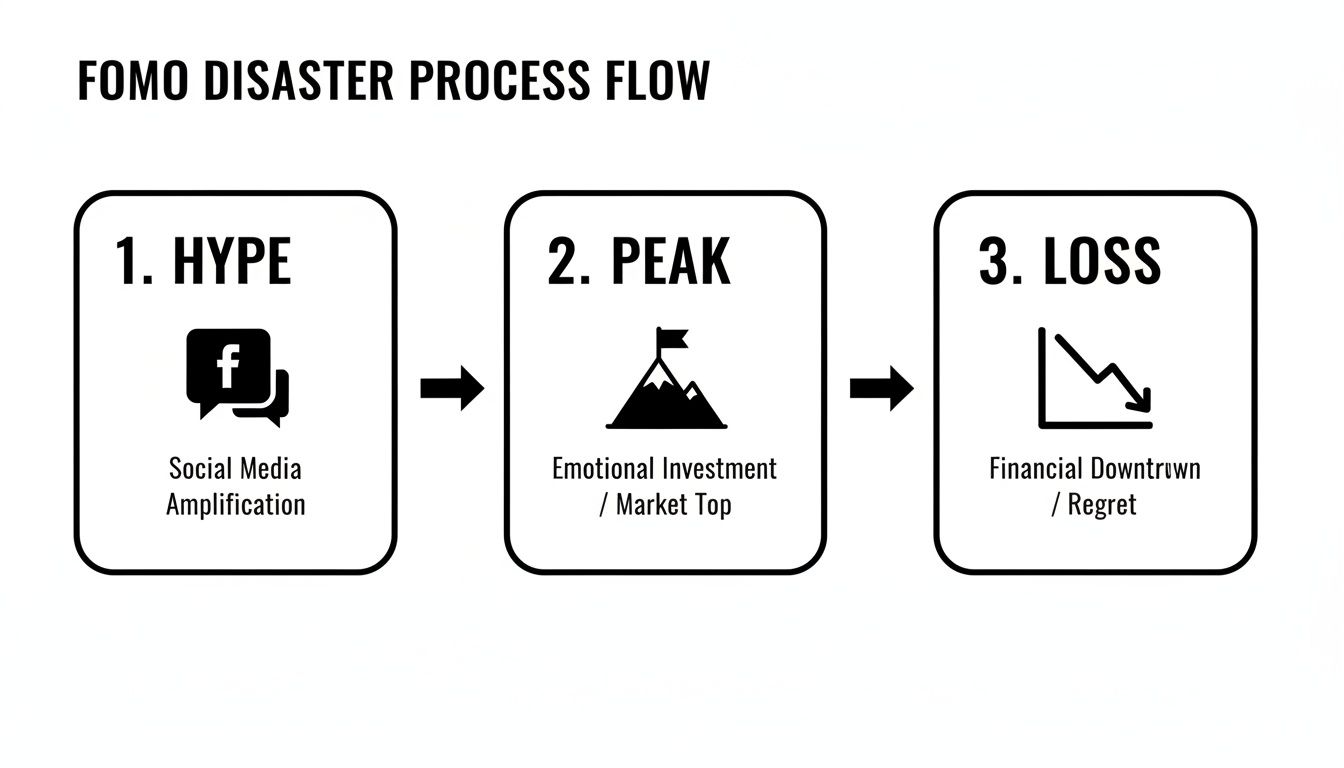
This is what the typical FOMO disaster looks like. It’s a predictable cycle that catches far too many traders.
1. Build Your Pre-Trade Fortress with a Plan
The battle against FOMO is won before you place an order. Your number one defense is a detailed, written trading plan. This document is your constitution, laying out exactly what you will and will not do.
Your plan must be crystal clear on:
- Strict Entry Criteria: Define the exact signals that must align for a trade. For example, "I will only enter a long on EUR/USD if the price is above the 50-period EMA on the 1-hour chart and has just printed a bullish engulfing candle." No signal, no trade.
- Non-Negotiable Exit Rules: Decide your profit target and stop-loss before you enter. This takes emotional guesswork out of the equation.
- The 1-2% Rule: Never risk more than 1% to 2% of your total account balance on a single trade. This is the bedrock of professional risk management and is vital for prop firm traders.
2. Use a Pre-Trade Checklist
You've spotted a potential setup. Before your finger gets near the mouse, force a pause with a pre-trade checklist. This simple but effective tool shifts you from a reactive state to a deliberate, analytical one.
Your checklist should be a series of "yes" or "no" questions. For instance: "Does this trade meet all of my entry criteria? Have I calculated my position size according to the 1% rule? Is my stop-loss set?" If you can't tick "yes" for every item, you walk away. No exceptions.
3. Implement Post-Trade Analysis
Your job isn't over when a trade closes. What you do next is critical for long-term discipline.
- Keep a Trading Journal: Log every trade. Note the entry, exit, and how you felt. Were you anxious? Impatient? This journal will reveal your personal FOMO triggers.
- Know When to Walk Away: If you hit a string of losses or feel emotional, shut it down. Close the charts and step away. A mental reset is always cheaper than revenge trading.
- Strengthen Your Decision-Making: Sticking to a plan requires confidence. Actively learn how to conquer your fear of making decisions so you can execute your plan without second-guessing yourself.
How FOMO Wipes Out Funded Accounts
For a prop firm trader, FOMO can be a career-killer. Your success is measured by your ability to follow a strict set of rules. A single trade driven by FOMO can lead to an instant rule violation, ending your challenge or costing you a funded account.
- Daily Loss Limit: You see a market ripping and jump in with a massive position. When it snaps back, you can blow through your daily loss limit in minutes. Account failed.
- Maximum Drawdown: That FOMO loss stings, so you jump back in to "win it back." This is revenge trading, and it's the fastest way to compound losses and breach your maximum drawdown.
A prop firm challenge is your training ground. The rules forge discipline. Mastering these rules is the key to mastering your own trading psychology. Instead of learning these brutal lessons with your own money, a prop firm challenge gives you a controlled environment to build emotional muscle.
Learning to control these emotions is a huge part of finding the secret to long-term success in prop firm trading. For a deeper dive into how speculative manias work, explore the dynamics of FOMO stocks on captrader.com.
FAQ: Frequently Asked Questions About FOMO
Is it possible to completely eliminate FOMO?
No, and you shouldn't even try. FOMO is a core human emotion. The goal isn't to eliminate the feeling, but to build a system so robust that the feeling doesn't dictate your actions. A pro trader feels the same pull, but their pre-defined plan acts as a guardrail. They acknowledge the emotion, then follow their rules anyway.
What’s the single best habit to beat FOMO?
Create and religiously use a pre-trade checklist. It forces a critical pause and shifts you from emotional reaction to logical analysis. Your checklist must be a non-negotiable part of your process. Does the trade meet all of your criteria? If even one box goes unchecked, you walk away. No exceptions.
Does social media make FOMO worse?
Absolutely. Platforms like X (formerly Twitter) and Instagram are a highlight reel of other traders' biggest wins, creating a distorted reality that pressures you to chase unrealistic returns. A huge part of managing what is fomo in trading is learning to tune out the noise. Consider a social media diet during trading hours to protect your mental capital.
Ready to prove you can trade with a disciplined process? At MyFundedCapital, our challenges are built to reward traders who follow a plan. Compare our account types and start your challenge today.
