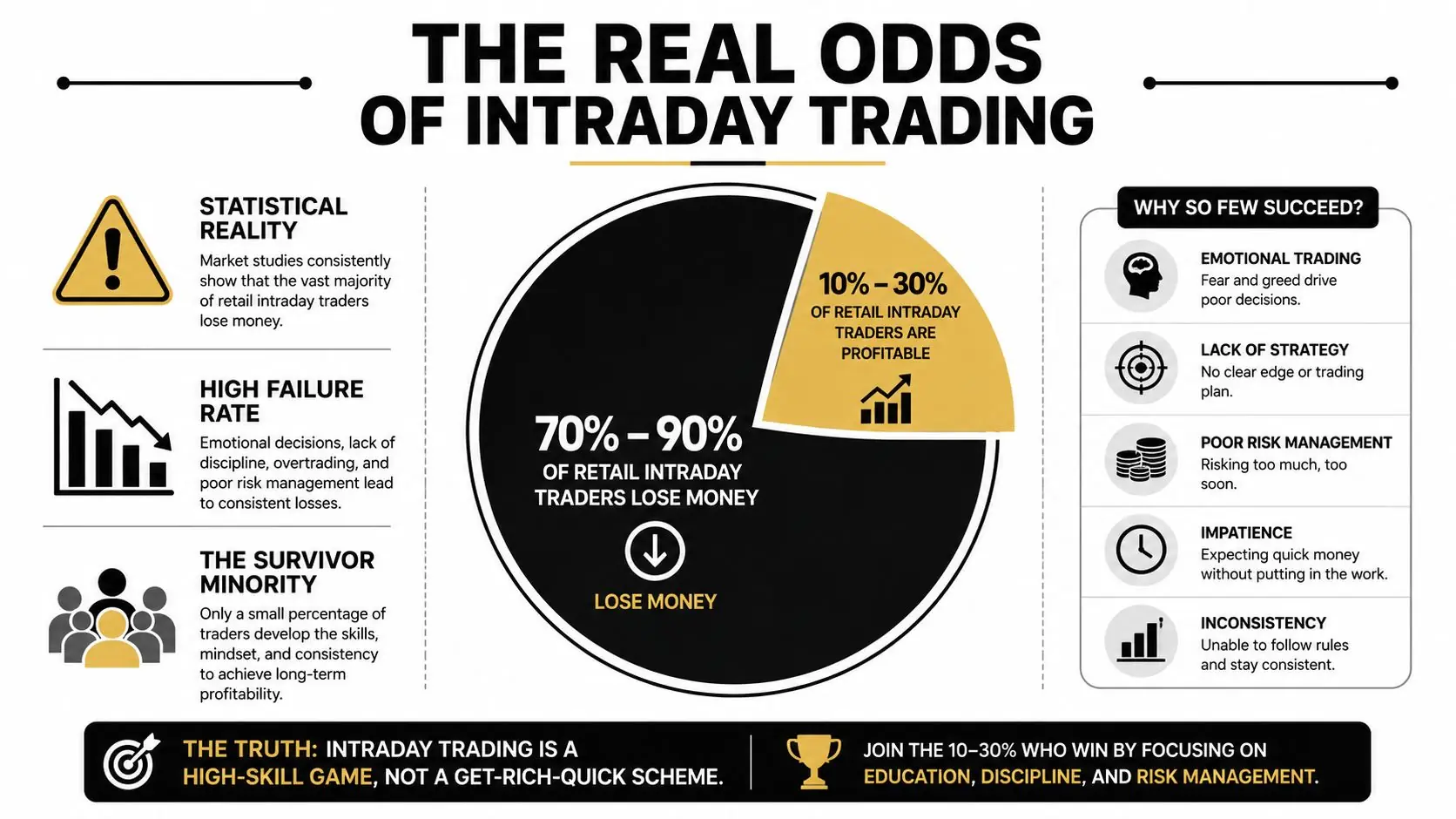
Intraday trading is brutal because the math is against careless traders, not because the market is mysterious. Independent analysis linked to SEBI says about 70% to 80% of intraday traders lose money, and an India-wide study found 71% were loss-makers in FY2023, with the average individual trader posting a negative P/L of Rs. 2,069 source context. If you want to learn how to trade intraday like a professional, the edge comes from tight risk control, session selection, and execution discipline, not from staring at charts longer.
Free resources: Daily Trading Checklist (a pre-market routine, in-session rules and a post-market review).
Understanding the Odds of Intraday Trading
A trader who keeps firing trades all day can still finish in the red. The issue is usually execution, costs, and account pressure, and the same India study showed that even traders with annual intraday turnover above Rs. 1 crore were still 76% loss-makers source context. That should reset expectations fast. Heavy activity does not fix a weak process, it usually exposes it.
Why the numbers matter
Intraday trading breaks down when a trader is wrong too often, pays too much in slippage, or keeps taking marginal entries. That is why the business has to be built around strict risk limits, narrow trade selection, and a measurable edge. The goal is not constant action. The goal is to trade only when the setup, the session, and the fill quality line up well enough to justify the risk.
Practical rule: If a setup does not have a defined stop, a defined target, and a reason to exist in that specific session, it is not a setup. It is noise.
For perspective on how to think about performance over a sequence of trades, a guide on annualized returns at Fintrack is a useful companion, because it forces you to judge results in process terms instead of by one emotional day.
Intraday is a profession, not a reflex test
Experienced intraday traders are not trying to impress anyone with frequency. They are trying to survive enough sessions for the edge to show up in the ledger. The loss-rate data fits that reality, and so does the structure of live markets. When turnover rises, both skill and mistakes get amplified, which is why poor trade selection gets punished so quickly.
If you want a practical check on account viability, the discussion at Can Day Traders Make Money lines up with the same core idea, trading has to be treated like a probability business, not a prediction game. In funded trading, that mindset matters even more because account rules can be tighter than the market itself, and your position size has to respect both volatility and drawdown limits.
The right conclusion is simple. Trade intraday with discipline, or do not trade it at all. The market does not pay for noise, and it certainly does not pay for hope.
Choosing Markets, Sessions, and Timeframes
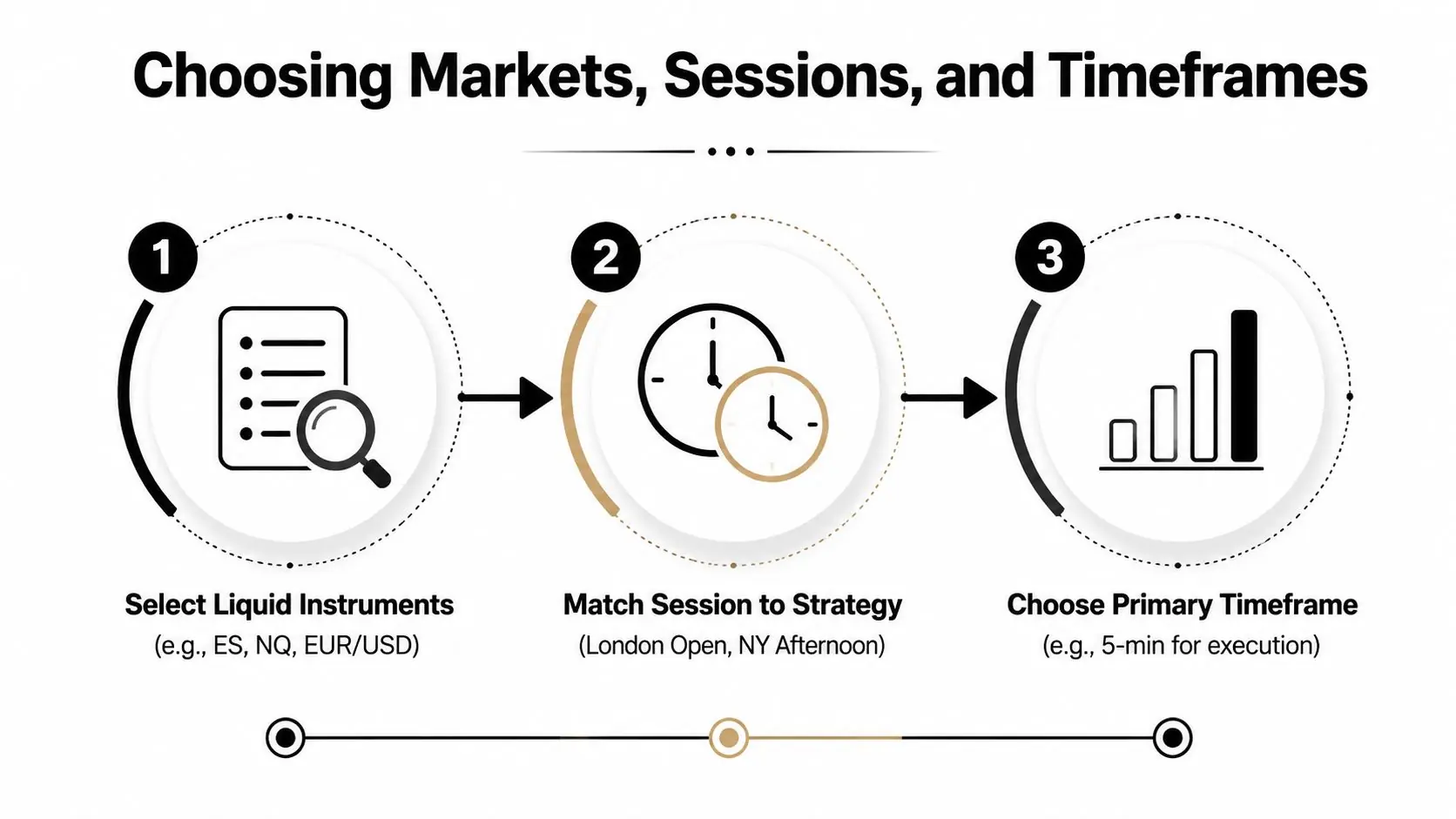
Start with liquidity, because thin names punish even decent decisions. For Indian cash equities, a practical filter is to stick to liquid names such as Nifty 50 and Bank Nifty constituents with at least ₹500 crore daily turnover, and to focus on the windows that historically offer the best odds, 9:15–10:30 AM and 2:30–3:20 PM Groww guide. That pairing matters because intraday edge usually comes from movement plus tradeable volume, not movement alone.
The opening hour deserves special attention. One Indian equities guide identified 9:15–10:00 AM as the highest-value window, with 352 signals and an average gain of 2.68% Dhanith guide. That doesn't mean you blindly chase the first candle. It means you prepare a short list before the bell, then let the market show you whether it's opening with impulse, reversal, or range behavior.
Match the instrument to the session
A good session/instrument match is a lot more important than a fancy indicator stack. A watchlist of 5 to 8 names is easier to execute cleanly than a screen full of possibilities. If you trade FX, indices, or CFDs, the same principle holds, concentrate on instruments that move cleanly during your chosen session and leave the rest alone. The best times to trade Forex are relevant here because session overlap and liquidity changes affect whether a setup can be filled well.
Use this filter:
- Trade the session that fits your strategy. Opening drive and late-session momentum need different expectations than lunchtime mean reversion.
- Prefer instruments with visible participation. Wide spreads and hesitant order flow kill intraday edge.
- Pick one primary timeframe. For execution, the 5-minute chart is often enough. Use higher timeframes only to set bias.
- Build from the calendar backward. If a session has a major release, know it before the open.
The chart doesn't matter if the session is dead. A perfect pattern in a poor liquidity window is still a bad trade.
For traders learning how to trade intraday inside a prop structure, the simple rule is to reduce noise. Smaller watchlists, fewer timeframes, and cleaner session selection produce better decision quality. That's especially true when your funded account rules punish random overtrading more than the market does.
Building a Repeatable Entry and Exit Framework
The cleanest intraday framework is boring on purpose. You define the bias, mark the range, wait for confirmation, and only then risk money. That sounds simple, but most traders fail because they want the first move, not the best one.
Opening-range breakouts with confirmation
One workable approach is the opening-range breakout. Mark the first 15-minute candle, wait for it to close, then mark the high and low. A breakout above that range high can be valid only if price accepts above the level and volume supports the move, while a breakdown below the range low needs the same kind of confirmation Sahi guide.
The stop belongs on the opposite side of the range. The target should be set before entry, not improvised after the trade starts moving. That keeps the trade mechanical and stops the common habit of turning a planned setup into an emotional gamble.
A simple execution sequence looks like this:
- Set the higher-timeframe bias. If the broader structure is bullish, favor long breakouts and avoid forcing shorts.
- Mark the first 15-minute range. This becomes your reference, not your prediction.
- Wait for breakout plus acceptance. A wick through the level isn't enough.
- Enter on retest or reclaim. Don't pay up for the first emotional burst.
- Place the stop at the invalidation point. If the setup fails, get out.
Session-confirmation setups work better than impulse entries
A more execution-focused version uses session structure. The common sequence is to define bias on the higher timeframe, map the overnight or Asian range, then wait for the London or New York open to sweep liquidity before dropping to a lower timeframe for confirmation. That style often uses a 5-minute chart for entry and looks for a retest after the first stop run ICT guide.
Practical rule: The first spike is usually the worst place to enter. Wait for the market to show its hand, then trade the retest if the setup is still valid.
Profit-taking should be planned, not guessed. A simple structure is partial profit at 1:1, then trail the rest toward 1:2 or 1:3 when the trade is behaving well ICT guide. That's not glamorous, but it protects winners from turning into scratches.
The point of this framework is consistency. If you can describe your entry in one sentence and your exit in one paragraph, you probably have something testable. If the explanation takes a whiteboard, you probably have a mess.
Position Sizing and Risk Limits for Prop Accounts
Prop accounts change the game because the firm's rules are part of your risk model. A trader who sizes like a personal-account gambler can break a funded account without ever being wrong on direction. The clean baseline is to risk 1% to 2% of capital per trade, then reduce further if the day is already volatile or the setup is low quality Groww guide, UpScale Trade guide.
Risk per trade should be derived, not guessed
The core formula is simple. If your stop is 10 points wide and one point equals a fixed amount for your market, position size must shrink until the dollar loss fits the rule. That logic is what a position sizing model is for, and the Alpha Scala position sizing resource is useful because it frames sizing as a formula, not a feeling.
For a funded trader, the job is not to maximize size, it's to stay alive inside the account rules. MyFundedCapital, for example, uses a 5% daily loss limit on its Challenges (3% on Instant Funding) and up to 10% maximum drawdown, so trade sizing has to leave room for normal noise and for a bad sequence of trades without forcing a breach. A tool like the position size calculator is useful precisely because it turns that constraint into a number before you click buy or sell.
Intraday Risk Sizing Examples
| Account Size | Risk per Trade (2%) | Max Daily Loss (5%) | Max Drawdown (10%) |
|---|---|---|---|
| $5,000 | $100 | $250 | $500 |
| $10,000 | $200 | $500 | $1,000 |
| $25,000 | $500 | $1,250 | $2,500 |
| $100,000 | $2,000 | $5,000 | $10,000 |
The table is only useful if you use it before the trade, not after the loss. If a setup can't work within the account's daily loss cap, skip it or reduce size. In a prop environment, the ability to survive the day is more important than being right on the first shot.
Practical rule: Once you've taken a loss, the next trade should often be smaller, not larger. Recovery trading breaks more accounts than bad analysis does.
The reason this matters so much is that intraday trading already carries a high failure rate. When the account has hard limits, the trader who respects size survives to trade again, while the trader who pushes size after one mistake usually doesn't.
When Intraday Strategies Stop Working
A breakout isn't broken just because it failed once. It's broken when the regime no longer supports it. Most traders miss that distinction and keep firing the same setup into a market that's either too quiet, too noisy, or already spent for the day.
Volatility regime filters matter more than most indicators
Academic work on intraday behavior found a reverse J-shaped pattern, with the highest volatility and kurtosis around 09:30–10:00 and 11:30–12:00, and volume peaking toward the close LU study. That matters because the same market can shift from clean trend behavior to choppy mean reversion in a single session. A strategy that needs follow-through can lose its edge once the session gets stretched or once the move has already happened.
The right question isn't, “Is there a setup?” The right question is, “Does this volatility state still support that setup?”
Use three filters:
- Volatility state. If the day is too quiet, breakouts may stall. If it's too wild, fills and stops become messy.
- Market structure. Trend days and range days reward different behavior.
- News context. A scheduled release can distort the first move enough to make a clean setup look valid when it isn't.
News and opening spikes need patience
Several guides advise avoiding news, and that advice is sensible, but the issue is execution around the first impulse. One contrarian takeaway is that the first post-news spike is often the most crowded part of the move, which makes it fragile for retail execution TradingView NIFTY guide. Waiting for the retracement after the impulse is often a better decision than trying to catch the spike itself.
A practical checklist before entering is simple:
- Is the session already extended? If yes, follow-through may be weaker.
- Did a macro release just hit? If yes, let the spread and candle structure settle.
- Is the market showing two-way price discovery? If yes, size down or stand aside.
If the market is fast but unclear, the correct position is often flat.
That's the part many intraday guides gloss over. Knowing when not to trade protects edge better than any indicator. A setup only works when the market is in the right mood for it, and that mood changes more often than beginners expect.
Execution, Journaling, and the Pre-Session Checklist
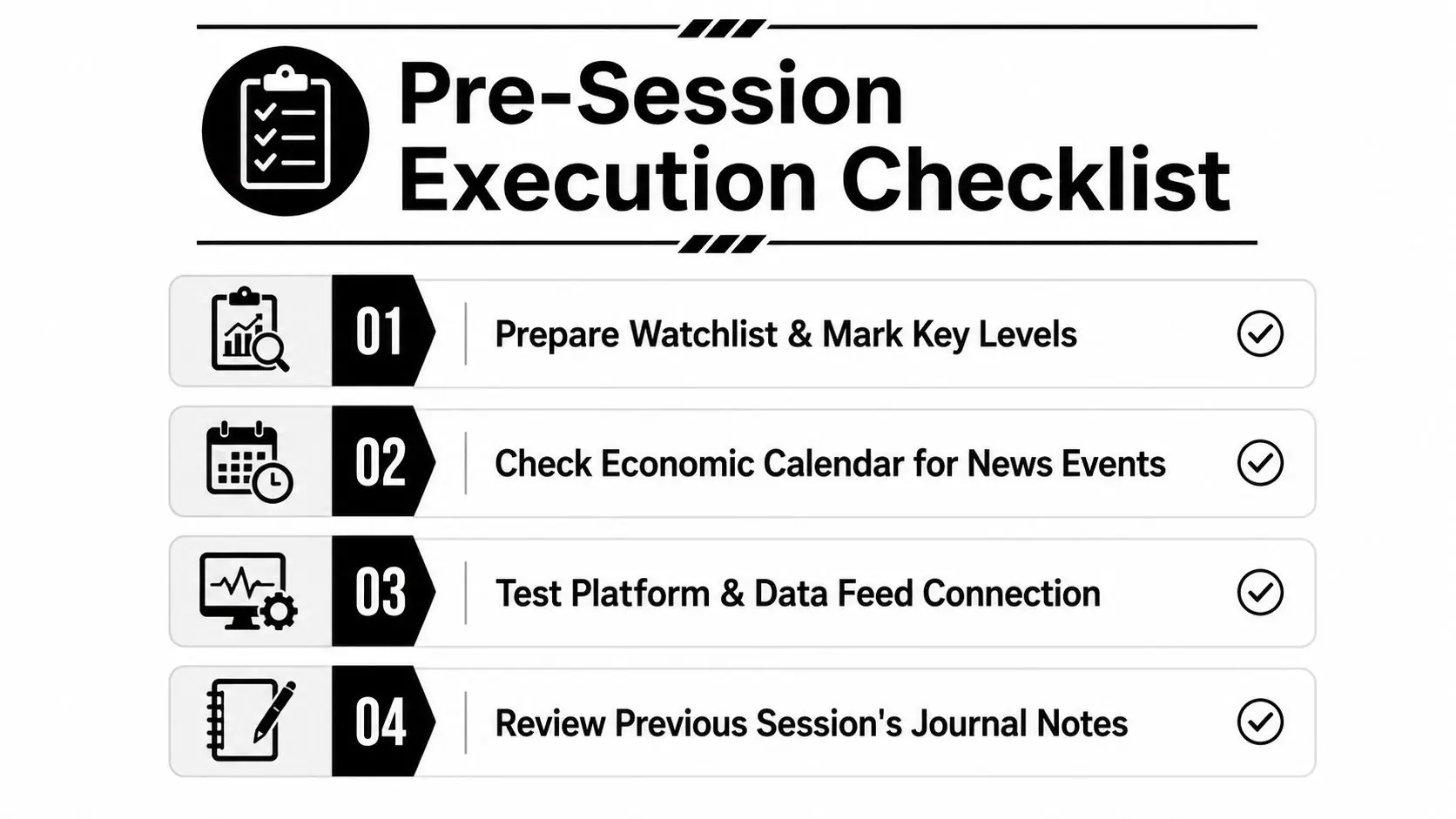
Good intraday traders don't rely on memory. They run a routine. The pre-session checklist is what keeps a watchlist from turning into a scramble, and the journal is what tells you whether your process is improving or just your mood.
A repeatable session routine
Before the open, lock in the basics:
- Prepare the watchlist. Keep it short, liquid, and relevant to the session.
- Mark key levels. Prior highs, prior lows, opening range, and obvious liquidity pools.
- Check the calendar. Know which releases can distort the first hour.
- Test the platform. Data feed, order routing, and hotkeys should all work before risk goes live.
That routine sounds obvious until a platform freezes, a news release appears unexpectedly, or a chart is loaded with levels you never reviewed. A clean pre-session process reduces those avoidable mistakes before they cost money.
Journal what actually affects performance
A useful journal tracks more than P/L. Record entry quality, stop placement, whether you followed the setup, and your emotional state when you took the trade. That matters because two trades can both lose money, but only one may be correct if the process was followed.
Write down three things after every session:
- What the setup was.
- Whether execution matched the plan.
- What would have invalidated the trade earlier.
Then review the week for patterns. If you keep overtrading after the first loss, the journal should show that. If you keep entering before confirmation, the journal should show that too. A funded trader improves faster when the journal is brutally honest and the checklist is mandatory.
Common Intraday Mistakes and How to Avoid Them
The biggest intraday mistakes are usually simple and expensive. Traders overtrade, chase the opening spike, ignore daily loss limits, and stay active when the regime is wrong. Those habits don't need a better indicator, they need a better process.
A cleaner way to trade intraday is to do less, but do it with rules. Use a short watchlist, trade only your preferred session, size positions so one loss doesn't threaten the account, and skip the first move when news or opening volatility makes the tape messy. That's how the frameworks above protect your edge.
If you're serious about trading inside defined rules, MyFundedCapital offers Instant Funding, 1-Step Challenge, and 2-Step Challenge programs, plus account sizes that let you practice disciplined intraday execution with hard risk limits. Explore the challenge format, compare account options, and see whether your process holds up in a structured environment.
If you want to test your intraday process inside a funded framework, visit MyFundedCapital and compare the challenge and instant funding options against the risk rules you trade with. The goal isn't to trade more, it's to trade cleaner, stay within limits, and prove you can repeat the same edge without blowing up.