ES
ES
 DE
DE
 FR
FR
 AR
AR
 IT
IT
 NL
NL
 PL
PL
 SV
SV

Knowing when to exit a profitable trade is a constant challenge for traders. You want to let your winners run, but you also need to protect your gains from a sudden market reversal. This article will explain the practical differences between a trailing stop and a trailing stop limit, helping you choose the right tool to manage your trades effectively.
The choice boils down to one critical question: what’s more important to you? Getting out of your trade no matter the price, or getting out only at a price you’re comfortable with? The answer defines your entire exit strategy and which order type you should use. Remember that all trading involves substantial risk of loss and this content is for educational purposes only, not financial advice.
Trailing Stop vs Trailing Stop Limit Core Differences
While both orders help you lock in profits automatically as a trade moves in your favor, the way they execute couldn't be more different. One prioritizes a guaranteed exit, while the other prioritizes a specific price.
- A trailing stop is an instruction to your broker to exit your position using a market order once the price pulls back by a specified amount. The goal is to exit the position instantly at the next available price. You are guaranteed an exit, but in a fast-moving market, that price could be worse than you expect due to slippage.
- A trailing stop limit is a two-step order. When the price retraces and hits your stop, it activates a limit order. This tells your broker, "Sell my position, but only if you can get my specified limit price or better." You get to define the worst-case price you'll accept, giving you control over slippage.
The core decision comes down to what you fear more: getting a bad price (slippage) or not getting out of your trade at all (non-execution). Your answer will guide your choice between these two orders.
Quick Comparison Trailing Stop vs Trailing Stop Limit
To make this clearer, let’s break down the key differences in a simple table. This summarizes how each order type is triggered, how it executes, and its main trade-off.
| Feature | Trailing Stop | Trailing Stop Limit |
|---|---|---|
| Trigger Mechanism | The stop price is hit by a market move against you. | The stop price is hit, which then activates a limit order. |
| Execution Type | Becomes a market order, executing at the next available price. | Becomes a limit order, executing only at your limit price or better. |
| Primary Goal | Guaranteed Exit: To get out of the trade no matter what. | Price Control: To get out of the trade only at a specific price. |
| Main Risk | Slippage: Your exit price could be worse than your stop price. | Non-Execution: Your order may not fill if the price gaps past your limit. |
As you can see, the trade-off is clear. With a trailing stop, you accept the risk of slippage to ensure your exit. With a trailing stop limit, you protect your price at the risk of the trade running against you if your limit order doesn't get filled.
How a Trailing Stop Order Works
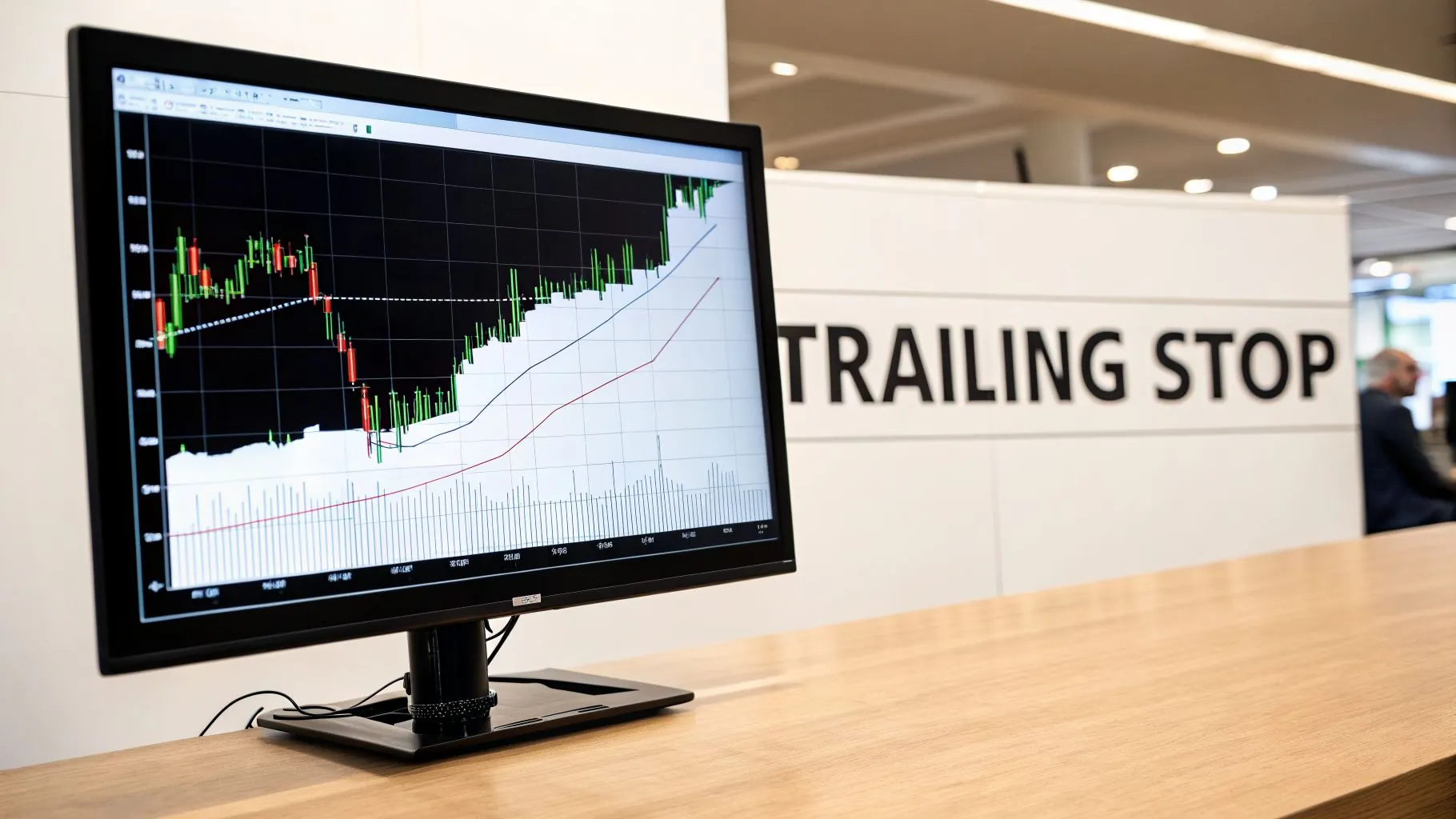
A standard trailing stop is a dynamic risk management tool that follows the price as it moves in your favor. Unlike a fixed stop-loss, it automatically pulls your safety net up behind a winning trade, helping you lock in profits while giving the position room to grow. If you're new to the basics of exit orders, our guide on what a stop loss is and how to use it is a great place to start.
You define a "trail amount" as a fixed number of pips, a percentage, or a dollar value. This dictates how far the price can pull back from its peak before your exit order is triggered.
A Practical Example in EUR/USD
Let's see this in action with a concrete example. Say you go long on EUR/USD at 1.0750.
- You place a trailing stop order with a 20-pip trail.
- Your initial stop-loss is immediately set at 1.0730 (1.0750 entry – 20 pips).
- The market rallies, and EUR/USD reaches a new high of 1.0780. Your trailing stop automatically adjusts upward, always staying 20 pips behind the peak. Your new stop is now at 1.0760, locking in 10 pips of profit.
- The stop only moves in your favor. If the price then reverses and drops to hit 1.0760, your stop is triggered.
Here’s the most important part: once a trailing stop is triggered, it becomes a market order. It tells your broker, "Get me out of this trade now, at whatever the next available price is." This guarantees your exit but also introduces the risk of slippage. In a volatile market, the actual fill price might be 1.0755 or worse. You get out, but not at the exact price you expected.
For a prop firm trader, this trade-off is critical. While slippage might reduce profit slightly, the guaranteed exit from a market order can prevent you from hitting a daily drawdown limit, protecting your account from a much larger loss.
How a Trailing Stop Limit Order Works
The trailing stop limit order is a more advanced tool for traders who value price precision over a guaranteed exit. It adds a safety net by introducing a second price—the limit price—that acts as a firm boundary against slippage.
You set a trail amount just like a standard trailing stop, but you also define a limit price offset. This tells your broker the absolute worst price you're willing to accept on your exit. When the market hits your stop price, it triggers a limit order to sell, not a market order. If you want a deeper dive, our guide on the stop-loss limit order covers similar mechanics.
A NAS100 Trade Example
Let's walk through how this works. Imagine you're long the NAS100 index.
- You enter a buy position on NAS100 at 18,500.
- You place a trailing stop limit order with a 50-point trail and a 10-point limit offset.
- Your initial stop price is 18,450. Your limit price (the floor for your exit) is 18,440 (stop price – 10-point offset).
- As NAS100 rallies to 18,600, your stop price automatically adjusts to 18,550, and your limit price moves up to 18,540.
- If the market turns and drops to your 18,550 stop price, the limit order activates. Your broker will now try to sell your position, but only at a price of 18,540 or better.
The Risk of Non-Execution
This price control comes with a serious catch: your order might not execute at all.
The greatest weakness of a trailing stop limit is the risk of non-execution. If the market moves too quickly and gaps past your limit price, your order will not be filled, leaving your trade open and exposed to further losses.
Let's revisit the NAS100 trade. The index is at 18,551. Breaking news causes the market to gap down instantly, opening at 18,535. Your stop at 18,550 was triggered, but the market is already trading below your limit of 18,540. Your order remains unfilled as the price continues to fall. Your protected profit has now become an unprotected, losing position.
Comparing Order Performance in Volatile Markets
Understanding these orders on paper is one thing, but the real test is how they perform when markets are chaotic. The trailing stop limit vs trailing stop debate becomes crucial during high-impact news or sudden market crashes.
- Trailing Stop in Volatility Imagine a volatile asset drops 10% in minutes. A standard trailing stop triggers and becomes a market order. You'll likely experience slippage, but you are out of the trade. Your capital is protected from further loss.
- Trailing Stop Limit in Volatility In the same scenario, if the price drops so fast that it gaps past both your stop and limit prices, your order will not fill. You wanted a better price but instead got no exit at all, leaving you fully exposed as the market crashes.
When markets are calm, both orders work well. But volatility is the separator. For a deeper look, see how trailing stops compare in volatile markets.
Implications for Prop Firm Traders
For anyone trading a funded account, risk management is paramount. Hitting a daily drawdown limit means your account is terminated. In this context, the guaranteed exit of a trailing stop is your most important risk management tool.
A standard trailing stop is your hard backstop. It guarantees an exit, which is the single most important action you can take to avoid violating a drawdown rule. A trailing stop limit that doesn't fill offers zero protection when you need it most.
Consider these two outcomes for a prop trader:
- Scenario A (Trailing Stop) The market turns hard. Your trailing stop triggers, you take a small, defined loss due to slippage, and you keep trading.
- Scenario B (Trailing Stop Limit) The market gaps down. Your order never fills, the loss balloons past your daily drawdown limit, and you lose your account.
When protecting your capital and account is the #1 priority—and in prop trading, it always is—the certainty of a trailing stop's execution is far more valuable than trying to avoid a little slippage.
Deciding on Your Exit: When to Use Each Order Type
Choosing between a trailing stop and a trailing stop limit is a tactical decision based on market conditions and your trade's objective. Getting this right protects your capital; getting it wrong can lead to unnecessary losses.
Your choice boils down to what you fear more: the risk of the market gapping past your exit, or the risk of a bad fill. The flowchart below outlines this decision process.
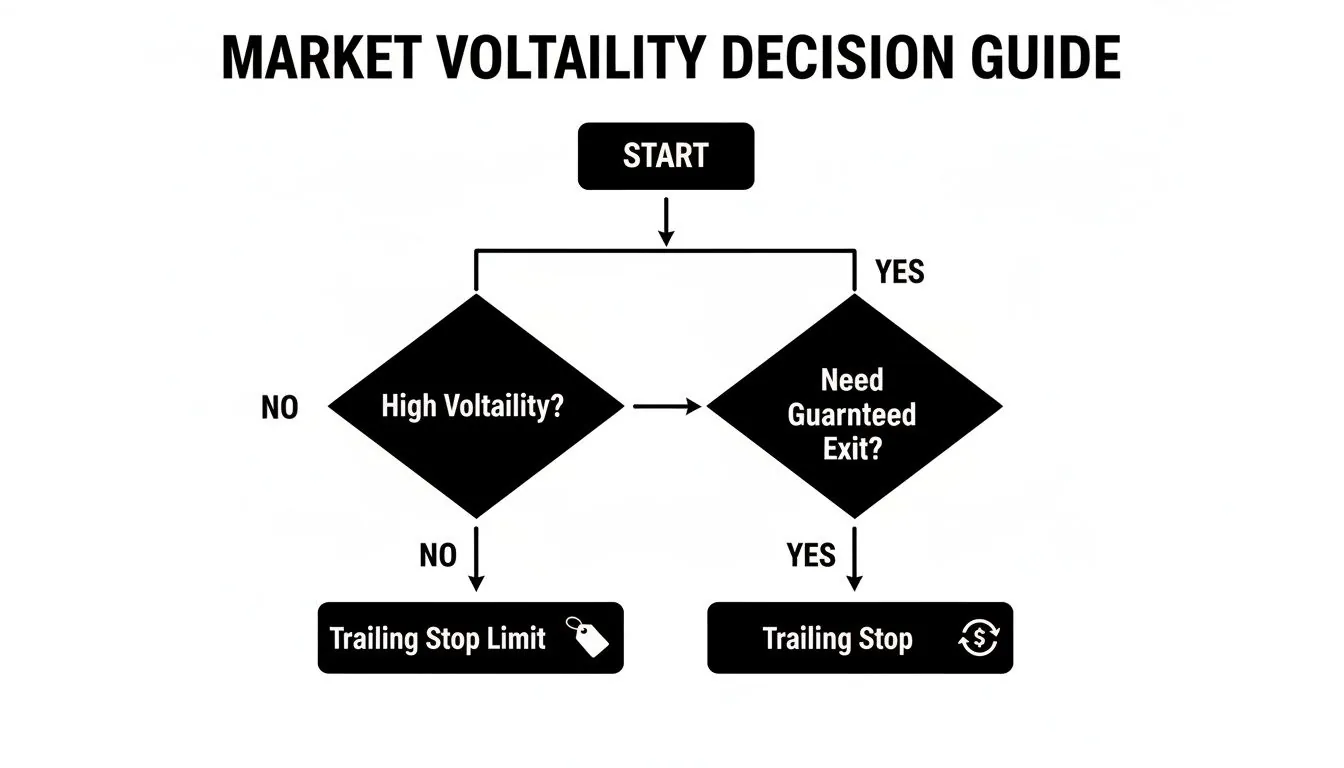
High volatility often forces you toward a standard trailing stop to guarantee an exit, while calmer conditions allow for the precision of a trailing stop limit.
When to Use a Standard Trailing Stop
Use a standard trailing stop when a guaranteed exit is more important than the exact exit price. It's your escape hatch in high-stakes situations.
- Trading Highly Volatile Assets For crypto, meme stocks, or volatile forex pairs, you need an order that executes immediately. A trailing stop gets you out, even with slippage.
- Navigating Major News Events During NFP reports or interest rate decisions, a trailing stop acts as a critical backstop against massive, unpredictable swings.
- Riding Strong, Clear Trends When you've caught a powerful trend, a trailing stop automatically locks in profits while giving the trend room to run.
- Prop Firm Trading For prop traders, a trailing stop is essential for risk management. The guaranteed execution ensures you cut a losing position before it jeopardizes your account by hitting a drawdown limit.
When to Use a Trailing Stop Limit
Use a trailing stop limit when price precision matters more than a guaranteed fill. It works best when the market is behaving predictably.
- Low-Volatility or Range-Bound Markets In calmer markets, the risk of the price gapping through your limit is much lower, making a trailing stop limit a viable option.
- Trading Liquid, Stable Instruments For major indices or forex pairs with deep liquidity and tight spreads, a limit order is more likely to be filled, helping you avoid slippage.
- Scaling Out of Positions If you're exiting a large position in stages, a trailing stop limit offers the control to get the prices you want for each part. Our guide on how to set effective stop-loss and take-profit levels provides more detail on this strategy.
Placing Your Orders on cTrader and DXtrade
Let's get practical and see how to set these orders up on your trading platform. Knowing how to place them correctly under pressure is what counts. We'll walk through the process for cTrader and DXtrade.
Disclaimer: What follows is a technical walkthrough, not a trading recommendation. All trading carries significant risk. Treat these settings as educational examples.
Setting Up on cTrader
In cTrader, you set a trailing stop after your position is live. You cannot set it from the initial order ticket.
- Open a Position Execute your trade as you normally would.
- Find Your Position Locate your live trade in the "Positions" tab at the bottom of your workspace.
- Enable the Trailing Stop Right-click on the trade, go to "Protection," and click "Trailing Stop."
- Set Your Trail Amount A window will pop up. Enter your trail distance in pips (e.g., 20 pips for a day trade, or a percentage for a swing trade).
Note: cTrader only offers a standard trailing stop. There is no native trailing stop limit order. When your trail is hit, it triggers a market order to ensure a guaranteed exit.
Setting Up on DXtrade
DXtrade integrates the trailing stop directly into the order ticket for convenience.
- Open the Order Ticket Click "New Order."
- Define Your Entry Fill out your trade details (symbol, size, etc.).
- Activate the Trailing Stop Find and click the "Trailing Stop" checkbox.
- Enter the Distance A field will appear for you to enter the trail distance in pips (e.g., 25 pips).
Like cTrader, DXtrade's trailing stop triggers a market order by default. There is no built-in function for a trailing stop limit, which aligns with the risk management needs of prop firm traders who must avoid drawdown violations.
FAQ: Trailing Stop Limit vs Trailing Stop
Can a quick price spike trigger my trailing stop?
Yes, absolutely. A sharp, sudden price spike (a "wick") can trigger your trailing stop, even if the price immediately reverses. This is known as getting "wicked out." To mitigate this, consider basing your trail amount on a volatility indicator like the Average True Range (ATR) instead of a fixed number of pips. This provides a buffer that adapts to current market conditions.
What happens if my trailing stop limit doesn't fill?
If the market moves so quickly that it gaps past both your stop trigger and your limit price, your order will not fill. It remains open, waiting for the price to return to your limit level, which may never happen. Your position is now open and unprotected, accumulating losses. This is the primary risk of using a trailing stop limit order.
Is one order type always better for prop firm trading?
For prop firm trading, the standard trailing stop is almost always the safer choice. Prop firms like MyFundedCapital have strict daily and maximum drawdown rules. A standard trailing stop becomes a market order when triggered, guaranteeing your exit. You might experience some slippage, but a slightly worse price is infinitely better than an unfilled order that lets a loss run and violates drawdown rules.
Ready to apply these risk management strategies in a professional trading environment? At MyFundedCapital, we provide the capital, platforms, and support to help you succeed. Compare our funding programs and start your journey to becoming a funded trader.