

 AR
AR
 NL
NL
 FR
FR
 DE
DE
 ES
ES
 PT
PT
 IT
IT
 PL
PL
 SV
SV


Confused by the hype around “AI forex trading”? This isn’t about a magic money-making robot. This guide explains what AI trading really is, how to build a practical strategy, and how to use it to tackle a prop firm challenge without getting lost in the science fiction.
What AI Forex Trading Really Means
At its heart, AI forex trading is about using powerful software to make smarter, data-driven decisions. Instead of relying on gut feelings, you use algorithms to find subtle patterns and statistical edges that are invisible to the human eye. The goal is not to win every trade, but to tilt the probabilities in your favor over hundreds or thousands of trades.
Think of it like this: a manual trader might watch a few currency pairs and indicators. An AI system can simultaneously monitor every pair, analyze global news sentiment, and track economic data in real-time, executing trades based on a logical framework.
The Core Job of AI in Trading
The main purpose of AI in your trading is to find and exploit a consistent statistical edge. It achieves this by performing several key tasks at a scale no human can match.
- Data Analysis: AI can process millions of historical data points—price, volume, volatility—to learn which market conditions typically lead to specific outcomes.
- Pattern Recognition: It excels at spotting complex, non-linear patterns that standard indicators miss. For example, it might find a unique relationship between oil prices and the USD/CAD pair that only appears under specific volatility conditions.
- Predictive Modeling: Based on historical data, the AI builds models to forecast the probable direction of future price movements.
- Automated Execution: The system can place, manage, and close trades based on its analysis, removing emotion, hesitation, and human error from the execution process.
Important Disclaimer: This content is for educational purposes only and does not constitute financial advice. All trading involves a substantial risk of loss, and past performance is not indicative of future results. Always conduct your own research.
What Kind of “Brain” Is Powering Your AI Trader?
When people talk about AI forex trading, they often picture a single, all-knowing machine. The reality is that there are several types of AI, each with a different way of learning and trading. Understanding the difference is the first step to choosing the right approach for your goals.
Machine Learning: The Pattern Spotter
Machine learning (ML) is the most common type of AI in trading. Think of an ML model as an incredibly powerful pattern-recognition engine. You feed it historical price data, and it learns to spot recurring setups that tend to lead to predictable results.
- Example: You could show an ML model thousands of examples of a classic breakout on the EUR/USD chart. It would learn to identify the signs—price consolidating near resistance, volatility dropping—that often precede a strong move.
Deep Learning: Finding Connections No Human Can See
Deep Learning is a more advanced branch of machine learning that uses complex neural networks. These models can analyze vast and varied datasets (like price, news, and economic data) to find subtle, non-linear relationships. A deep learning system might discover that a specific combination of gold price movements and social media sentiment reliably predicts a reversal in USD/JPY.
Reinforcement Learning: Learning from Experience
Reinforcement Learning (RL) is different. Instead of studying historical charts, an RL model learns by doing. You give the AI a goal (e.g., “maximize profit while keeping drawdown under 5%”) and let it place millions of trades in a simulated market.
The model gets rewarded for good trades and penalized for bad ones. Through relentless trial and error, it teaches itself a profitable strategy from scratch without pre-programmed rules.
Traditional Expert Advisors: The Rule Followers
It’s crucial to distinguish modern AI from traditional Expert Advisors (EAs). Most EAs are automation scripts that follow a rigid, pre-defined set of “if-then” rules.
- Rule-Based EA: “If the 50-period moving average crosses above the 200-period moving average, always buy.”
- AI Model: Learns the best conditions for a moving average crossover and might skip a signal if market volatility is dangerously high.
The key difference is adaptability. An old-school EA is static, while an AI model can learn from context. This is a major reason why more traders are exploring dynamic strategies for algo trading.
Comparison of AI Trading Models
This table breaks down the key differences between the AI models and traditional EAs.
| Model Type | Core Concept | Adaptability | Best Use Case |
|---|---|---|---|
| Machine Learning | Learns from historical data to recognize profitable patterns. | Moderate: Can adapt to new data but needs retraining. | Identifying well-defined, repeatable chart patterns and statistical arbitrage. |
| Deep Learning | Uses complex neural networks to find hidden, non-linear relationships. | High: Can model complex market dynamics and unstructured data. | Analyzing news sentiment, advanced volatility forecasting, and multi-asset correlations. |
| Reinforcement Learning | Learns through trial and error in a simulated environment. | Very High: Can develop novel strategies from scratch and adapt in real-time. | Dynamic risk management, optimizing order execution, and high-frequency trading. |
| Rule-Based EA | Executes trades based on a fixed set of pre-programmed rules. | None: The strategy is static and does not change with market conditions. | Automating simple, mechanical strategies like moving average crossovers. |
The growth of AI in trading is happening fast. Projections from this complete 2025 guide to AI in trading suggest a future where algorithms execute the vast majority of trades. For prop firm traders, learning to deploy a well-tested AI strategy on a platform like cTrader or DXtrade is becoming a core skill.
From Raw Data to a Battle-Tested AI Strategy
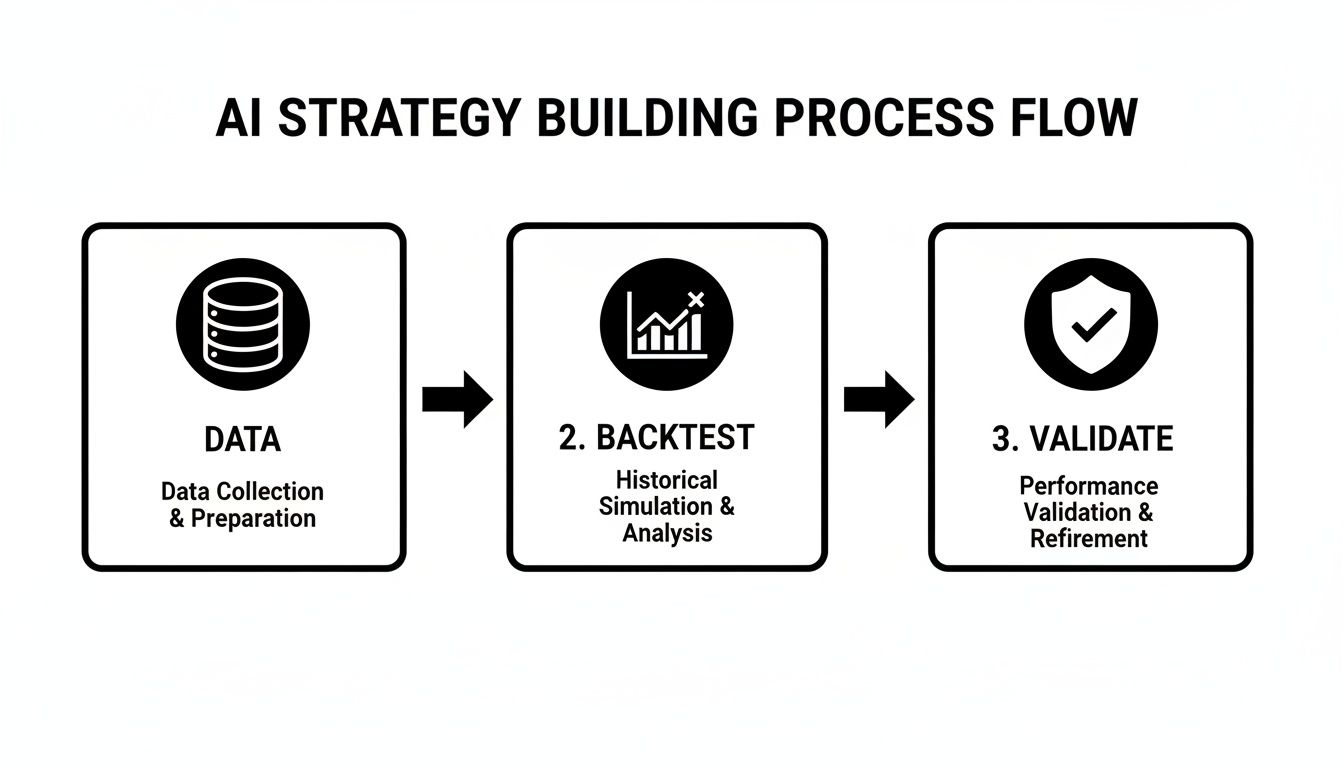
Building a reliable AI trading strategy is a structured process. A sophisticated model is worthless if it’s fed bad data or isn’t tested properly. The old saying “garbage in, garbage out” has never been more true.
Step 1: Source and Prepare Quality Data
You need clean, high-quality historical data. Once you have the raw data, you must translate it into meaningful clues for your AI. This process is called feature engineering.
- Calculate Indicators: Start by adding well-known indicators like RSI, MACD, or Bollinger Bands as “features” for your model to analyze.
- Describe Price Action: Create features that describe candlesticks, such as the size of a candle’s body compared to its wicks. This helps the model spot patterns of indecision or buying pressure.
- Add Context: Include features like the day of the week or the hour of the day. An AI might discover a setup works well during the London session but consistently fails during the Asian session.
Step 2: Avoid the Backtesting Trap
Backtesting—running your strategy on historical data—is where many aspiring AI traders fail. A backtest that produces a perfect equity curve is often a red flag for a trap called overfitting.
Overfitting happens when your AI model doesn’t just learn the market’s patterns; it memorizes the historical data itself, including random noise. It becomes perfectly “curve-fitted” to the past, making it useless for predicting the future. An overfitted strategy looks brilliant in a backtest but falls apart in live trading.
Step 3: Use Advanced Validation Methods
To avoid overfitting, professionals use tougher validation methods to ensure a strategy has a genuine edge.
Walk-Forward Analysis
Instead of testing on one massive chunk of history, walk-forward analysis breaks the data into rolling periods.
- Train: Train the AI on an initial block of data, for example, from 2018 to 2020.
- Test: Test its performance on the next block of unseen data, like 2021.
- Repeat: The window then “walks” forward. You retrain the model on 2019-2021 and test it on 2022.
If your strategy remains profitable across multiple “out-of-sample” periods, you have stronger evidence of a real, adaptable edge.
Monte Carlo Simulations
A Monte Carlo simulation stress-tests your backtest results by injecting controlled chaos. It might randomly shuffle the order of your trades or tweak execution prices to simulate slippage. By running thousands of simulations, you can see a full range of potential outcomes and gain probabilistic insights, such as having a 95% probability of keeping drawdown below 10%.
Critical Risk Management for AI Forex Trading
A profitable predictive model is useless if it doesn’t have ironclad risk controls. Let’s move past simple stop-losses and build truly intelligent risk management into your AI forex system.
A smart AI doesn’t just ask, “Where should I exit?” It constantly asks, “Given current market conditions, how much should I be risking right now?” This dynamic thinking is essential for passing prop firm challenges.
Dynamic Position Sizing
Instead of risking the same lot size on every trade, a sophisticated AI uses dynamic position sizing. It calculates the position size for each trade based on real-time market volatility.
- Low Volatility: When the market is calm, the AI might take a slightly larger position size, as a logical stop-loss is closer.
- High Volatility: During a chaotic news release, the AI should reduce its position size to compensate for wild price swings and heightened risk.
This approach keeps your actual dollar risk consistent from trade to trade.
AI-Driven Drawdown Controls
One of the most powerful risk tools is an automated drawdown control that mirrors prop firm rules. For instance, knowing there’s a hard 5% daily drawdown limit, your AI should have an internal circuit breaker.
If your AI tracks its performance and detects its daily loss has reached 4%, it can trigger a “risk-off” mode. It could be programmed to stop trading for the day or slash its risk per trade to something tiny, like 0.25%, to protect the account. This automated discipline removes emotion and prevents a bad day from turning into a blown account.
Managing Systemic Risk with Correlation Matrices
You might think you’re diversified with five different trades, but if they are all USD-based pairs, you’ve made one big, concentrated bet on the dollar. An intelligent AI can manage this hidden exposure using a correlation matrix.
Before taking a new trade, the AI scans its open positions to check correlations. If it’s already long EUR/USD and GBP/USD (highly correlated), it might automatically reject a new signal to also go long AUD/USD, thus avoiding accidentally stacking risk.
Taking Your AI Live: Deployment and Monitoring
After rigorous testing, it’s time to deploy your AI in the live market. This is not a “set it and forget it” process. For traders at a prop firm like MyFundedCapital, this means connecting your AI to platforms like cTrader, DXtrade, or Match-Trader.
Getting Your AI Connected to the Market
There are two main ways to get your AI to place trades:
- Platform-Native Scripts: Many platforms have their own scripting language. For example, cTrader uses C# to build “cBots” that run directly inside the platform. This is often the most reliable option.
- API Connections: If your AI is a more complex Python script, you can connect it to your trading platform via an API (Application Programming Interface). This offers flexibility but means you are responsible for managing the connection.
Expert Advisors (EAs) or custom bots are popular choices. The key is to understand your prop firm’s guidelines. For more details, check out our guide on how to properly use an Expert Advisor at MyFundedCapital.
Your Day-to-Day Monitoring Checklist
Once your AI is live, your role shifts from creator to mission controller. The market is constantly evolving, so you must monitor your system’s performance closely.
Here’s a practical checklist of what to watch:
- Performance Degradation: Are key metrics like profit factor or Sharpe ratio declining? This is a red flag that market conditions may have shifted against your model.
- Drawdown Levels: Monitor your maximum drawdown. Is it within your backtested limits and, more importantly, well within your prop firm’s rules (e.g., the 5% daily drawdown limit)?
- Latency and Slippage: How quickly are your orders being filled? Delays (latency) cause slippage (the difference between expected price and fill price), which can slowly destroy profitability.
- Connection Stability: If using an API, is the connection stable? Frequent disconnects or error codes could leave a trade unmanaged at a critical moment.
Making Your AI Strategy Work for a Prop Firm Challenge
Passing a prop firm challenge isn’t just about being profitable; it’s about performing within a specific set of rules. You need to adapt your AI to hit targets while respecting strict risk boundaries.
The drawdown limits are not suggestions—they’re hard lines you cannot cross. Your AI must be coded to actively steer clear of them.
Weaving Prop Firm Rules into Your AI’s DNA
You must hard-code the prop firm’s drawdown rules into your AI’s core logic. For a MyFundedCapital challenge, your AI must respect two main constraints:
- 5% Daily Drawdown: Your bot needs a built-in “kill switch.” It should calculate its daily loss and stop opening new trades if the loss approaches the limit (e.g., at 4%).
- 10% Maximum Drawdown: Your AI needs a constant monitor tracking the total drawdown from the account’s peak. If this limit is breached, the challenge is over.
The goal is not just to avoid breaking the rules, but to build a system that automatically shuts down long before you’re in the danger zone. For a full breakdown of the calculations, it’s worth understanding the prop firm challenges.
Checklist for a Challenge-Ready AI
Once your risk controls are in place, focus on hitting the profit target without being reckless. For a standard 1-step challenge with a 10% target, optimize for consistency.
- Find the Right Trading Pace: Test your AI to find a balance between generating consistent profit and over-trading, which adds unnecessary risk.
- Dial in Your Risk-to-Reward: Ensure your AI’s take-profit and stop-loss logic is configured to realistically achieve the profit target over multiple trades.
- Build in a Consistency Filter: Program your AI to use stable position sizes. Many firms want to see responsible trading, not one huge “Hail Mary” trade.
- Stay Away from News Events: Unless you have a news trading add-on, program your AI to be inactive during major economic releases to avoid chaotic price spikes.
By adapting your AI this way, it becomes a purpose-built engine designed to hit clear objectives and unlock a funded account.
AI Forex Trading FAQ
Here are answers to some common questions about using AI in forex trading.
Can I use AI trading without knowing how to code?
Yes. While coding offers the most customization, it’s not required. You can use platforms with no-code strategy builders to drag-and-drop your ideas into a working system. Alternatively, you can purchase a pre-built Expert Advisor (EA), but always do thorough research, as many are marketed with more hype than substance.
What kind of profits are realistic with AI forex trading?
There are no guaranteed profits in any type of trading. Be wary of anyone promising massive, overnight returns. For a well-built retail algorithm, achieving consistent single-digit monthly returns is a significant accomplishment. The focus should be on sustainable growth, not “get rich quick” schemes.
How much does it cost to get started?
The cost can range from nearly free to several thousand dollars. You can start with open-source tools like Python and free historical data. A more professional setup might include costs for high-quality data feeds, a Virtual Private Server (VPS) to run your bot 24/7 (typically $20-$50 per month), and the price of a commercial EA.
Are prop firms okay with AI and EA trading?
Yes, prop firms like MyFundedCapital welcome traders who use AI and Expert Advisors. The key requirement is that your strategy must comply with the firm’s rules, especially risk parameters like the 5% daily drawdown limit. As long as your AI operates within our trading guidelines, it is a legitimate tool for tackling challenges.
Ready to put your AI trading strategy to the test?
Explore the challenge accounts at MyFundedCapital and see how our funding programs are designed to support algorithmic traders.
