

 AR
AR
 NL
NL
 FR
FR
 DE
DE
 ES
ES
 IT
IT
 PL
PL
 SV
SV
 PT
PT


A stop loss is one of the most fundamental tools in a trader's arsenal, yet many traders use it incorrectly or not at all. This guide explains what a stop loss trade is, how to place one strategically, and how to use it to protect your trading capital from significant losses. You will learn the practical steps to make it an effective part of your risk management plan.
Think of it as your financial safety net. Its entire purpose is to cap your potential losses on any single trade, ensuring a bad decision doesn't turn into a catastrophic one. It's not about making a profit; it's about staying in the game. Remember, trading involves a significant risk of loss and this content is for educational purposes only, not financial advice.
Why a Stop Loss is Your Trading Fire Escape
Imagine you're in a high-rise apartment. You hope you’ll never need the fire escape, but you'd feel pretty foolish if you didn't know where it was. A stop loss is that fire escape for your trades. It’s your pre-planned, no-hesitation exit strategy for when things go wrong.
When a trade sours, it's easy to get caught up in hope, praying for a market reversal that might never arrive. A stop loss removes that dangerous emotion from the equation. By setting it before you even enter the trade, you've already decided the maximum amount of money you're comfortable losing on that specific idea. This is the bedrock of capital preservation—and a trader’s first job is always to protect their capital.
Why Is a Stop Loss Non-Negotiable?
For anyone serious about trading, mastering the stop loss isn't optional. It forces discipline and gives you a concrete way to manage risk every single time you put money on the line.
Here’s why it’s so critical:
- It Automates Your Exit Plan: Once you set it, the order sits on the server and executes automatically. No second-guessing, no panic-clicking.
- It Protects Your Trading Capital: It’s a hard barrier that prevents one disastrous trade from wiping out your account and your confidence.
- It Frees Up Your Mental Energy: Knowing your maximum risk is defined beforehand lets you stop staring at every tick and focus on finding the next high-quality setup.
To give you a clearer picture, let's break down the moving parts of a typical stop loss order.
Anatomy of a Stop Loss Order
| Component | What It Is | Example |
|---|---|---|
| Asset | The financial instrument you are trading. | EUR/USD |
| Entry Price | The price at which you bought or sold the asset. | Bought at 1.0750 |
| Direction | Whether you are buying (long) or selling (short). | Long (Buy) |
| Stop Loss Price | The predetermined price where your trade automatically closes for a loss. | 1.0720 |
| Risk Amount | The total potential loss if the stop loss is triggered. | 30 pips (1.0750 – 1.0720) |
This simple structure provides a powerful framework for managing risk on every single trade.
A stop loss is your contract with yourself to admit when a trade idea is wrong. It’s the mechanism that protects you from your own emotional biases, like hope and fear, which can be destructive in trading.
Ultimately, long-term trading success isn't just about how much you make when you're right. It's about how little you lose when you're wrong. A stop loss is often a key component of a broader strategy, which you can explore further by understanding what is forex technical analysis. Getting this one tool right is a massive leap toward becoming a consistently disciplined trader.
Choosing The Right Stop Loss Order Type
Knowing you need a stop loss is the first step, but picking the right kind is where strategy really begins. Not all stop orders are created equal, and the type you choose can make a huge difference in the outcome of your trade. It all comes down to your trading style, how much risk you're comfortable with, and what the market is doing at that moment.
Think of it like choosing brakes for a car. They all do the same basic job—stop you—but some offer more precise control, while others give you guaranteed stopping power, even if the road gets icy. Let's dig into the common types you'll encounter so you can pick the right tool for the job.
The Standard Stop-Loss Market Order
This is your bread-and-butter stop loss. It’s the most straightforward type: you set a price, and if the market touches it, your broker immediately sends a market order to close your position. Simple as that. It’s designed to get you out of a bad trade, fast.
The catch? Slippage. In a chaotic or fast-moving market, the price your order actually gets filled at might be worse than the price you set. If your stop is at $50, a sudden drop could mean you get out at $49.95. It’s a small difference, but it can add up.
- Pro: It's incredibly simple and almost guaranteed to execute.
- Con: You can lose a bit more than you planned due to slippage.
The Stop-Limit Order
If you want more control over your exit price, the stop-limit order is your go-to. This one has two parts: the stop price and the limit price. When the market hits your stop price, it doesn't just sell at any price—it places a limit order to sell at your specified limit price or better.
The trade-off here is certainty of execution. If the market gaps down or moves violently past your limit price, your order might get skipped entirely. This leaves you stuck in a losing trade with the potential for much bigger losses than you anticipated.
Key Takeaway: A stop-limit order prioritizes price over execution. You get the price you want, but you risk not getting out of the trade at all if the market moves too quickly.
The Guaranteed Stop-Loss Order (GSLO)
For traders who can't afford any surprises, the Guaranteed Stop-Loss Order (GSLO) is the ultimate safety net. A GSLO does exactly what its name suggests: it guarantees your trade will close at the exact price you set, no matter how volatile the market gets or if it gaps overnight. Slippage is completely off the table.
Of course, this level of protection isn't free. Brokers charge a premium for GSLOs, which you'll usually pay when you place the order. It’s a powerful tool, especially if you’re trading around major news releases or holding positions over the weekend.
This simple flowchart shows the fundamental job of any stop loss: to provide a clear, pre-planned exit when a trade goes south.
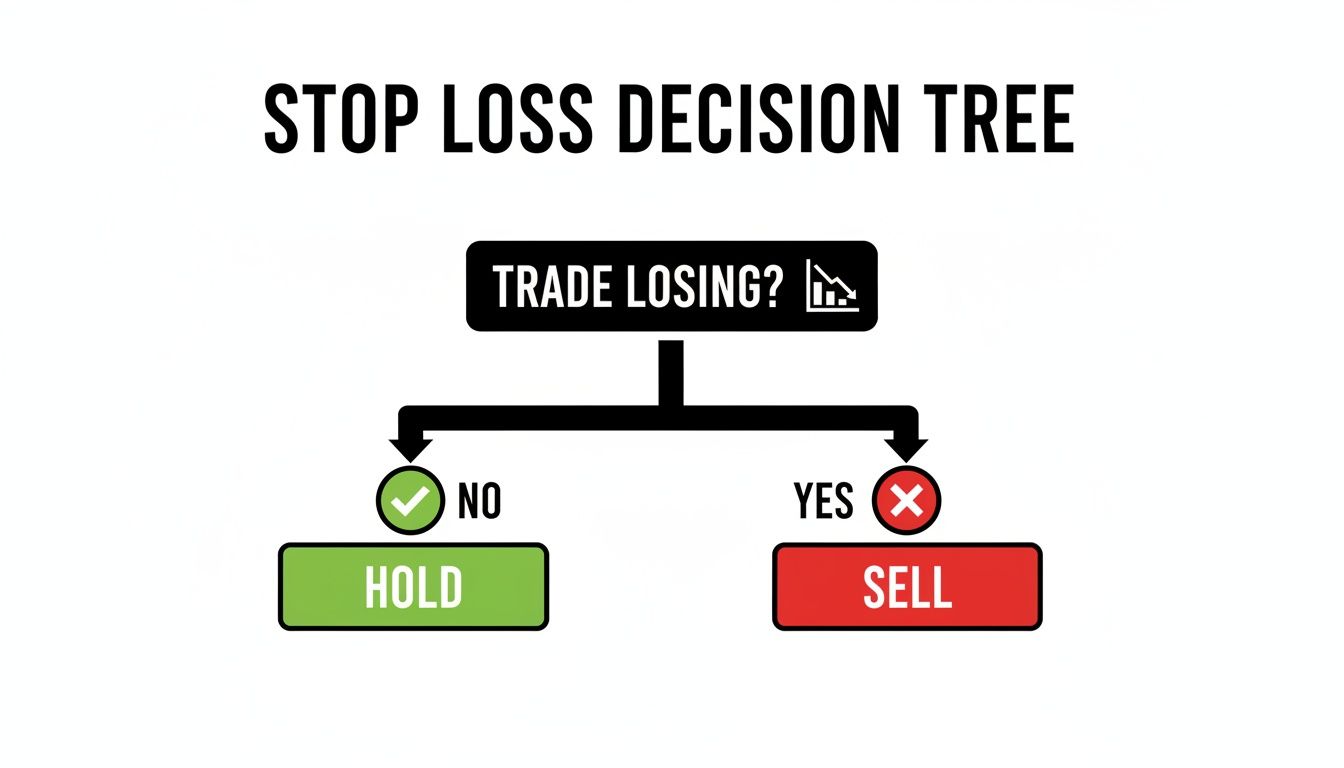
It’s the most basic decision in risk management—sticking to your plan instead of hoping for a turnaround.
The Trailing Stop Order
A trailing stop is a clever, dynamic tool that lets you protect your profits as a trade moves in your favor. Instead of setting a fixed price, you set a "trailing" distance in points, pips, or as a percentage. For instance, if you set a 20-pip trailing stop on a long EUR/USD trade, your stop will always sit 20 pips below the highest price the trade has reached so far.
This is a fantastic way to let your winners run while systematically locking in gains along the way. If the market turns against you and hits that trailing level, the trade closes, securing the profit you've already made.
Comparing Stop Loss Order Types
Each stop loss type serves a different purpose, and choosing the right one often depends on balancing your need for price precision against the certainty of getting out of a trade. Here’s a quick breakdown to help you decide.
| Order Type | How It Works | Best For | Key Risk |
|---|---|---|---|
| Stop-Loss Market | Triggers a market order at your stop price. | Most day-to-day trading situations; ensuring an exit. | Slippage in volatile markets. |
| Stop-Limit | Triggers a limit order at your stop price. | Traders who prioritize a specific exit price over a guaranteed fill. | Order may not be filled if the market gaps past the limit price. |
| Guaranteed Stop | Your position is closed at the exact stop price, period. | Trading around major news events or holding positions overnight. | Comes with a premium/fee from the broker. |
| Trailing Stop | The stop price adjusts automatically as the trade moves in your favor. | Locking in profits on a trending trade while giving it room to grow. | A sharp, temporary pullback can stop you out too early. |
Ultimately, the best choice depends on your strategy and the market's personality on any given day. A quiet, trending market might be perfect for a trailing stop, while a volatile news release might call for the security of a GSLO.
Where to Place Your Stop Loss Strategically
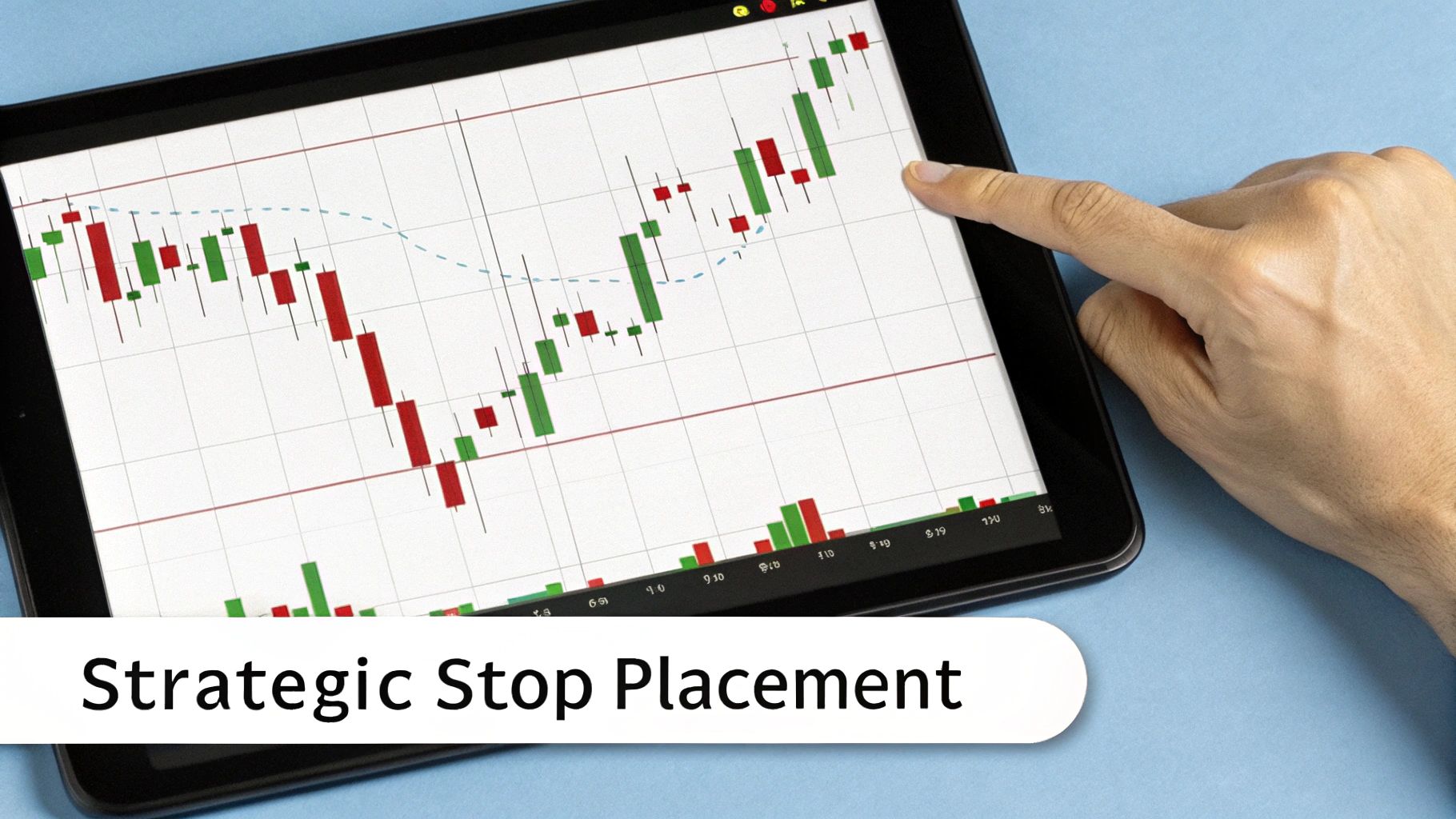
Figuring out where to place your stop loss isn't about guesswork or gut feelings. It’s a strategic decision based on your risk tolerance and what the market structure tells you. Where you set that level can be the difference between a small, controlled loss and a devastating hit to your account.
Let's break down three of the most reliable methods traders use to place their stops with precision.
The Percentage Method
This is the most straightforward approach, and it’s a great starting point for building discipline. You simply decide on a fixed percentage of your total trading capital you’re willing to risk on any single trade. A widely accepted rule of thumb is to risk no more than 1% to 2% of your account balance.
This method forces consistency. Your potential loss is always a known quantity, preventing one bad trade from blowing a huge hole in your account.
Example Calculation (Forex):
- Account Balance: $10,000
- Risk Percentage: 1%
- Maximum Risk per Trade: $10,000 x 0.01 = $100
With a $100 risk limit, if you buy EUR/USD and your position size means each pip is worth $10, you’d place your stop loss 10 pips below your entry price. Your loss is capped at $100.
The Technical Analysis Method
This method ties your stop directly to the market's behavior. Instead of picking an arbitrary number, you use the chart itself to tell you where your trade idea is proven wrong.
You're essentially looking for key structural points on the chart. Common places to hide your stop include:
- Below a support level if you're buying.
- Above a resistance level if you're selling.
- Just beyond the high or low of a critical candlestick pattern.
- A little past a significant moving average that has been holding the price.
The logic is simple: if the price breaks through a key structural level, the original reason for your trade is likely invalid. Your stop is no longer just a financial backstop; it’s an invalidation point for your entire trade thesis.
If you want to get better at spotting these levels, our guide on technical analysis trading tips and charting trends is a fantastic resource to sharpen those skills.
The Volatility-Based Method (ATR)
Markets breathe. Some days are calm, and others are chaotic. A volatility-based stop adapts to this reality. The best tool for the job here is the Average True Range (ATR) indicator.
The ATR measures how much an asset typically moves over a given period (usually 14 days). When the ATR is high, the market is volatile, and you need a wider stop. When the ATR is low, things are quiet, and you can use a tighter stop. This is a practical way to avoid getting stopped out of a good trade by normal market noise.
Example Calculation (Crypto):
- Find the ATR value: On your chart, you see the 14-day ATR for Bitcoin is $500.
- Pick a multiplier: Many traders use a 2x multiplier. This means you'll place your stop 2 * ATR away from your entry.
- Calculate the stop distance: $500 (ATR) * 2 = $1,000.
- Set your stop: If you go long on Bitcoin at $65,000, your stop loss goes in at $64,000.
This isn't just theory. Research shows that volatility-based stops can be effective. An analysis of S&P 500 data found that a simple -1.10% stop loss outperformed buy-and-hold in sideways markets, and a tight -0.60% intraday stop on T-Bonds was shown to be highly effective at protecting capital.
Common Stop Loss Mistakes and How to Avoid Them
Knowing what a stop loss is and knowing how to use one effectively are two different things. Even the most carefully laid plans can go awry. Let's walk through some of the most common traps traders fall into so you can avoid them.
We're going to tackle three big ones: slippage, the dreaded "stop hunt," and treacherous market gaps.
Dealing with Slippage
You've probably seen it happen. You set your stop at a specific price, but your trade actually closes out at a worse price. That's slippage.
It happens when the market is moving so fast that there's no available liquidity at your exact price. Your broker has to fill your order at the next best price available, which might be several pips away. This is common during major news or a sudden market shock.
- How to Handle It: You can't eliminate slippage with a standard stop-market order, but you can manage it. Avoid holding open positions right into a high-impact news release unless your strategy is built for it. For complete protection, see if your broker offers a Guaranteed Stop-Loss Order (GSLO). It costs a small premium, but it ensures your trade closes at the exact price you set.
Understanding the "Stop Hunt"
Stop hunting is a controversial topic, but it's something every trader should be aware of. The theory is that large institutional players can see where massive clusters of retail stop losses are sitting and will intentionally push the price to that level.
Why? Triggering that cascade of stop orders creates a flood of liquidity, allowing them to fill their huge positions at better prices. These stop-loss clusters typically form around obvious places: big round numbers (like 1.1000 on EUR/USD) or textbook support and resistance levels.
Research from the New York Fed highlighted that stop-loss orders can account for a staggering 43% of all order volume in currency markets, often piled up around these key psychological levels. When triggered, they can accelerate price moves. You can read the full research about these market dynamics for a deeper dive.
- How to Handle It: Make your stop less of an obvious target. Instead of placing it right at a support level, give it some breathing room just beyond it. Using a volatility-based tool like the Average True Range (ATR) to set your stop distance is a great way to place your stop outside the typical market "noise" where these hunts often happen.
Protecting Against Market Gaps
A market gap is when a market opens at a price that is significantly different from where it closed, with no trading in between. This is a common occurrence over the weekend in forex or after a major earnings announcement for a stock.
A standard stop loss is useless against a gap. If the market opens on the other side of your stop, your order will trigger at the very first available price—which could be catastrophically far from your intended exit.
A weekend gap can turn a calculated 1% risk into an unexpected 5% loss. This is a major reason why holding trades over the weekend requires a specific strategy and risk tolerance.
To stay safe, always be aware of the market's trading hours and check the economic calendar. For traders at prop firms like MyFundedCapital, this is exactly why there are strict rules around weekend holding and news trading—they’re in place to protect both the trader and the firm from these unpredictable risks.
Navigating a Prop Firm Account With a Stop Loss
When you're trading with a prop firm's capital, a stop loss isn't just a suggestion—it's your lifeline. These firms give you access to significant capital, but in return, they set hard rules you cannot break. Your stop loss is the single most important tool for staying within those rules.
Its main job is to ensure one bad trade doesn't breach a firm's drawdown limits and get you disqualified.
Staying Within the Drawdown Rules
Most prop firms, including MyFundedCapital, build their risk management around two core pillars. A stop loss is your best defense for managing both.
Daily Drawdown: This is a hard ceiling on how much you can lose in one day, usually set at 5%. A properly calculated stop loss prevents any single position from spiraling out of control and pushing you over that daily limit.
Maximum Drawdown: This is the overall high-water mark for your account's total loss, often 10%. By consistently using stops on every trade, you keep small losses from piling up and threatening your entire account.
Think of the drawdown rules as the boundaries of the playing field. Your stop loss is the skill that keeps the ball in play. Without it, you're far more likely to get disqualified.
Getting a handle on these rules is fundamental to your success. You can learn more about how proprietary trading firms work to fully grasp the environment you'll be operating in.
Why Stops Matter for Weekend and News Trading
You'll often find that prop firms don't allow you to hold trades over the weekend or during a major news release. This isn't them being difficult; it’s because of market gaps.
A stop loss can't save you if the market opens on Monday hundreds of pips away from where it closed on Friday. The price "gaps" right over your stop, and it gets filled at the first available price—which could be a catastrophic loss. These rules shield both you and the firm from that unpredictable risk.
This forces you to be a better trader during the week. It builds the discipline of managing risk when the markets are behaving more predictably, which is a cornerstone of professional trading.
Academic research has shown that when a cluster of stop orders gets triggered, it can pour fuel on a fire and accelerate price moves. In fact, some studies suggest stop-loss cascades can increase mean volatility by as much as 27%. You can discover more insights about these market effects in the research. It’s this exact kind of systemic risk that prop firm rules are designed to protect against.
Frequently Asked Questions About Stop Loss Orders
Here are answers to some of the most common questions beginner and intermediate traders have about using a stop loss in live markets.
Should I ever move my stop loss?
Here’s a simple rule: only in the direction of your trade. Moving your stop to lock in profits (e.g., to break-even) is a smart, professional tactic. Moving your stop further away from your entry because a trade is going against you is a catastrophic habit that negates the purpose of a stop loss and turns a calculated risk into an unknown one.
Does a stop loss guarantee my exit price?
No, a standard stop-loss order does not guarantee your exit price. During extreme volatility or a market gap, your order will be filled at the next available price, which could be worse than your stop level (this is known as slippage). The only type of order that guarantees your price is a Guaranteed Stop-Loss Order (GSLO), which usually comes with an extra fee from your broker.
How do I decide how wide my stop loss should be?
The width of your stop loss should be based on the market's current volatility, not just a random number of pips. A practical method is using the Average True Range (ATR) indicator to determine a multiple (e.g., 2x ATR) that places your stop outside of normal market noise. In highly volatile markets like crypto, stops need to be wider than in less volatile markets like forex.
Where Do You Go From Here?
You now have a solid grasp of what a stop loss trade is and why it's the single most important tool in a trader's arsenal. It's your first line of defense, the mechanism that keeps you in the game day after day. Knowing the theory is one thing, but making it second nature is what separates a disciplined trader from the crowd.
The best way to build that discipline is through practice in a simulated trading environment. This is where you can get a real feel for placing stops based on ATR or market structure, see how different order types behave, and build the mental muscle to honor your stop when a trade turns sour. This is where you forge the habits that protect your capital when you’re trading for real.
Ready to put your risk management skills to the test? At MyFundedCapital, we give you the platform to prove you can trade with discipline. Pass our evaluation in a simulated environment, and you’ll get to trade our capital and keep a share of the profits.
