

 AR
AR
 NL
NL
 FR
FR
 DE
DE
 ES
ES
 IT
IT
 PL
PL
 SV
SV
 PT
PT

Losing money on a trade is inevitable, but letting a small loss spiral into a disaster is a choice. A stop loss is an automated order that closes your trade at a predetermined price, preventing catastrophic losses before they happen. This guide will show you exactly what a stop loss is, which type to use, and how to place it effectively.
Why a Stop Loss is Your Most Important Trading Tool

We’ve all been there—that gut-wrenching moment when a trade starts moving hard against you. A stop loss is your pre-set escape hatch. It turns the raw, unpredictable nature of risk into a calculated variable you can actually manage.
It's like a safety harness for your trading capital. Far from being a sign of a failed trade, it's a professional's tool for survival. It’s what ensures you live to trade another day. Of course, before you jump into advanced tools, it's smart to learn the basics of how to start investing in the stock market to get a solid foundation.
Why Every Trader Needs a Stop Loss
Trading without a stop loss is like walking a tightrope without a net. One bad trade, fueled by a dose of "hope-ium" or a surprise news event, can cripple your account. For serious traders, using a stop loss on every single position isn't a suggestion—it's a hard and fast rule.
The benefits are straightforward but incredibly powerful:
- Capital Preservation: Its number one job is to shield your trading account from devastating drawdowns.
- Emotional Detachment: You decide your maximum pain point before you even enter the trade. This takes fear, hope, and greed out of the equation when things go wrong.
- Discipline Enforcement: It forces you to be honest about how much you're willing to lose, which is the cornerstone of any solid trading plan.
A stop loss order gives you a predefined exit if a trade moves against you, so a single position does not damage your entire account. It's the mechanism that separates professional risk management from gambling.
Choosing the Right Type of Stop Loss Order
Once you’ve decided to use a stop loss, the next big question is: which one? They aren't all created equal. Each type comes with its own trade-offs between a guaranteed exit and price control. Picking the right one really boils down to your strategy, the market you're trading, and what you’re trying to accomplish with that specific trade.
Let's break down the main options so you can make the right call.
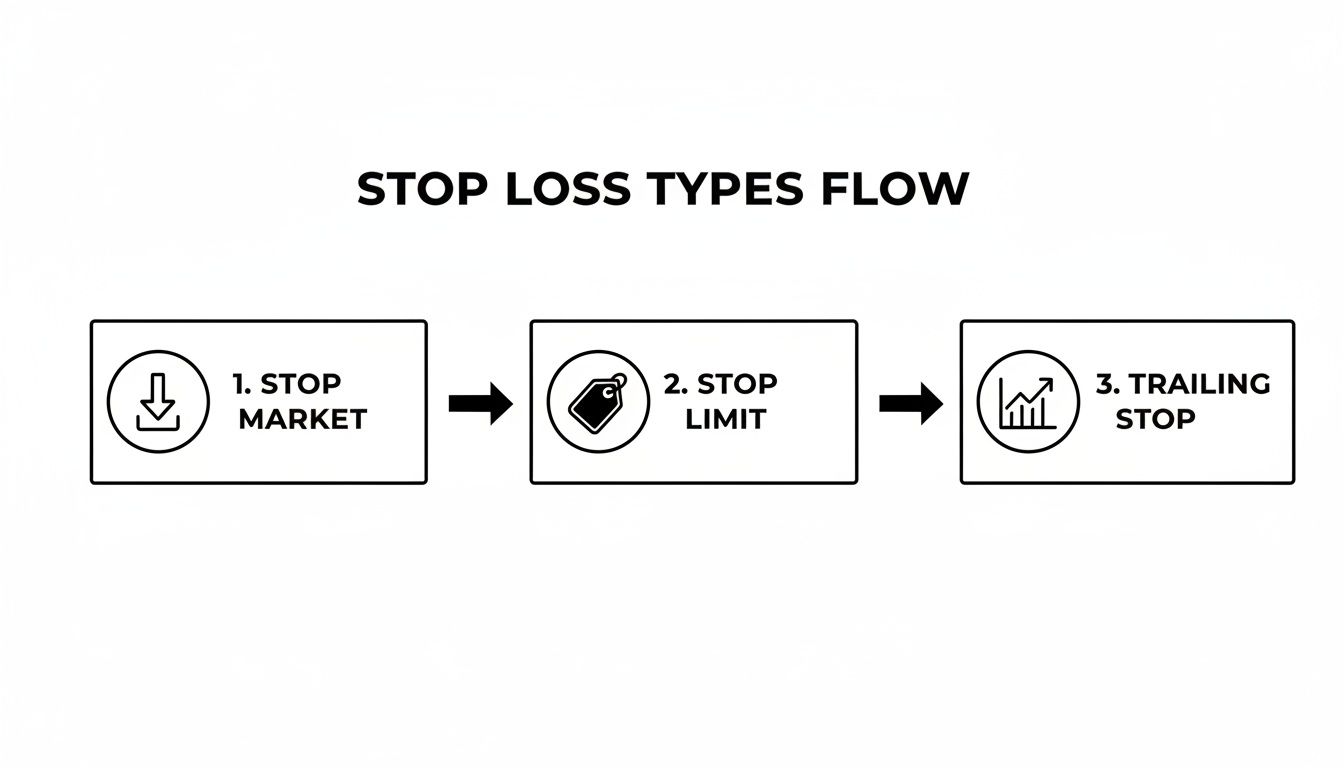
The Stop Market Order: Your Go-To for a Guaranteed Exit
The stop market order is the workhorse of the trading world—simple, reliable, and the most common type you'll encounter. It’s incredibly straightforward: when the market hits your stop price, it instantly triggers a market order to close your position.
The entire focus of this order is on getting you out of the trade, period. In a fast-moving market, this can mean the price you actually get filled at is a bit worse than the price you set. We call this difference slippage. But for most traders, the certainty of getting out is worth that risk.
- How it works: Price hits your stop level, which instantly becomes a market order and sells at the next available price.
- Best for: Traders who absolutely need a guaranteed exit, especially in liquid markets.
- Key risk: Slippage. When volatility spikes, your actual exit price could be significantly different from your stop price.
The Stop-Limit Order: Price Control at a Cost
A stop-limit order gives you more say over your exit price, but it comes with a major catch. This order has two parts: the stop price (which activates the order) and the limit price (the absolute worst price you’re willing to accept).
Here’s the difference: when the market touches your stop price, it places a limit order to sell at your limit price or better. The danger? If the market gaps down violently and blows right past your limit price, your order might never get filled. You could be left holding a losing position that's getting worse by the second.
A stop-limit order offers price precision but absolutely no guarantee of execution. It's a trade-off: you avoid a bad fill, but you might not get filled at all if the market moves too quickly against you.
The Trailing Stop: Protecting Profits as You Win
A trailing stop is an order that automatically follows your trade as it moves into profit. You set it at a specific percentage or dollar amount away from the current market price. If the price moves in your favor, your stop moves with it, locking in gains. If the price turns against you, the stop stays put.
This is a fantastic way to protect your profits on a winning trade while still giving it room to run. The data backs it up. A comprehensive 11-year study showed that a 20% trailing stop strategy outperformed traditional methods by 27.47%—even through major market crashes. You can dig into the numbers yourself and read the full research on trailing stop effectiveness to see how powerful it can be.
The Guaranteed Stop: Ultimate Protection for a Fee
Think of a Guaranteed Stop Loss Order (GSLO) as an insurance policy for your trade. It works just like a standard stop loss but with one huge advantage: it guarantees to close your trade at your exact specified price, no matter how volatile the market gets or how far it gaps. Slippage is completely off the table.
Of course, this level of protection isn't free. Brokers typically charge a premium for it, either through a wider spread or an upfront fee. It's the ultimate safety net, best reserved for situations with extreme risk, like holding a position through a major news event or over a weekend.
Comparing Key Stop Loss Order Types
To make the choice easier, here's a quick side-by-side comparison.
| Order Type | How It Works | Best For | Key Risk |
|---|---|---|---|
| Stop Market | Triggers a market order at your stop price. | Traders who prioritize a guaranteed exit above all else. | Slippage in volatile markets. |
| Stop-Limit | Triggers a limit order at your stop price. | Traders who need precise price control and can accept the risk of non-execution. | The order may not be filled if the price gaps past the limit. |
| Trailing Stop | Stop level automatically adjusts as the trade moves into profit. | Locking in profits on winning trends while giving them room to grow. | Can be triggered prematurely by normal market volatility. |
| Guaranteed Stop | Guarantees your exit at the exact stop price for a premium. | Protecting against extreme volatility, slippage, and weekend gaps. | The extra cost (premium or wider spread) can eat into profits. |
The right choice is the one that aligns with your trading plan, risk tolerance, and the specific conditions of the trade. For a deeper dive into the mechanics, our guide on how to properly use Take Profit and Stop Loss is a great next step.
How to Calculate and Set Your Stop Loss
Knowing what a stop loss is and which type to use is only half the battle. The real make-or-break moment comes when you have to decide exactly where to place it. Get this wrong, and a stop loss can do more harm than good.
Let’s get practical and walk through three of the most effective methods for setting your stop loss.
Method 1: The Percentage Method
The most straightforward way to set a stop is to risk a fixed percentage of your trading capital. This strategy puts capital preservation front and center. For new traders especially, the golden rule is to risk no more than 1% to 2% of your total account balance on a single trade.
Here’s a step-by-step example:
- Define Your Account Risk: First, decide the absolute maximum you're willing to lose. Let’s say you have a $10,000 account and stick to a 1% risk rule. That means your maximum loss on this trade is $100.
- Calculate the Stop Price: If you buy EUR/USD at 1.0750, a simple 1% stop from your entry would place your exit at 1.06425 (1.0750 * 0.99).
- Set Your Position Size: This is the critical step. Your position size must be calibrated so the distance between your entry and your stop equals your max dollar risk ($100). You can skip the manual math by using a professional lot size calculator to get the precise figure instantly.
While this method is fantastic for instilling discipline, it can be rigid as it doesn't account for market volatility.
Method 2: The Technical Analysis Method
A much more nuanced approach is to let the market’s structure dictate your stop placement. Instead of relying on an arbitrary percentage, you look for key technical levels on the chart that would invalidate your entire trade idea if broken.
Placing a stop based on technicals means you're identifying the exact point where your reason for entering the trade is proven wrong.
Here are some of the most common spots traders use:
- Below a support level: If you're going long, the logical place for a stop is just beneath a clear floor where buyers have shown up in the past.
- Above a resistance level: For a short position, you’d place your stop just over a price ceiling where sellers have historically taken control.
- Beyond a key moving average: Many traders use moving averages to define the trend. Placing a stop on the other side of that line acts as a signal that the trend might be breaking.
- Past a recent swing high or low: This is a classic. A stop placed just beyond the most recent peak or trough invalidates the immediate market structure that your trade was based on.
Method 3: The Volatility Method Using ATR
For the most robust approach, we turn to a volatility indicator like the Average True Range (ATR). The ATR measures the average "noise" or price movement of an asset over a set period. Using it helps you set a stop that gives your trade enough room to breathe, preventing you from getting shaken out by normal price fluctuations.
Here's how to apply it in 3 steps:
- Find the ATR value: Add the ATR indicator to your chart (the 14-period setting is standard). Let's say the current ATR for a stock you're watching is $0.50.
- Choose a multiplier: Most traders use a multiplier between 1.5x and 3x the ATR value. A smaller multiplier creates a tighter stop, while a larger one gives the trade more space.
- Calculate the stop level: If you entered a long trade at $50.00 and decided on a 2x ATR multiplier, your stop loss would be calculated as: $50.00 – (2 * $0.50) = $49.00.
This method is powerful because it's dynamic. Your stop loss automatically adapts to the market's current conditions. In quiet markets, your stops will be tighter. When things get choppy, they'll automatically be wider.
Common Stop Loss Mistakes to Avoid
Knowing where to put a stop loss is one thing. Avoiding the common traps that bleed trading accounts is another. Even a perfectly planned stop loss can backfire if it’s misplaced or tampered with emotionally.
Setting Your Stop Too Tight
This one is the absolute worst. You do everything right, place a stop, and then watch as the price ticks down, tags you out to the exact pip, and then screams back in your original direction.
This happens because your stop was placed inside the market's natural "noise." Every market has a normal back-and-forth wiggle. If your stop is too close to your entry, you haven't given your trade any room to breathe and will likely get shaken out by random fluctuations.
Placing Your Stop Too Wide
On the flip side, being too generous with your stop is just as deadly. A stop loss that's miles away from your entry price might feel "safe," but it completely defeats the purpose.
Sure, the trade has plenty of breathing room, but when you're eventually wrong—and you will be—the loss is devastating. A stop loss marks the exact point where your analysis is proven invalid. If one loss can erase a whole week of profits, your risk management is broken.
The Psychological Sin: Moving Your Stop
This is the cardinal sin of trading discipline. Before the trade, you set a stop loss based on a solid plan. But as soon as the market starts moving against you, fear and hope take over. You tell yourself, "I'll just move it a little further down," to give the trade a chance to turn around.
Moving a stop loss to avoid taking a loss is the fastest way to turn a small, manageable mistake into a catastrophic one. Your initial placement was based on logic; moving it is based on pure emotion. A protective stop should only ever be moved in the direction of a winning trade to lock in profit, never away from it to avoid a loss.
Ignoring Slippage and Market Gaps
Finally, a stop loss isn't a magical force field. During high-impact news events or over a weekend, the market can move so violently that it "jumps" over your stop price. This is called slippage.
When this happens, your stop-market order executes at the next available price, which could be drastically worse than your intended exit. Always be aware of the economic calendar. Knowing when volatility is about to spike lets you prepare for these gaps—or better yet, avoid them altogether.
Using Stop Losses in a Prop Trading Firm
When you're trading with a prop firm, a stop loss isn't just good practice—it's your lifeline. Prop firms provide capital, but in exchange, they have strict risk rules you cannot break. Your personal stop-loss strategy must align perfectly with the firm’s hard limits.
Aligning Personal Risk with Firm Rules
Your job is to make sure that the total potential loss from all your open trades—defined by where you place your stops—never puts you over the firm's daily loss limit.
Let's break it down with a concrete example:
- Account Size: $10,000
- Daily Loss Limit: 5%, which is $500
- Maximum Loss Limit: 10%, which is $1,000
In this scenario, you cannot risk more than $500 across all your open trades for the day. If you open just one trade, your stop loss must be set to risk no more than that amount. If you have five trades running, their combined risk must still add up to less than $500. For a deeper dive into how these limits work, you can learn more about trailing drawdown in our comprehensive guide.
This shifts your stop loss from just a tool for exiting a bad trade into your primary tool for staying compliant.
In prop trading, your stop loss isn't just about protecting your trade; it's about protecting your career. Every stop must be set in the context of the firm's drawdown rules, making it a professional's tool for maintaining compliance and managing firm capital responsibly.
The Strategic Advantage of Strict Stops
This rule-based environment forces a kind of discipline that will make you a better trader. A stop loss is just a pre-set instruction to close your position at a certain price to cap your losses. But when used strategically, it's so much more.
Research from MIT found that disciplined stop-loss rules can actually boost returns by around 1.5% while simultaneously cutting volatility by 5%. This powerful combination can improve a trader’s Sharpe Ratio by up to 20%, proving that stops do more than just prevent disasters—they can sharpen your risk-adjusted performance. To explore this concept further, you can discover more insights on the benefits of stop-loss strategies.
Successfully trading a funded account means treating the firm's capital with respect. Your stop loss is the number one way you demonstrate that respect, keeping you safely within the risk parameters.
It’s Time to Take Control of Your Trading Risk
Mastering the stop loss is what separates consistently profitable traders from everyone else. This isn't just a tool; it's a fundamental shift in mindset. It turns risk from a terrifying unknown into a measurable, manageable part of your trading plan.
When you commit to using a stop loss on every single trade, you’re building the discipline and emotional control that are absolutely essential for long-term success.
A stop loss is only as good as the thought you put into it. Before anything else, you need a clear-eyed view of your own financial and psychological limits. Take the time to properly determine your investment risk tolerance—it’s the foundation for any sound risk strategy.
Frequently Asked Questions About Stop Loss Orders
Here are answers to a few common questions traders have about using stop losses.
Should I use a stop loss on every trade?
Yes. For most retail traders, using a stop loss on every trade is non-negotiable. It's the one tool that removes emotion from the decision to close a losing position. In a prop firm environment with strict drawdown rules, it is absolutely essential to protect your account and stay in the game.
Why does my stop loss get hit right before the price reverses?
This is a common and frustrating experience. It usually happens for two reasons: your stop is too tight for current market volatility, or it's placed at an obvious technical level where institutional orders are likely to be clustered. To avoid this, consider using a volatility-based placement method, like setting your stop 1.5x or 2x the Average True Range (ATR) away from your entry. This gives your trade more room to breathe and helps it survive normal market noise.
Do I have to pay for a stop loss order?
Placing a standard stop loss order (like a stop-market or stop-limit) is typically free with most brokers. However, some brokers offer a Guaranteed Stop Loss Order (GSLO), which ensures you are exited at your exact price with no slippage, even in extreme volatility. This type of order usually comes with an extra cost, either as a direct fee or a wider spread on your trade.
Ready to prove you have what it takes to manage risk like a professional? Explore our funding programs and start your challenge today.
