

 AR
AR
 NL
NL
 FR
FR
 DE
DE
 ES
ES
 IT
IT
 PL
PL
 SV
SV
 PT
PT


Knowing when to enter a trade is only half the battle; knowing when to exit is what separates consistently profitable traders from gamblers. This guide breaks down the two most critical orders for managing your trades: Take Profit (TP) and Stop Loss (SL). You'll learn practical, actionable methods to set these levels, protecting your capital and securing your gains without letting emotions take over.
Why Take Profit and Stop Loss are Non-Negotiable
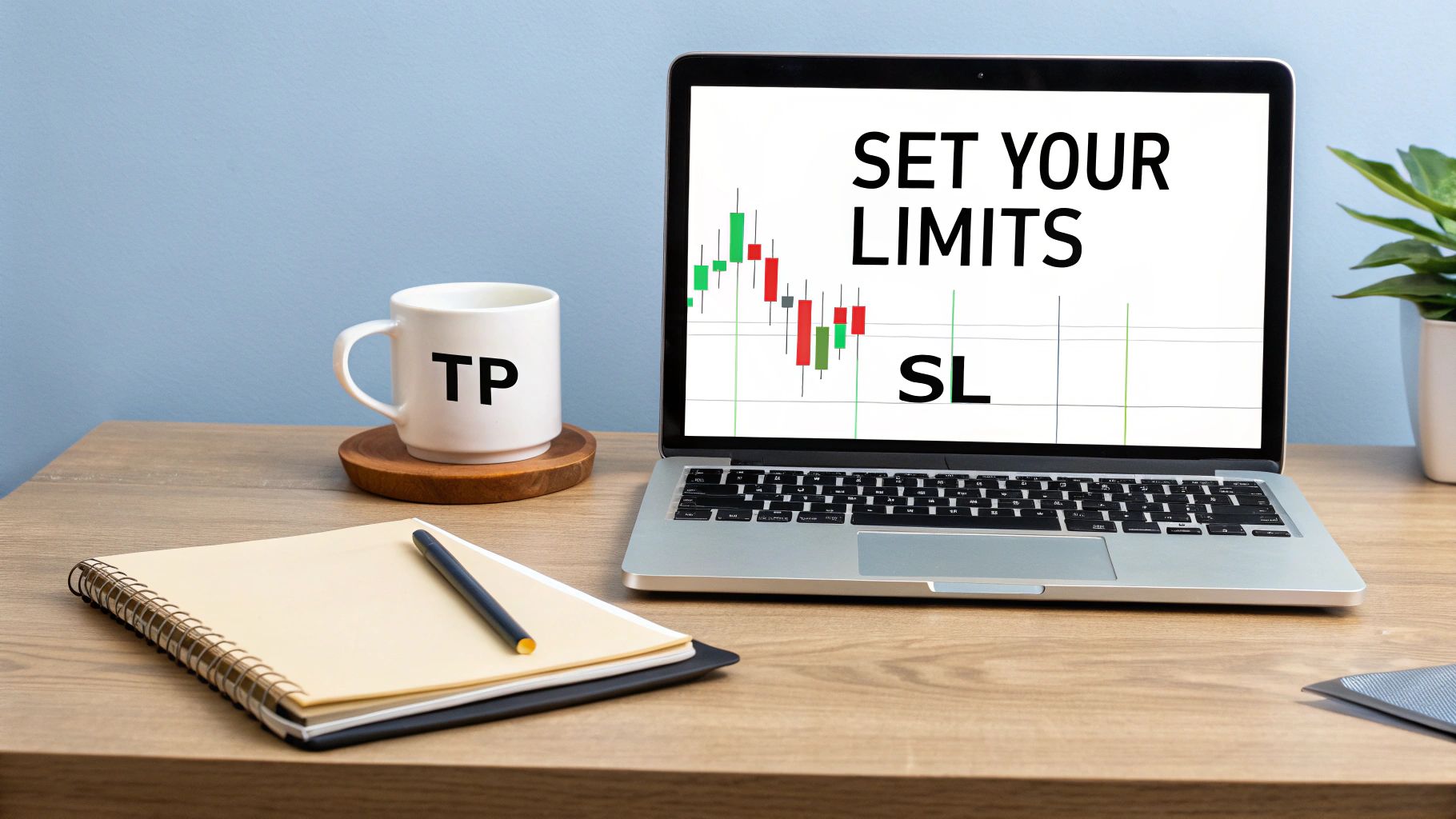
New traders often focus on finding the perfect entry, but professionals know that a solid exit strategy is where you make—and save—your money. A strategically placed take profit and stop loss removes emotion from your decision-making, forcing your original trade plan to play out without interference from fear or greed.
At their core, these two orders are the foundation of risk management. Trading is a game of probabilities, and not every trade will be a winner. Using TP and SL orders makes your strategy sustainable over the long term.
- Stop Loss (SL): This is your safety net. It's a pre-set order that automatically closes your position at a specific price to prevent a small, manageable loss from turning into a devastating one. It's your acknowledgement that the trade idea was wrong.
- Take Profit (TP): This is your predetermined exit point for a winning trade. It automatically closes your position to lock in gains when the price hits your target, preventing a winning trade from reversing back into a loss.
- Enforcing Discipline: When you set your exit points ahead of time, you commit to your plan. This is your defense against the emotional rollercoaster that derails so many traders. It's important to understand that all trading involves substantial risk of loss and is not suitable for every investor.
How Stop Loss and Take Profit Work in Practice
The main job of a TP and SL is to take you out of the equation once a trade is live. When real money is on the line, it's incredibly easy for fear and greed to wreck a well-thought-out strategy.
- Greed is a profit killer. It convinces you to hold a winning trade for "just a little more," only to watch it reverse and turn into a loss. A Take Profit order silences that voice by executing your original plan.
- Fear causes premature exits. It can make you panic and close a trade at the first sign of a normal pullback. A Stop Loss keeps you in the game until your trade idea is actually invalidated by price action.
Imagine trading MES (Micro E-mini S&P 500) futures. You go long at 5000.
- Stop Loss: You place your SL at 4990. This is a 10-point buffer that caps your maximum risk at $50 per contract.
- Take Profit: You set your TP at 5020 to capture a 20-point gain, worth $100.
This simple 2:1 reward-to-risk setup is powerful. Even if you only win 40% of your trades, you can still be profitable over time because your winners are twice as large as your losers. Sticking to them requires mental fortitude. Understanding the psychology of trading discipline is just as important as the technical setup. For a deeper look at the mechanics, check out our complete guide on what a stop loss trade is.
Four Practical Methods to Set Your Exit Points
Knowing you need a take profit and stop loss is easy. The skill is figuring out where to place them. This isn't about finding a magic number; it's a strategic decision based on your trading plan. Let's break down four common and effective methods.
1. The Percentage Method
This is the most straightforward approach. You decide on a fixed percentage away from your entry price for both your stop loss and take profit. A common rule is risking 1% of your capital to aim for a 2% gain.
- How it works: Let's say you buy EUR/USD at 1.0700. A 1% stop loss would be at 1.0593. A 2% take profit order would be at 1.0914.
- Best for: Beginners who want a simple, repeatable rule that can be applied to any asset without complex analysis.
- The catch: This method ignores an asset's unique volatility. A 1% move in crypto is very different from a 1% move in a forex pair.
2. Support and Resistance Levels
This technical approach uses key market structure—support and resistance levels—to find logical places for your orders. These are price zones where buying or selling pressure has historically reversed the trend.
- Stop Loss Placement: If you're buying at a support level, your stop loss should sit just below it. If you're selling at resistance, your stop goes slightly above it. This ensures you're only stopped out if the level truly breaks.
- Take Profit Placement: Your take profit is usually set just before the market reaches the next major support or resistance level, where the price is likely to stall or reverse.
For instance, if you buy BTC/USD at $60,000 (a support zone), you might place your stop loss at $59,400. If you see major resistance at $64,000, setting your take profit at $63,800 is a practical way to cash out before sellers might step in.
3. The Risk-to-Reward Ratio
This method focuses on the relationship between your potential profit and your potential loss. Most experienced traders won't enter a trade unless the risk-to-reward ratio (R:R) is at least 1:2 (risking $1 to make $2).
First, you determine a logical spot for your stop loss (perhaps using support/resistance). Then, you use your desired R:R to calculate your take profit.
Let’s say you buy the US100 index at 18,000 and place your stop loss at 17,950. You're risking 50 points.
- A 1:2 R:R means you need a profit of 100 points. Your take profit would be at 18,100.
- A 1:3 R:R requires a 150-point gain, putting your take profit at 18,150.
This discipline forces you to trade with a positive expectancy, meaning you can be profitable even if your win rate is less than 50%. For a deeper look, see our guide that explains how to calculate your risk-to-reward ratio.
4. Average True Range (ATR)
The ATR indicator brings market volatility into the equation. It measures the average price fluctuation over a set period (typically 14 days), helping you adapt your stops to the current market environment.
A high ATR means the asset is volatile, so you’ll need a wider stop loss to avoid getting shaken out by normal price swings. A low ATR means less volatility, allowing for a tighter stop.
- How it works: Take the current ATR value from your chart and use a multiple of it to set your stop. A common setting is 2x the ATR.
- Example: You trade Gold (XAU/USD) and the 14-day ATR is $15. If you go long at $2,350, a 2x ATR stop loss would be placed at $2,320 ($2,350 – (2 * $15)). This is a more dynamic approach than fixed percentages.
Using Volatility for Smarter Exits
To improve your exit strategy, let the market's own behavior dictate your stop and take profit levels. Volatility-based stops align your risk with an asset's typical price swings, helping you avoid getting knocked out of a good trade by normal market "noise." A quiet stock and a wild cryptocurrency shouldn't be traded with the same generic 1% stop loss.
One of the best tools for this is standard deviation (SD), which measures how spread out prices are from their average. High SD means high volatility; low SD means prices are calm.
A Practical Step-by-Step Example
Let's say a stock has an average price of $26.10 and a calculated standard deviation of $0.21. You can use multiples of this SD to set your exits based on your risk tolerance.
-
Conservative (1x SD):
- Stop Loss: $26.10 – (1 * $0.21) = $25.89
- Take Profit: $26.10 + (1 * $0.21) = $26.31
- This is a tight stop, best for quick scalps.
-
Moderate (2x SD):
- Stop Loss: $26.10 – (2 * $0.21) = $25.68
- Take Profit: $26.10 + (2 * $0.21) = $26.52
- A balanced approach that gives the trade more room to develop.
-
Aggressive (3x SD):
- Stop Loss: $26.10 – (3 * $0.21) = $25.47
- Take Profit: $26.10 + (3 * $0.21) = $26.73
- This wider stop is better suited for swing trading or volatile moves.
Using a statistical measure like standard deviation creates a systematic framework for risk management. It removes emotion and ensures every trade has a mathematically sound exit plan—a crucial skill for succeeding with a prop firm.
Advanced Tactics: Trailing Stops and Partial Profits
Once you've mastered basic TP and SL orders, you can use more dynamic tactics to maximize winners and cut risk.
What is a Trailing Stop?
A trailing stop is a dynamic stop loss that follows your profitable trade. It "trails" the current price by a fixed number of points or a percentage. As your trade moves deeper into profit, the trailing stop moves with it, locking in gains. If the price reverses, the stop triggers, and you exit with the secured profit. This is an excellent tool for letting your winners run during strong trends.
The Power of Taking Partial Profits
This technique involves closing a piece of your position at an initial target, then letting the rest run. It's a hybrid strategy that lets you bank guaranteed profit while still aiming for a bigger win.
Here’s a simple process:
- Define your first profit target (TP1).
- When TP1 is reached, close 50% of your position. You've now paid yourself.
- Move the stop loss on your remaining position to your entry price. This is now a risk-free trade.
You’ve locked in a win, protected your capital, and have a "free ride" to see if the market pushes to a second, more ambitious target (TP2). Stop-loss strategies are proven tools for preventing catastrophic losses. Research analyzing T-Bond data showed a simple stop-loss strategy significantly outperformed buy-and-hold, especially in volatile markets. You can review the full actuarial research on investment returns to see the data.
Playing by Prop Firm Rules
For prop firm traders, mastering take profit and stop loss isn't just good practice—it's essential for survival. Your number one job is to manage risk and stay within the firm's drawdown limits. Your stop loss is the single most important tool for this.
Prop firms have strict rules on daily and maximum drawdown. For example, on a $100,000 account with a 5% daily drawdown limit, your equity cannot drop by more than $5,000 in one day.
Your stop loss is your shield. Before entering a trade, you must know exactly how much money you will lose if that trade hits your stop. That number must be a small fraction of your daily drawdown limit. For more details, you can learn more about how trailing drawdown works.
Your Pre-Trade Checklist
Before entering any trade, run through this mental checklist to ensure you are aligned with prop firm rules.
- Define Max Risk: What is 1% of my account? (e.g., $500 on a $50k account). This is my maximum loss per trade.
- Identify Invalidation Level: Where on the chart is my trade idea proven wrong? This is my stop loss price.
- Calculate Stop Distance: How many pips or points are between my entry and my stop?
- Determine Position Size: Use a position size calculator to ensure my dollar risk matches my defined max risk.
- Set the Take Profit: Is my target realistic? Does it give me at least a 1:2 risk-to-reward ratio?
- Final Sanity Check: If this trade hits my stop, will I still be comfortably below the daily drawdown limit?
Following this process turns trading from a gamble into a professional operation where risk is obsessively managed.
FAQ: Common Take Profit and Stop Loss Questions
Here are answers to some of the most common questions beginner and intermediate traders have about setting their exits.
Should I ever move my stop loss?
The disciplined answer is: only in one direction. It is acceptable to move your stop loss to your entry point (breakeven) or to trail it behind a winning trade to lock in profits. However, you should never move your stop loss further away from your entry price to give a losing trade more room. This is called "widening your stop" and is one of the fastest ways to blow up an account.
What is a good risk-to-reward ratio?
A widely accepted baseline for a good risk-to-reward ratio is 1:2, meaning your potential profit is at least twice your potential risk. Some strategies may work with a lower ratio if they have a very high win rate, but aiming for 1:2 or higher (like 1:3) builds a mathematical edge into your trading, allowing you to be profitable even if you don't win every trade.
What happens if a quick price spike hits my stop loss?
This is known as getting "wicked out," and it's a common frustration. If the price momentarily touches your stop loss level, even for a split second, your order will be executed. To avoid this, many traders place their stop loss slightly beyond a key support or resistance level, creating a small buffer against normal market noise and sudden volatility.
At MyFundedCapital, we know that disciplined risk management using tools like take profit and stop loss is what defines a successful trader. Our funding programs are designed to reward traders who can manage risk effectively and consistently.
Ready to prove your risk management skills? Compare our funding programs and find the account that best fits your trading strategy.
