Identifying the world's weakest currency might seem like a niche interest, but for a forex trader, it offers a raw look at how powerful economic and political forces can impact a nation's money. This guide explains what makes a currency collapse, which currencies are currently the weakest, and how to approach these highly volatile assets with a practical, risk-managed trading plan. Trading currencies in freefall is high-risk and not suitable for everyone; this content is for educational purposes only and not financial advice.
What Causes a Currency to Become the Weakest in the World?
A weak currency is one that has cratered in value against a global benchmark like the U.S. Dollar, signaling a profound loss of confidence. Spotting these currencies isn’t about finding a cheap buy; it’s about recognizing the extreme fundamental factors driving the market. A currency’s value doesn’t fall by accident; it's usually pushed off a cliff by a toxic mix of economic and political disasters.
Key Drivers of Currency Collapse
- Hyperinflation When a government prints money excessively to pay its debts, it floods the market. The currency becomes so plentiful that it's worth less and less, causing the price of everyday goods to explode and making savings worthless.
- Economic Mismanagement Years of bad policy, runaway government debt, and a failure to build a resilient, diverse economy will eventually catch up. A country can't sustain its currency's value without a solid economic foundation.
- Political Instability and Conflict War, civil unrest, or crippling international sanctions scare away investors, halt production, and shatter any remaining faith in the country's leadership and its currency.
- Depleted Foreign Reserves Countries need a stash of strong foreign currency (like the U.S. Dollar) to pay for imports and defend their own currency's value. When that fund runs dry, there’s nothing left to stop a total collapse.
Current Contenders for the Weakest Currency
While the list can change based on global events, several currencies consistently rank among the weakest due to deep-seated issues. As of late 2024, the Lebanese Pound (LBP) is a prime example, having lost over 99% of its value since 2019 due to a catastrophic banking crisis, political gridlock, and devastating hyperinflation.
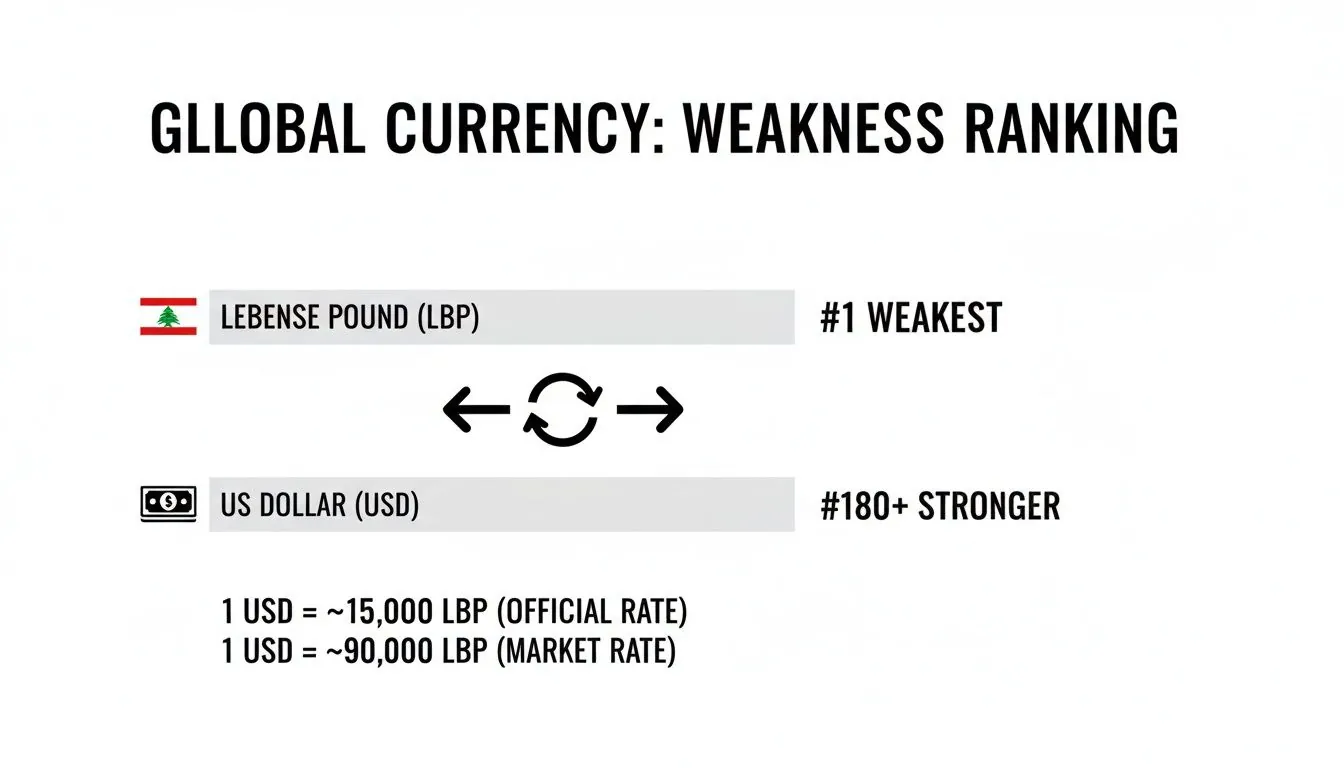
Other currencies facing extreme devaluation include the Iranian Rial (IRR), Venezuelan Bolívar (VES), and Sierra Leonean Leone (SLL).
Top 5 Weakest Currencies vs the US Dollar
This table provides a snapshot of the world's most devalued currencies and the core issues driving their weakness. Note that rates, especially black-market ones, fluctuate wildly.
| Currency (Code) | Country | Approximate Rate per 1 USD | Primary Driver of Weakness |
|---|---|---|---|
| Lebanese Pound (LBP) | Lebanon | ~89,000 LBP | Banking crisis, hyperinflation, political paralysis |
| Iranian Rial (IRR) | Iran | ~42,000 IRR (official) | International sanctions, economic isolation, inflation |
| Venezuelan Bolívar (VES) | Venezuela | ~36 VES (post-redenomination) | Hyperinflation, political crisis, economic collapse |
| Sierra Leonean Leone (SLL) | Sierra Leone | ~22,500 SLL | High inflation, economic struggles post-civil war |
| Vietnamese Dong (VND) | Vietnam | ~25,400 VND | State-controlled economy, historical devaluation |
An exchange rate gives you a static photo, but a real-time currency strength meter is an essential tool for traders, showing how different currencies are performing against each other at a glance. It helps you instantly spot which currencies are gaining ground and which are in a nosedive.
Analyzing the Top Contenders for Weakest Currency

To understand trading opportunities, you need to go beyond the numbers and analyze the story behind each currency's decline. For a trader, recognizing the recurring patterns of sanctions, hyperinflation, and political chaos is key to building a solid trading thesis.
The Iranian Rial (IRR): A Story of Sanctions and Isolation
The Iranian Rial's weakness is a textbook case of how international isolation can suffocate a currency. Decades of economic sanctions, primarily from the U.S., have largely cut Iran off from the global financial system.
- Impact of Sanctions Sanctions block exports (like oil), restrict imports, and trigger massive capital flight as investors pull their money out. This chokes off the country's supply of foreign currency and causes the local currency to plummet.
- Dual Exchange Rates The relentless pressure created a huge gap between the official government exchange rate and the black-market rate, where the Rial’s true, much lower, value is found. For traders, this is a critical reminder that official numbers in crisis-hit economies rarely tell the full story.
The Rial's decline has been exacerbated by severe inflation, often above 40%, and internal turmoil. You can find a deeper dive into these dynamics in the top 20 weakest currencies analysis from CurrencyTransfer.com.
The Venezuelan Bolívar (VES): A Case of Hyperinflation
The Venezuelan Bolívar is one of modern history's most shocking examples of hyperinflation. Once the currency of a prosperous, oil-rich nation, the Bolívar is now a poster child for economic meltdown driven by over-reliance on a single commodity and catastrophic mismanagement.
- The Trigger When global oil prices cratered in 2014, Venezuela’s main revenue stream dried up. Instead of making tough reforms, the government fired up the printing presses to cover its budget deficits, sparking hyperinflation.
- Redenominations The government has repeatedly re-denominated the currency by lopping off zeros—a staggering 14 zeros in total since 2008. However, these were accounting tricks that did nothing to fix the underlying economic rot.
The lesson for traders is clear: a currency’s value is built on real economic health, not on how many zeros are on the bill. Without sound policy and stability, even a resource-rich nation's currency can be driven into the ground.
How to Trade the World’s Weakest Currencies
Let's be clear: trading a currency in freefall is a high-risk activity that is completely different from trading stable major pairs. The rules of engagement are different, and approaching these markets requires extreme caution and a specialized plan. This type of trading involves a significant risk of loss and is not suitable for all investors.
Key Differences: Major vs. Weak Currency Pairs
Thinking a USD/LBP trade will behave like a EUR/USD trade is a critical mistake. The trading characteristics are fundamentally opposed.
| Characteristic | Major Pairs (e.g., EUR/USD) | Weak Currency Pairs (e.g., USD/VND) |
|---|---|---|
| Liquidity | Very High | Low to Very Low |
| Spreads | Very Tight (e.g., under 1 pip) | Very Wide (can be 50+ pips) |
| Volatility | Moderate to High | Extreme and Erratic |
| Primary Drivers | Economic Data, Central Bank Policy | Geopolitics, Crises, Sanctions |
| Availability | Universal on All Platforms | Limited or Not Offered |
| Execution Risk | Low (Minimal Slippage) | High (Significant Slippage) |
The wider spreads and lower liquidity mean your transaction costs are higher and getting into or out of a trade at your desired price can be difficult.
Building a Trading Plan for Extreme Volatility
A generic plan won't cut it. Your strategy must be built around fundamental drivers and long-term trends, as short-term chart noise can be misleading.
- Focus on Fundamentals: The fate of a weak currency rests on its country’s political and economic chaos. Monitor geopolitical news, central bank actions (or inaction), and inflation reports. These are the real catalysts that drive major moves.
- Use Higher Timeframes: Technical analysis is still useful, but you should focus on daily and weekly charts. This helps you identify the dominant, long-term downtrend and filters out chaotic daily noise.
- Choose Pairs Carefully: Not every weak currency is tradable. Focus on pairs where the weak currency is quoted against a strong, stable one, like the US Dollar (USD). Pairs such as USD/VND might be available, but you must check if your broker offers them. Many, like the Lebanese Pound (LBP), are often unavailable for retail CFD trading due to extreme risk.
- Trade with a Clear Thesis: Never enter a trade on a whim. Have a strong, simple reason based on your fundamental research. For example: "I am shorting the Venezuelan Bolívar because hyperinflation is accelerating with no signs of political reform, which I believe will lead to continued devaluation against the USD." This keeps you disciplined.
Smart Risk Management for Volatile Pairs
The wild swings of exotic pairs are tempting, but that volatility is a double-edged sword. Without an iron-clad risk management plan, you are simply gambling. In these markets, protecting your capital is your first and most important job.
Step 1: Adjust Position Size for Volatility
The biggest mistake traders make with volatile pairs is using the same position size as they would for a stable major. This is a fatal error. The massive price swings of a weak currency demand a much smaller position size.
To account for the high volatility, you need to use a wider stop-loss to avoid being stopped out by normal market noise. To accommodate that wider stop while keeping your risk per trade constant, your position size must shrink.
Example:
Imagine you’re risking 1% on a $100,000 account, which is $1,000 per trade.
- On EUR/USD, a 20-pip stop-loss might be reasonable. This allows for a position size of 5 lots ($1,000 risk / (20 pips * $10/pip/lot)).
- On a volatile exotic pair, you might need a 200-pip stop. To keep your risk at the same $1,000, your position size must drop to just 0.5 lots ($1,000 risk / (200 pips * $10/pip/lot)).
This simple math is the key to surviving the turbulence.
Step 2: Diversify and Manage Costs
Never bet the farm on a single volatile trade. Tying up your entire risk budget in one unpredictable currency is a recipe for disaster. A sudden political announcement could cause the price to gap hundreds of pips against you. Instead, treat it as one small, calculated position within a larger portfolio. Exploring different forex risk management strategies can provide a framework for building this resilience.
Finally, keep an eye on costs. Exotic pairs almost always have wider spreads, and transaction fees can be significant. It’s worth learning how to avoid currency conversion fees where possible. Platforms like DXtrade and cTrader offer advanced tools for analyzing these costs, while some traders use external asset conversion platforms for broader asset management.
Trading Exotic Pairs with Our Funding Programs
To trade the world’s weakest currencies, you need a disciplined approach. At MyFundedCapital, our rules, such as the 5% daily loss limit and 10% maximum drawdown, are designed to act as guardrails, ensuring that one bad trade on a volatile pair doesn't end your trading journey.
We give our traders access to over 350+ instruments, including a range of exotic pairs, on both the DXtrade and cTrader platforms.
Checklist for Trading Exotic Pairs on Your Platform
- Use Advanced Charting Start your analysis on higher timeframes (daily, weekly) to spot the dominant, long-term trend.
- Use All Order Types Get comfortable using limit and stop orders to define your entry and exit points with precision. This is how you manage risk instead of letting the market manage you.
- Check Instrument Availability Double-check that the specific pair you want to trade is actually available. Due to low liquidity, you won’t find the most extreme pairs on every platform.
Using Our Add-Ons to Sharpen Your Edge
Trading weak currencies is often about trading the news. For traders in our Challenge or Instant Funding programs, our optional add-ons can be game-changers.
- News Trading Add-On This is crucial. It lets you hold positions during high-impact news events. For a weak currency, a single government announcement can cause massive volatility, and this add-on gives you the freedom to trade those fundamental drivers.
- Weekend Holding Add-On Geopolitical risk doesn't stop on Friday. This add-on lets you hold positions over the weekend, which is vital if you're anticipating a major event that could cause a price gap at the market open.
By combining powerful platforms with these strategic add-ons, you can bring a disciplined, professional approach to these complex markets. Our funded forex trading accounts are set up to support traders who take their craft seriously.
Frequently Asked Questions
What is the difference between official and black-market exchange rates?
The official rate is the exchange rate published by a country's government. In a crisis, this rate is often artificially high and doesn't reflect reality. The black-market (or parallel) rate is what people are actually paying on the street to exchange currency. It's driven by real-world supply and demand and is a much more accurate indicator of a currency's true, devalued worth.
Can a weak currency ever be good for an economy?
In a stable economy, a controlled, gradual weakening of a currency can make a country's exports cheaper and boost tourism. However, it also makes imports more expensive, which can fuel inflation. For the world's weakest currencies, any theoretical export benefit is completely wiped out by hyperinflation, political chaos, and economic collapse. The negatives don't just outweigh the positives; they crush them.
Why can't I find some weak currencies on my trading platform?
Brokers often don't list currencies like the Lebanese Pound or Venezuelan Bolívar due to extreme risk and a near-total lack of liquidity. With not enough buyers and sellers, it's impossible to create a functioning market. The spreads would be massive, slippage would be uncontrollable, and executing trades reliably would be a minefield for both the trader and the brokerage. Therefore, platforms stick to pairs that, despite any volatility, still have a fundamental level of tradability.
Ready to apply what you've learned with a supportive prop firm? MyFundedCapital offers the tools and transparent rules you need to trade a wide range of instruments, including many exotic pairs.
Start your trading journey and explore our funding programs today.