ES
ES
 DE
DE
 FR
FR
 AR
AR
 IT
IT
 NL
NL
 PL
PL
 SV
SV

Before algorithms took over, trading was a raw, physical, and chaotic art form known as open-outcry trading. While the physical pits are now mostly silent, understanding the skills required to survive in them can give you a real edge in today's digital markets. This guide breaks down those timeless lessons and shows you how to apply them to your own screen-based trading.
While the physical pits are now mostly silent relics of the past, the core principles forged within them are more relevant than ever for today's traders. Trading involves a substantial risk of loss, and this content is for educational purposes only, not financial advice.
What Was Trading in the Pit and Why It Still Matters
Trading in the pit was the dominant method for executing futures and options contracts for more than 100 years. Picture a room packed with hundreds of traders, each wearing a distinctly colored jacket to identify their firm, all screaming orders and using a complex language of hand signals to communicate bids and offers.
This wasn't just a marketplace; it was a living, breathing embodiment of supply and demand. You could literally see and feel the order flow as it surged and ebbed around you.
Success in that environment wasn't just about having the loudest voice. It demanded a unique combination of skills. Traders had to process a firehose of information in real-time, read the collective mood of the crowd, and execute with unshakable discipline. A moment of hesitation could—and often did—result in a massive financial loss.
The Timeless Principles of Pit Trading
The hard-won lessons from that high-pressure crucible translate directly to modern, screen-based trading. The fundamental challenges are identical: you still have to interpret market data, manage your risk, and master your own psychology. The tools have changed, but the game remains the same.
-
Reading the Market: A pit trader's edge came from watching other traders, not just staring at a price ticker. They learned to sense fear and greed from the tone of the crowd and the urgency in their gestures. Today, we use tools like Level 2 data and volume profiles to get a similar, albeit digital, view of that underlying order flow.
-
Risk Management: In the pit, risk was tangible and immediate. A bad trade meant instant, visible losses, often confirmed by an out-trade slip in your hand moments later. This environment forced a brutal discipline; you learned to cut your losses without a second thought. This is the exact skill needed to navigate the strict drawdown rules of modern prop firm challenges.
-
Psychological Fortitude: The pit was a relentless test of mental and emotional resilience. To survive and thrive, you had to stay calm under immense pressure and make rational decisions in the middle of pure chaos.
This chart breaks down the three pillars of trading that every successful pit trader had to master simply to survive.
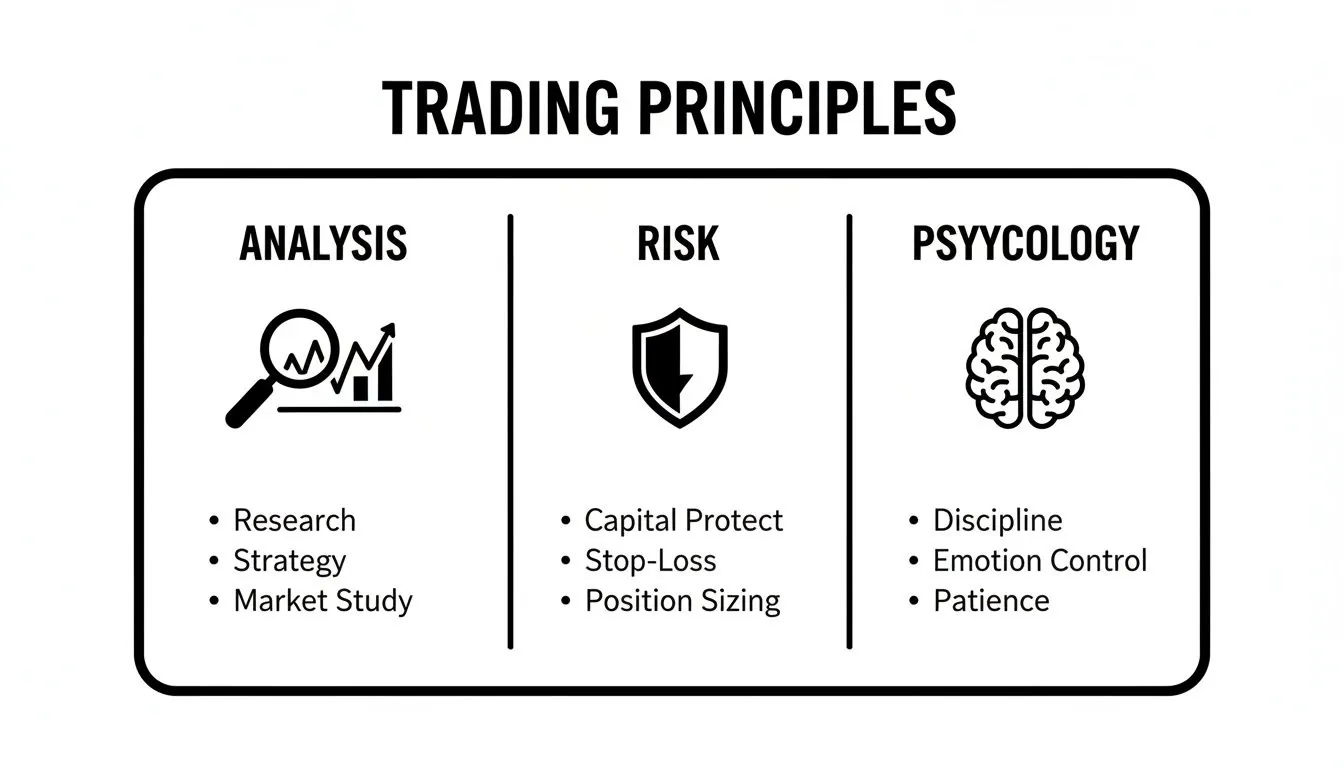
As you can see, analysis, risk, and psychology are deeply interconnected. Mastering one without the others is a recipe for failure. Throughout this guide, we'll dig into how you can apply these old-school, time-tested principles to find your edge in the modern market.
From Shouts to Clicks: The Evolution of Modern Markets
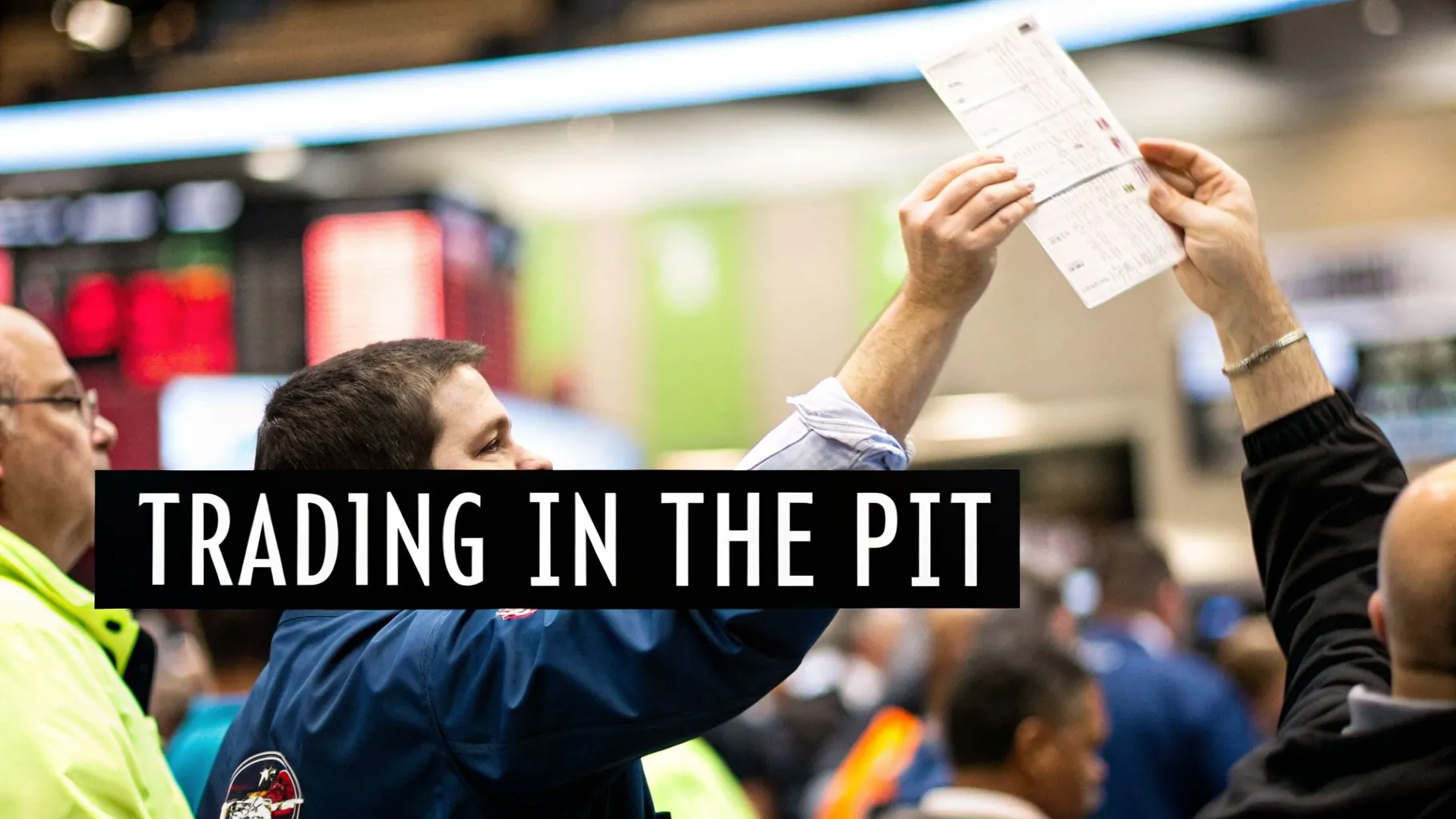
The deafening roar of the open-outcry trading pits didn't just fade away overnight. It was a gradual, decades-long shift, where the frantic energy of the floor was slowly but surely replaced by the quiet efficiency of the digital network. While the pits hit their peak of chaos and activity in the 1980s and 90s, the technology that would eventually make them obsolete was already taking shape.
It all started with simple growing pains. As markets became more global and complex, the physical nature of the pit itself became a huge bottleneck. There was a hard limit to how many orders could be screamed across the floor and how fast information could travel beyond its walls.
The Dawn of Electronic Trading
The real game-changer arrived in 1992 with the launch of the CME's Globex system. Initially, it was just meant for trading after the pits closed for the day. But it did something revolutionary: it proved that a screen-based market wasn't just a novelty, but a powerful and potentially better way to trade.
The move away from the pits was fueled by a few undeniable advantages:
- Speed Electronic systems could match orders in microseconds—a speed no human could ever hope to achieve. As trading volumes exploded, this became a non-negotiable advantage.
- Cost Running a physical trading floor with all its staff and infrastructure is incredibly expensive. Digital trading slashed those overhead costs.
- Access Suddenly, you didn't need to be in Chicago or New York. Traders from anywhere in the world could connect directly to the markets, blowing the doors wide open for global participation.
This new technological arms race completely reshaped how markets worked. The focus shifted from a trader's "gut feel" on the floor to a new reliance on advanced trading analytics to find an edge in the data stream.
Why the Floor Became a Relic
As electronic platforms grew more powerful and reliable, they began to eat into the pit's daytime trading volume. By the early 2000s, a huge chunk of futures trading had already migrated to the screen. The financial crisis of 2008 was the final nail in the coffin, forcing firms to find every possible efficiency and pushing the rapid growth of algorithmic trading.
The core function of a market is to facilitate transactions efficiently. Once technology provided a more efficient method, the economic argument for maintaining costly physical trading floors disappeared.
The final chapter for most trading pits was written in 2015. That's when giants like the CME Group and Cboe announced they were closing the vast majority of their futures and options pits for good. While a few iconic options pits still operate, their volume is just a shadow of what it once was. This wasn't just a simple tech upgrade; it fundamentally changed how market information is generated and interpreted.
Translating Lost Floor Trader Skills for Today's Markets
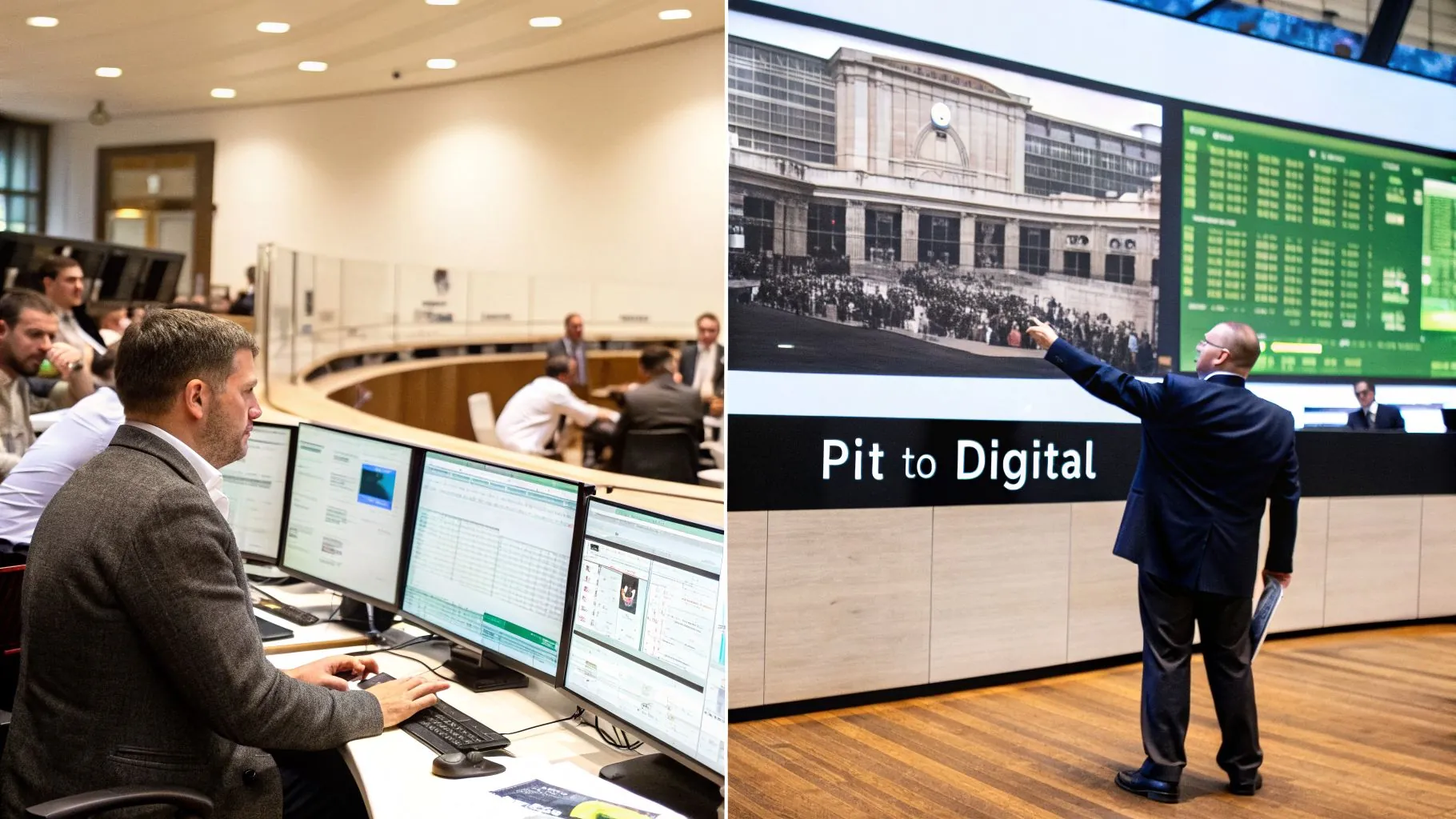
The secret sauce of an old-school pit trader wasn't some mystical ability. It was the skill of processing information that never appeared on a screen. They developed a sixth sense by watching the crowd, hearing the roar, and seeing the subtle tells of fear, greed, or the heavy hand of an institution placing a massive bet.
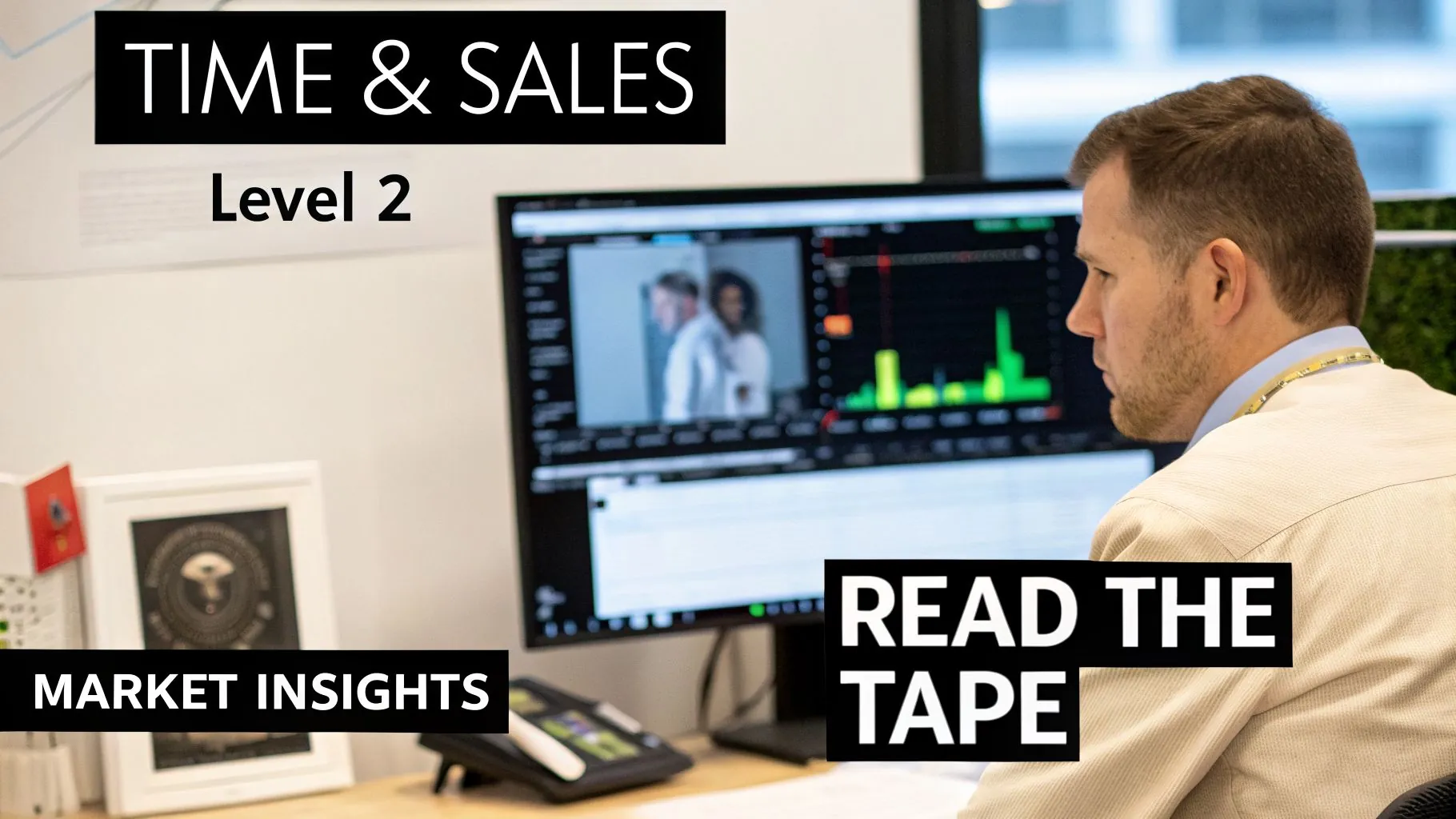
While we've lost that physical arena, the fundamental skill they mastered—reading order flow—is actually more transparent now than ever before. The trick is learning to translate those human cues into the digital footprints on your monitor. Instead of seeing a rival broker start to sweat, you're watching the Time & Sales tape accelerate.
Reading the Tape Like a Pit Trader
The closest you can get to the pit's raw, chaotic energy today is the Time & Sales window, affectionately known as "the tape." This is a real-time, streaming log of every single trade executed in the market. What a floor trader saw as a storm of hand signals, you see as a scrolling list of prices and quantities.
A pit trader’s edge wasn’t just knowing the price, but seeing who was bidding and how aggressively. Modern tape reading aims to achieve the same goal by analyzing the speed, size, and location of trades.
Keep an eye out for these tell-tale signs on the tape:
- Pace and Speed When the tape suddenly starts flying by but the price barely budges, it can be a huge clue. This often signals a big institution quietly absorbing every share or contract offered at a specific level.
- Large Block Trades Although big players often try to hide their size, you'll sometimes see unusually large prints hit the tape one after another. That's the footprint of a serious player making their move.
- Repetitive Small Orders See a constant stream of identical, small-lot trades hitting the market? That could easily be an algorithm stealthily working a much larger order, trying to fly under the radar.
This isn't about rote memorization. It’s about building a feel for the market's normal rhythm. Once you know what "normal" looks like, you'll instantly spot when something is off.
Using Level 2 Data to See Supply and Demand
If the tape shows you what just happened, the Level 2 order book (or Depth of Market) shows you what might be about to happen. It's a snapshot of all the live buy and sell orders waiting at different price levels. For a floor trader, this was like looking at the entire crowd of buyers and sellers, all jostling for position.
Here's how to start reading Level 2:
- Large Resting Orders (Icebergs) You might spot a massive stack of bids sitting right at a known support level. These can act like a brick wall, absorbing selling pressure. But be careful—these "iceberg" orders can be pulled in a flash, a deceptive tactic known as "spoofing."
- Order Book Imbalance A lopsided book, like 500 contracts offered for sale versus only 50 bids to buy, screams intent. But context is crucial. Sometimes, the market defies expectations and chews right through the heavy side to absorb that liquidity.
The real power comes from using the tape and Level 2 together. You can see the intent in the order book, then watch the tape to confirm if those orders are actually getting hit. For example, if you see a huge sell wall on Level 2, but the tape is a constant stream of green (buy-at-ask) prints chipping away at it, that's a powerful sign that buyers are in control.
Mastering the Psychology Forged in the Pit
The trading pit wasn’t just a market—it was a crucible. It was a chaotic, physical, and intensely psychological environment that demanded a certain kind of mental fortitude. While today’s screen-based trading feels like a world away, the core psychological lessons from the pit are more relevant than ever.
In that raw, face-to-face arena, traders had to make split-second decisions under immense pressure, keep their emotions in check, and, most importantly, cut a losing trade without a moment's hesitation. These weren't just "best practices"; they were absolute survival skills. Adopting these same traits can make a significant difference in managing your account and navigating modern markets.
Developing Iron-Clad Discipline
On the trading floor, there was no time for second-guessing or getting emotionally attached to a position. A bad trade was a fact you had to accept immediately. This environment forced the habit of instantaneous loss recognition—a skill that directly translates to succeeding within today's prop firm rules, like sticking to a 5% daily drawdown.
For a pit trader, holding a loser wasn't just poor risk management. It was a public signal that you couldn't handle the pressure. Cutting losses fast wasn't just a strategy; it was second nature.
This is all about separating your ego from your P&L. A loss isn’t a personal failing; it's simply the cost of doing business in the markets. The goal for any modern trader is to build that same reflex: when a trade setup is invalidated, you get out. Period. To dig deeper into this, you can check out our guide on developing a trading mindset.
Understanding and Acting on Crowd Behavior
Pit traders were experts in reading crowd psychology because they were literally swimming in it every single day. They could feel the mood of the market shift from calm to panicked, or from cautious to greedy, creating powerful trading opportunities.
This unique vantage point gave them two main ways to play the market:
- Fade the Extremes When they felt the crowd tipping into irrational panic or euphoria, they could step in and confidently take the other side. They became the voice of reason when everyone else was shouting.
- Ride the Momentum On the other hand, when they saw a real, powerful trend backed by heavy institutional buying or selling, they knew how to jump aboard and ride the wave. The roar of the crowd was their confirmation.
Today, you may not hear the physical roar, but you can see its digital footprint everywhere—in the order flow, in sudden volume spikes, and in the sheer velocity of price action. Learning to spot these patterns gives you the same edge, whether you're fading an exhausted move or joining a powerful trend.
Applying Pit Trader Discipline to Prop Firm Rules
The lessons forged in the chaos of the trading pits offer a direct blueprint for any trader looking to pass a modern prop firm challenge. The setting has changed, but the fundamental test is identical: can you consistently execute a profitable strategy while managing risk like your career depends on it?
A floor trader’s risk was policed by the immediate threat of financial ruin. In a prop firm evaluation, that same intense pressure is replicated by hard rules, like a 5% daily drawdown or a 10% maximum drawdown.
A pit trader who couldn’t control their losses wouldn't last a week on the floor. Similarly, a prop firm trader who consistently breaches drawdown limits demonstrates a lack of the professional discipline required for funding. The rules are the new 'crowd' keeping you accountable.
From Pit Edge to Prop Firm Strategy
But it wasn't just about avoiding ruin; a successful floor trader had a repeatable edge they could execute day in and day out. They weren’t gambling—they were reacting to order flow and market sentiment with a method that worked. Your job in a funding challenge is to do the very same thing.
-
Define Your Edge: A pit trader had a specialty, whether it was a specific commodity or a particular tactic. You need to have a well-defined strategy with a known statistical advantage. This means knowing your precise entry signals, profit targets, and stop-loss levels before you even think about clicking the mouse.
-
Execute with Consistency: An evaluation is designed to see if you are consistent, not to see if you can hit one massive home run. A pit trader survived by grinding out a steady stream of small, manageable wins. You should focus on executing your A+ setups and have the discipline to sit on your hands when a trade falls outside your plan.
-
Risk Per Trade: A floor trader knew their risk on every single position, almost instinctively. You must apply that same thinking by calculating your position size based on your stop-loss, making sure no single trade can cause catastrophic damage. A standard professional guideline is to risk no more than 1% of your account per trade.
Passing a prop firm challenge has less to do with finding a "secret" strategy and everything to do with proving you have the unwavering discipline of a professional. The unbreakable focus on risk required to survive in the pit is the very same key that will unlock your funding.
Frequently Asked Questions
Are there any open-outcry trading pits left?
A handful still exist, but they're largely symbolic. You might find traders in the options pits for certain indexes at exchanges like the Cboe, but their market impact is a whisper compared to the roar of electronic counterparts. For FX, crypto, and the vast majority of futures, the open-outcry era is over.
Can I learn to trade like a pit trader?
You can't recreate the physical chaos, but you can absolutely master the underlying skills. It’s about seeing the market through a different lens by becoming an expert in order flow (using Level 2 and Time & Sales), embracing ruthless risk discipline, and developing a "feel" for market dynamics by analyzing volume and price action.
Was pit trading fairer than electronic trading?
That's debatable. The pit had issues like "dual trading," where brokers could prioritize their own trades. However, many felt there was an honesty to face-to-face dealing. Electronic markets brought incredible access but also new issues like certain high-frequency trading (HFT) strategies. Neither system is perfect, but electronic trading has made markets more efficient and accessible for the average person. Remember, all trading involves risk.
The trading pits may be silent, but their lessons on discipline, risk management, and market psychology are more valuable than ever. Ready to apply these principles and prove your skills?
Explore our funding programs and start your challenge today.