Confused by terms like margin, leverage, and equity? You're not alone. This guide breaks down the trade margin definition into simple, practical terms, showing you how it works and how to manage it to avoid blowing up your account.
Free resources: Forex & Prop Trading Glossary (drawdown, breach, lot, pip and the rest in plain words).
What Is Trade Margin and How Does It Work?
Trade margin is the amount of your own money you need to put up as collateral to open a leveraged position. It's not a fee or a cost; think of it as a good-faith deposit that your broker holds while your trade is open. Once you close the position, the margin is returned to your account, adjusted for any profit or loss.
Margin is what makes leverage possible. For example, with 100:1 leverage, you can control a $100,000 position with just $1,000 of your capital. That $1,000 is your required margin.
- The Power Margin allows you to access larger positions than your capital would normally allow.
- The Risk Leverage is a double-edged sword. It amplifies both your potential profits and your potential losses. A small market move against you can wipe out your margin and lead to significant losses.
Disclaimer: Trading involves a significant risk of loss and is not suitable for all investors. This content is for educational purposes only and is not financial advice.
Key Margin Terms You Must Know
To manage risk effectively, you need to understand the key metrics on your trading platform.
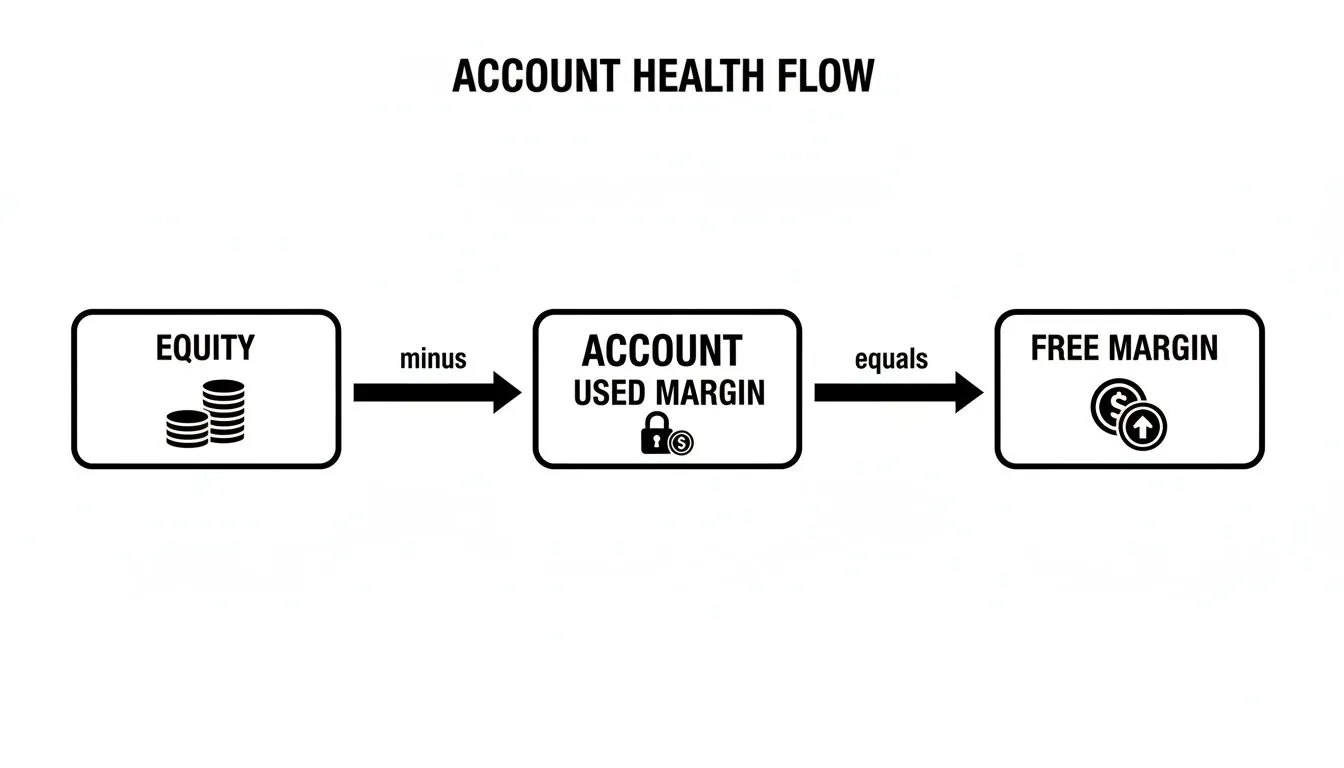
- Equity The real-time value of your account. It's your balance plus or minus any floating profits or losses from open trades.
- Used Margin The total amount of your equity that is currently locked up to maintain all your open positions.
- Free Margin The money left in your account that is available to open new trades or absorb losses. It's calculated as Equity – Used Margin.
- Margin Level This is the most critical indicator of your account's health. It shows you how close you are to a margin call.
The formula is:
Margin Level % = (Equity / Used Margin) x 100
A high margin level means you have a healthy cushion. A low level means you're in the danger zone.
Practical Example:
- You have $5,000 in Equity and $1,000 in Used Margin.
- Your Margin Level is ($5,000 / $1,000) x 100 = 500%. This is a safe buffer.
Now, let's say your trade goes against you, and your Equity drops to $1,500.
- Your Margin Level is now ($1,500 / $1,000) x 100 = 150%.
- Your account is now at high risk. If it drops to your broker's threshold (often 100%), you will face a margin call.
How to Calculate Required Trade Margin
Before entering any trade, you must calculate the required margin to ensure you're not over-leveraging your account. The calculation is straightforward and depends on the asset's price, the size of your trade, and your broker's leverage.
The formula is:
Required Margin = (Market Price x Trade Size) / Leverage
Let's look at some concrete examples.
Calculating Margin for Different Instruments
1. Forex Example: EUR/USD
You want to trade 1 standard lot (100,000 units) of EUR/USD at a price of 1.0800 with 100:1 leverage.
- Calculation (1.0800 x 100,000) / 100 = $1,080
- Result You need $1,080 of your capital as required margin for this trade.
2. Index CFD Example: US30
You plan to trade 10 contracts of the US30 at a price of 39,000 with 200:1 leverage.
- Calculation (39,000 x 10) / 200 = $1,950
- Result This position would require $1,950 of used margin.
For a deeper dive, check out our guide on how to calculate Forex margin.
3. Crypto Example: BTC/USD
You want to buy 0.5 BTC at $68,000 with 10:1 leverage (crypto leverage is typically lower).
- Calculation (68,000 x 0.5) / 10 = $3,400
- Result This trade would lock up $3,400 of your equity as margin.
Mastering this simple calculation is essential for planning your trades and managing your overall risk exposure.
What is a Margin Call?

A margin call is an alert from your broker when your account equity falls so low that your margin level hits a critical threshold (e.g., 100%). It’s a demand to either deposit more funds to increase your equity or close some positions to reduce your used margin.
If you fail to act and your margin level continues to drop, the broker will trigger a stop out. This means they will automatically start closing your positions (usually the most unprofitable ones first) to prevent you from losing more money than you have in your account.
How an Account Blows Up: A Step-by-Step Example
- Setup You have a $2,000 account and open a trade requiring $1,500 in Used Margin. Your initial Margin Level is ($2,000 / $1,500) x 100 = 133%, which is already risky.
- Market Turn The trade moves against you, creating a $500 floating loss. Your Equity drops to $1,500. Your Margin Level is now ($1,500 / $1,500) x 100 = 100%. You get a margin call.
- Stop Out The loss worsens to $1,100, and your Equity is now just $900. Your Margin Level crashes to ($900 / $1,500) x 100 = 60%. If your broker's stop-out level is 70%, they will forcibly liquidate your position, leaving you with only $900 in your account.
This isn't just theory. According to industry data, the amount of money borrowed on margin can reach trillions of dollars globally, highlighting how widespread leveraged trading is. You can monitor these trends on the FINRA website.
Don't let this happen to you. You can use a handy margin call calculator to understand at what price point you might face a margin call.
Practical Strategies for Managing Trade Margin
Effective margin management is about discipline and having a solid plan. It's not about complex strategies, but about following simple, robust rules to protect your capital.
Checklist for Proactive Risk Management
Follow these steps for every trade to stay in control.
- Always Use a Stop-Loss This is non-negotiable. A stop-loss automatically closes your trade at a predetermined price, limiting your loss.
- Follow the 1% Rule Never risk more than 1% of your total account balance on a single trade. If you have a $5,000 account, your maximum loss per trade should be no more than $50.
- Calculate Position Size Correctly Your position size should be based on your risk tolerance and stop-loss placement, not guesswork. Use a lot size calculator to determine the correct size for every trade.
- Don't Overuse Leverage Just because your broker offers 500:1 leverage doesn't mean you should use it. High leverage amplifies losses just as much as gains. Use it wisely to improve capital efficiency, not to gamble.
- Monitor Your Margin Level Keep a constant eye on your margin level. If it drops below 300%, you are likely over-exposed and should consider reducing your risk.
FAQ: Common Questions About Trade Margin
1. What is a good margin level to maintain?
Aim to keep your margin level well above 500% to ensure you have a substantial buffer against market volatility. A level below 200% is a warning sign, and anything near 100% puts you in the immediate danger zone of a margin call.
2. Can I lose more than my initial margin?
Yes. It’s a common misconception that your loss is limited to the margin required for a trade. A sharp market move can wipe out your entire account balance. In extreme cases (like a major market gap), you could even end up with a negative balance, owing money to your broker. This is why stop-losses are critical.
3. Do margin requirements change?
Yes, brokers can increase margin requirements, especially during periods of high volatility, around major news events, or on weekends. This means you might need more capital to hold the same position. Always be aware of your broker's policies and current market conditions.
4. How is prop firm risk different from a margin call?
Prop firms like MyFundedCapital replace the traditional margin call system with clear drawdown rules. Instead of a fluctuating margin level, you have a fixed Daily Loss Limit (e.g., 5%) and a Maximum Drawdown (e.g., 10%). If you hit these limits, it's a rule breach. This structure enforces discipline and prevents the catastrophic losses that a margin call scenario can cause in a personal account.
Ready to trade with a professional risk framework? MyFundedCapital replaces confusing margin calls with simple, clear drawdown rules, so you can focus on your strategy. Compare our funding programs and start your challenge today!