Failing to understand forex margin is one of the fastest ways to blow a trading account. The margin calculation forex formula isn't just theory; it's the critical calculation that determines the deposit you need to open and maintain a leveraged trade. This guide provides the practical steps and formulas to help you manage margin, protect your capital, and avoid unnecessary losses.
Disclaimer: This content is for educational purposes only and is not financial advice. All trading involves significant risk of loss.
Free resources: Forex & Prop Trading Glossary (drawdown, breach, lot, pip and the rest in plain words), and the free Position Size Calculator.
Why Understanding Forex Margin Is Not Optional
For many traders, margin is a fuzzy concept often mistaken for a fee or trading cost—it's neither. Margin is a portion of your own money that your broker holds as collateral to cover potential losses on an open trade. It’s what makes trading with leverage possible.
Without a solid grasp of how this works, you’re flying blind. A sudden market move against you can trigger a margin call, forcing your broker to automatically liquidate your positions. This is how accounts get wiped out, and the risk is even greater when trading with a prop firm where strict drawdown rules are always in play.
The Bedrock of Risk Management
Proper risk management isn't just about placing a stop loss. It starts with knowing exactly how much of your account is tied up as collateral for every single trade you take. A solid margin calculation forex practice allows you to:
- Avoid over-leveraging It prevents you from opening positions that are dangerously large for your account size.
- Protect your capital You can ensure there's enough of a buffer in your account to absorb market swings without being stopped out.
- Trade with discipline It forces a deliberate approach to position sizing, making you aware of the real impact on your account's health before you click "buy" or "sell."
Ultimately, mastering your margin calculations is what separates a professional trader from a gambler. It’s a non-negotiable skill for anyone who wants to last in this business, especially if you're aiming to pass a prop firm challenge where every single percentage point of drawdown is under a microscope.
The Core Vitals of Your Trading Account
Before we dive into the math, let's define the key metrics on your trading platform's dashboard. These aren't just abstract figures; they are the vital signs that tell you, in real-time, whether your account is healthy or in trouble.
Account Balance vs. Equity
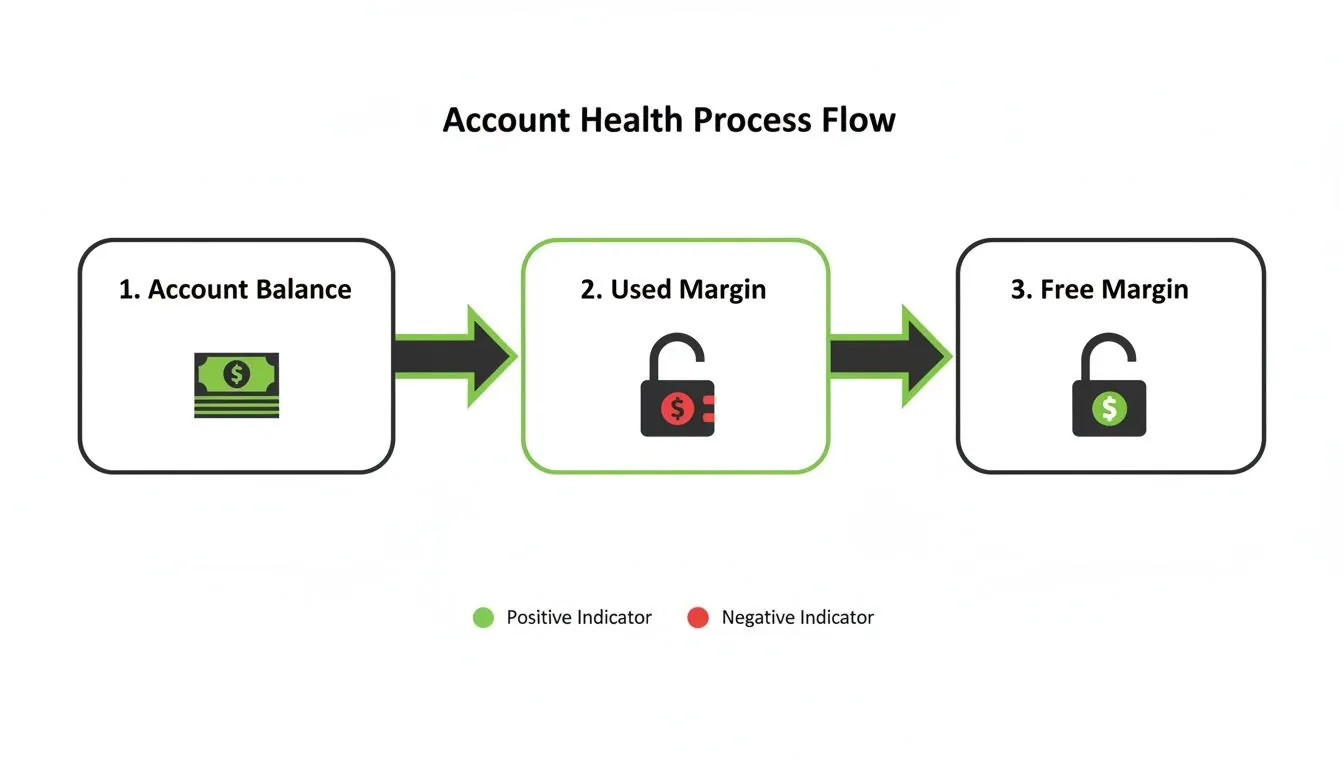
- Account Balance This is the total cash in your account, reflecting your deposits, withdrawals, and any profits or losses from closed trades.
- Equity This is the live, floating value of your account. It's calculated by taking your Account Balance and adding or subtracting the unrealized profit or loss from your open trades. If your trades are winning, Equity will be higher than your Balance. If they are losing, Equity will be lower.
Used Margin and Free Margin
- Used Margin When you open a position, your broker sets aside a portion of your equity as a good-faith deposit. This is the Used Margin (or Required Margin), and it acts as the collateral to keep your trades open.
- Free Margin This is the money left over that you can actually use—either to open new positions or, more importantly, to absorb losses from current ones without getting a dreaded margin call.
Free Margin = Equity – Used Margin
A healthy amount of Free Margin gives your positions room to breathe. When it runs out, you're in the danger zone.
Key Margin Terminology at a Glance
| Term | What It Is | Simple Analogy |
|---|---|---|
| Account Balance | Your starting capital, or cash after all trades are closed. | The money you put in your wallet before a trip. |
| Equity | The real-time value of your account, including open P&L. | The money in your wallet plus the value of winning lottery tickets you haven't cashed yet (or minus losing ones). |
| Used Margin | The portion of your equity held by the broker as collateral. | A security deposit on a rental. It's still your money, but it's tied up. |
| Free Margin | The equity you have available to open new trades or absorb losses. | Your "spending money" after the security deposit has been paid. |
| Margin Level | A percentage showing the ratio of your equity to used margin. | The fuel gauge for your account's health. You never want it to hit empty. |
The Most Important Metric: Margin Level
The Margin Level is the ultimate health indicator for your account, telling you exactly how close you are to trouble. It’s shown as a percentage and is calculated by comparing your Equity to your Used Margin.
- Margin Level = (Equity / Used Margin) x 100%
A high Margin Level (1,000% or more) means you're in great shape with a large buffer. A low Margin Level is a serious red flag that you're approaching a margin call. This metric is absolutely vital for prop firm traders. For instance, traders at firms like MyFundedCapital, which might offer $100,000 in simulated funds, have to respect strict 5% daily and 10% maximum drawdown rules. A plunging Margin Level is a direct threat to passing an evaluation.
The temptation to use high leverage can quickly escalate risk. This isn't just a retail trading phenomenon. FINRA data on securities margin accounts shows how fast leveraged risk can pile up when markets are hot, making disciplined margin management essential.
How to Calculate Required Margin With Simple Formulas
Now, let's get into the actual math. Manually calculating your required margin gives you a much deeper feel for how leverage, position size, and price all work together, turning you from a passive platform user into an active risk manager.
The Primary Margin Calculation Formula
At its heart, the formula for calculating the margin needed to open a trade is straightforward.
Required Margin = (Contract Size × Lot Size × Market Price) / Leverage
Let’s quickly unpack each part:
- Contract Size This is the standard number of units in one lot. For most forex pairs like EUR/USD, this is 100,000 units of the base currency.
- Lot Size This is your trade volume, such as a standard lot (1.0), a mini lot (0.10), or a micro lot (0.01). You can practice with our lot size calculator.
- Market Price The current exchange rate when you enter the trade.
- Leverage The ratio your broker offers (e.g., 1:30, 1:100). For 1:100 leverage, you’d just use the number 100 in the formula.
For context on other financial metrics, you might find this guide on the profit margin calculation formula a helpful read.
Converting Margin to Your Account Currency
Here’s a crucial step: making sure the margin is in your account's currency. If you’re trading a pair where the base currency matches your account currency (e.g., trading GBP/USD with a GBP account), you’re set.
But what if they're different? Say you're trading EUR/JPY, but your account is funded in USD. Your margin will first be calculated in the pair's base currency (EUR). You then have to convert that amount into your account currency (USD) using the current EUR/USD exchange rate.
Putting Forex Margin Calculation to the Test
Theory is great, but let's run the actual numbers. We'll walk through a few practical scenarios to show how margin calculation works in the real world.
Example 1: The Major Pair (EUR/USD)
Let's begin with a common trade: a major pair like EUR/USD, traded from a USD-denominated account.
Trade Details:
- Pair EUR/USD
- Position Size 0.50 lots
- Leverage 1:100
- Entry Price 1.0900
- Account Currency USD
Step 1: Calculate Notional Value (in base currency)
Notional Value = Contract Size × Lot Size = 100,000 × 0.50 = 50,000 EUR
Step 2: Calculate Required Margin (in base currency)
Required Margin = Notional Value / Leverage = 50,000 / 100 = 500 EUR
Step 3: Convert to Account Currency (USD)
Final Required Margin = 500 EUR × 1.0900 (EUR/USD rate) = $545.00
To open this trade, your broker will set aside $545.00 of your equity as used margin.
Example 2: The Cross-Currency Pair (GBP/JPY)
Now let's try a cross-currency pair with a USD account, which requires an extra conversion step.
Trade Details:
- Pair GBP/JPY
- Position Size 0.20 lots
- Leverage 1:50
- Entry Price 201.50
- Account Currency USD
- Required Conversion Rate GBP/USD at 1.2700
Step 1: Calculate Notional Value (in base currency)
Notional Value: 100,000 × 0.20 = 20,000 GBP
Step 2: Calculate Required Margin (in base currency)
Required Margin (in GBP): 20,000 / 50 = 400 GBP
Step 3: Convert to Account Currency (USD)
Final Required Margin (in USD): 400 GBP × 1.2700 (GBP/USD rate) = $508.00
For this trade, $508.00 of your account balance would be locked up as used margin.
The Impact of Leverage on Required Margin
The amount of leverage you use has a direct impact on your required margin. The forex market's growth, with daily turnover exploding according to forex trading statistics on BestBrokers.com, makes careful margin management more critical than ever.
Let's revisit our first EUR/USD example, but with 1:30 leverage instead of 1:100.
Scenario Comparison:
- With 1:100 Leverage Margin was $545.00.
- With 1:30 Leverage Required Margin = (50,000 EUR / 30) × 1.0900 = $1,816.67.
The takeaway is clear: lower leverage increases the required margin for the same trade. This acts as a built-in risk management tool, forcing you to trade smaller positions and leaving more Free Margin to absorb market swings.
What Happens When Your Margin Level Drops Too Low
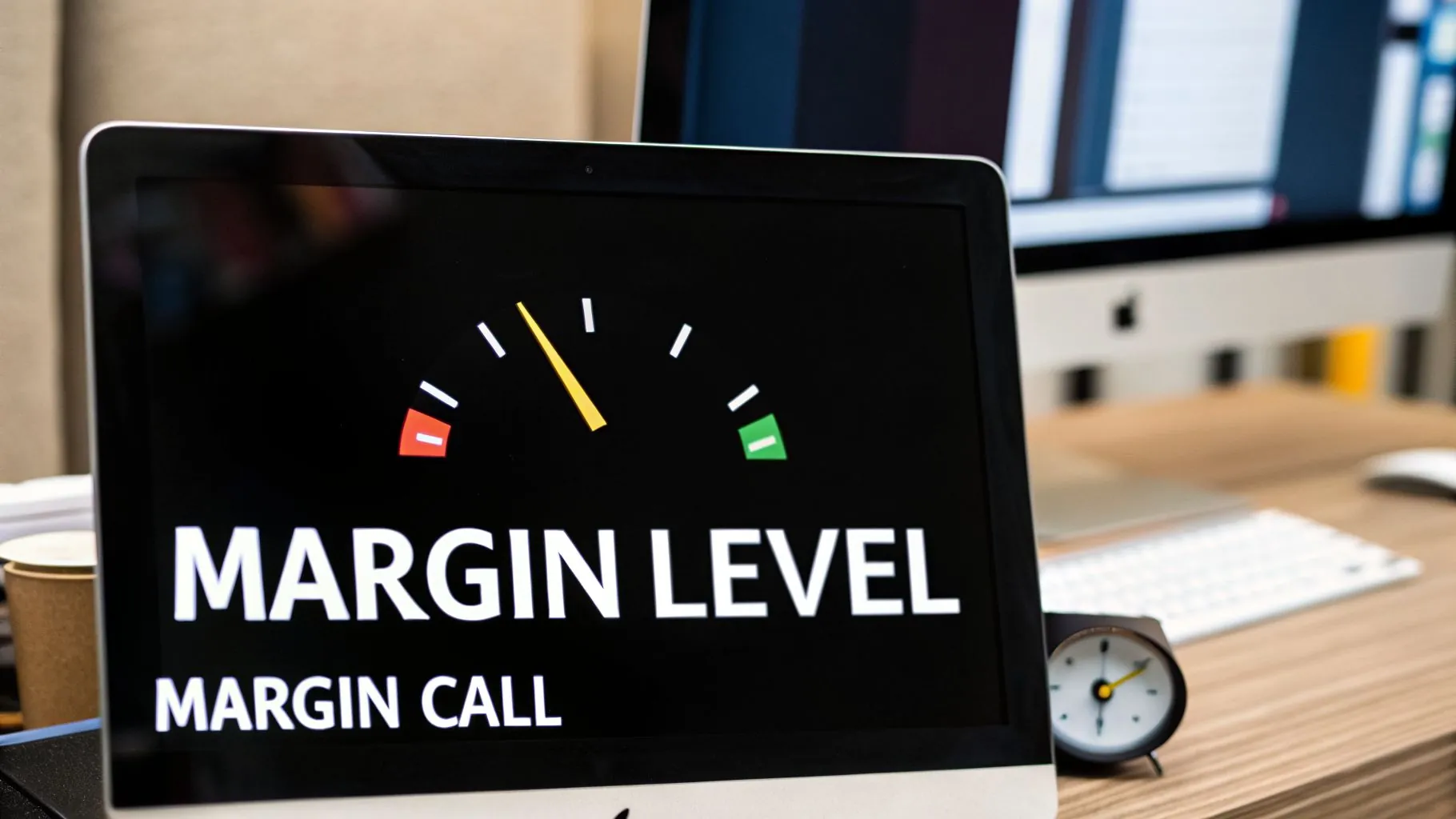
Think of your Margin Level like a fuel gauge. When it drops too low, you risk facing a Margin Call and, eventually, a Stop Out. These are automated safety nets your broker uses to prevent your account from going into a negative balance.
The Margin Call: A Warning Shot
A margin call is an automated warning triggered when your account equity dips to a specific percentage of your used margin. It’s a red flag telling you that your free margin is nearly gone and your trades are in immediate danger of being liquidated.
You have two primary options:
- Cut your losses Start closing positions (ideally the largest losers) to free up used margin and increase your Margin Level.
- Add more funds Deposit more capital to increase your equity. Be cautious with this, as it can be like throwing good money after bad.
If you’re ever unsure how a new trade might impact your margin, you can run the numbers first with a Margin Call Calculator.
The Stop Out: Automatic Liquidation
If you ignore the margin call and your Margin Level continues to fall, you’ll hit the Stop Out Level. At this point, your broker’s system will automatically start closing your trades, beginning with the largest losing position, until your Margin Level is back above the required threshold.
A Stop Out is the point of no return. For a prop firm trader, hitting a stop-out almost guarantees you've breached your maximum drawdown rule, leading to a failed challenge or loss of a funded account. High volatility is often the culprit, and you can see how different pairs behave by checking forex volatility data on Investing.com.
How to Monitor Your Margin Level
On platforms like MT4/5, your Margin Level is always visible in the "Trade" tab. Make it a habit to look at it.
- Check it before every trade. Know where you stand before adding more risk.
- Set your own alerts. Decide on a personal danger level (e.g., below 500%) and use it as your cue to reassess.
- Know your broker's rules. Find out the exact Margin Call and Stop Out percentages for your account.
Proactive monitoring is the best way to avoid a margin call and manage risk like a professional.
Practical Margin Strategies for Prop Firm Success
In a prop firm challenge, where strict drawdown rules apply, margin management is even more critical. A single miscalculation can end your evaluation. That's why you need a pre-trade checklist.
Your Pre-Trade Margin Checklist
Before taking any trade, run these numbers:
- What’s the Collateral? Calculate the required margin. How much capital will be locked up?
- What's Left in the Tank? Subtract the required margin from your free margin. Is there a healthy cushion left?
- How's the New Margin Level Look? Project what your Margin Level will be after the trade is open. If it drops too low, consider reducing your position size.
- How Close to the Edge Are You? Based on your stop loss, how close will a negative move bring you to the daily drawdown limit?
This proactive thinking forces you to put capital preservation first. For a deeper look, our guide on risk management in forex trading is an essential read.
Managing Multiple Open Positions
When juggling multiple trades, your total used margin is the sum of the margin for every open position. A classic mistake is "stacking" trades without recalculating the total impact on free margin and Margin Level. Every new trade makes your entire account more fragile.
Remember, prop firm rules like a 5% daily drawdown are unforgiving. A conservative approach to margin isn't just a good idea—it's mandatory for survival. Using smaller lot sizes, especially in choppy markets, keeps your used margin low and your Margin Level high.
FAQ: Common Questions About Forex Margin Calculation
Here are answers to some of the most common questions about margin.
What is the difference between margin and leverage?
Leverage is the tool that magnifies your purchasing power, allowing you to control a large position with a small amount of capital. Margin is that small amount of capital—the good-faith deposit you must put up to use leverage. Leverage gives you the firepower; margin is the collateral you put on the line.
How does my account currency affect margin calculation?
If your account currency is different from the base currency of the pair you're trading (e.g., a USD account trading GBP/JPY), there's an extra step. Your broker first calculates the required margin in the base currency (GBP) and then instantly converts it to your account currency (USD) at the current exchange rate (GBP/USD).
Does lowering my leverage reduce risk?
Yes, indirectly. Lowering your leverage doesn't make a trade less risky on its own, but it increases the required margin for any given position size. This forces you to use smaller trade sizes relative to your account balance, which is a fundamental principle of sound risk management. Your true risk is ultimately determined by your position size and stop loss placement.
Is Free Margin or Margin Level more important to watch?
Margin Level is the more critical metric. Free Margin tells you how much capital you have left to open new trades, which is useful. However, Margin Level is the real-time health gauge of your entire account. A high Margin Level means you have a solid buffer to absorb losses on open positions, while a plummeting one warns of an impending margin call.
Ready to put your risk management skills to the test? At MyFundedCapital, we provide the platform for disciplined traders to prove their skills and earn funding.
Explore our funding programs and find the challenge that's right for you.