ES
ES
 DE
DE
 FR
FR
 AR
AR
 IT
IT
 NL
NL
 PL
PL
 SV
SV

You're probably in one of two spots right now. You've either blown a few prop challenges because your normal day-trading style doesn't fit the rulebook, or you're profitable enough on a small account to know capital is the bottleneck. This guide is for traders in that exact spot, and it'll help you judge a trade day prop firm by the rules that matter: loss limits, drawdown structure, consistency, payout cadence, platform fit, and whether your strategy can survive the migration.
Trading involves risk of loss. Most retail day traders lose money, with independent summaries citing loss rates ranging from roughly 74% to 97% across different studies and disclosures, which is why funded trading should be treated as a disciplined evaluation environment, not a shortcut to easy income (retail day-trading risk overview). This is educational only, not financial advice.
Free resources: Daily Trading Checklist (a pre-market routine, in-session rules and a post-market review).
Introduction to Trade Day Prop Firms for Day Traders
A lot of day traders pick a prop firm the wrong way. They look at the headline profit split, maybe the account size, then buy a challenge and realize too late that their strategy was never built for a hard daily loss limit, a drawdown cap, or a consistency rule that punishes one big session.
I've seen this over and over. A trader has a strong momentum setup for open volatility, catches one excellent morning, and thinks the challenge is basically done. Then the firm flags the profit concentration, or a sloppy revenge trade later in the week tags the daily loss limit and kills the account. The problem wasn't the strategy alone. The problem was strategy-to-rule mismatch.
If you're a beginner or intermediate trader in the 20 to 40 range, that mismatch matters more than almost anything else. A good trade day prop firm for one trader can be a terrible fit for another, even if the offers look nearly identical on the surface.
You need to judge firms by practical constraints:
- Funding model instant funding, 1-step, or 2-step
- Account size path whether you start smaller and scale logically
- Drawdown rules daily loss limit and total drawdown
- Payout structure how often you can withdraw and what split you keep
- Platform fit whether you can trade comfortably on the available platform
- Strategy permissions manual trading, EA use, copy trading, news trading, weekend holding
Your job isn't to find the “highest funded account.” Your job is to find a rule set your actual trading can survive.
I'll keep this direct. If your system can't stay inside the rule bands, the prop firm isn't funding your edge. It's exposing your lack of discipline.
How Trade Day Prop Firms Work and Why They Grew So Fast
You pass a strong morning session, finish up 2.3%, and start thinking about payout timing. Then one oversized trade in the afternoon clips the daily loss limit and the account is gone. That is how trade day prop firms work in real life. They sell access to buying power, but they control it through hard rules that judge your path, not just your end result.
The retail prop model is simple. You pay for an evaluation or buy an instant-funded account, trade a simulated account under a fixed rule set, and earn a split if you stay inside those limits. The appeal is obvious. A day trader who can execute but cannot scale personal capital gets a shot at larger size without wiring in tens of thousands of dollars.
The category grew fast because it packaged capital access into a repeatable online product. Industry estimates compiled by Atmos Funded put modern retail prop firm revenue around US$4.0 to 4.5 billion, with the broader ecosystem near US$20 billion and more than 2,000 firms worldwide (retail prop firm industry estimates).
Search interest rose with it. Google Trends data shows a sharp increase in attention to prop firms over the last few years, and SEO market reports have tracked a similar jump in monthly searches for terms like “prop firm” and “prop trading firm” (Google Trends, Prop Firm topic).
Why firms tightened the rules
Fast growth brought copycat firms, looser marketing, and a flood of traders who treated challenges like lottery tickets. Firms responded the only way they could. They standardized daily loss limits, max drawdown logic, minimum trading days, and payout review rules so they could filter for traders who manage risk the same way every session.
That shift matters more than the headline profit split.
Track360's 2026 industry summary reports first-attempt pass rates in the low double digits across many programs, and payout rates stay far below the number of people who buy challenges (evaluation pass and payout benchmarks). That lines up with what experienced traders already know. The business runs on attrition. Firms make money from fees and from traders who cannot keep their strategy inside the rule box long enough to reach a payout.
A useful reference point for how firms structure these programs is this prop trading firm breakdown.
What that means for day traders
A prop account changes the job. In a personal account, you can decide to trade lighter after a bad open, skip two days, or hold back until conditions improve. In a prop evaluation, the rulebook keeps running even when your market is flat, your setup is cold, or your edge comes in bursts.
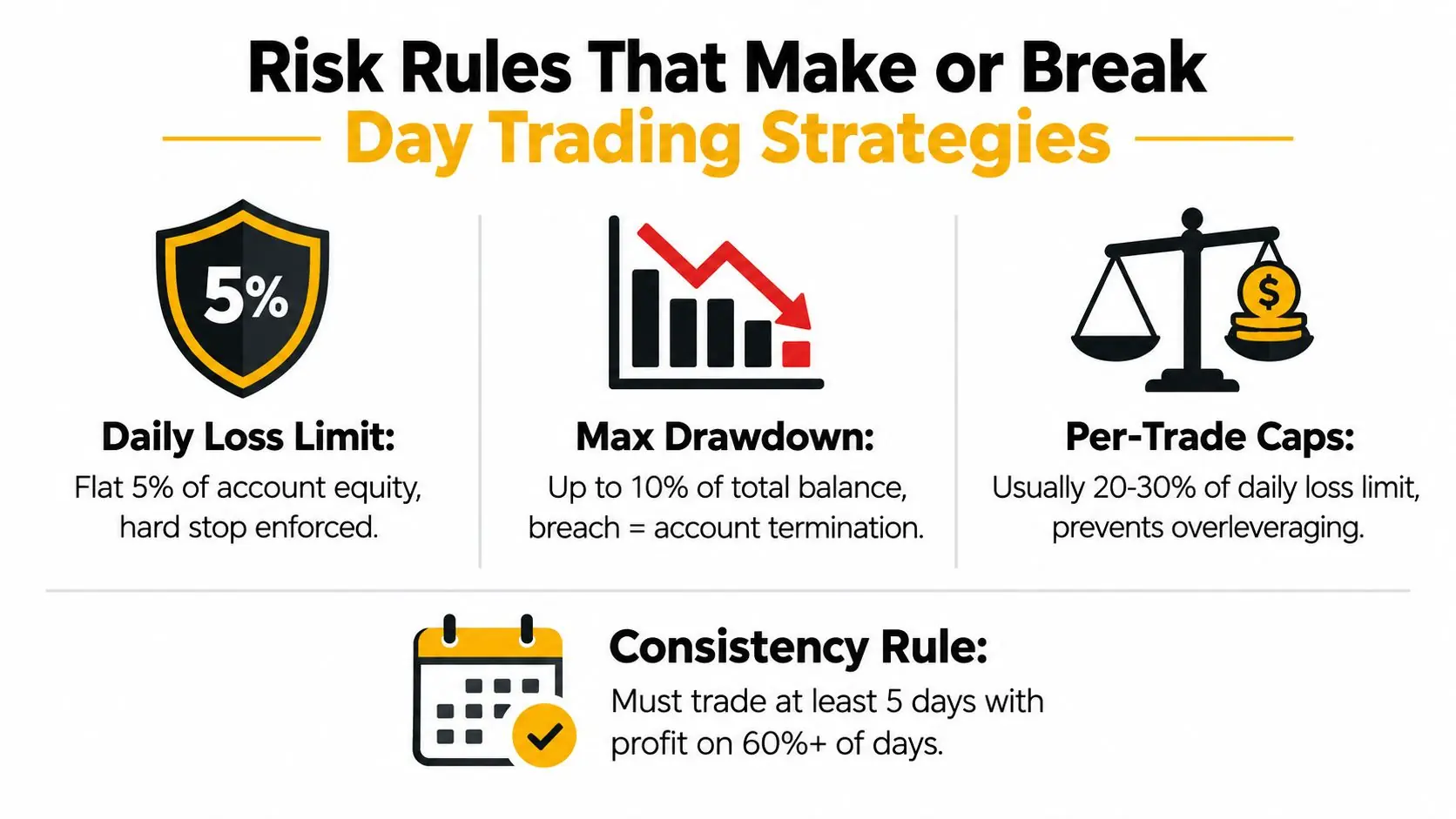
Common rule ranges across challenge firms include phase-one profit targets around 8% to 10%, daily loss limits around 4% to 6%, and maximum drawdown limits around 6% to 12% (common challenge rule ranges). For a day trader, those numbers are not background details. They decide position size, session cutoff time, whether you can press after a winner, and whether one outsized day creates a consistency problem later.
Judge a trade day prop firm the way you would judge a broker for execution quality. Start with the constraints that can break your actual strategy. Daily loss limit first. Drawdown calculation method second. Consistency rule third. Payout cadence fourth. Profit split comes after that.
If your setup needs room for uneven PnL distribution, a firm that punishes one big day is a bad fit. If your strategy performs best in two high-volatility sessions a week, a payout model that delays access for a month creates pressure you do not need. That is why these firms grew so fast, and why many traders still choose the wrong one. They shop the upside and ignore the constraints.
Funding Models Compared for Day Traders
Different funding models suit different day traders. Don't treat them as interchangeable. The right choice depends on how fast your setup produces returns, how evenly your profits are distributed, and how much pressure your strategy can handle.
Here's the side-by-side view first.
| Funding Model | Profit Target and Fees | Account Size and Scaling | Best For Day Traders |
|---|---|---|---|
| Instant Funding | No classic evaluation phase, but usually higher upfront cost and tighter expectations on discipline | Common starting sizes include $5K to $100K, with scaling paths up to $500K in some programs | Traders with proven execution who want to skip a traditional challenge |
| 1-Step Challenge | Usually one main target, often in the general market range where phase-one style targets cluster around 8% to 10% | Common account sizes run from $5K to $100K, with room to scale | Traders with a repeatable intraday edge who want a faster path |
| 2-Step Challenge | More process, often psychologically easier because the performance burden is spread across phases | Common account sizes run from $5K to $100K, with scaling to $500K in some models | Newer prop traders, part-time traders, and traders who perform better under less pressure |
Instant funding versus challenge models
Instant funding sounds attractive because it removes the pass-fail pressure of a classic evaluation. That can help traders who execute well when they're not staring at a target. It can also hurt traders who use structure as discipline, because without a clear challenge framework they often oversize early.
1-step challenges fit active intraday traders who can produce results quickly and keep their risk clean. If your edge comes from frequent small wins and tight trade management, this can work well. If your P and L tends to come in bursts, the pressure can backfire.
2-step challenges are usually better for traders who need room to settle in. They're often a better match for part-time day traders or anyone still ironing out emotional mistakes. The second phase can act like a filter for consistency, not just profitability.
What account size really means
A larger account doesn't automatically make trading easier. It often makes bad habits more expensive.
If a firm offers $5K to $100K accounts with scaling toward $500K, that range is useful only if your sizing model scales cleanly. Many traders fail after moving up because they anchor on notional size instead of risk per trade. The account got bigger. Their discipline didn't.
A practical way to sort the models:
- Choose instant funding if you already have a tested strategy and want immediate live-style structure.
- Choose 1-step if your edge is clean, frequent, and rule-friendly.
- Choose 2-step if you need more room to perform without forcing trades.
Profit split matters, but less than traders think
Profit split is important after you prove you can keep an account. Mainstream industry coverage places trader profit splits most often in the 70% to 90% range, with many firms starting around 80% and sometimes increasing to 90% after consistent performance (prop-firm profit split ranges).
That sounds great until you fail three evaluations because the rule set doesn't fit your strategy. A lower-friction rulebook beats a prettier split every time.
Risk Rules That Make or Break Day Trading Strategies
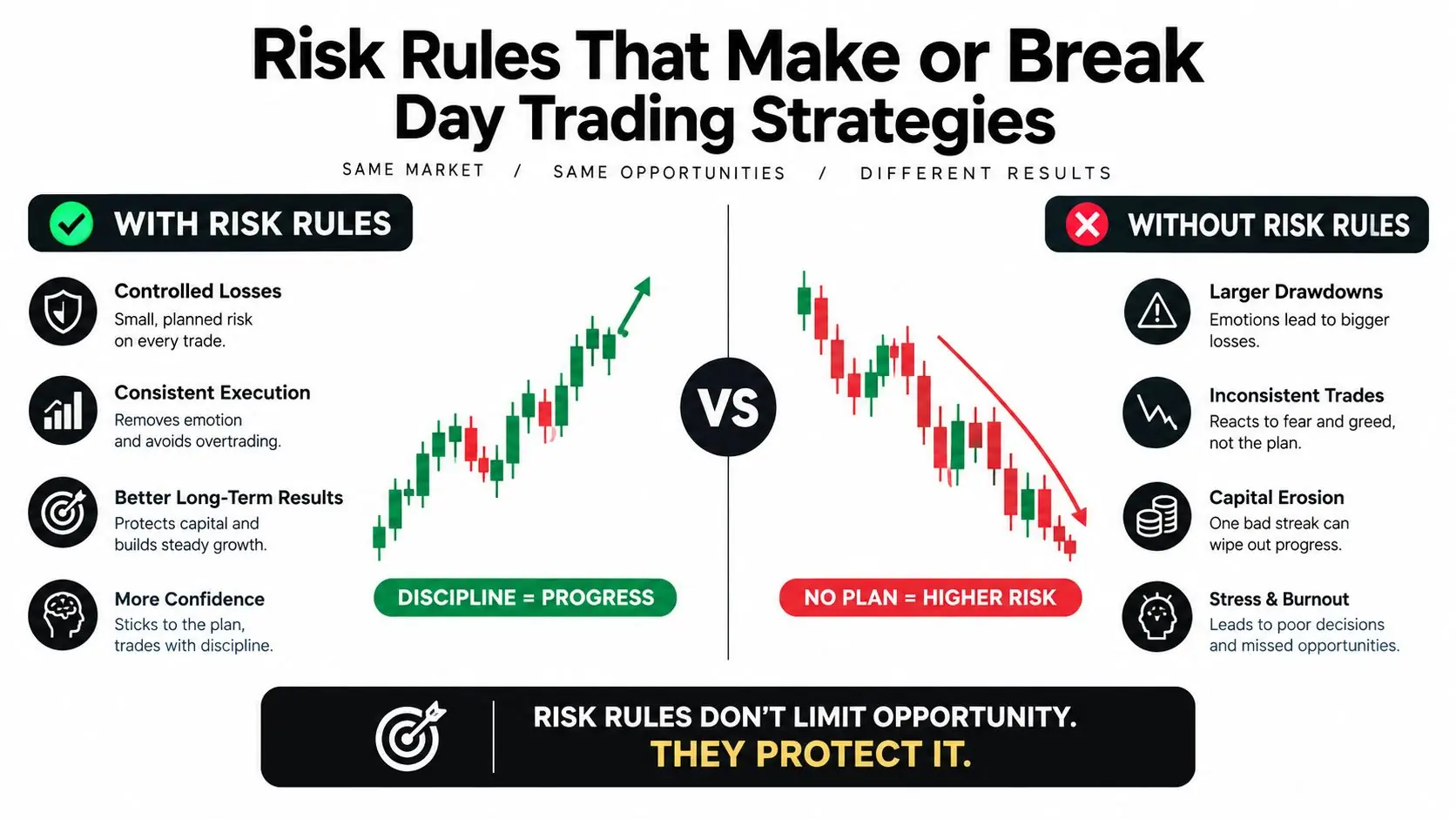
Most traders fail prop challenges because they trade their strategy the same way they trade a personal account. That's the mistake. A trade day prop firm is a rule environment first and a trading environment second.
Independent reviews of prop-firm risk management show rulebooks commonly clustering around a 3% to 5% daily loss limit, an 8% to 12% maximum drawdown cap, and a 1% to 5% per-trade position-size ceiling. The same review also notes a 30% to 50% consistency rule that can limit how much a single trading day contributes to total simulated profit (prop risk-rule bands and consistency limits).
A closer look at daily loss limit mechanics helps if you're trying to translate those headline numbers into actual trade sizing.
Daily loss kills more accounts than max drawdown
Most day traders obsess over total drawdown because it sounds bigger. That's backward. The daily loss limit is the rule you're most likely to hit first.
If your strategy takes clustered losses during the open, your day can be over long before your total drawdown is in danger. That's why daily risk planning matters more than raw expectancy.
Here's the hard truth:
- Scalpers often fail because transaction clustering pushes them into overtrading after two or three losses.
- Momentum traders fail when they size aggressively after a missed move.
- EA traders fail when slippage or trade clustering worsens intraday drawdown.
- Copy traders fail when master-account behavior doesn't map cleanly to the prop rulebook.
Practical rule: Build your personal stop below the firm's hard stop. If the firm allows a 5% daily loss limit on its Challenges (3% on Instant Funding), don't plan your day around using all of it.
Drawdown quality matters more than win rate
Performance measurement is shifting away from headline win rate and toward drawdown quality. Independent trading-education benchmarks define maximum drawdown as peak-to-trough equity decline and recommend tracking monthly or rolling drawdown, average drawdown, recovery time, and drawdown duration. One benchmark guide classifies under 10% drawdown as excellent, 10% to 20% as normal for active swing and day traders, and above 30% as high risk (drawdown benchmarks for active trading systems).
That's the lens you should use before paying for any evaluation.
Two traders can have the same profit factor. One recovers quickly, keeps drawdown under control, and distributes profit across several sessions. The other spends long stretches underwater and relies on one huge day to save the month. The first trader is prop-compatible. The second trader is usually challenge bait.
A quick strategy fit check
Ask these before switching firms:
- How concentrated are your best days? If one day often carries your week, consistency rules can disqualify you.
- How many losses cluster in your worst session? That decides whether the daily cap is survivable.
- How long do you stay underwater after a losing streak? Long recovery time is a red flag.
- Do you increase size after losses? If yes, the rulebook will expose it fast.
If your strategy can't answer those questions cleanly, don't buy another challenge yet.
Payouts Platforms and Strategy Permissions in Real Use Cases
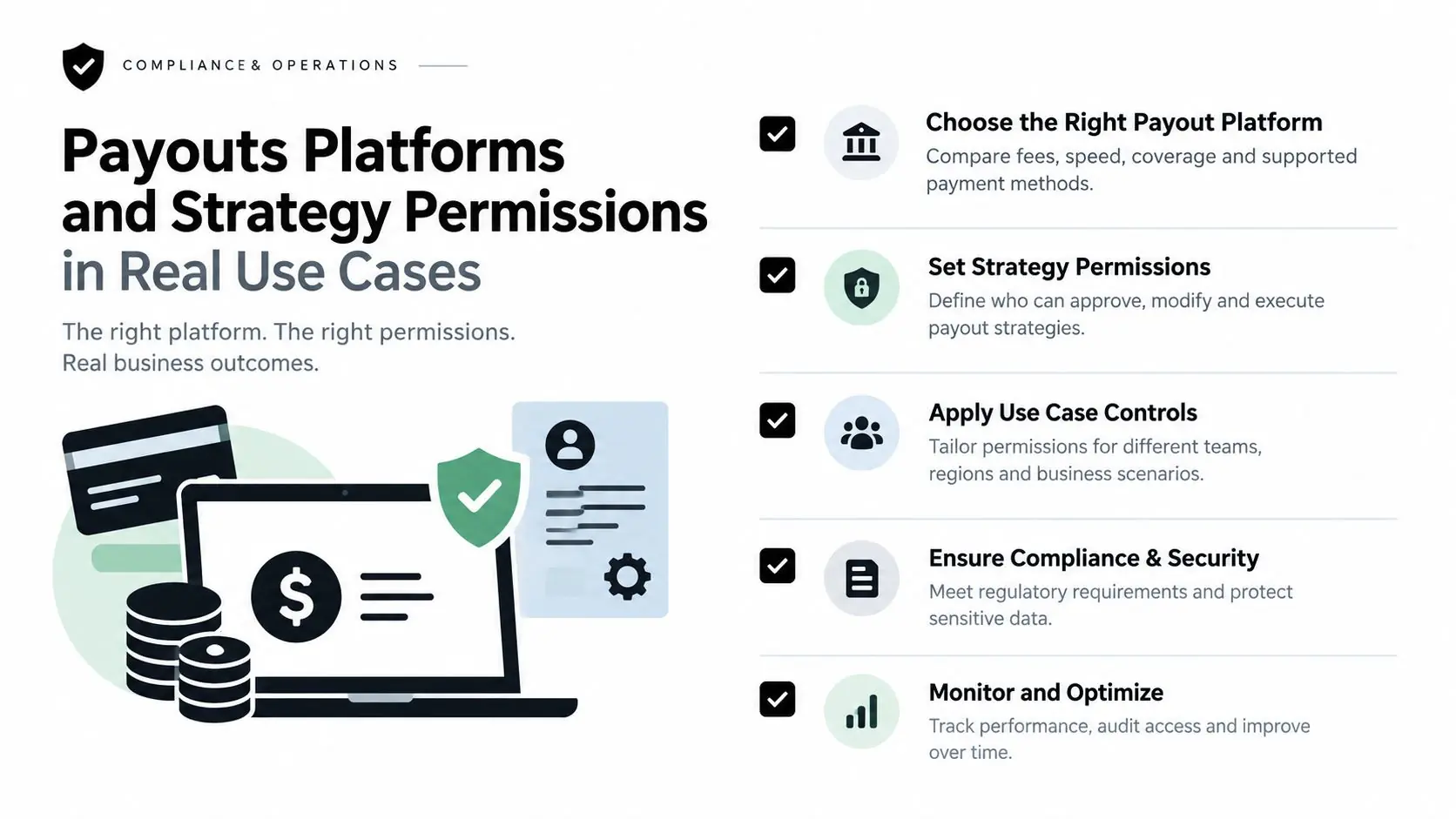
Once a trader finds a survivable rule set, the next filters are operational. Payout timing, platform comfort, and strategy permissions decide whether a funded account is usable in real life or just looks good on a sales page.
The first thing to understand is that prop-firm demo environments are not the same as a normal retail broker demo. A standard retail demo usually has no enforced daily loss cap, while a prop-firm demo can apply rules such as a 5% daily loss limit and other challenge restrictions (difference between prop demos and retail demos).
Three real trader use cases
Fast payouts are nice. A usable payout policy is better. If you can't trade your actual method, the split doesn't matter.
Manual intraday trader
You care about platform stability, chart workflow, and fast payout access. If payouts are available every 7 or 14 days depending on the program, or on demand with the payout add-on, with average processing around 2 hours, that's operationally useful because it lets you turn performance into realized cash flow without waiting too long. You should also care less about the max headline split and more about whether the firm starts around the industry-standard 80% range and pays consistently.
EA or algorithmic trader
You need permission clarity, not vague marketing. If the firm says it supports algorithmic trading, verify whether that applies to all account types, whether trade copying is allowed, and whether latency-sensitive logic behaves properly on the platform. DXtrade and cTrader can both work, but your execution model matters more than brand preference.
News and weekend trader
This trader needs add-ons or explicit written permission. If your edge depends on event-driven volatility or holding positions through a session boundary, a generic prop setup can block your strategy even if the account size looks perfect.
What to check in the fine print
One firm option in this space is MyFundedCapital's payout methods, which outlines bank and crypto withdrawals along with payout timing. More broadly, your checklist should be simple:
- Payout cadence Can you withdraw on a rhythm that matches your goals, or are you waiting too long?
- Platform support Do you want to trade on DXtrade or cTrader every day?
- Instrument coverage If you rotate across forex, indices, crypto, and commodities, broad access matters.
- Strategy permissions Manual, algorithmic, and copy trading should be stated clearly.
- Optional permissions News trading and weekend holding should be explicit, not assumed.
The split trap
Traders fixate on profit split because it's easy to compare. But a 70% to 90% typical market range is only meaningful after platform, payout, and permission fit are solved. A higher split on a restrictive account is often worth less than a lower split on a structure you can trade well.
That's especially true for day traders who need fast adaptation. If your platform feels clunky, your execution suffers. If your payout cycle is too slow, you start forcing performance. If your strategy permissions are vague, you trade defensively instead of decisively.
How to Choose Test and Migrate to the Right Prop Firm
Switching to a new prop firm is where many solid traders sabotage themselves. They assume a strategy that works on one setup will work unchanged on another. It usually won't.

Step one, audit your current strategy honestly
Write down your real trading behavior, not your ideal behavior.
Include:
- Your worst intraday losing streak
- Your average risk per trade
- How much of your weekly profit comes from your best day
- Whether you rely on news spikes, overnight holds, or automation
- How quickly you recover after a drawdown
If you can't describe those points clearly, you're not ready to migrate. You're guessing.
Step two, test in a prop-style demo
Don't test on a normal retail demo and assume it translates. A prop evaluation environment enforces challenge rules in a way a standard demo usually doesn't.
Use a test account that mirrors the target rulebook as closely as possible. You want to feel the constraints while the stakes are low.
- Run the same setup for multiple sessions
- Track daily loss behavior, not just net P and L
- Note whether platform execution changes your entries or exits
- Watch for concentration risk if one session dominates your gains
Treat migration like a system test, not a confidence exercise.
Step three, downshift size before you scale
Traders get reckless. They move from a personal account to a bigger funded account and think they should trade “bigger” immediately.
Don't.
Start with reduced risk until you've proven your strategy can survive the new environment. If the account offers a larger capital base, use that extra room to reduce pressure, not to inflate ego. A larger nominal account should make your process calmer.
Step four, match the model to your lifestyle
A trader with two focused market windows each day shouldn't pick the same model as someone trading full-time across multiple sessions.
Consider practical fit:
- If you trade part-time, a 2-step structure may reduce pressure.
- If your edge is immediate and repeatable, a 1-step or instant model may fit better.
- If you use EAs or copy trading, verify permissions before paying.
- If you hold through events, make sure news and weekend policies are written clearly.
Step five, plan your migration rules in advance
Set clear boundaries before funding:
- Personal daily stop
- Maximum number of trades per session
- Maximum risk per trade
- Conditions for stopping after a drawdown
- Criteria for scaling size
That prevents the most common migration mistake, which is overleveraging because the account size looks larger.
Trading still involves risk of loss. A prop account doesn't remove that risk. It compresses it into a stricter rule framework.
Trade Day Prop Firm FAQs and Next Steps With MyFundedCapital
Is a trade day prop firm actually regulated where I live
Often, not in the way new traders assume. A major gap in the market is regulatory status and jurisdiction risk, because many retail funded-trader models operate outside direct securities or futures oversight by design, while regulators in the US, UK, and EU are moving in different directions (cross-border prop regulation overview).
That matters for payouts, disclosures, and how the firm is categorized when it markets to your country. Don't assume the same protections apply everywhere. Read the terms for your jurisdiction before you buy anything.
Do prop firms still make sense after the pattern day trader rule change in the US
Yes, but for different reasons than before. Coverage of FINRA's 2026 replacement margin framework says there is no longer a fixed $25,000 equity floor or the old four-trades-in-five-days cap for equities day trading. Margin is now based on actual intraday risk (PDT framework change and what it means for prop firms).
So the old “use a prop firm to get around PDT” angle is weaker. Prop firms still make sense if you want increased buying power, scaling structure, payout mechanics, or a rule framework that keeps you disciplined.
How hard is it to get paid from a prop firm
Harder than most sales pages imply, because getting funded and getting paid are different milestones. As covered earlier, pass rates are low and not every challenge buyer reaches payout. That's why you should judge a firm by the path to payout, not just the existence of one.
A trader who wants a clean payout path should focus on rule compatibility, strategy permissions, and payout cadence before worrying about marketing extras.
What's the simplest rule for choosing a trade day prop firm
Pick the firm whose rules interfere the least with your proven process. Not the flashiest account. Not the biggest headline split. Not the cheapest challenge.
If your strategy relies on concentrated wins, avoid harsh consistency limits. If your losses cluster intraday, focus on daily loss survivability. If you trade with automation or around news, permissions matter more than branding.
Trading involves risk of loss, and none of this is a promise of performance. It's educational only, not financial advice.
If you want to apply this framework in practice, MyFundedCapital offers Instant Funding plus 1-Step and 2-Step programs with account sizes from $5K to $100K and scaling paths up to $500K. If you're comparing trade day prop firm options, review the account types, check the risk limits against your strategy, and start a challenge only when the rules fit the way you trade.