You’re probably in one of two spots right now. Either your strategy can pull money out of the market, but your personal account is too small to matter, or you’ve realized the actual ceiling isn’t your setup at all. It’s your capital and your discipline under pressure.
Trade day funding sits right in that gap. Done properly, it gives skilled traders a path to larger buying power without risking a large personal account. Done carelessly, it becomes another failed challenge fee and another lesson in ignored rules. This guide breaks down how it works, why most traders fail, and what disciplined traders do differently.
Your Trading Strategy Works But Your Account Is Too Small
A lot of traders hit the same wall.
They finally stop random clicking. They build a repeatable setup. They learn when to stay out. They even stack a few green weeks together. Then reality shows up. A small account doesn’t leave much room for error, and even solid execution can feel pointless when position size is tiny.
That frustration is real. It’s one of the reasons so many traders start looking at trade day funding.
The small-account trap
With a small personal account, every decision gets distorted:
- A normal loss feels too large because the account can’t absorb much heat.
- A good setup is pursued with oversized positions because the trader wants faster progress.
- Patience disappears because slow growth feels like standing still.
- Risk management gets bent because the account size pushes traders to force returns.
That’s how decent traders turn into reckless ones.
A small account often teaches the wrong lessons. Instead of focusing on process, traders start thinking in rent money, monthly targets, and “I need this one trade to work.” Once that mindset takes over, the market usually exposes it fast.
Why self-funded growth is so hard
The hard truth is that self-funded day trading has brutal odds over time. Quantified Strategies notes that only 13% of day traders remain profitable over six months and only 1% succeed over five years. That doesn’t mean success is impossible. It means the path is narrow, especially when you’re trying to scale from limited personal capital.
Most traders don’t fail because they can’t find entries. They fail because pressure changes how they behave once real money feels scarce.
Trade day funding appeals to traders in exactly this position. You keep your process, but you try to prove it inside a structured evaluation instead of trying to compound a tiny personal account forever.
What traders usually get wrong
Many people approach funded trading with the wrong expectation. They think the prop firm is buying their strategy.
It isn’t.
The firm is testing whether you can follow rules while trading your strategy. That’s a very different game. If your system works only when you can average down, revenge trade, or hold and hope, it won’t survive a funding challenge.
Trade day funding can solve the capital problem. It does not solve the discipline problem.
That’s why the traders who eventually get funded usually make a psychological shift first. They stop trying to prove they’re brilliant. They start trying to prove they’re reliable.
What Is Trade Day Funding and How Does It Work
Trade day funding is easiest to understand if you stop thinking about it like a brokerage account and think about it like access.
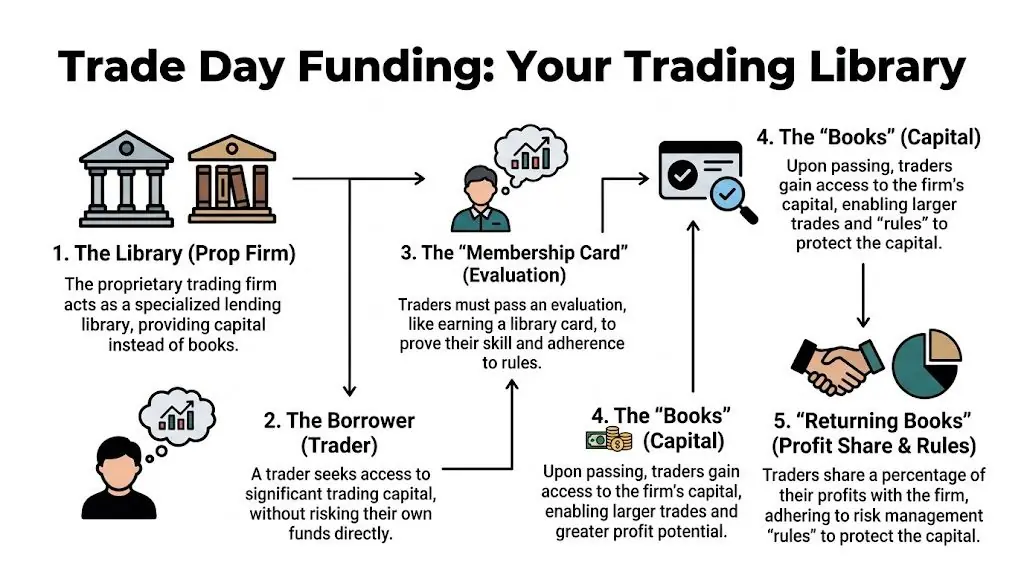
A prop firm is a bit like a professional organization that screens traders before giving them a larger field to operate in. You don’t walk in and get handed meaningful capital just because you say you’re good. You have to prove you can follow instructions, manage risk, and perform under constraints.
The simple version
Here’s the relationship in plain language:
- You pay for an evaluation or funding model
- You trade on a simulated account with real market data
- You follow the firm’s rules while trying to hit required objectives
- If you pass, you receive a funded account structure
- If you generate eligible profits, you receive a share based on the firm’s payout terms
That’s the core loop.
The details vary from firm to firm, but the model is always built around the same question: can this trader manage risk consistently enough to deserve more capital allocation?
The three terms that confuse beginners
Evaluation
The evaluation is your audition. You’re not just trying to make money. You’re trying to show controlled performance inside fixed rules.
That means a trader with a decent strategy and poor discipline often fails, while a trader with a simpler strategy and tighter control can pass.
Funded account
A funded account in this space usually means you’re trading a firm-structured account in a simulated environment that mirrors live market conditions. The purpose is assessment, consistency, and risk control. It’s not the same as opening your own retail account with your own deposit.
Profit split
The profit split is the share of eligible profits paid to the trader. Firms keep part of the upside in exchange for the infrastructure, capital model, and risk framework.
Why firms run this model
Prop firms aren’t charities, and they aren’t looking for gamblers. They want traders who can survive rules that most retail traders ignore.
That’s why the technology stack matters so much. Stable execution, dashboards, risk monitoring, payout workflows, and account controls all rely on the kind of infrastructure used across modern fintech software development. If the backend is weak, the trader feels it immediately through slippage issues, poor reporting, or confusing account enforcement.
A prop firm is less interested in your biggest winning day than in whether you can avoid the day that blows the account.
The mindset shift that matters
A lot of traders hear “funded account” and think freedom.
The better word is structure.
Trade day funding works best for traders who accept that structure upfront. You’re agreeing to trade inside boundaries. If that feels restrictive, funded trading may frustrate you. If that feels like a framework that can help you scale, it can be a strong fit.
The traders who last tend to treat the evaluation like a professional screening process, not a shortcut to quick money.
Comparing The Main Paths to a Funded Account
Not every funded path asks the same thing from the trader. That matters because many people choose the wrong model for their personality, not just their strategy.
A trader who hates waiting may sabotage a challenge model by forcing setups. A trader who likes structure may do poorly in an instant route if the room for error is tighter. The right choice depends on how you behave when pressure shows up.
The three common models
Most traders will run into these paths:
- Instant funding
- 1-step challenge
- 2-step challenge
The names sound simple, but the trade-offs are not.
Funding model comparison
| Attribute | Instant Funding | 1-Step Challenge | 2-Step Challenge |
|---|---|---|---|
| Access to account | Immediate access after purchase | Access after passing one evaluation phase | Access after passing two evaluation phases |
| Best fit for | Traders who already trust their process and want to skip a formal test phase | Traders who want a simpler evaluation path | Traders who prefer a more gradual proving process |
| Pressure point | Little room for sloppy execution from day one | Balancing speed with control in a single phase | Maintaining discipline over a longer process |
| Psychological challenge | You must stay calm without a “practice” stage | You may feel tempted to rush the target | You may lose focus between stages |
| Typical trader mistake | Treating immediate access like permission to size up too fast | Trying to finish too quickly | Relaxing after phase one and failing phase two |
| Why some traders prefer it | Fast start and direct path | Clean structure with fewer moving parts | Often feels more forgiving mentally because the process is split |
| Who should avoid it | Impulsive traders | Traders who panic when close to targets | Traders who struggle with patience or consistency over time |
How to choose honestly
A useful test is to ask one question: where do I usually break discipline?
If your problem is impatience, instant access may become dangerous. If your problem is overtrading after early wins, a challenge can expose that quickly. If your issue is staying focused over a longer campaign, a 2-step path may feel heavier than it looks on paper.
Some traders also compare funded routes to institutional trading career paths. Looking at a role like a Delta One Trader at a firm like Flow Traders can help you see how professional environments value consistency, process, and risk discipline over hero trades. The prop challenge world is different, but the mindset overlap is real.
What instant funding really changes
Instant funding attracts traders who don’t want to spend time proving themselves in a formal challenge. That can be a smart choice if your process is already mature.
But “instant” doesn’t mean “easy.” It often means the account starts evaluating your behavior from the first trade. If you want to explore that route, a practical reference point is this breakdown of instant funding prop firm models.
The best funding path isn’t the one that sounds fastest. It’s the one your psychology can survive.
A mentor’s rule of thumb
Use this quick filter:
- Choose instant funding if you already trade a rules-based system and don’t need the evaluation stage to keep you disciplined.
- Choose a 1-step challenge if you want a straightforward target and can stay patient.
- Choose a 2-step challenge if you prefer proving consistency in stages and don’t mind a longer runway.
A bad model fit can make a good trader look bad. A good fit won’t make you profitable by itself, but it removes one unnecessary mismatch.
Navigating The Core Rules of Prop Firm Trading
At this stage, most challenge attempts die.
Not on entries. Not on indicators. Not because the trader couldn’t spot a trend. They fail on rules they thought they understood but didn’t respect in real time.

The numbers that matter most
Across the industry, the pass rate is low because risk rules perform the filtering. FunderPro’s pass-rate analysis notes that strict limits like 5% daily drawdown and 10% overall drawdown are a major reason only 5% to 10% of participants pass evaluations. That should reset how you view the challenge. The main test is control.
Daily loss limit versus maximum drawdown
These two get mixed up all the time.
Daily loss limit
A daily loss limit caps how much you can lose in one trading day. If the firm uses 5% daily drawdown, your job is to make sure your losses never cross that threshold within the day.
This rule exists to stop one emotional session from destroying the account.
Maximum drawdown
A maximum drawdown caps the total decline allowed on the account. If the firm uses 10% overall drawdown, that’s your outer boundary. Hit it, and the account is done.
This rule exists to stop slow-motion account destruction.
A plain example
On a $100K account with a 5% daily loss limit and 10% maximum drawdown, the numbers are simple:
- Daily loss limit = $5,000
- Maximum drawdown = $10,000
Now here’s where traders get sloppy.
They see $5,000 and think that’s the amount they can risk freely in a day. It isn’t. A serious trader builds in a cushion because spread, slippage, execution timing, and bad judgment under pressure can push losses further than planned.
A disciplined trader might think like this instead:
- “My hard stop is the firm’s rule.”
- “My personal stop is well inside that rule.”
That one adjustment changes behavior immediately.
Balance based, equity based, trailing, static
These terms sound technical, but the logic is straightforward.
Balance based drawdown
This measures losses using closed trades. Unrealized profit or loss usually doesn’t count until the trade is closed.
Equity based drawdown
This measures losses using current account value, including open positions. That means an open trade going against you can trigger a breach even if you planned to close it later.
This catches traders who hold and hope.
Static drawdown
A static drawdown stays fixed. The loss limit doesn’t move around as your account grows.
Trailing drawdown
A trailing drawdown moves upward as your account reaches new highs. That can help when you build profits, but it also creates pressure because the allowed loss threshold can tighten behind you.
Why trailing rules confuse traders
With a trailing system, your safety line can move after a strong day. Many traders celebrate the profit and forget the floor has moved too.
That’s why some traders pass early profit targets and still fail later. They stop thinking defensively once they’re up.
Practical rule: If you can’t explain your drawdown rule in one sentence without looking it up, you’re not ready to trade the account.
The hidden killers besides drawdown
Drawdown gets the headlines, but several other rules cause quiet failures:
- Minimum trading days can force impatient traders to avoid oversized “one-and-done” behavior.
- Profit targets can lure traders into pressing too hard near the finish line.
- Payout cadence affects how traders think about withdrawals and account preservation.
- News and holding restrictions can invalidate an otherwise good trade if the timing breaks policy.
A trader should know all of these before placing trade one. Not after a breach email.
The mentor view
The top traders in these programs don’t obsess over how close they can get to the rule. They build distance from it.
They know that challenge accounts reward boring professionalism. If your trading style depends on flexibility, recovery trades, or emotional improvisation, the rules will expose that fast. If your process is already built around pre-defined risk, these rules become manageable instead of threatening.
Pros and Cons for Different Trading Styles
A prop model can feel excellent for one trader and completely wrong for another. The difference usually comes down to style.
Some traders need fast intraday execution and hard structure. Others rely on automation, cross-asset setups, or more flexibility around holding periods. If the firm’s rulebook doesn’t match the way you trade, friction shows up quickly.
Manual day traders
Manual intraday traders often adapt well to trade day funding because the environment rewards routine, quick feedback, and clearly defined session risk.
Pros
- Clear structure Fixed rules can stop a bad trading day from turning into a disaster.
- Capital access The model can give a day trader room to execute a proven plan without trying to build from a tiny personal balance.
- Routine friendly Traders who work with session plans, hard stops, and clean market windows often fit naturally.
Cons
- Emotional pressure A hard daily loss boundary can make some traders force exits or revenge trade.
- Overfocus on the target Traders may start trading the challenge metrics instead of the market.
- Restricted flexibility If your normal style includes holding through events or adapting on the fly, the rules can feel tight.
Algorithmic and EA traders
Algo traders often assume a funded account will be easier because the system handles execution. Sometimes that’s true. Sometimes the exact opposite happens.
TradeDay’s own “how it works” material leaves many cross-asset and strategy questions unaddressed, which reflects a broader industry issue for traders using forex, crypto, or automated systems. If the firm doesn’t clearly explain support for your style, you’re left guessing about fit before you even buy the challenge.
Pros
- Less emotional interference A tested system can remove a lot of impulsive decision-making.
- Repeatable execution Automation helps traders stick to the same setup every time.
- Scalability A system that works can often be deployed more consistently than a discretionary approach.
Cons
- Rule conflict Some firms limit or discourage certain algorithmic behaviors.
- Platform mismatch Your EA or workflow may not translate cleanly to the firm’s supported platform.
- Policy ambiguity If the firm is vague about copy trading, automation, or holding rules, you take on avoidable risk.
Traders should never assume a prop firm supports their style just because it supports their market.
Swing traders and hybrid traders
Swing traders face a different problem. Many prop environments are designed around active intraday behavior, not longer holds. That doesn’t make swing trading impossible, but it does mean you need to study hold-time, news, and weekend policies before committing.
If you’re still deciding which style fits your temperament, this guide on swing trading vs day trading helps clarify the practical differences in pace, exposure, and routine.
A simple fit test
Your style is probably a decent fit for trade day funding if:
- You already trade with hard stops
- You don’t need to average down to survive
- You can operate inside clear timing rules
- You know exactly how your platform and strategy behave under restriction
If any of those are unclear, the challenge will teach the lesson the expensive way.
A Practical Guide to Passing Your Evaluation
Most traders approach an evaluation like a race. That’s backwards.
The traders who pass usually treat it like a job interview where every day of behavior counts. They’re not trying to impress anyone with one huge win. They’re trying to show they can be trusted with risk.

The odds are harsh. Pass rates across major firms generally sit around 5% to 10%, and only about 20% of traders who become funded go on to receive a payout. That’s why this breakdown of prop firm challenge outcomes is useful reading before you start. Passing is only the first checkpoint.
Step one, trade smaller than your ego wants
Most evaluation failures happen because traders size the account as if they need to finish quickly.
That’s the wrong objective. Your first goal is survival.
On a $100K account with a 5% daily loss limit, the formal cap may be $5,000, but no experienced trader should build a plan around using the full amount. Your personal per-trade risk should sit far enough below that line that a bad sequence doesn’t push you into panic.
A good rule is simple: if two or three normal losses in a row make you feel urgency, your size is too big.
Step two, define a stop day before you need one
Every trader plans entries. Fewer plan emotional limits.
Write down what ends your day:
- A fixed realized loss
- A certain number of losing trades
- A clear drop in focus
- Violation of your session plan
If one of those happens, stop.
That sounds obvious. It isn’t, because the worst decisions usually happen after the trader believes the next trade can “fix” the session.
If you need one trade to save the day, the day is already over.
Step three, aim for repeatable singles
Most evaluations are lost by traders swinging for home runs.
You don’t need dramatic P&L. You need steady execution. That means taking the setups you know, passing on marginal ones, and ending sessions without damage.
What consistency looks like
- Planned market windows instead of all-day screen watching
- One or two valid setups traded well instead of random activity
- Clean exits that respect the account rules
- No emotional resizing after wins or losses
Step four, keep a pre-session checklist
Before the open, ask:
- What market condition am I expecting?
- What setup is valid today?
- Where does my trade become invalid?
- What is my maximum loss for the session?
- When do I stop trading, win or lose?
If you can’t answer those in a sentence each, you’re not prepared. You’re hoping.
Step five, use the full runway
A lot of traders rush because they want to be funded by Friday.
That urgency causes dumb trades. If the challenge allows time, use it. Professional behavior often looks slow from the outside. You may have sessions where doing nothing is the best decision.
Step six, protect yourself after a strong day
Big green days create almost as much danger as red ones. Traders get loose, start feeling “in sync,” and abandon the process that got them there.
The best move after a strong session is often to reduce emotional temperature the next day. Trade the same plan. Keep the same standards. Don’t reward yourself with bigger mistakes.
A simple passing routine
Here’s a practical template:
- Before the session Mark key levels, define valid setups, and set your stop day.
- During the session Trade only your proven pattern. Log entries and exits.
- After the session Review whether you followed process, not just whether you made money.
- At the end of the week Check for rule drift. Most failures begin with “just this once.”
Passing an evaluation is rarely about discovering a better indicator. It’s usually about becoming less chaotic.
How MyFundedCapital Empowers Your Trading Journey
By the time traders have failed a few challenges, they usually stop asking, “What’s the cheapest account?” and start asking better questions.
Are the rules clear? Can I tell whether my style fits before paying? Are payout terms understandable? Will this firm still be around long enough for the relationship to matter?
Those questions matter even more in a shaky market environment. As noted earlier, the industry saw an estimated 80 to 100 prop firms disappear in 2024, which is why firm stability and transparent rules should carry real weight in your decision-making.
Why transparency matters
A serious trader doesn’t need softer rules. They need rules they can understand and plan around.
MyFundedCapital is built around that idea. Its structure is clear about key constraints, including a 5% daily loss limit on its Challenges (3% on Instant Funding) and up to 10% maximum drawdown, so traders can judge fit before they commit. That’s a major advantage for anyone tired of vague conditions or hidden restrictions.
Built for different trader profiles
Not everyone needs the same entry path.
Some traders want Instant Funding because they already trust their execution and want to start immediately. Others prefer a 1-Step or 2-Step Challenge because they’d rather prove consistency through a formal process first.
The platform choice matters too. MyFundedCapital supports traders across DXtrade and cTrader, with access to 350+ instruments across forex, crypto, and commodities. That wider range helps traders who don’t want to be boxed into a single-asset workflow.
Flexibility where many firms stay vague
A lot of prop firms leave traders guessing on practical issues. MyFundedCapital addresses that directly with support for:
- Manual trading
- Algorithmic trading
- Copy trading
- Optional weekend holding
- Optional news-trading add-ons
That matters because strategy fit isn’t a small detail. It often decides whether a funded account feels usable or restrictive.
Payouts and long-term fit
A funded program only works if the payout side is reliable and understandable. MyFundedCapital offers profit splits starting at 80/20, with upgrade paths to 90/10 and 95/5, along with payout options every 7 or 14 days depending on the program, or on demand with the payout add-on. The firm also states average processing around 24 hours.
For traders who are done with hype and want a model built around transparency, flexibility, and practical scaling paths from $5K to $100K with room to grow toward $500K, that combination is worth a close look.
Frequently Asked Questions About Trade Day Funding
Is trade day funding the same as trading my own brokerage account
No. In a prop setup, you’re trading within a firm’s rules, infrastructure, and payout model. The account is designed to test skill and discipline under defined constraints. That’s very different from depositing your own funds into a personal retail account and doing whatever you want.
Can beginners pass a prop firm evaluation
A beginner can pass, but experience helps because the challenge tests emotional control as much as market knowledge. Traders who usually struggle with revenge trading, oversizing, or changing plans mid-session often fail even if they understand basic chart analysis.
Should I use the same strategy in an evaluation that I use on my own account
Only if that strategy already respects strict risk rules. If your personal style relies on wide discretion, averaging down, or flexible hold times, it may need adjustment before it fits a prop environment.
Do funded traders still face risk after passing
Yes. Passing the challenge doesn’t remove risk. You still have to protect the account, follow the rules, and maintain consistency to qualify for payouts. Trading always involves risk of loss, and this article is educational only, not financial advice.
If you want a prop firm built around clear rules, flexible account types, and support for manual, algo, and copy traders, take a closer look at MyFundedCapital. Compare the funding models, review the risk parameters, and choose the path that matches how you trade.