

 AR
AR
 NL
NL
 FR
FR
 DE
DE
 ES
ES
 IT
IT
 PL
PL
 SV
SV
 PT
PT


If you're looking at prop firms right now, you're probably in a familiar spot. You can trade well enough to know undercapitalization is the bottleneck, but the prop space is full of marketing, rule traps, and half-explained payout promises.
This top step trader review is the practical version. No hype, no fantasy pass-rate talk, and no pretending one firm fits everyone. The core question is simple: does Topstep fit the way you trade, or are you trying to force your style into the wrong model?
Is Topstep the Right Path to a Funded Trading Account
Topstep has been around since 2012, which matters in an industry where plenty of firms appear fast and disappear just as fast. It’s one of the most recognized names in futures prop trading, and that visibility is why many traders start their search there.
The catch is that visibility and fit are not the same thing.
A lot of traders searching for a funded account aren't pure futures specialists. They trade forex, rotate into crypto when volatility picks up, or use semi-automated execution. If that's you, the first thing to understand is that Topstep is built for a narrower trader profile than its marketing often suggests.
Who Topstep tends to fit
Topstep makes the most sense for traders who want a structured path and already trade futures with discipline. That usually means:
- You already focus on futures: Products like ES, NQ, CL, and GC are where Topstep is strongest.
- You trade manually: Rule-based discretionary trading fits this model better than automation-heavy workflows.
- You want a clear evaluation: The Trading Combine gives a defined target and risk structure instead of vague scaling promises.
Who should pause before signing up
Topstep is a weaker fit if your strategy depends on flexibility.
- Multi-asset traders: If you want forex, crypto, or CFD access, you'll feel boxed in.
- EA or copy traders: Topstep is not designed around those methods.
- Traders who need broader challenge options: Some firms offer different paths that line up better with different risk profiles and markets.
If you're comparing options before paying for an evaluation, it helps to look at broader funded trading account models first, then decide whether a futures-only path matches your edge.
Topstep can be a solid route. It just isn't a universal route.
How the Topstep Trading Combine Works
A trader signs up expecting a straight shot to funding, then realizes the true test is not the profit target. It is whether their normal process can survive a month inside someone else's structure.
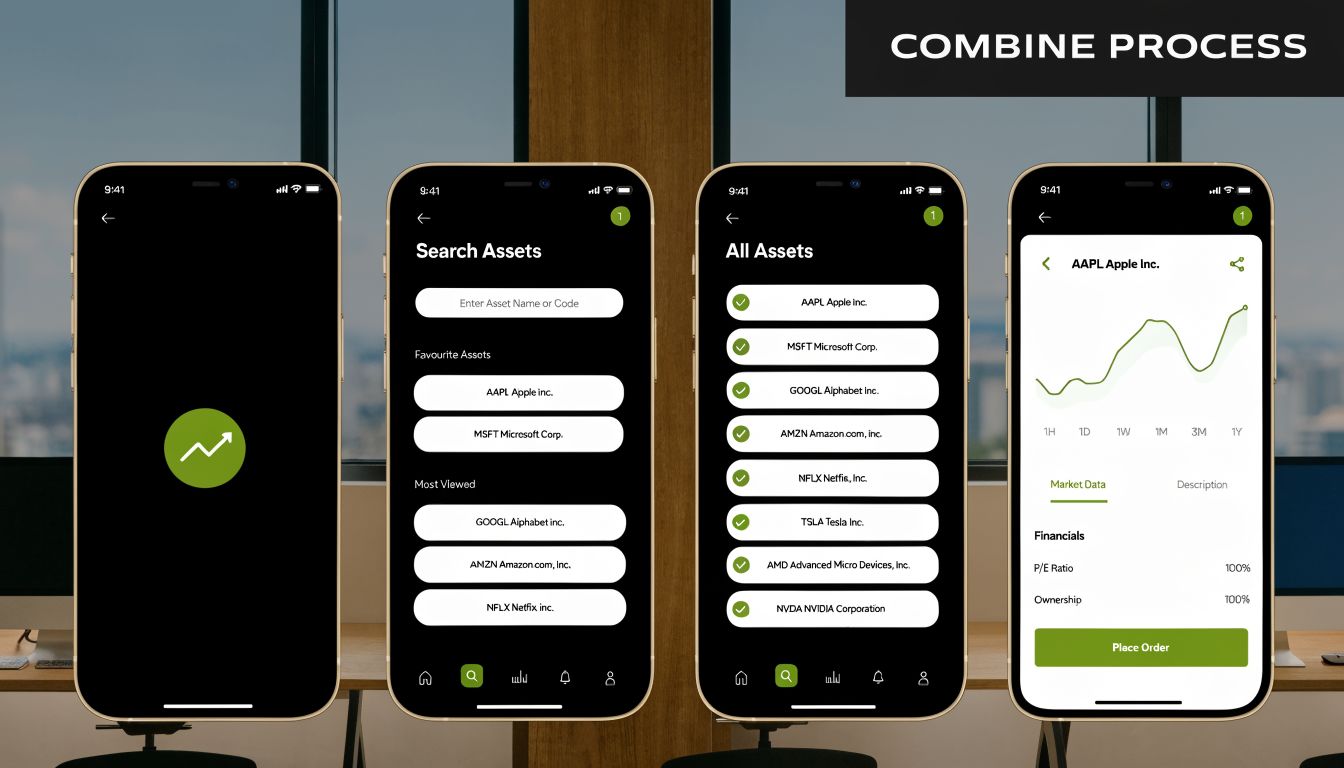
Topstep calls its evaluation the Trading Combine®. The mechanics are simple enough. You choose an account size, pay a monthly fee, trade futures under the firm's rules, and reach the target without disqualifying the account. What matters is how that feels in live use. For a disciplined futures day trader, the model is clear. For anyone who needs more asset choice or more freedom in execution, it can feel narrow fast.
The account sizes and targets
Topstep usually presents three Combine sizes:
| Combine size | Monthly fee | Example profit target |
|---|---|---|
| $50K | $49 | $3,000 |
| $100K | $99 | target scales higher |
| $150K | $149 | target scales higher |
The $50K Combine gives the clearest reference point because the target is stated directly at $3,000. That sounds reasonable on paper. In practice, the number only matters alongside the risk limits and contract caps. Traders who focus on the target and ignore the path usually end up forcing trades.
What passing actually requires
The Combine rewards controlled repetition more than occasional big days.
A trader has to do four things well:
- Pick a size that matches real behavior, not ego.
- Trade within the contract limits and avoid sizing up just to speed up the evaluation.
- Build profit with consistency, because one strong session rarely fixes sloppy risk management.
- Keep the account eligible every day so the attempt stays alive long enough to matter.
That is why Topstep works better for traders who already have a tested futures routine. If your edge depends on rotating between forex, crypto, and indices, or using automation across multiple setups, this process starts to feel restrictive before you are halfway through it.
Why traders fail the Combine
The common mistake is urgency.
Some traders press too hard because they want to finish in a few sessions. Others trade too casually because they assume there is plenty of time to recover. Both habits are expensive inside a paid monthly evaluation.
Topstep's own published statistics show a low pass rate on individual Combine attempts, while repeat participants do better over time. The practical takeaway is straightforward. Persistence helps, but retries are not free. If the first attempt exposed a bad process, paying for another month without fixing that process just turns the evaluation into another trading expense.
Practical rule: Start a Combine only when your recent sim or live sample already fits the rules.
Where the structure helps, and where it doesn't
Topstep deserves credit for clarity. The path is easier to understand than many prop evaluations with layered phases, vague scaling promises, or extra conditions hidden behind the signup page. A manual futures trader can look at the model and know what is required.
That clarity does not make it flexible.
If you trade products like ES or NQ with a rules-based discretionary approach, the Combine can be a useful filter. If you want broader asset coverage, more room for different trading styles, or a setup that better matches multi-market traders, compare that narrow futures path with a Topstep funded account alternative breakdown before committing.
A practical fit check
A discretionary futures trader who journals trades, respects stops, and keeps position sizing steady can use the Combine well. A trader who bounces between markets, loosens risk after a red open, or relies on copied execution usually runs into friction quickly.
That is the honest version beyond the marketing. The Trading Combine is not confusing. It is selective. And that is exactly why it works for some futures traders and wastes time for others.
Understanding Topstep Rules and Risk Limits
A trader can be up on the day, feel in control, and still put the account in danger by misunderstanding how the limits work. That happens with Topstep more often than many reviews admit. The rules are clearer than at many prop firms, but clear rules still punish sloppy execution.
The end-of-day drawdown is the rule that shapes everything
Topstep’s biggest risk-rule advantage for futures traders is the end-of-day drawdown structure. Myfxbook’s Topstep review summary points out why traders prefer this setup to firms that trail the drawdown intraday.
That difference matters in live decision-making.
With an intraday trailing drawdown, a normal pullback in NQ or CL can put the account on life support before the session settles. Topstep gives more room inside the day, as long as the account is still within limits at the close. For a manual futures trader, that is a real edge because it allows trade management instead of forcing defensive exits every time volatility expands.
It also creates a trap. Extra room can tempt traders to hold bad positions too long. The rule helps disciplined traders. It hurts traders who treat breathing room like permission to improvise.
Why some traders perform better under this model
The end-of-day structure tends to fit traders who execute with a plan and know their invalidation before entry. It is especially useful for:
- traders who scale in with predefined risk
- traders working volatile index or energy contracts
- traders who reduce size after a rough open instead of trying to win it back fast
For that group, the account behaves more like a real trading environment and less like a tripwire.
For traders who need broad asset access, looser style constraints, or more flexibility outside the futures-only lane, this is also where Topstep stops fitting. A multi-market trader may be better served elsewhere, including firms such as MyFundedCapital. Topstep is built for futures specialists, not for traders who want one funded setup to cover everything. Even the way firms structure fees and restrictions reflects that broader business model, much like a payment gateway pricing guide shows how the fine print often matters more than the headline rate.
Contract caps matter more than traders expect
Position limits shape strategy from the first trade. Earlier verified summaries note that Topstep sets contract caps by plan. The exact number depends on account size and platform setup.
That limit affects more than maximum exposure. It affects how you scale, how you defend a position, and whether your usual playbook even fits the account. Traders who normally build into size across multiple entries need to map that out before the session starts. If you discover the cap only after a setup is moving, you planned badly.
Three habits help here:
- Set your maximum size before the open
- Build around your average trade, not your best-case trade
- Cut size when market conditions get messy, even if the rules still allow more
The removed daily loss limit does not fix bad discipline
Topstep also removed the Daily Loss Limit for newer TopstepX accounts, as noted earlier in the article. That gives traders more flexibility inside the session.
It does not give bad traders a second life.
Some traders will read that change as freedom. In practice, it raises the importance of self-imposed limits. If your process depends on a hard platform stop to keep you from spiraling, the issue here is not the firm's rule set. It is the lack of a personal loss limit.
How traders usually violate the spirit of the rules
The account usually breaks down before the rule violation shows up on screen. The pattern is familiar.
| Mistake | What it looks like in practice |
|---|---|
| Oversizing after a small green streak | Jumping from controlled execution to target-chasing |
| Letting a winner turn into a problem | Refusing to pay yourself because the day "could be bigger" |
| Using the drawdown as a cushion | Holding weak trades because the account still has room |
| Averaging without a plan | Adding size to avoid taking the loss |
The traders who handle Topstep well treat the risk limits as outer boundaries, not working space. That is the honest divide. If you already trade futures with structure, Topstep’s rules are workable and sometimes better than what competitors offer. If your style depends on broad market access, aggressive recovery trading, or flexible execution across asset classes, the limitations show up fast.
Analyzing Payouts Profit Splits and Pricing
A trader passes the evaluation, sees the profit split, and starts doing the math on future withdrawals. The better question is simpler. How much will this model cost before you get to that point, and does it still make sense if you need more than one attempt?
Topstep’s payout terms are appealing for futures traders who can get through the process efficiently. The firm lets traders keep 100% of the first $10,000 in profits, then shifts to a 90/10 split after that, as noted earlier in the article. That is a real strength. If you are profitable and you reach payout stage, the split is competitive enough to matter.
The catch is that payout terms are not the whole business model. Evaluation fees and post-pass costs decide whether the setup stays reasonable or turns into a slow bleed.
What the evaluation actually costs
Topstep uses a monthly subscription model, with pricing that varies by account size. There is also an activation fee after you pass.
For disciplined traders, that structure can be fine. Passing in a short window keeps total cost under control, and the lower upfront price feels easier to justify than a large one-time challenge fee.
For everyone else, monthly billing is where the optimism tax starts.
A trader who fails once, reviews the mistakes, and comes back with a tighter plan can treat the fee as part of the process. A trader who keeps resetting the same habits is stacking business expenses on top of poor execution. After a few cycles, the evaluation fee matters more than the advertised split.
The pricing trade-off most traders miss
This is one of the clearest dividing lines between Topstep and more flexible alternatives.
Topstep can work well if you already trade futures with a repeatable process and fairly clean execution. If your style is broader, slower, or spread across asset classes, the value gets weaker fast because you are paying recurring fees for a narrow lane. That is where firms like MyFundedCapital enter the conversation. Not because Topstep is bad, but because a futures-only model does not fit every trader who wants funded capital.
I look at prop pricing the same way I look at trading costs. The headline number matters less than the total spend over time, the reset pattern, and the restrictions tied to that spend. A neutral framework like this payment gateway pricing guide is useful for that reason. It pushes the same habit. Examine the full cost structure, not just the first charge.
Who gets the most value from the payout model
Topstep’s pricing and payout setup is strongest for traders who:
- pass in a reasonable time instead of dragging the subscription across several months
- plan to stay inside futures rather than needing forex or broader CFD access
- want a favorable early profit split once funded
- treat the account like a business process, not a lottery ticket with recurring entry fees
Who should think twice
The model gets expensive for traders who need repeated attempts, experiment with inconsistent styles, or want more freedom in what they trade.
That does not make Topstep overpriced across the board. It means the pricing only looks attractive when the trader fits the model.
If you are a structured futures trader, the payout terms are good enough to take seriously. If you want cross-asset flexibility or your learning curve still involves multiple resets, the advertised split can distract you from the more important number. Your total cost to get there.
The Pros and Cons of Trading with Topstep
A trader passes an evaluation on a clean, rule-based futures setup, then realizes a month later that the same structure blocks the way they typically trade. That is the gap in a lot of Topstep coverage. The firm is solid in its lane, but the lane is narrower than the marketing suggests.
What Topstep does well
Topstep works best for traders who want structure, not freedom.
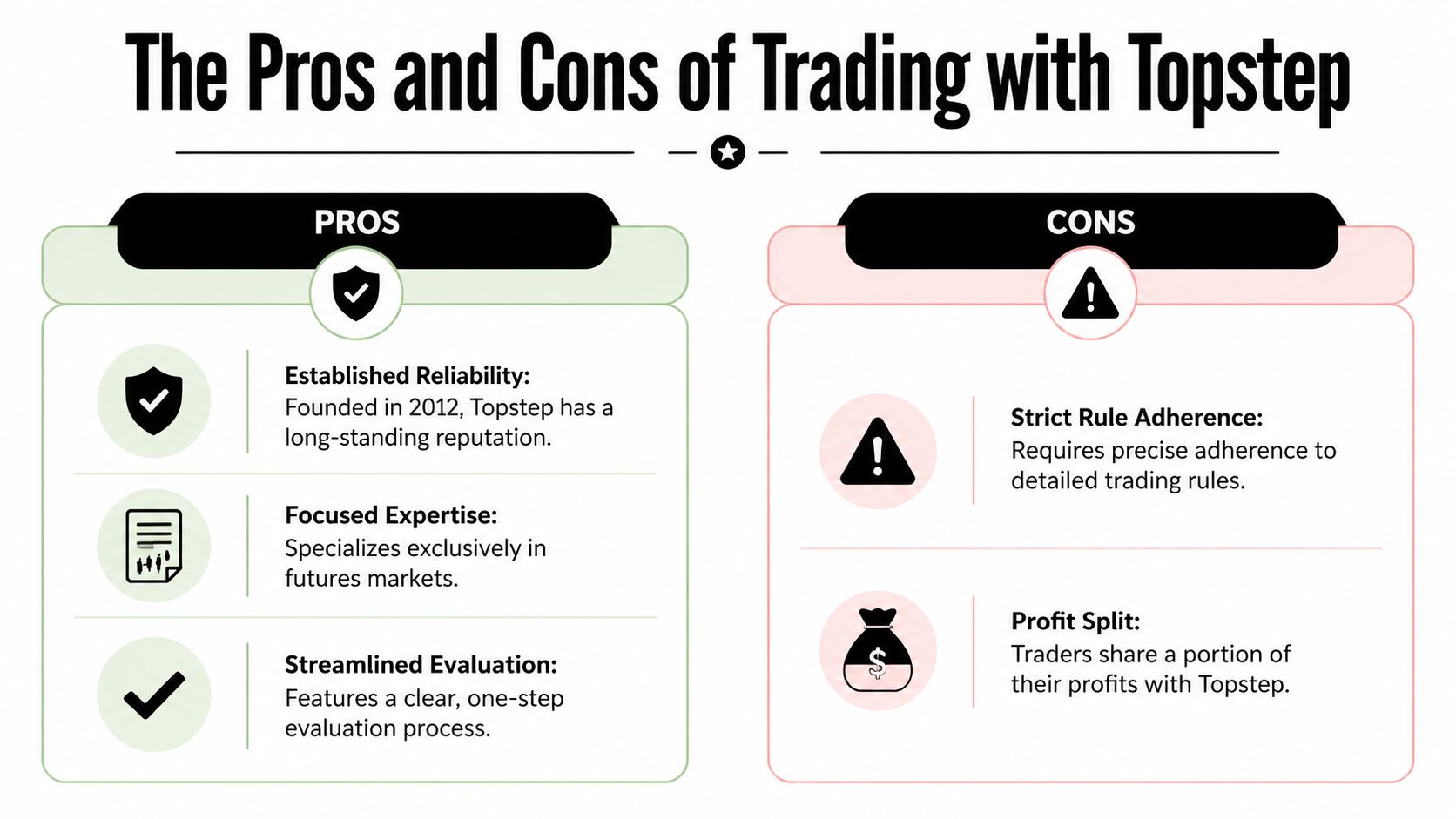
Its strongest advantage is focus. The firm has been around since 2012, and that matters in a prop space where newer brands appear fast and disappear just as fast. More important, it built its process around futures traders instead of stretching into every asset class and every platform type.
That creates a few practical benefits:
- Clear identity: Topstep knows who it serves. Manual futures traders get a model built around their market rather than a generic prop wrapper.
- Rules that are easier to follow: The evaluation is easier to understand than many firms with layered conditions and exceptions.
- Useful risk framework: The end-of-day drawdown setup is more workable than firms that punish normal intraday fluctuation.
- Better fit for process-driven traders: Traders who already have discipline usually adapt to Topstep faster than traders still changing methods every week.
Where the fit starts to break
Topstep's weakness is not legitimacy. It is range.
A lot of traders read a positive Topstep review and assume that means broad suitability. It does not. Topstep is a specialized option for a specific type of trader. If your edge depends on multi-asset access, automation, copy trading, or more flexible execution, the limitations show up quickly.
I would put it this way after comparing multiple prop models. Topstep is often a strong operational choice for discretionary futures trading, but a poor business fit for traders whose strategies need flexibility more than structure.
Key limitations for modern traders
The main trade-offs affect day-to-day execution, not just account setup.
| Strength for some traders | Limitation for others |
|---|---|
| Futures-first environment | No natural fit for forex, crypto, or broad CFD trading |
| Manual trading focus | Weak fit for copy-based or automated workflows |
| Tighter rule structure | Less freedom for unconventional or hybrid trading styles |
| Strong brand recognition | Easier to overestimate how many traders the model actually suits |
These points matter more than branding. A firm can have a long operating history and still be too restrictive for the way many traders work now.
Traders comparing firms should also look beyond brand familiarity and review firms by asset access and execution flexibility, especially if they are considering top proprietary trading firms for different trading styles.
Even adjacent parts of the trading infrastructure have changed faster than firms like Topstep. The rise of products tied to on-chain order book DEX development shows how much demand there is for flexible, technology-driven execution environments. Topstep is not trying to serve that segment, and that is fine. Traders just need to be honest about it.
Who feels these limitations first
Three types of traders usually hit friction early:
- Systematic traders: If the strategy depends on automation or replication, Topstep will feel restrictive fast.
- Cross-asset traders: Traders who move between futures, forex, crypto, and indices usually outgrow a futures-only setup.
- Style-flexible traders: If the edge changes with volatility, session, or market type, a narrower rule set can become a constraint instead of a guardrail.
This is the part many reviews soften too much. Topstep is good at being Topstep. It is not a universal funded account solution.
For a disciplined discretionary futures trader, that specialization can be an advantage. For everyone else, especially traders who want broader instruments or more flexibility, alternatives such as MyFundedCapital may be closer to how they trade.
Topstep vs Competitors MyFundedCapital and Others
The easiest way to decide on Topstep is to stop asking whether it’s good and ask whether it matches your trading workflow.
If you’re a manual futures trader, it may. If you trade forex, crypto, indices, use algorithms, or want copy-trading support, the answer changes quickly.
Topstep vs MyFundedCapital at a Glance
The verified data from DailyForex’s Topstep review makes the key limitation explicit. Topstep is a futures-only environment and lacks support for non-futures assets and modern methods like EA/copy trading, while firms such as MyFundedCapital offer 350+ instruments, support for Forex, CFDs, and Crypto, and platform options like cTrader and DXtrade.
| Feature | Topstep | MyFundedCapital |
|---|---|---|
| Tradable markets | Futures only | Forex, CFDs, crypto, commodities, indices |
| Trading style fit | Best for discretionary futures traders | Broader fit across manual, algo, and copy styles |
| Platform flexibility | Narrower platform path | DXtrade and cTrader support |
| Automation | Not suitable for EA/copy workflows | Supports algorithmic and copy trading |
| Evaluation choice | Structured futures evaluation | Instant, 1-step, and 2-step paths |
| Trader profile | Futures specialist | Multi-asset trader who wants flexibility |
Why this matters in the real world
A lot of traders don't fail because they're unskilled. They fail because they choose a prop model that conflicts with how they naturally trade.
If your edge depends on holding crypto through event volatility, running an automated forex model, or using broader CFD exposure, forcing yourself into a futures-only prop setup usually creates friction from day one. You end up changing the strategy to fit the firm instead of choosing a firm that fits the strategy.
That’s also why traders interested in exchange-style crypto infrastructure sometimes look into topics like on-chain order book DEX development when comparing how different trading environments are built. It sharpens your understanding of market structure and execution design, especially if you’re moving between centralized futures and crypto-native venues.
A practical selection filter
Use this quick filter:
- Choose Topstep if: you only want futures and trade manually with tight self-control.
- Look elsewhere if: you want asset variety, automation support, or more challenge formats.
- Compare before paying: a shortlist of top proprietary trading firms is more useful than locking in on the biggest brand first.
At this stage, one mention of the publisher is relevant. MyFundedCapital is one of the firms that serves the traders Topstep leaves out, especially those who want simulated funding across more instruments with support for manual, algorithmic, and copy trading. That doesn't make it better for every trader. It makes it a better fit for a different kind of trader.
The Verdict Who Should and Should Not Use Topstep
Topstep is not a scam. It is not a magic shortcut either. It’s a specialized futures prop model with clear strengths and clear blind spots.
Topstep is a strong fit if you are this trader
You’ll likely get the most from Topstep if you:
- Trade futures by choice, not by compromise
- Execute manually and don't rely on copy systems
- Want a structured evaluation with defined risk boundaries
- Can handle challenge pressure without turning every day into a pass-or-fail drama
For that trader, Topstep can be a clean environment. The firm’s futures focus and more practical drawdown structure make sense.
Topstep is a poor fit if you trade this way
You should probably look elsewhere if you:
- Trade forex, crypto, or broader CFD markets
- Use algorithmic systems or copy-trading workflows
- Need more flexibility in how you hold or manage positions
- Want multiple funding paths instead of one narrow route
That’s the brutally honest version of this top step trader review. Topstep works best for a disciplined futures trader who already knows exactly what they trade and why. It works poorly for the trader who wants freedom across markets, methods, and platforms.
The right prop firm should reduce friction between your strategy and the rules. If the rules force you to become a different trader, keep looking.
Trading involves risk of loss. Prop evaluations also carry business risk because failed attempts cost money. This article is for educational purposes only and is not financial advice.
Frequently Asked Questions About Topstep
Can you use EAs or copy trading with Topstep
No. Based on the verified data discussed earlier, Topstep is not a fit for traders who depend on automated strategies or copy trading. If that’s central to your workflow, this is one of the first reasons to exclude it from your shortlist.
What happens if you fail the Trading Combine
The practical result is that you need to pay again through the firm’s evaluation structure, either by resetting or starting another paid attempt depending on the account path you’re using. That’s why failed combines should be treated as a business expense, not just a trading setback.
If you aren't journaling the exact reason for each failure, you're likely to repeat it.
Is Topstep a broker
No. Topstep is better understood as an evaluation and funding firm for traders rather than a standard retail brokerage account where you deposit capital and trade freely under broker terms.
That distinction matters because you are trading inside a rule framework designed to assess performance, not just placing trades in an unrestricted personal account.
Is Topstep good for beginners
It can be useful for beginners who already want to specialize in futures and are serious about risk control. It’s a poor fit for beginners who are still exploring markets, switching between strategies every week, or trying to learn while under challenge pressure.
For newer traders, the smartest move is usually to stabilize your process first, then pay for an evaluation.
If Topstep feels too narrow for the way you trade, take a look at MyFundedCapital to compare funding paths, account types, and supported trading styles before you commit to another challenge.
