You're probably in one right now. A Discord full of charts, a Telegram full of alerts, or a forum where half the posts look smart until you try to trade them live.
A proper community comparison helps you separate noise from operational value. The right community won't hand you magic entries. It will help you protect risk, stay disciplined, and avoid the kind of avoidable mistakes that end trading careers early.
| Community factor | What to check fast | What good looks like | Why it matters to traders |
|---|---|---|---|
| Operational health | Are questions answered, and by whom? | Members help members, not just admins | Strong peer support reduces dependence on one guru |
| Psychological safety | Can traders discuss losses without getting mocked? | Calm review of bad trades and rule breaches | You learn faster when ego isn't driving the room |
| Information quality | Are claims challenged and verified? | Members ask for context, charts, and rules | Bad info costs money fast |
| Platform fit | Does the platform match your workflow? | Discord for live flow, Telegram for alerts, forums for archives | Good structure saves time during market hours |
| Accessibility | Is support usable for your platform and language needs? | Clear resources, platform-specific help, multilingual support | Traders fail when they can't get clear answers |
Why Your Trading Community Can Make or Break Your Career
Most traders start alone. You test setups, scroll social feeds, second-guess your entries, and absorb ten conflicting opinions before London open. That isolation creates two bad habits fast. You either trust nobody, or you trust the loudest person in the room.
A serious trading community fixes neither problem by giving you “calls.” It helps by creating a place where risk gets discussed in plain language, losing days get reviewed without theater, and traders can compare process instead of bragging about screenshots.
What a healthy community actually does
A strong group improves your trading in practical ways:
- Pressure-tests ideas If you post a setup, competent traders challenge your bias, timing, and invalidation.
- Normalizes discipline Taking a small loss stops feeling like weakness when other traders do the same.
- Reduces panic trading During drawdown, calm peers matter more than motivational quotes.
- Builds repeatable habits Journaling, review, rule-checking, and execution discipline spread through culture.
That last point matters more than most beginners think. Communities shape behavior. If the room rewards patience, clear risk limits, and clean execution, people tend to trade better. If it rewards bravado, revenge trading follows.
A trading community should feel more like a risk desk than a fan club.
There's a broader lesson here. Existing community comparison content often misses the specific pressure traders face inside prop environments. Research from other fields shows strong, culturally competent communities can improve retention and reduce costs, which supports the idea that trading communities with transparent rule structures, including limits such as a 5% daily loss discussion framework, are better positioned to retain members through support and clarity rather than hype (community-based retention findings).
What weak communities do to your decision-making
Bad communities usually look “active” on the surface. Messages fly. People post profits. Admins keep the room moving. None of that means the environment is useful.
What fails in practice:
- Crowded rooms with no filter Activity without quality burns your attention.
- Groupthink When nobody can disagree, bad ideas spread unchecked.
- Hero worship One personality becomes the strategy.
- Shame around losses Traders hide mistakes instead of fixing them.
If you're trying to build a durable routine, study how good operators create trust and participation, not just volume. This guide on strategies for authentic online engagement is useful because it focuses on real interaction quality rather than vanity metrics. For a trader-first example of peer learning in action, it also helps to look at communities built around the idea of traders helping traders.
Stop judging by member count
A big room can still be useless. A smaller room with strong moderation, clear expectations, and honest post-trade discussion often produces better traders.
That's the shift that matters. Don't ask, “How many people are in this community?” Ask, “Does this place make me more disciplined, more informed, and less likely to do something stupid under pressure?”
Trading involves risk of loss. A community can reduce avoidable mistakes, but it can't remove market risk. This content is educational only and not financial advice.
The Ultimate Scorecard for Your Community Comparison
Most traders compare communities the wrong way. They look at size, branding, or whether a few members post big wins. None of that tells you whether the place is operationally healthy.
Use a scorecard instead.
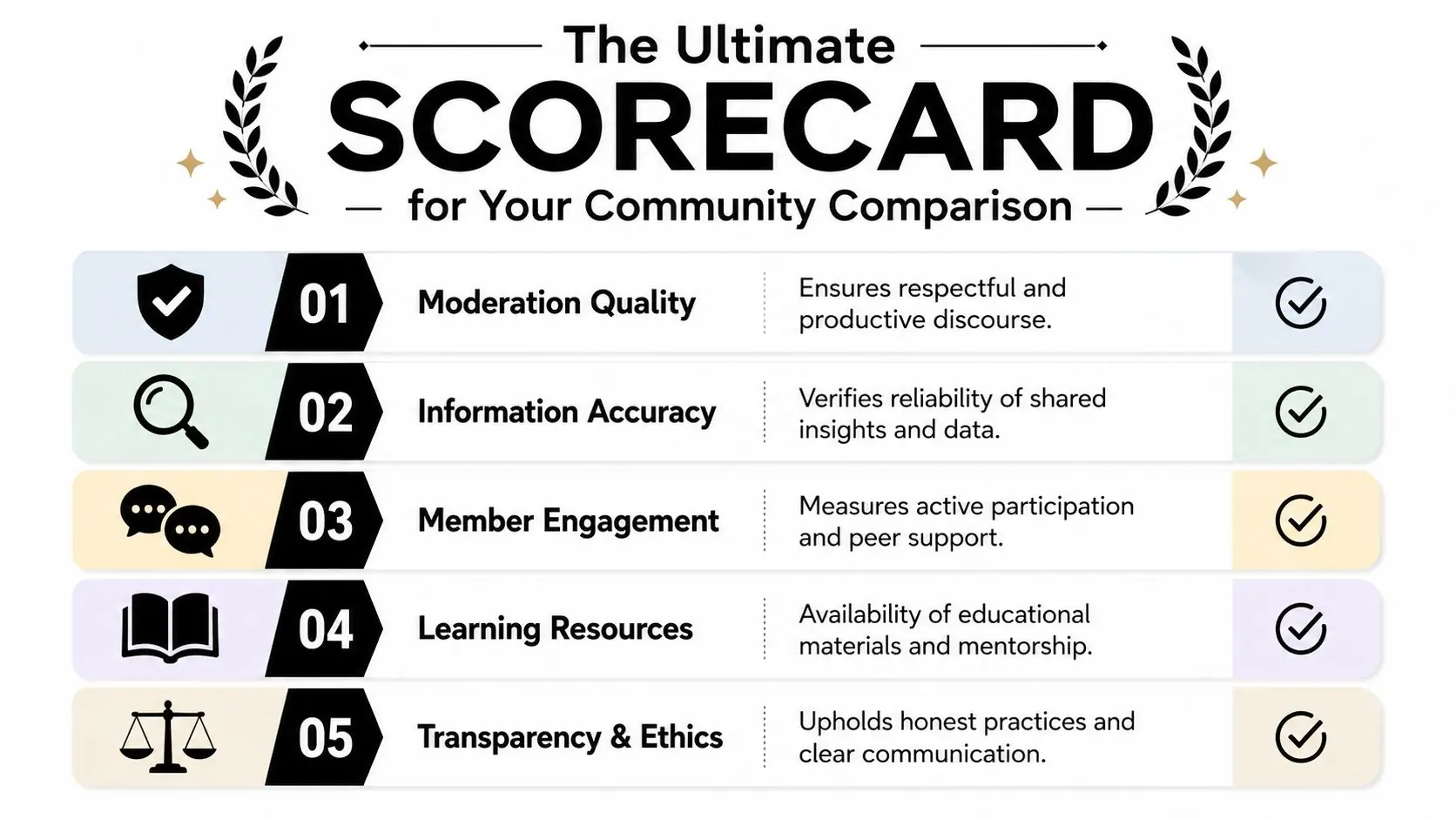
The metrics that matter
Start with support behavior, not vibes. In community benchmarking, the Peer-to-Peer Support Ratio matters because it shows how often members solve problems for each other instead of waiting for staff. A ratio above 40% signals a self-sufficient community. You should also watch Time-to-First-Response, where under 2 hours is a good target, and Accepted Solution Rate, where over 85% is excellent. Those support benchmarks are associated with a 20 to 30% reduction in support tickets in strong communities (community benchmark guide).
For trading communities, those numbers translate into simple questions:
- When someone asks about rule interpretation, does another trader answer correctly before staff arrives?
- If a member has a platform issue before a session, does the room react quickly enough to matter?
- Do answers solve the problem, or just create more chatter?
How to score a community by observation
You don't need admin access to evaluate most of this. You can test a room in a few days.
Moderation quality
Look at how moderators handle bad behavior and bad information.
Good signs:
- They remove dangerous nonsense Fake payout claims, reckless sizing advice, and rule myths get challenged.
- They keep debate productive Traders can disagree without the chat turning tribal.
- They enforce standards evenly Friends of admins don't get a free pass.
Bad sign: moderation exists only to protect the brand.
Information accuracy
Watch what happens when someone posts a strong claim. In a healthy room, other members ask for context, screenshots, rules, or logic. In weak rooms, people repost it and move on.
That same discipline shows up in crypto communities too. If you want a cleaner framework for how community participation and incentives influence behavior, this explainer on understanding governance tokens is worth reading because it makes governance visible instead of treating communities like random crowds.
Practical rule: If nobody asks “why,” the room will eventually punish people who should have asked.
Member engagement
Many traders get fooled by superficial activity. A channel can look busy and still be hollow. What you want is repeated, useful participation from people who return and contribute over time.
Check for:
- Returning contributors The same capable members show up across different periods, not just during hype.
- Thread follow-through Members return to close the loop after asking for help.
- Peer coaching Traders explain process, not just outcomes.
Learning resources and archives
A real community stores knowledge. It doesn't force every new member to ask the same questions from scratch.
Look for:
- Pinned rules and platform guides
- Recorded sessions or written breakdowns
- Searchable channels or forum archives
- Examples of reviewed mistakes, not just winning trades
Transparency and ethics
A trustworthy community is clear about incentives, moderation, and boundaries.
Ask yourself:
- Are educators also selling something in every second post?
- Are losses discussed transparently?
- Are rules explained clearly, especially around execution and evaluation constraints?
A simple pass-fail filter
If a community is strong in only one area, it's not strong. The useful rooms usually clear all five:
- Moderation
- Accuracy
- Engagement
- Resources
- Transparency
That's what makes a community comparison worth doing. You're not evaluating popularity. You're evaluating whether the room is structured to help you trade with more discipline over time.
Trading involves risk of loss. No community scorecard can protect you from poor execution or oversized risk. This content is educational only and not financial advice.
Discord vs Telegram vs Forums A Trader's Showdown
A platform changes how traders behave. That matters more than people admit. The same members can look disciplined in one format and chaotic in another because the tool shapes the flow.
Here's the practical view.
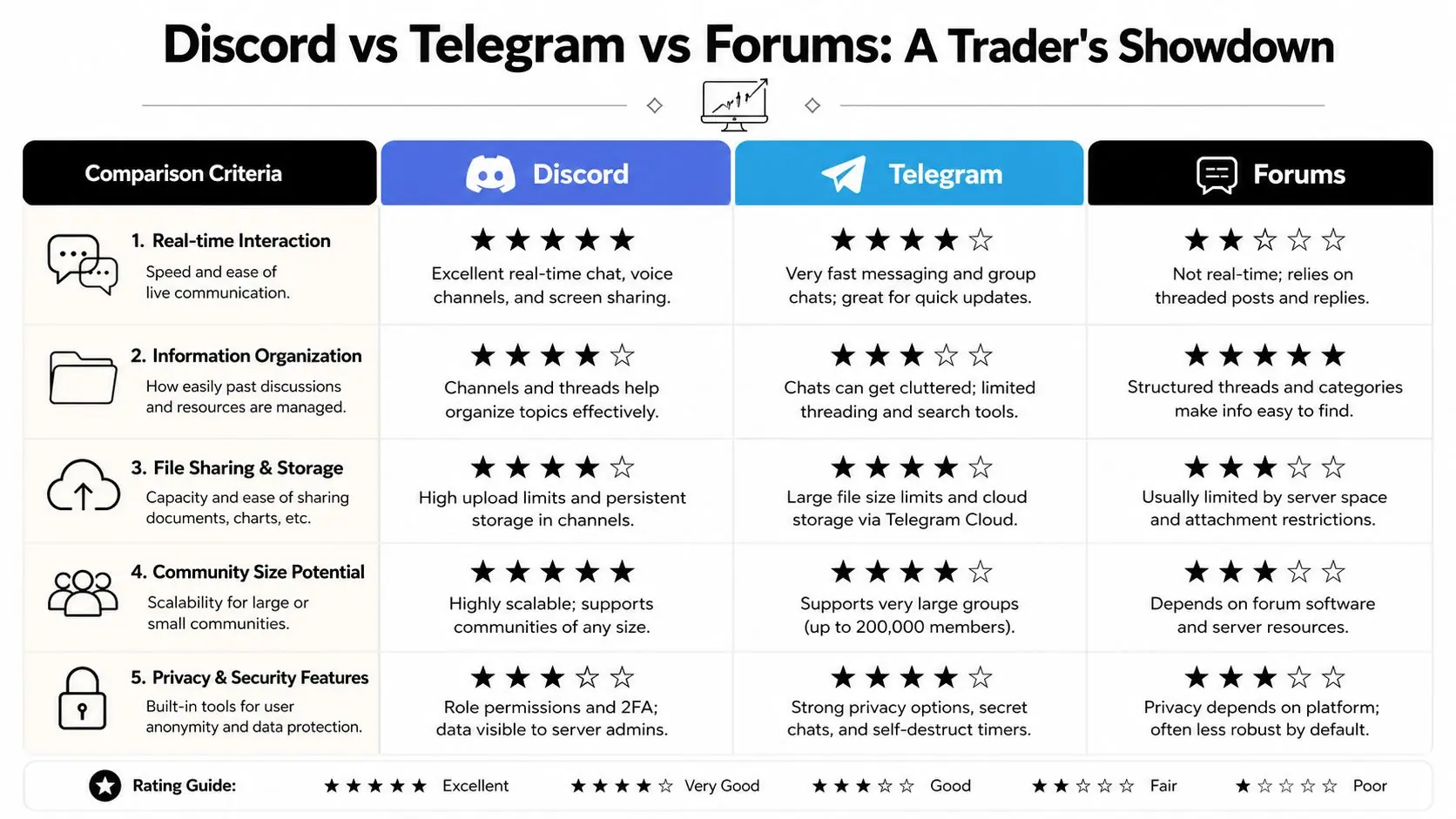
Quick platform comparison
| Platform | Best use | Main strength | Main weakness | Best for |
|---|---|---|---|---|
| Discord | Live collaboration | Channel structure and real-time discussion | Can get noisy fast | Intraday traders, live sessions, team-style review |
| Telegram | Fast alerts | Speed and mobile convenience | Weak archives and poor long-form organization | News-sensitive traders, quick updates |
| Forums | Deep research | Searchable, durable knowledge base | Slower conversation | Strategy development, post-trade analysis, journals |
Discord as the virtual trading floor
Discord works best when traders need separate spaces for live setups, post-trade review, platform support, and rule questions.
For active trading communities on Discord or Telegram, two viability signals matter a lot: Response Rate and Unanswered Question Rate. Healthy communities should keep response rate above 90% and unanswered questions below 5% (community growth metrics benchmark).
Discord makes that easier when it's well organized. Channels let you separate topics that would otherwise collide:
- Execution rooms Good for live market commentary
- Journal channels Better for accountability
- Platform help rooms Useful when someone needs a quick operational answer
- Voice chat Strong during volatile sessions
Where Discord fails is obvious. Too many channels, weak moderation, and nonstop notifications turn it into a second market noise feed. If you want to see how some traders use that structure in practice, this example of a day trading Discord shows why organization matters as much as activity.
Telegram as the fast alert pipe
Telegram is useful when speed matters more than structure. If you need quick updates on news, schedule changes, or immediate alerts, it does the job well.
Best use cases:
- Breaking market headlines
- Brief trade alerts
- Mobile-first updates
- Short bursts of communication
The problem is memory. Good conversations disappear into the feed. New traders join, ask the same question, and get a different answer every time. That's not ideal for rule-heavy environments or for strategies that need careful explanation.
Forums as the trading library
Forums are where complex ideas survive long enough to be challenged properly.
If someone wants to explain an execution model, break down a week of trades, or document a strategy with screenshots and follow-up replies, forums still do that better than chat apps.
Forums fit:
- Long-form strategy posts
- Detailed trade reviews
- Searchable rule discussions
- Persistent journals
They're slower, but that's part of the advantage. Slower formats reduce impulse posting and make it easier to evaluate ideas on merit.
Which one should you choose
Don't ask which platform is “best.” Ask which platform fits your actual workflow.
Pick Discord if you want live interaction during market hours.
Pick Telegram if you care about immediate mobile alerts.
Pick Forums if you need depth, archives, and serious study.
Most solid trading ecosystems use more than one. The mistake is expecting one tool to do everything well.
Trading involves risk of loss. Fast communication can help execution, but it can also amplify bad decisions when traders act on incomplete information. This content is educational only and not financial advice.
Seven Red Flags That Signal a Toxic Trading Community
Some communities don't fail loudly. They fail by bending your standards a little at a time. You stop journaling. You widen stops. You chase what worked for someone else. A month later, your process is gone.
That's why red flags matter.

The warning signs worth leaving over
Every conversation circles back to money screenshots
If proof of competence is always a payout image or a single winning day, the room is training your attention on outcome, not process.Losses are mocked
Traders need room to discuss bad execution, missed stops, and emotional mistakes openly. Shame kills that. Then people hide risk instead of managing it.One guru controls the narrative
If nobody can question the main voice, the community isn't a learning environment. It's an audience.Moderation is opaque
Rules apply to some people, not others. Posts disappear without explanation. Staff correct criticism but ignore misinformation. That usually means brand control matters more than trader welfare.
The subtle ones newer traders miss
Risk management gets treated like weakness
Any room that laughs at small losses or disciplined sizing will eventually produce traders who blow up trying to fit in.Everything is an upsell
The “free” community exists only to funnel people into courses, VIP channels, or secret signals. Education becomes a pretext, not the product.Nobody revisits bad calls
In healthy rooms, bad trades get reviewed. In toxic rooms, failed ideas vanish and the chat moves on.
If a community can't examine its own bad decisions, it can't help you improve yours.
Why these red flags are expensive
The damage isn't just emotional. Toxic rooms distort your decision-making:
- You overtrade to match the room's energy
- You stop respecting your plan
- You borrow conviction you haven't earned
- You take bigger risks to avoid looking timid
That's especially dangerous for traders already dealing with evaluation rules, platform constraints, or pressure to recover after a bad day. If you want to see how traders openly discuss account models and community quality outside official channels, browsing places where people compare funded trading accounts on Reddit can help you spot recurring complaints and patterns.
Leave faster than you think
A lot of traders stay too long because they think they can “filter out the noise.” Usually they can't. Repeated exposure changes behavior.
If the room makes you more impulsive, more defensive, or more focused on proving yourself than following your process, that's enough reason to go.
Trading involves risk of loss. A toxic community adds behavioral risk on top of market risk. This content is educational only and not financial advice.
Your Actionable Checklist to Find the Right Prop Firm Community
When you're comparing prop firms, don't stop at pricing, payouts, or challenge structure. Run a community comparison with the same seriousness you'd use for a strategy backtest. You're judging the operating environment around the trader, not just the product.
A useful checklist starts with what usually gets ignored.
Support and accessibility
Some traders can handle rough edges. Most perform worse when support is unclear, slow, or platform-blind.
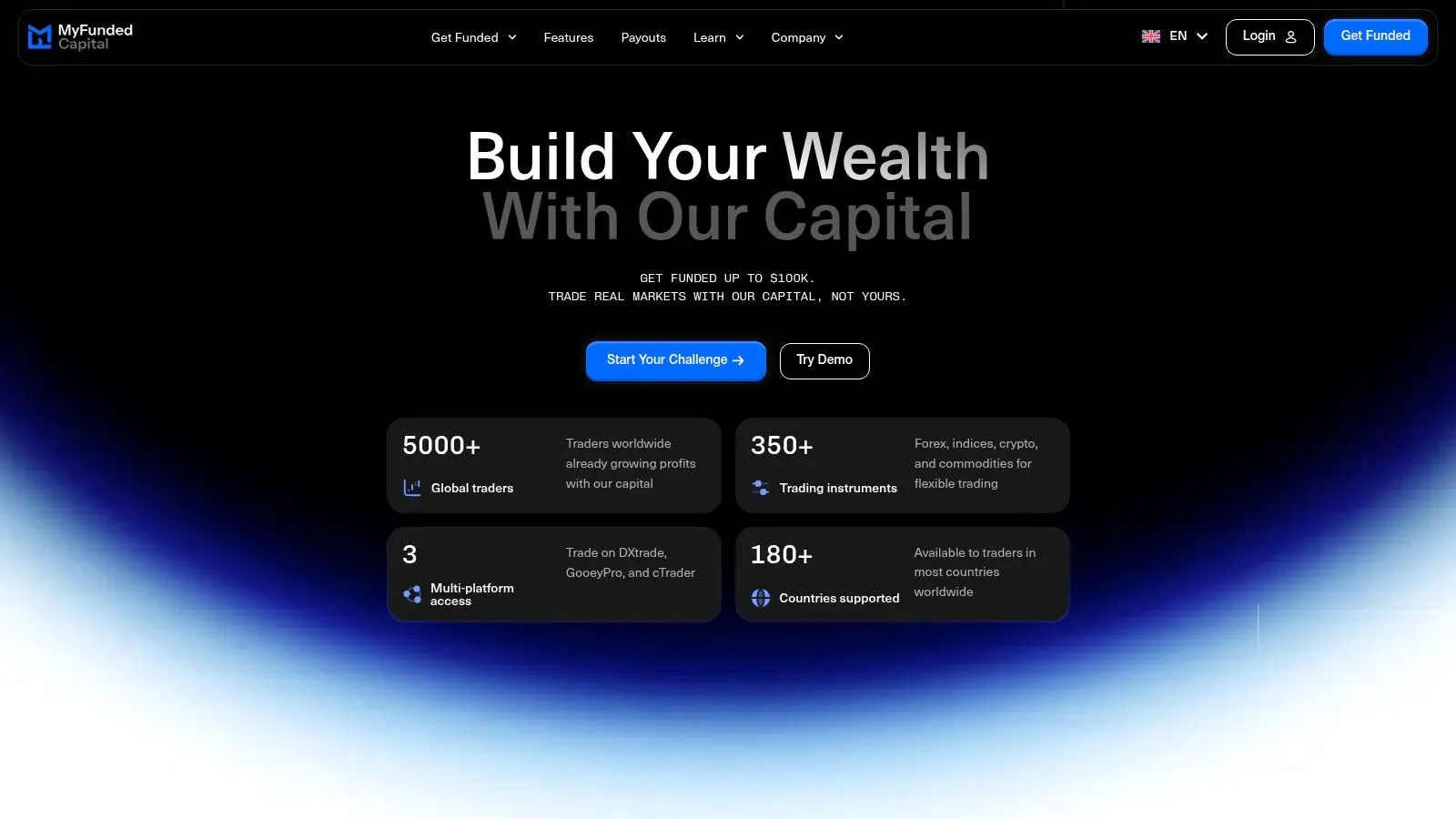
One of the most overlooked points in community comparison is platform migration pain. Traders moving from MT4 or MT5-focused environments into tools like cTrader or DXtrade often run into compatibility questions, workflow changes, and resource gaps. Community comparison should also check multilingual support and platform-specific help because underserved users, including non-English speakers, need alternate paths to get clear answers (access and underserved participation considerations).
Use this checklist:
- Platform fit Are there community resources for your actual platform, not just generic trading talk?
- Migration help Can members explain practical differences when switching platforms?
- Language access Can non-native English speakers get usable support?
- Support visibility Are answers public and searchable, or trapped in private tickets?
Quality of information
A prop firm community gets stress-tested when traders ask boring questions. Not flashy strategy questions. Operational ones.
Check for:
- Rule clarity Are challenge rules explained consistently?
- Execution realism Do traders discuss slippage, timing, and discipline, not just targets?
- Historical answers Can you search old threads and find solid explanations?
- Correction culture When someone gives a wrong answer, does the room fix it quickly?
The best prop communities don't just explain how to pass. They explain how not to fail for stupid reasons.
Community culture under pressure
Rigorous due diligence occurs. Markets expose culture fast.
Ask:
- What happens after a trader breaches a rule?
- Do members review mistakes calmly?
- Can someone say “I messed up” without getting clowned?
- Are traders encouraged to reduce size, step back, and reset?
A healthy room usually has a professional tone during ugly sessions. Not cold. Just composed.
Your field test before you commit
Don't join and immediately trust the marketing. Observe.
Try this short test:
- Lurk for a few days Watch how people ask for help.
- Search old threads Look for recurring complaints and how they were handled.
- Ask one specific question Make it operational, not broad.
- Measure the reply quality Did you get a real answer or canned reassurance?
- Review the archives See whether knowledge compounds or disappears.
The final pass-fail decision
A prop firm community is worth your time if it gives you:
- Clear answers
- Usable platform guidance
- Respectful accountability
- Calm behavior during losses
- Resources you can revisit
If it only gives you excitement, that's not support. That's stimulation.
Trading involves risk of loss. A better community can improve your operating conditions, but it can't remove the consequences of poor risk control. This content is educational only and not financial advice.
Trader Community FAQs and Your Next Step
A few questions usually come up once traders start taking community comparison seriously. The answers below matter because they affect how useful the room becomes for you, not just whether it looks good on day one.
Should I join a free or paid trading community
Neither is automatically better. Free communities often give you a wider sample of real member behavior, which makes them easier to evaluate. Paid communities sometimes filter out tourists, but they can also create false authority.
Judge the room by standards, not price:
- Are questions answered well?
- Can members disagree openly?
- Do you see actual review and education?
- Is the payment for access, or for hype?
How do I contribute without oversharing my trades
Post process, not ego. Share your setup logic, risk plan, invalidation, and what happened after the trade. You don't need to post size, account balance, or every live position.
Useful contribution looks like this:
- Before trade market context and plan
- After trade what confirmed or invalidated the idea
- On mistakes what rule you broke and how you'll prevent it next time
That kind of posting helps the room and sharpens your own discipline.
Why do prop communities talk so much about daily loss limits
Because the rule is unforgiving. Proprietary trading firms typically enforce a 5% daily loss limit based on the day's starting equity, and breaching it even briefly can mean immediate failure in evaluation or suspension on a funded account (daily loss limit explanation).
That's why experienced communities keep coming back to it. It isn't paranoia. It's operational survival. A trader who ignores that rule can be technically right on market direction and still lose the account through bad intraday risk control.
Do bots and AI improve trading communities
They can, if the community uses them for structure instead of replacing judgment. Bots are useful for alerts, FAQs, channel organization, and reminders. AI can help summarize discussions or draft study notes.
But neither replaces experienced review. For actual skill development, human mentorship still matters. If you want a grounded look at how structured guidance can accelerate learning without turning into hero worship, this piece on unlock trading potential with mentorship is a useful companion read.
What makes someone a good community member
Consistency. Good members don't just post winners. They answer questions, correct misinformation carefully, and leave the room better organized than they found it.
A strong community comparison isn't just about what you get. It's also about whether the environment attracts traders who take responsibility for their own process.
Trading involves risk of loss, and no community removes that. The right one can help you build discipline, reduce avoidable mistakes, and stay clear-headed when pressure rises. This content is educational only and not financial advice.
If you want a prop firm built around clear rules, practical trader support, and a real community culture, explore MyFundedCapital. Compare the funding programs, review the account types, and start a challenge when you're ready to trade with structure instead of noise.