Many skilled traders have a working strategy but lack the capital to generate significant returns. An option trading prop firm can solve this by providing the funding, allowing you to trade and split the profits. This guide explains how to navigate this space, find a suitable firm, and understand the rules to get funded.
The Problem of Undercapitalization in Trading
If you’ve developed a solid options strategy, you’ve likely hit the biggest hurdle for most traders: a small account. Trying to generate a real income or grow your account meaningfully with just a few thousand dollars is a slow, frustrating process.
This lack of capital often leads to poor trading habits:
- Over-leveraging Risking too much on a single trade in the hope of a large, account-changing win.
- Limited Strategies Complex, risk-defined strategies like iron condors or multi-leg spreads are often unavailable due to high margin requirements.
- Psychological Pressure Trading with your own savings is stressful and can lead to emotional, and often costly, decisions.
The Proprietary Trading Firm Solution
A proprietary trading firm, or "prop firm," is designed to solve this capital problem. Instead of risking your own money, you trade the firm's simulated capital after passing an evaluation that proves your skill and discipline. Once funded, you keep a large share of the profits, typically between 70% and 90%.
This is a partnership: the firm provides the buying power, and you provide the trading strategy. This model allows you to scale your skills without the personal financial risk associated with trading your own capital. To learn more, check out our guide on how proprietary trading firms work.
The prop trading industry has grown rapidly, but this growth has included instability. Many firms disappeared in 2024 due to unsustainable business models. This history underscores the importance of partnering with established firms with a proven track record. Diligent research is non-negotiable before paying for any evaluation.
How Options Prop Firms Compare to Forex and Futures
When exploring prop trading, you'll find that firms differ significantly based on the assets they offer. For an options trader, understanding these distinctions is the first step to finding a realistic path to funding. The proprietary trading industry is largely segmented by asset class, with futures-based models gaining prominence, especially in the United States, due to regulatory factors.
The CFD and Regulatory Divide
One of the biggest reasons you'll struggle to find a true option trading prop firm is because of Contracts for Difference (CFDs). Many firms claiming to offer stocks and options are actually providing them as CFDs. A CFD is a contract that lets you speculate on an asset's price movement without ever owning the underlying asset.
While CFDs are common globally, they are banned for US residents for single stocks and ETFs. This regulatory wall has split the prop firm market. For example, "stock trading prop firm" generates about 1,500,000 global searches, yet fewer than five active firms serve US traders. In contrast, futures prop firms see 1,200,000 searches and support over 20 firms, as they operate within US regulations.
This disparity reveals that most "stock" and "options" firms are CFD providers, which excludes a large segment of traders. You can dig deeper into prop firm market statistics to see how these trends have shaped the industry.
This is the classic journey for a trader looking to get funded.
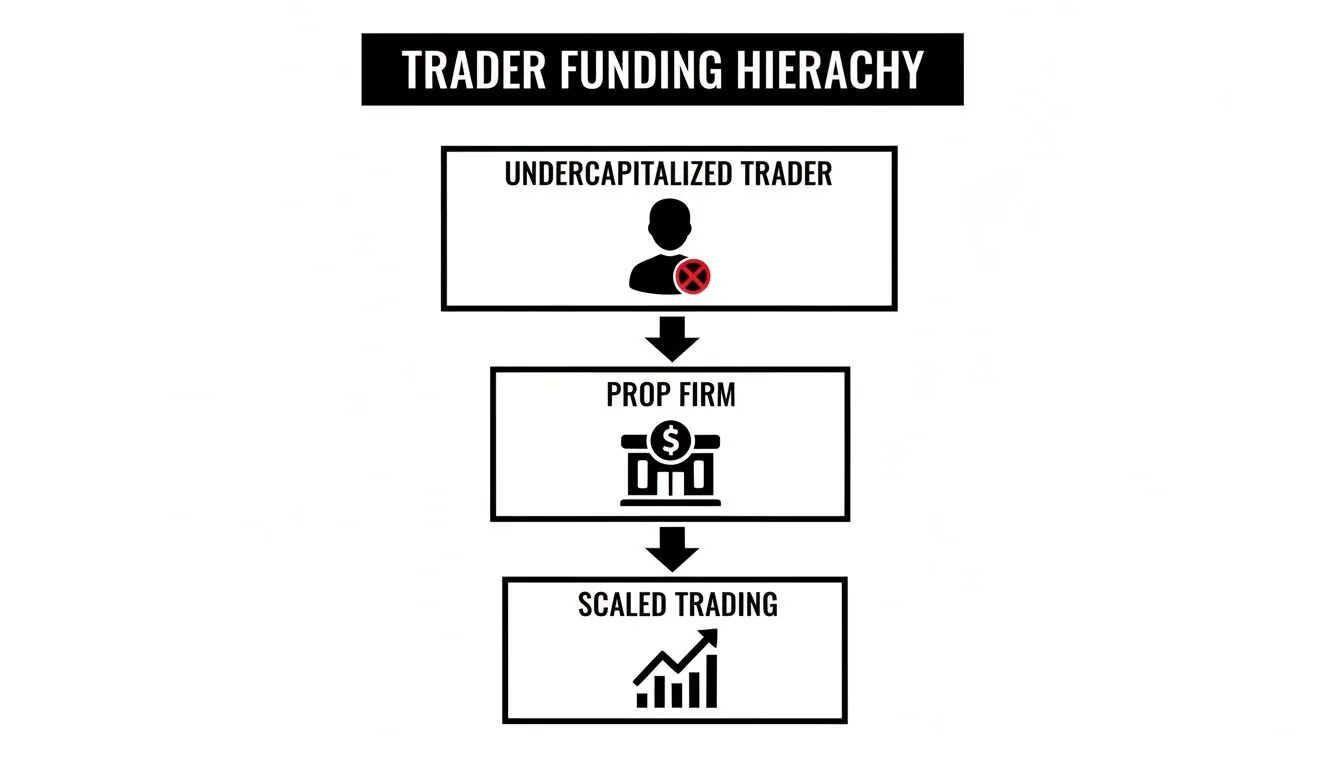
A prop firm acts as a bridge, connecting a talented but undercapitalized trader with the funding needed to trade at a meaningful scale.
Prop Firm Models at a Glance
To put it all into perspective, it helps to see the different models side-by-side. Each one comes with its own set of rules, assets, and overall trading environment.
| Feature | Forex/CFD Prop Firms | Futures Prop Firms | Options Prop Firms (often CFD-based) |
|---|---|---|---|
| Primary Instruments | Currency Pairs, Indices, Commodities | Index, Commodity, & Currency Futures | Stock/Index Options (or CFDs on them) |
| Regulation | Often operate in less-regulated zones | Access regulated exchanges (e.g., CME) | Varies; CFD-based models avoid US |
| US Trader Access | Limited (especially for stock CFDs) | Widely available and very popular | Very rare for direct listed options |
| Transparency | Can be opaque; "B-Book" models | High; traded on public exchanges | Depends; direct is transparent, CFDs less so |
| Commonality | Most common type globally | Dominant in the US market | Rarest and most difficult to find |
As the table shows, the path for a US-based trader interested in equities or their derivatives is often directed toward the futures market due to accessibility and regulation.
Asset Access and Trading Conditions
Beyond the high-level structure, the day-to-day trading experience varies significantly between firm types.
- Forex/CFD Firms The most widespread type, offering high leverage and a vast list of assets. However, their business models can sometimes lack transparency.
- Futures Firms Extremely popular in the US, these firms provide access to regulated exchanges. Many traders prefer futures for their transparent pricing and execution.
- Options-Focused Firms A genuine option trading prop firm offering direct access to listed options is incredibly rare. Those that exist are often CFD-based or have high entry barriers, making them inaccessible for most traders.
This means most aspiring options traders must adapt. Instead of trading options directly, you can apply your analytical skills to other instruments. For instance, index CFDs (like US30 or SPX500) let you trade your directional views on the broader market, which is the foundation of many options strategies.
Know the Rules or Get Disqualified: What to Look For

Before paying an evaluation fee, you must master the firm’s rulebook. These rules are not suggestions; they are automated tripwires. Breaking a rule results in immediate disqualification. Understanding these rules is more critical than your trading strategy itself, as a profitable system is useless if it violates the firm's risk parameters.
The number one reason traders fail is drawdown. Let's look at the specifics.
Daily and Maximum Drawdown
The daily drawdown is the maximum loss allowed in a single trading day, typically set at 5% of the starting balance. On a $100,000 account, if your equity drops by $5,000 at any point—even for a moment in an open position—the account is breached, and the challenge is over.
The maximum drawdown is the total loss your account can sustain, often around 10%. It's crucial to know if this is a static limit based on your initial balance or a trailing limit. A trailing drawdown is far more restrictive.
A trailing drawdown means your stop-out level moves up with your account's highest point. If you make a profit, your effective risk tolerance shrinks. This can be a trap for traders who need to give positions room to move. Always clarify if the drawdown is static or trailing.
Profit Targets and Key Restrictions
To pass, you must also hit a profit target. A one-step challenge might require a 10% gain, while a two-step challenge could ask for 8% in phase one and 5% in phase two. However, hitting these targets is irrelevant if you've already breached a drawdown limit.
Beyond these main metrics, you must examine the fine print for other restrictions:
- Holding Positions Over the Weekend Many options strategies rely on holding for days or weeks. However, many prop firms require all positions to be closed by Friday afternoon to avoid weekend gap risk. If your strategy involves holding over the weekend, that firm is not a good fit.
- Trading During News Events To protect their capital, most firms prohibit trading around major economic releases like Non-Farm Payrolls (NFP) or CPI data. If your strategy thrives on this volatility, you must find a firm that explicitly allows news trading.
- Minimum and Maximum Trading Days Some firms require a minimum number of trading days to demonstrate consistency, while others impose a maximum timeline to hit your profit target. Know these time constraints to pace yourself and avoid desperate trades.
Ignoring these rules is like flying a plane without checking the instruments. Your success depends on treating the rulebook as your most critical tool.
Understanding Payouts, Profit Splits, and Fees
The primary reason to join an option trading prop firm is to get paid for your skills. Before being impressed by large account sizes, you need to understand the financial agreement, as it determines your actual take-home pay. All trading involves substantial risk of loss and is not suitable for every investor.
The main attraction is the profit split, which is the percentage of profits you keep. The industry standard is generous, with most firms offering between 70% and 90%. For example, a $10,000 profit could net you $7,000 to $9,000. Many firms also have scaling plans that increase your split as you prove your consistency.
Decoding Payout Schedules
A high profit split means little if you must wait months to receive your earnings. Payout frequency is a critical factor for your cash flow.
- Monthly Payouts This was once the standard but is becoming less common as it can feel like a long wait.
- Bi-Weekly Payouts A popular middle ground that provides a regular, predictable income stream every two weeks.
- Weekly or On-Demand Payouts This is the new gold standard. Top firms allow you to access your profits quickly, which is a significant advantage.
Fast and frequent payouts have become a key area of competition among firms. For context, a major firm like Funding Pips paid out $11.66 million to traders in February 2024 alone, with top earners making $33,000 to $58,000 that month. This highlights the power of a good payout system, a topic explored further in these insights on prop firm payout structures.
Watch Out for Fees and Hidden Costs
Your real profit is what remains after all fees are paid. The one-time evaluation fee is your first cost. This fee, which can range from under $100 to over $1,000 depending on the account size, is for taking the funding challenge. It is non-refundable if you fail. Successful traders view it as an investment for the opportunity to trade a much larger capital base.
A major red flag is any firm that charges recurring monthly fees or has a confusing list of additional charges. A trustworthy firm should be transparent: you pay a single evaluation fee, and that's it, unless you opt for add-ons.
Always read the terms and conditions for hidden costs like platform access or withdrawal fees. A simple, one-time fee model is a sign of a straightforward firm. At MyFundedCapital, we prioritize transparency. You can review our clear payout information and schedules to see our process.
How to Adapt Your Options Strategy for Prop Trading
So, what should you do when a dedicated options trading prop firm is hard to find? The reality is that most accessible prop firms are built around instruments like forex, indices, and commodities. This is not a dead end for an options trader; it's an opportunity to pivot.
Your most valuable skill isn't just trading options; it's your ability to analyze markets. Whether you are dissecting an options chain or a CFD chart, you are performing the same fundamental tasks: determining direction, identifying key price levels, and assessing volatility. These skills are transferable.
Translate Your Strategy to Other Instruments
Instead of searching for a firm with direct options access, consider how to apply your strategies to the instruments they offer, like index CFDs. Break down what your options strategy truly accomplishes.
- Directional Plays If you buy calls because you are bullish or puts because you are bearish, you are making a directional bet. You can express the same view by buying or selling a CFD on the US30 (Dow Jones) or SPX500 (S&P 500). Your analysis of support, resistance, and momentum remains the same.
- Volatility Analysis If you trade straddles or strangles around news events, you are betting on a large price move in either direction. You can apply the same logic by trading indices during high-impact news, aiming to capture the explosive move with a different instrument.
The key is to shift your focus from the specific instrument to the underlying asset. An options contract is just one tool to trade your idea on the S&P 500; a CFD on the SPX500 is another. Your edge comes from predicting the market, not from the product you use.
Finding a Firm That Supports Your Style
Once you reframe your approach from "options trading" to applying "options-style strategies," your list of potential prop firms expands significantly. The goal is to find a firm with rules and features that accommodate your methodology, even with a different instrument.
At MyFundedCapital, we offer a wide range of instruments, including forex pairs and commodities that options traders already analyze (plus US indices and oil, priced from US ETFs and traded intraday only). We also provide flexible add-ons like weekend holding and news trading. For any trader whose strategy relies on multi-day moves or event-driven volatility, these features are essential and align well with common options trading approaches.
How to Prepare and Pass Your Funding Challenge
Passing a funding challenge requires more than just a profitable strategy; it demands airtight discipline. Statistics show that only about 10% of traders pass their evaluation. The primary reason for failure isn't an inability to find good trades, but rather a breakdown in risk management under pressure.
Your preparation should start long before your first evaluation trade. Rigorously backtest your strategy against the firm’s specific risk parameters. This is a stress test to see if your approach can withstand the drawdown limits during volatile market conditions.
The Game Plan That Gets You Funded
Treat the evaluation like a business, with a written plan. This document is your customized rulebook for passing the challenge.
Your plan must include:
- Strategy Entry and Exit Rules Define the exact conditions for entering and exiting a trade with no ambiguity.
- Position Sizing Base your position size on the firm's drawdown limits. A conservative approach is to risk no more than 1% of your starting balance on any single trade.
- Daily Routine Outline your trading schedule, including pre-market analysis of news and key price levels. Structure promotes consistency.
A prop firm is primarily testing your behavior. They want to see if you can stick to a plan and respect their capital, especially during a losing streak. A trader who follows rules consistently is exactly who they want to fund.
Taming the Psychological Beast
The evaluation environment is intentionally designed to be stressful, with a profit target and a deadline. This pressure can lead to common mistakes like revenge trading or over-leveraging to recover losses quickly.
The best way to manage this pressure is to focus on executing your plan perfectly, one trade at a time. Forget the profit target. If you follow a solid process and adhere to your risk management plan, the profits will take care of themselves. Learn more about what to expect in our guide to prop firm challenges. Passing an evaluation is proof of your discipline and shows a firm you can be trusted to manage capital professionally.
Frequently Asked Questions About Options Prop Firms
Here are answers to some of the most common questions options traders have about the prop firm landscape.
Can I trade options directly with most prop firms?
No, the vast majority of prop firms, especially those available to US traders, do not offer direct options trading. Their platforms and risk models are typically built for forex, indices, and commodity CFDs or futures. However, the analytical skills used in options trading—like identifying key levels, reading volatility, and placing directional bets—are directly transferable to trading index CFDs like the SPX500 or US30.
What is the biggest reason traders fail prop firm evaluations?
The most common reason for failure is poor risk management, not a bad strategy. Most traders fail by breaching the daily or maximum drawdown limits. This often happens due to impatience—taking oversized positions to hit the profit target quickly—or revenge trading after a loss. A prop firm challenge is a test of your discipline under pressure. Consistent risk management is the key to passing.
Is the prop firm evaluation fee worth the cost?
The fee can be a worthwhile investment if you are fully prepared. If you have a proven, profitable strategy that you have tested against the firm’s rules, the one-time fee provides access to a large amount of simulated trading capital. This opens the door to potentially larger profits than you could achieve on your own. However, the fee is non-refundable if you fail, so you should treat it as risk capital and only proceed when you are confident in your strategy and discipline.
At MyFundedCapital, we focus on providing the instruments and flexible rules that traders with an analytical, options-style approach need to thrive. See how our funding programs can help you put your skills to work on a bigger scale.