Stop shopping for the biggest split. A trader who picks a profit sharing account by headline percentage alone is reading the price tag and skipping the contract, and you'll learn below how to judge what gets paid, when, and what can stop it.
What a Profit Sharing Account Really Is
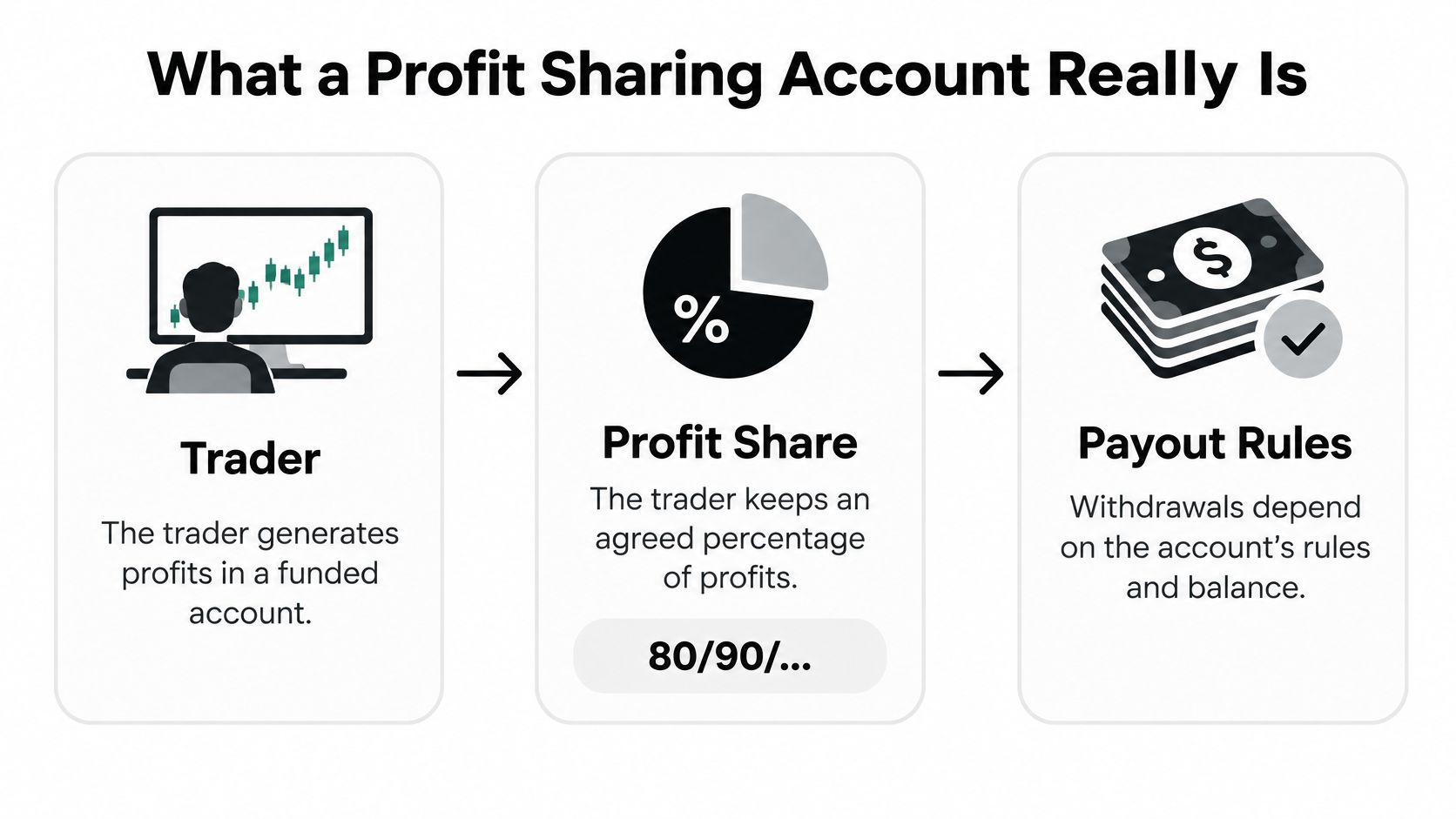
You see 80%, 90%, or even 100% next to a large account size and your brain fills in the rest. It assumes cash sits in a live brokerage account, the firm trades your orders in the market, and you own your share of whatever profit appears.
That assumption is wrong often enough to cost you money. In many retail prop style arrangements, you're trading in a simulated environment, and a payout is compensation calculated from simulated performance rather than ownership of segregated trading capital, as explained in this breakdown of funded versus simulated capital in prop trading. Simulated profit can still produce a real payment. It doesn't automatically give you a broker style claim.
Ask What Is Actually Being Shared
Don't ask only what percentage you keep. Ask what profit means in the agreement, which balance is the reference balance, and what happens if the provider delays or rejects a payment. A percentage of an undefined number is marketing, not a deal.
Read the full chain before you trade:
- Reference balance The starting point your eligible profit is measured from.
- High-water mark The peak you must stay above after losses and fees.
- Loss and drawdown rules The limits that can end the account before any payout.
- Eligibility rules Minimum days, closed profit, or other conditions in the contract.
- Profit invalidation clauses Behaviors that can remove otherwise green results.
- Payment timing and dispute process When money moves and how you challenge a refusal.
Judge payout reliability, rule stability, and the contractual definition of profit before you celebrate a higher split.
That contract view changes your comparison with salary and commission later in this guide. You're not buying an investment account, and protections such as client-money segregation or investor compensation may not apply in the way they would with a regulated broker. If the provider can't pay, or says your profit wasn't eligible, your practical protection is the written agreement and its dispute route.
Trading involves risk of loss. This article is educational only and isn't financial advice.
Risk Rules That Make the Split Work
A split creates a built in tension. You control entries, exits, and position size. The capital provider carries much of the downside if the strategy blows up, yet it can't see your intent behind every order.
That is a classic principal-agent problem. Research on profit and loss sharing contracts identifies profit misreporting and information asymmetry as core moral-hazard risks in shared profit arrangements. In plain trading language, an account can look payable if the calculation leaves out floating losses, trading costs, or open risk.
Balance Is Not Equity
A sound profit sharing account separates balance from equity and says so in writing. Balance reflects closed trades. Equity moves with open positions, so equity is the honest number for risk.
Check these mechanics before your first trade:
- Floating losses count Drawdown should include open losses, not only closed ones.
- Reset timing is stated You need to know whether the daily limit resets, at what time, and in which time zone.
- Costs are included Commissions, swaps, and fees should be in the profit figure before a split is calculated.
- Open risk blocks shortcuts A withdrawal calculation shouldn't pretend an open losing position doesn't exist.
If a firm can't explain those points clearly, don't fill the gaps with optimism. Build your own pre trade routine around them with a structured approach to risk controls and loss limits for funded traders, then compare that routine with the provider's rules.
The High-Water Mark Protects Both Sides
Think of a high-water mark as a watermark on a tank. Once water reaches a level and falls back, you don't get paid again for refilling the same space. Later payouts should come only from profit still above prior peaks after fees and realized losses.
That stops a temporary spike from being withdrawn and then reversed at the firm's expense. It also stops you from treating a good morning as banked money when an afternoon loss can erase eligibility.
Practical rule: Treat daily loss and maximum drawdown as walls, not as unused spending room you should consume because it's there.
At MyFundedCapital style terms used as an example in the payout discussion below, boundaries such as a 5% daily loss limit and maximum drawdown up to 10% illustrate the point, but any provider's exact numbers belong in your contract check. Don't confuse the distance to termination with risk you can afford to spend on one idea.
A generous split can push you toward overtrading. You capture much of the upside, while termination caps your personal downside compared with risking the full notional balance yourself. That incentive is exactly why continuous risk limits matter, and it's why no split removes the possibility of market loss.
How Payouts Move to Bank or Crypto
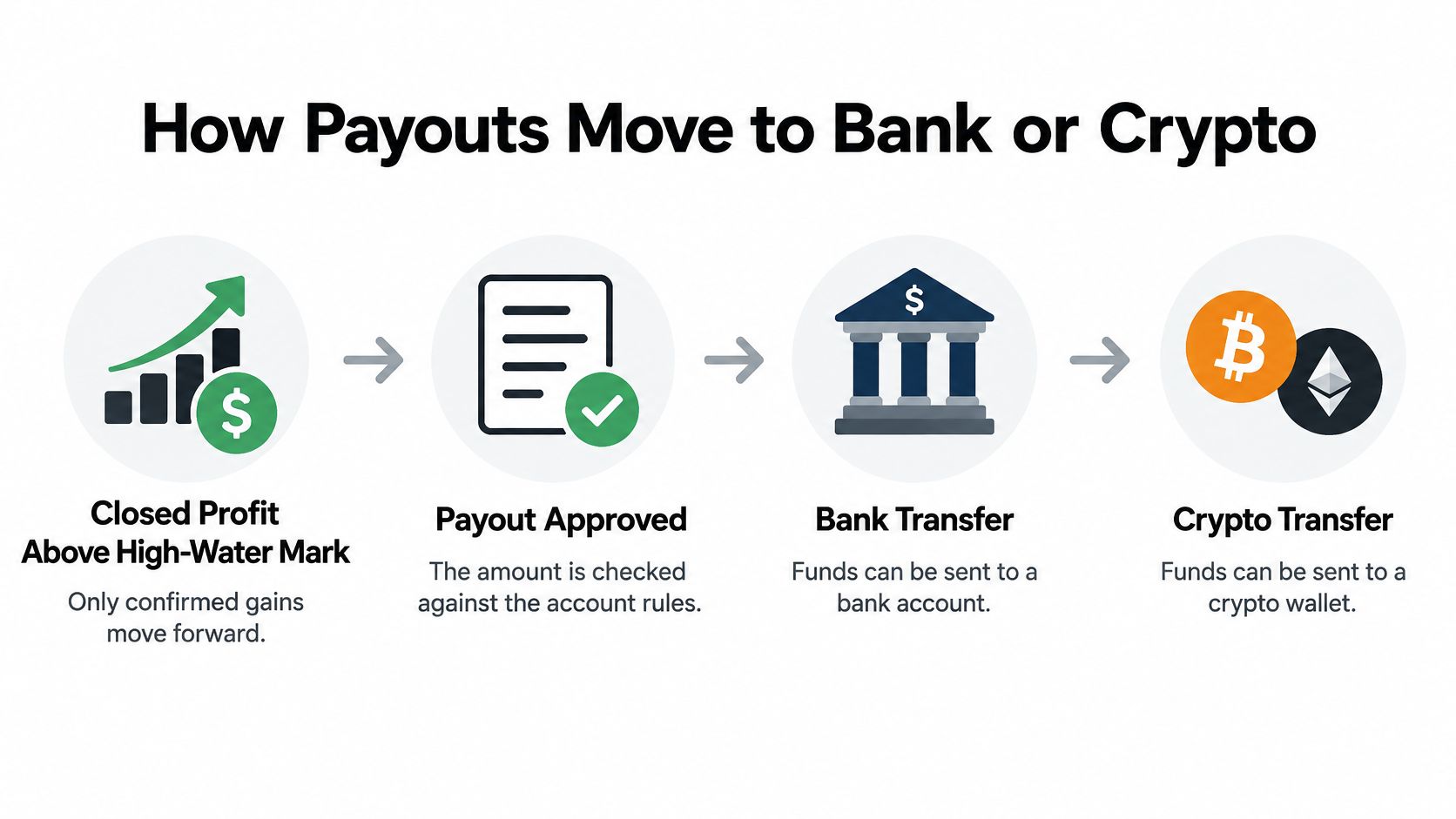
A payout isn't real because your dashboard is green. It becomes real when closed, rule compliant profit survives eligibility checks and lands in an account you control.
Audit the path in order:
- Close the profit Eligible gains should be closed and above the high-water mark after costs.
- Clear account conditions Check minimum trading days, consistency rules, or other conditions written into your agreement.
- Submit the request Payouts may run on a 7 to 14 day cycle or be available on demand, depending on the account and any add-ons.
- Pass identity and destination checks The firm verifies you and the bank account or wallet receiving the money.
- Wait for processing and arrival Approval, provider processing, and the receiving method are separate stages, so don't treat them as one clock.
Bank Transfer Versus Crypto
A bank transfer is usually easier to document for your records. It can also be slower, and your receiving bank may charge fees or hold an international payment for checks.
Crypto can suit a global trader who needs a wallet based route, but it adds risks the split doesn't cover. A wrong address, wrong network, or bad conversion decision is your problem quickly. Confirm the network, test your wallet details, and keep transaction records.
Use the provider's published timeline rather than forum claims. MyFundedCapital's guide to payout methods and processing times for funded accounts is the kind of page you should read before assuming approval means same day arrival.
One Concrete Example to Compare Against
MyFundedCapital is one concrete choice, not a universal standard. Its profit splits start at 80/20 and can be upgraded to 90/10 or 100%, with payouts every 7 to 14 days or on demand by bank or crypto, and average processing around 24 hours.
Its Instant Funding, 1-step challenge, and 2-step challenge are different routes into that payout contract. Account sizes run from $5K to $100K with scaling paths up to $500K, on demo environments with real market quotes.
Optional add-ons for news trading, weekend holding, and faster payouts are rule choices. They aren't profit promises, and you should buy one only if your strategy needs that permission.
Tax and Legal Lines Traders Confuse
The words profit sharing also describe a U.S. employer retirement plan. That shared label causes expensive confusion when traders import retirement rules into a prop firm contract.
In modern U.S. retirement law, a profit-sharing plan is generally a defined-contribution arrangement where the employer decides how much to contribute each year, because the IRS explains that employer contributions to a profit-sharing plan are discretionary. The employer may contribute in one year, change the amount in another, or contribute nothing, and the business doesn't legally need a profit despite the name.
The $72,000 Figure Is Not a Trader Payout Cap
For 2026, annual contributions and forfeitures allocated to a participant are limited to the lesser of 100% of compensation or $72,000, according to the Department of Labor guidance on profit-sharing plans for small businesses and their contribution limits. If employees can defer salary into the arrangement, it's treated as a 401(k) plan rather than a purely employer funded profit-sharing plan.
Say this plainly to yourself before you sign anything. That $72,000 retirement limit is not a prop firm payout cap and not a standard withdrawal limit for traders.
A trader profit sharing account is a private contract about remuneration for simulated or funded style results. Your governing document, not retirement plan law, decides whether conditions concern realized profit, minimum trading days, drawdown recovery, or invalidation clauses.
What to Do With the Legal Difference
First, identify which meaning a webpage is using. Retirement content talks about employer contributions, eligibility, and allocation formulas. Trader content should talk about splits, loss limits, and withdrawal eligibility.
Second, keep clean payout records from day one. Save agreements, payout statements, bank or wallet receipts, and dates. If you've had a strong year, review accounting considerations after a strong trading year from Blue Sage Tax & Accounting Inc. as background, then ask a qualified adviser how your jurisdiction treats the payment.
Third, read general educational material on prop firm taxes and trader payout record keeping without treating it as personal tax advice. Don't invent a tax treatment because another trader in another country described theirs online.
Broker rules can still sit underneath markets you trade elsewhere, including margin calls on a personal account. A prop contract doesn't cancel obligations you take on outside it. This section is educational only and isn't tax or legal advice.
Profit Sharing Versus Salary and Commission
Don't ask which pay label sounds fairest. Ask who gets paid in a flat month, who absorbs a losing month, and what behavior each model rewards.
A salary gives predictable cash and usually shifts market risk to the employer. That stability has value, especially if you have fixed bills. The trade off is that a strong month rarely changes your pay much, and you may work inside a narrow mandate.
Commission pays for activity or revenue. That can reward volume even when the account's risk adjusted result is poor, so a busy trader isn't automatically a profitable one.
A profit sharing account pays only after the rule defined result is positive and eligible. A quiet or losing stretch can mean zero personal cash, while a stable account can pay more than a modest salary without you posting the full notional balance.
| Pay model | When you get paid | Who bears trading downside | What to judge |
|---|---|---|---|
| Salary | On a regular payroll cycle | Mostly the employer | Stability, mandate, and upside limits |
| Commission | When activity or revenue is generated | Depends on the employment or contractor deal | Whether volume is rewarded over quality |
| Profit sharing | After eligible, rule compliant profit clears payout checks | The firm bears account loss within the contract, you bear lost time and termination risk | Expected payout, survival odds, and payout reliability |
Automation Does Not Change the Pay Logic
Recent research on financial algorithms finds that traders' adoption of algorithms depends strongly on relative performance and a preference for systems they can override. Separate findings that algorithmic trading can improve liquidity don't prove every EA or copy setup belongs on a profit sharing account.
That's the contrarian point many traders miss. A tool can be active, complex, and still be wrong for an account where a drawdown breach ends the deal.
A lower split you can withdraw from repeatedly can beat a higher split attached to an account you keep losing.
Judge expected payout, not the headline. Estimate whether your strategy can pass, stay inside the limits, and reach more than one withdrawal. If a higher split tempts you into larger size or more trades, it may reduce the very survival probability that makes the account valuable.
Salary wins on certainty. Commission wins only if activity reliably turns into your cash without encouraging bad trades. Profit sharing wins when your edge is steady, your risk is controlled, and the contract pays as written.
Expected Payout Examples for Traders
Numbers expose the split trap faster than opinions do. The scenarios below are illustrations, not forecasts, promises, or typical results.
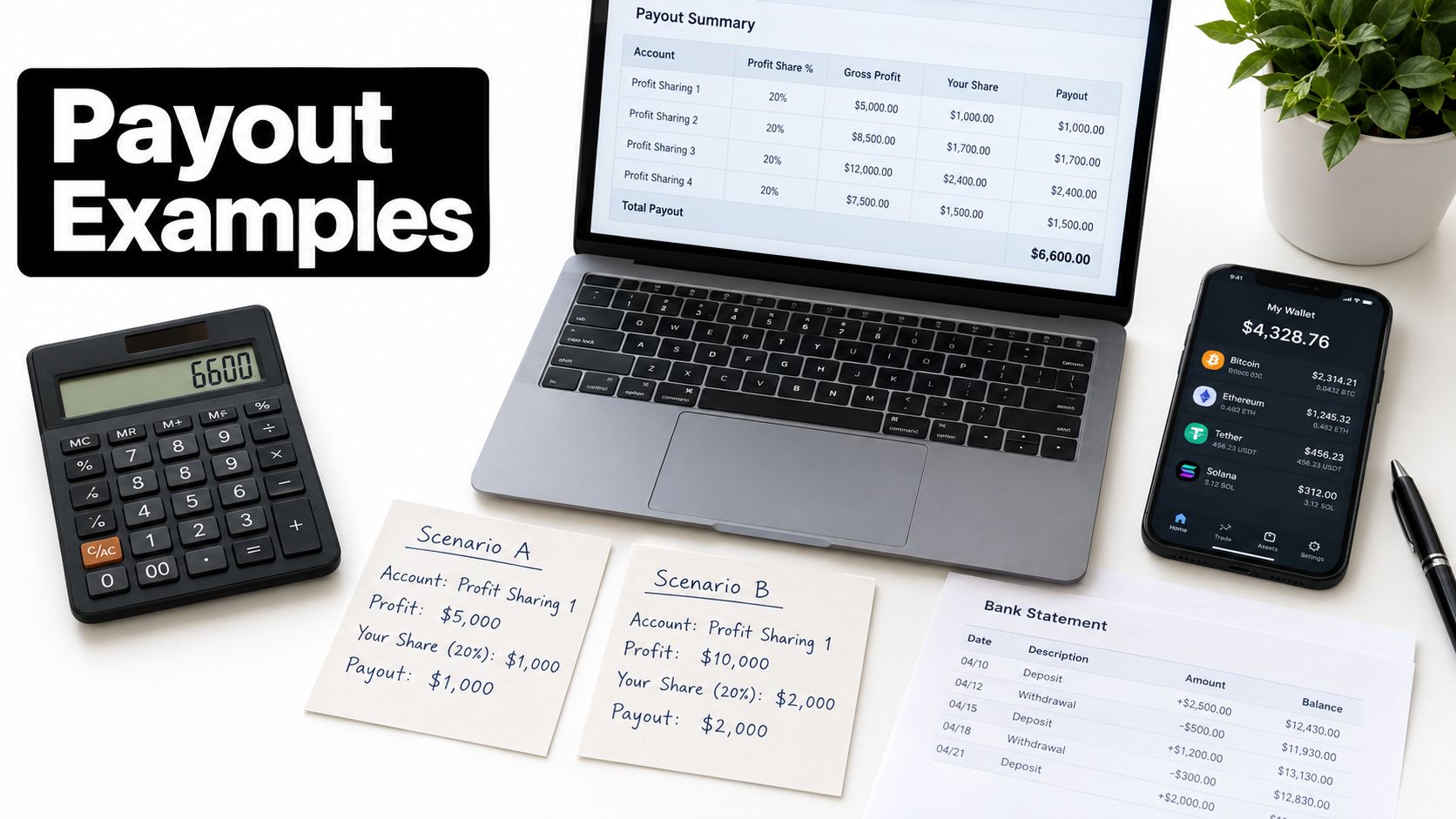
Scenario One at an 80% Split
Take a $50,000 notional account that produces $2,000 of rule compliant closed profit. At an 80% split, your share is $1,600.
That $1,600 exists only if the $2,000 remains above the high-water mark after costs and you respected the daily and overall loss limits. If open losses or a later drawdown erase eligibility, the arithmetic on a sales page won't save the payout.
Scenario Two at a 90% Split
The same $2,000 at a 90% split pays $1,800. The upgrade adds $200 in this illustration.
One breach of a 5% daily loss limit can end the account and make that extra $200 irrelevant. If chasing the higher split changes your sizing, the economically better choice may be the account you're more likely to keep.
Why the $50,000 Is Not Your $50,000
Compare that with a self funded U.S. equity margin account. FINRA's traditional pattern day trader rule covers a customer who executes four or more day trades within five business days, provided those trades are more than 6% of total trades in that period, and the account must maintain at least $25,000 in equity, as summarized in the SEC investor guidance on margin account requirements and pattern day trading.
Cash in another account doesn't count toward that equity requirement for the day trading account. A prop style $50,000 notional balance is different again, because your practical capacity is controlled by the firm's loss and drawdown rules rather than by capital you own.
It adds another layer. The SEC warns that leveraged investing can cause losses beyond the amount originally invested, which is why fast markets, slippage, and gaps deserve respect even when a simulated account limits your contractual loss.
Before you run a manual, EA, or copy strategy, check:
- Risk per trade Size from the daily loss wall backward, not from the notional balance forward.
- News and weekend gaps Confirm whether holding through those periods is permitted.
- Duplicate correlated positions Copying the same idea across accounts can multiply one mistake.
- Automation permissions Confirm EAs and copying are allowed before you connect anything.
Stop when you reach your daily loss line. Walking away early feels expensive for an hour and cheap compared with losing the account.
Profit Sharing Account Questions and Next Steps
Does a 100% Split Mean There Are No Other Costs
No. A 100% split describes how eligible profit is divided, not whether platform, processing, challenge, or add-on costs exist elsewhere in the deal. Find those costs in the agreement and checkout terms, not in the headline.
How Should Open Trades Be Treated at Withdrawal
Floating loss isn't spendable profit. Your request should be based on eligible profit above the high-water mark after fees, with open position risk handled under the provider's stated rules. If the contract is vague on that point, get clarification before you rely on a payout date.
Can an EA, Copy Setup, or News Trade Invalidate a Green Week
Yes, if the account rules don't permit that method or you didn't select a required add-on. A profitable week doesn't override permissions for automation, copying, news trading, or weekend holding. Check the rule first, then place the trade.
Can a Prop Firm Skip an Eligible Payout Like a Retirement Employer Can Skip a Contribution
Don't merge the two legal ideas. A retirement employer's discretion to contribute nothing doesn't automatically give a prop firm discretion to skip a trader payout that its own trading contract has already made eligible. Your remedy and evidence come from that trading agreement, your records, and its dispute process.
Read the payout clause as if you'll need to quote it back during a dispute, because that is exactly when it matters.
Your next step is comparison, not impulse. Compare MyFundedCapital Instant Funding with its 1-step and 2-step challenges, check the 5% daily loss and up to 10% maximum drawdown rules, and review payout timing before you start. Pick the route your strategy can survive, not the route with the loudest split.
Trading can lose money, and past simulated results aren't a promise of profit. Nothing here is financial, tax, or legal advice.
Compare Instant Funding, 1-step, and 2-step account routes, their profit splits, loss limits, and bank or crypto payout options before you commit to a profit sharing account. Visit MyFundedCapital to review the current program terms and choose the challenge structure that fits your risk rules.