You're watching the first hour chop sideways, price pokes above the opening high, and you chase it only to get stopped back inside the range. This guide shows how to mark that range consistently, decide when a break counts, and know when to skip it before a bad trade eats your daily loss budget.
What Initial Balance Trading Actually Measures
The first hour creates a dilemma. Orders hit fast, spreads can widen, and early candles often reverse. Without a fixed reference, you're reacting to noise and calling it a plan.
Initial Balance trading comes from Market Profile, a framework developed by J. Peter Steidlmayer at the Chicago Board of Trade. His board service ran from 1981 to 1983, and Market Profile tools became available through CBOT systems around 1984-1985, as outlined in this history of Market Profile and its CBOT origins. That history matters because the concept was built to organize intraday auction activity before modern electronic order flow platforms were common.
The first hour as an auction
The Initial Balance, or IB, is the high-low range formed during the first two 30-minute periods of a stated regular session. That's usually the first 60 minutes. The high and low then become reference levels for the rest of the session.
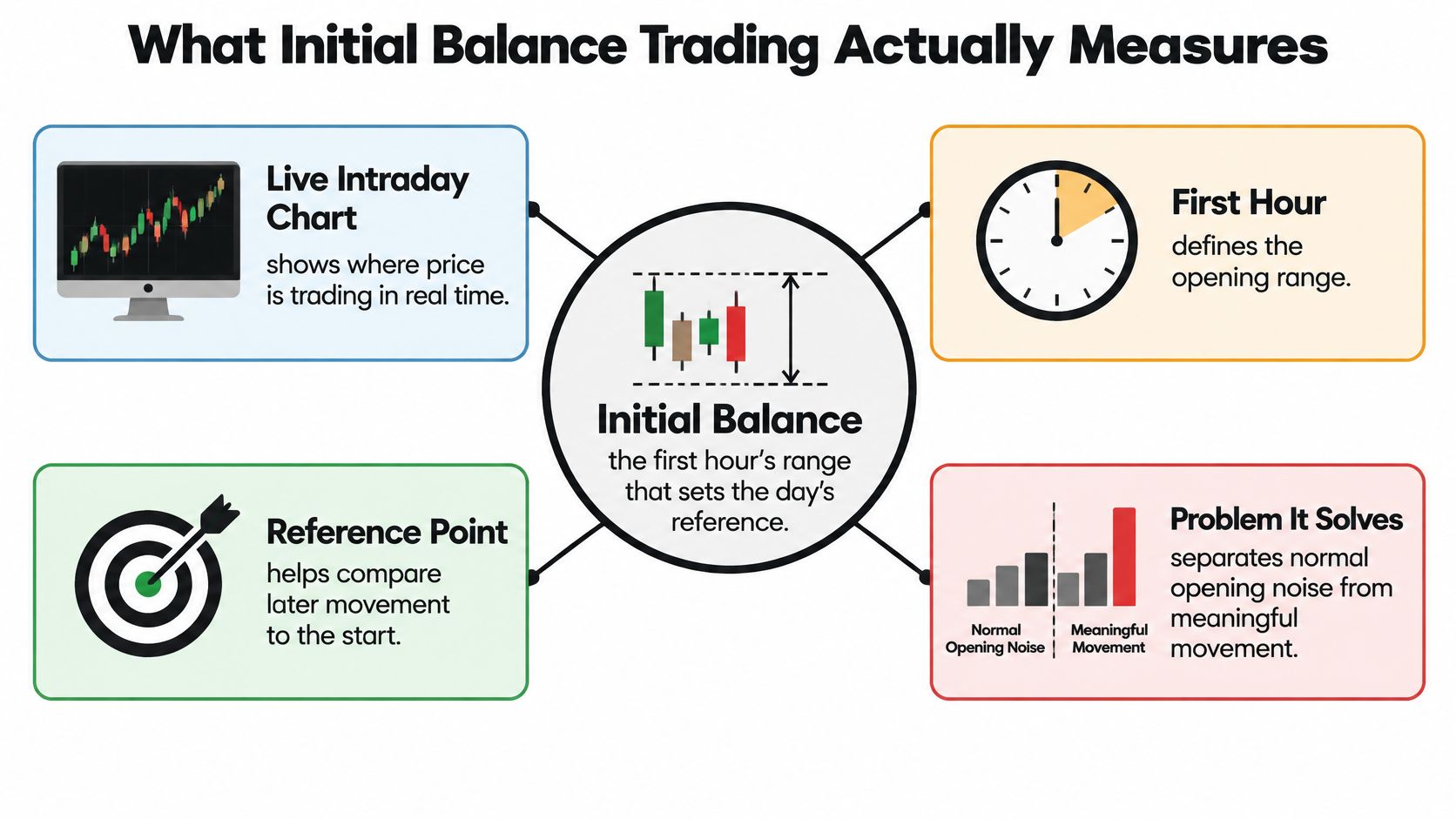
Traders use those levels to judge what happens next:
- Acceptance price trades outside the range and stays there, suggesting buyers or sellers are willing to transact at new prices.
- Rejection price probes outside, then returns inside, suggesting that excursion didn't attract follow-through.
- Range extension price moves beyond either boundary, showing one side is gaining directional control for that session.
- Balance price keeps rotating inside the first hour, which tells you not to force a trend idea.
That framing connects directly to auction market theory and how price explores value, where the market is treated as an ongoing auction rather than a series of random candles. If you're still building your chart reading, pairing this with broader chart analysis for self-directed investors helps you place the IB inside wider structure instead of trading it in isolation.
An Initial Balance is a reference range, not a prediction. It tells you where the opening auction stopped and asks whether later trading accepts prices beyond it.
You'll learn how to mark the range, define a valid breach, skip poor conditions, choose the right session, and size risk for a funded account. Trading involves risk of loss, and this material is educational only, not financial advice.
How to Mark a Clean Initial Balance
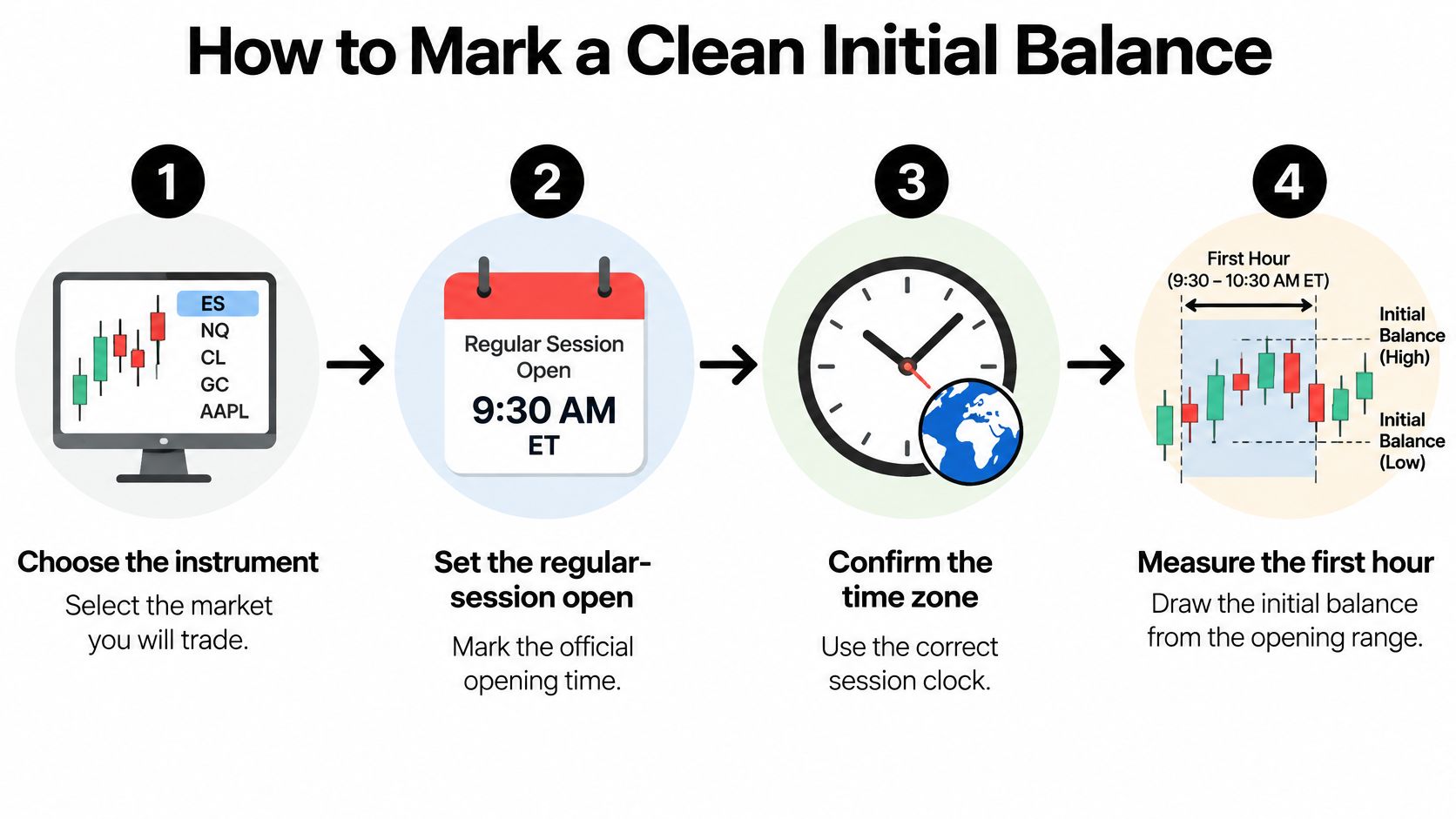
Don't start by drawing a box that looks right. Start by writing four decisions in your plan and keeping them unchanged between your live chart and your backtest.
Lock the definition first
Write down these items before the session:
- Instrument the exact contract or symbol you'll trade, not a related proxy.
- Session open the regular-session start for that instrument.
- Time zone the clock your platform and journal will use.
- Measurement length the classical 60 minutes, built from two 30-minute brackets.
For U.S. equities and equity-index futures, the classical window is 9:30-10:30 a.m. Eastern Time. CQG's Market Profile documentation defines the Initial Balance as the range of the first two trading periods, which matches that first-hour approach. Platforms may let you configure bracket length, so don't assume your default setting matches your test.
Use one-minute or tick data when your instrument and platform allow it. A 30-minute candle can hide the exact high or low if your session template is off by a few minutes. Small marking errors turn into different breakouts later.
A worked marking example
Suppose the first 30-minute bracket trades from 5,000 to 5,012. The second bracket trades from 5,004 to 5,014. Your Initial Balance is 5,000-5,014.
The logic is simple. The IB high is 5,014 because that's the highest price in either bracket. The IB low is 5,000 because that's the lowest price in either bracket. This Market Profile method for combining the first two brackets into one range shows that same construction.
Mark only those two prices. Don't drag a line to the body of an opening candle because it looks cleaner. Don't redraw the range after price leaves it.
Journal rule: If you can't state your instrument, open, time zone, and IB length in one sentence, you don't have a testable range yet.
A 30-minute IB is common, but it's a different strategy. LuxAlgo's overview of the 30-minute and 60-minute Initial Balance variants makes clear that the interval must be specified in advance. Mixing a 30-minute range live with a 60-minute range in testing changes your levels, signal timing, and trade count.
Entry and Exit Rules That Stay Testable
A clean box doesn't create a trade. You need a breach definition that another trader, or a script, could apply without guessing what you meant.
After 10:30 Eastern Time on U.S. equity-index futures, record the first breach of either boundary. Count it only when price trades at least one minimum tick beyond the IB high or low. A touch isn't a break.
Pick one execution model
Choose one model for an entire test:
- Close outside enter after a candle closes beyond the boundary in your chosen timeframe.
- Retest that holds wait for price to break, return to the boundary, and hold outside it before entering.
Don't switch between them because one would've worked better today. Place the initial stop inside the IB or beyond the retest swing, whichever matches your model. Exit at a predefined multiple of risk or before the session close, and write that choice down before entry.
Filter the idea first by direction, where the open sits inside the range, current volatility, and scheduled macro events. Size the position from the stop distance so one loss consumes a fixed fraction of equity. If the stop is too wide for that fraction, you reduce size or you don't trade.
How often the range breaks
The table uses regular trading hours from January 2, 2020, through June 30, 2026, with the IB defined as 09:30-10:30 Eastern Time, based on this six-year study of Nasdaq-100 and S&P 500 E-mini Initial Balance breaks.
How Often the First-Hour Range Broke
| Contract | Sessions | Any side | IB high | IB low | Both sides | Neither side |
|---|---|---|---|---|---|---|
| Nasdaq-100 E-mini | 1,670 | 97.0% | 63.0% | 55.6% | 21.7% | 3.0% |
| S&P 500 E-mini | 1,668 | 97.8% | 67.1% | 59.4% | 28.6% | 2.2% |
Those figures explain why traders watch these levels. Price rarely stays inside the first hour all session. They don't prove that buying every break makes money.
A break can travel one tick and reverse. Both sides can break on the same day, which means the first signal can fail before the second one works. Direction, entry price, stop placement, slippage, commissions, spread, and news timing decide whether a frequent event becomes a profitable trade.
Market Profile documentation on range extension beyond the IB high or low describes extension as one side gaining control, not as a guaranteed outcome. Treat it that way. Your job is to define the trigger, cap the loss, and let a fixed sample tell you whether your version has value after costs.
When to Skip an Initial Balance Break
Most Initial Balance trading content teaches entry patterns and stops there. That's incomplete. On a funded account, knowing when not to trade protects you more than finding one extra entry.
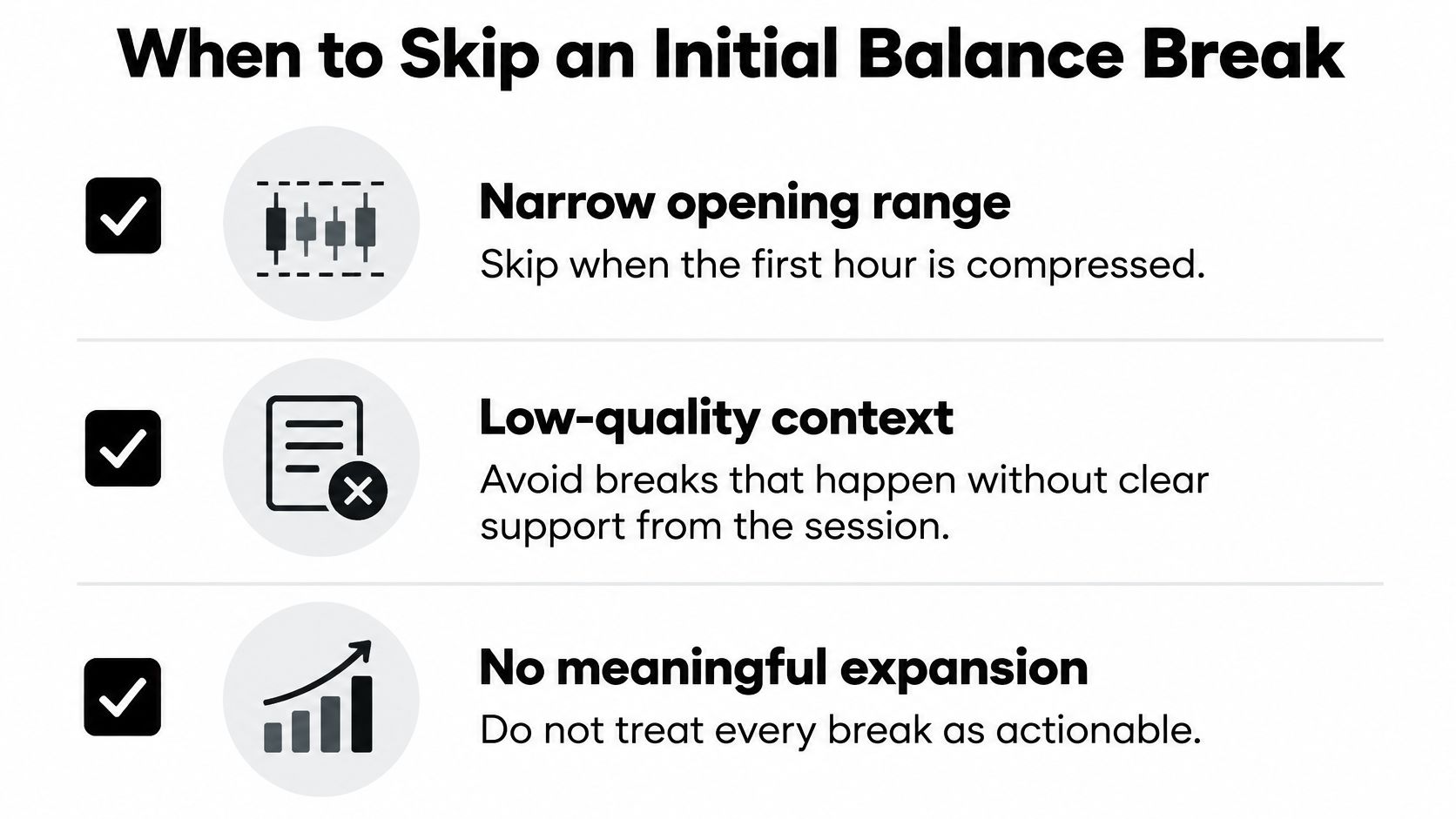
A narrow IB isn't automatically a better breakout. It may reflect compressed liquidity before a release, thin participation, or a market waiting for information. A wide IB isn't automatically stronger either. It may mean the volatile move already happened in the first hour and your stop now has to be uncomfortably large.
Normalize width before you judge it
Compare today's IB width with something objective:
- Rolling ATR Is the first hour small or large relative to recent daily movement for this instrument?
- Implied volatility Is the market already pricing an event move that makes your normal stop unrealistic?
- Opening-range percentile Where does today's width sit versus recent opening ranges on the same session?
If the required stop can't be justified by expected movement after spread and slippage, skip it. Breakout distance and slippage aren't fixed. They change with the volatility regime.
CME reported that interest-rate futures average daily volume exceeded 14 million contracts in 2025, a fourth consecutive record, while volatility remained above historical averages despite easing from April, in CME's 2025 interest-rate liquidity review. High participation doesn't remove event risk. It can coexist with sharp, expensive moves.
Your stand-aside checklist
Skip or reduce size when a central-bank decision, CPI release, employment report, or geopolitical shock sits close to your entry window, unless your tested plan specifically covers that event. Skip when price breaks both sides quickly and shows no acceptance outside either boundary. Skip when you're already near your daily loss limit and a normal stop would leave no room for error.
Don't ask only whether price can break the line. Ask whether the likely move pays for the stop, the spread, and the damage a failure does to your day.
That last point matters for funded traders. A false break isn't just one losing trade. It can push you toward a daily-loss limit or maximum drawdown and end the account. Losses are part of this method, so your skip rules must be written before the open, not invented after the first stop.
Choosing the Session That Defines the Range
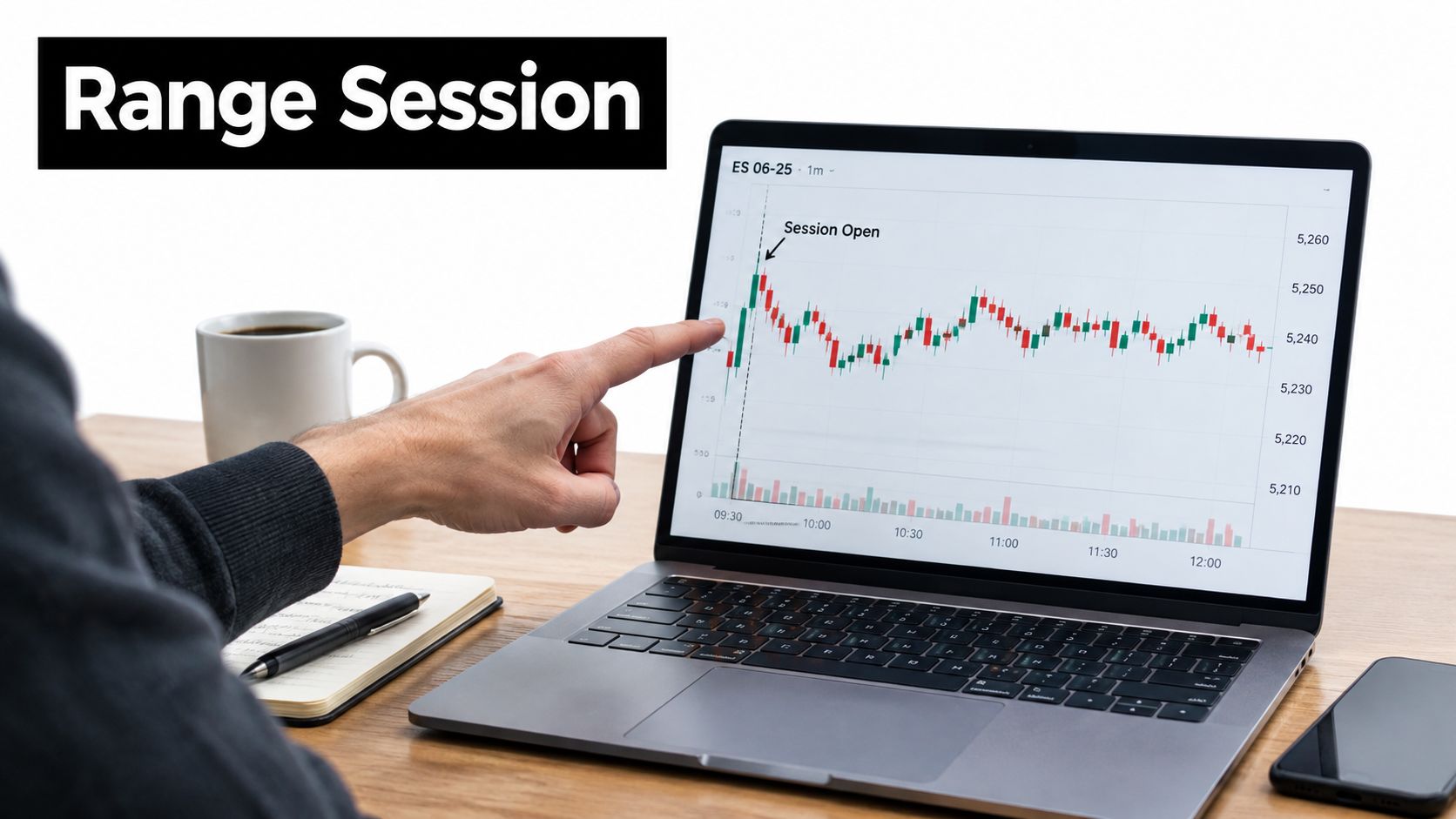
Which open are you actually trading? That question sounds trivial until you trade indices, forex, or crypto across time zones and realize three different ranges are all claiming to be the open.
Classical Market Profile teaching assumes one regular session, often the U.S. cash open. Markets don't stop discovering price outside U.S. hours. CME reported equity-index options volume during non-U.S. hours reached more than 200,000 contracts per day by December 2025, representing 16% of total daily equity-options volume, in CME's article on around-the-clock equity-index options activity. That weakens the assumption that the first U.S. cash hour always contains the most informative move.
Compare candidates, then choose one
Consider these definitions as alternatives, not simultaneous signals:
- Asia range useful context for overnight positioning, but often built in thinner conditions for U.S. instruments.
- London range can capture European price discovery for forex and global indices.
- U.S. premarket range shows positioning before the cash open, including reactions to early data.
- U.S. cash Initial Balance the classical 9:30-10:30 Eastern range for U.S. equities and related futures.
For U.S. focused trading, understanding New York session timing in forex and related markets helps you avoid mixing a London-based range with New York execution rules. For each candidate, write the open, time zone, and your daylight-saving rule. A one-hour clock error creates a completely different IB twice a year.
Test one primary definition per instrument. You can use a second session as context, for example noting that price already travelled a long way overnight before the cash IB formed. Don't take the same liquidity event as a London break and then again as a cash-session break.
Ask whether a cash break after a large overnight move is continuation or exhaustion. Your journal should separate those cases instead of blending them into one result. Forex and crypto traders need the same discipline: name one session open, keep it fixed, and don't trade duplicate signals from overlapping clocks.
Older research shows why definitions need care. A published summary of Jan Firich's 2012 analysis reported that when the prior day had no IB breakout, the current day showed 19.87% for no breakout and 73.72% for a breakout, with some sessions unclassified, in this summary of Firich's conditional Initial Balance percentages. Without an unambiguous contract and session definition, treat figures like those as prompts for your own test, not proof of an edge.
Risk Limits That Fit a Funded Account
Your stop location is only half the risk decision. The other half is what that stop does to your account limits when you're wrong twice in a row.
Size from the stop, then check the day
Use this sequence:
- Define entry and stop measure the distance in ticks or points before you place the order.
- Convert to money calculate the loss per contract, lot, or share at that stop.
- Set size choose quantity so one full loss equals your prechosen fraction of equity.
- Check the daily cap confirm that a second planned loss still leaves you inside the daily limit.
That process ties directly into a broader risk management framework with defined steps and limits, where position size follows risk rather than excitement. If you're trading on margin in any account type, it's also worth reviewing practical strategies for mitigating margin risk so borrowed capital doesn't turn a normal IB failure into a forced exit.
A concrete funded-account example
MyFundedCapital is a proprietary firm that funds traders with simulated capital and pays a share of profits. Paths include Instant Funding or a 1-Step or 2-Step Challenge, with account sizes from $5K to $100K and scaling paths up to $500K. Place your IB stop math beside its flat 5% daily loss limit and up to 10% maximum drawdown before you choose a size.
Profit splits start at 80/20 and can be upgraded to 90/10 or 100%. Payouts are every 7-14 days or on demand by bank or crypto, with average processing around 24 hours. Platforms are DXtrade and cTrader, with MT5 coming soon, across 350+ forex, index, crypto, and commodity instruments, including manual, algorithmic, and copy trading.
Optional add-ons cover news trading, weekend holding, and faster payouts. Evaluations and funded accounts run on demo environments with real market quotes. That structure assesses skill, but it doesn't remove the risk of hitting limits and losing the account.
Match the account to the strategy, not the other way around. Your stop distance, news exposure, and hold time should fit the daily and maximum loss rules before you start.
If your IB method needs wide stops on an index, a small account may force size so low that costs dominate, or tempt you to oversize. If your method holds through data releases, confirm the account terms allow that exposure. Discipline isn't abstract here. It's arithmetic you do before the first order.
Questions Traders Still Ask
Is a 30-minute Initial Balance wrong
No. It's a variant, not an error. The problem is inconsistency: your live chart, journal, and historical test must all use the same 30-minute or classical 60-minute length, session open, and time zone. Changing length changes the trade.
Can forex or crypto use Initial Balance trading without a cash open
Yes, if you name one session open and apply it consistently. Choose the session you'll actually trade, state how daylight-saving changes are handled, and don't also take the same move as a signal from a second session. Without that rule, you're selecting whichever range worked after the fact.
Should you hold through news or the weekend
Only if that hold is in your written plan and your account permits it. A scheduled release can gap price through your intended stop area and increase slippage, so many intraday IB traders flatten before major events. Weekend holding adds reopening risk that a first-hour intraday framework wasn't designed to manage.
Record keeping matters after the trade too, especially if trading becomes a business activity, which is why some Australian traders review share trader guidance from EndureGo Tax alongside their own professional advice. Tax treatment depends on your circumstances, so don't treat general information as personal advice.
Does a high break rate mean you should trade every day
No. Frequency tells you the levels are often tested. It doesn't tell you direction, distance travelled, or profit after costs. Your skip checklist, stop, and session definition still decide whether today offers a trade worth risking capital on.
Your next step is practical. Compare MyFundedCapital Instant Funding with the 1-Step and 2-Step Challenge, check which account size fits your stop fraction, and review the funding programs before you commit. This is education, not financial advice, and trading involves risk of loss.
If your Initial Balance plan has a fixed session, a testable entry, and a stop sized to stay inside a 5% daily loss limit, you're ready to compare funding paths instead of guessing. Visit MyFundedCapital to review Instant Funding and the 1-Step and 2-Step Challenge options, check account sizes and platform access, and choose the path that matches your risk rules before you start.