ES
ES
 DE
DE
 FR
FR
 AR
AR
 IT
IT
 NL
NL
 PL
PL
 SV
SV

Most advice on how to start algo trading begins with an indicator, a coding tutorial, or an impressive backtest. That order is backwards. You'll learn how to build the complete trading system, validate it in stages, and adapt it to hard prop-firm limits without treating historical profits as proof of future results.
What Algo Trading Actually Means in Practice
Algo trading isn't a script that spots a pattern and opens a position. It's a chain of connected decisions: selecting a venue, acquiring market data, generating a signal, sizing the position, routing the order, confirming the fill, and monitoring what happens afterward. Electronic order execution existed before modern machine learning. The NYSE began computerizing order flow in the early 1970s through its Designated Order Turnaround system and introduced SuperDOT in 1984, developments that helped support increasingly electronic and interconnected markets (algorithmic trading history).
That history matters because a strategy is only one component. A profitable rule set can still fail through stale data, incorrect quantities, rejected orders, broken connectivity, or an execution assumption that never exists in the live market. Trading involves risk of loss, and automation can make both correct and incorrect decisions faster.
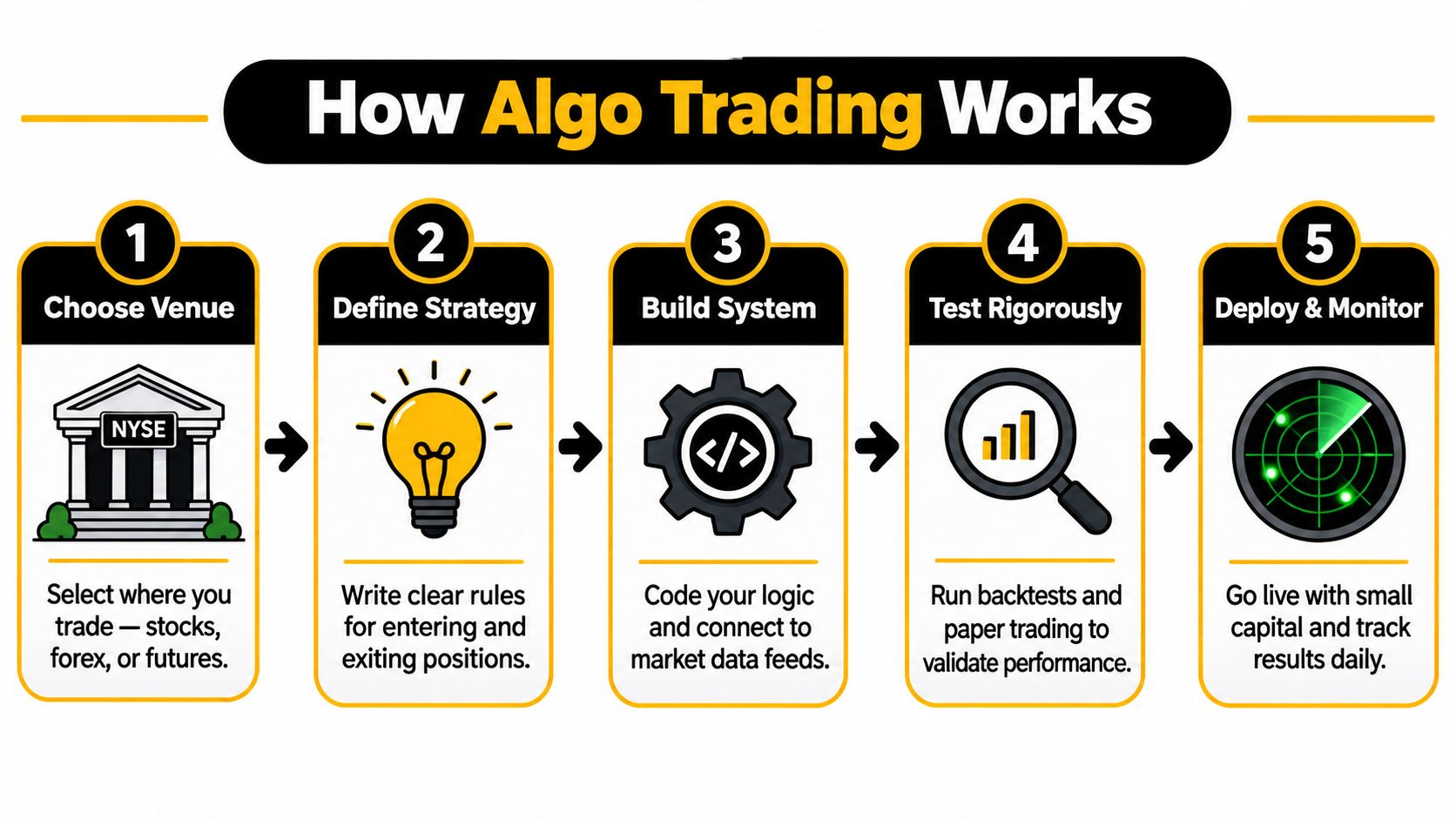
Build the whole workflow
Start with a one-page system map:
- Choose the venue Decide whether you'll trade stocks, forex, futures, CFDs, crypto, or another instrument, then document its hours, contract rules, spreads, financing, and liquidity.
- Define the strategy Write exact entry, exit, stop, sizing, and exposure rules.
- Build the system Connect reliable data to your signal engine and order interface.
- Test rigorously Use historical data, out-of-sample validation, paper trading, and execution checks.
- Deploy and monitor Start cautiously, reconcile positions, preserve logs, and stop the system when controls are breached.
This is closer to running a small production service than writing a clever indicator. If you enjoy organising research and documenting systems, even resources outside finance, such as Simsima's travel resources, illustrate the value of structured planning before execution. The same principle applies here: define the route before you start moving capital.
Picking Your Market and Execution Platform
Choose the market before choosing the strategy. A breakout system designed for liquid FX sessions has different data, spread, financing, and timing requirements from a crypto system that operates continuously or an index strategy exposed to session gaps.
Start by answering four questions:
- What do you trade? Select a narrow instrument universe first. More symbols create more data and operational complexity, not automatically more opportunity.
- When does it trade? Define active sessions, rollover periods, holidays, and whether weekend exposure is permitted.
- How does the venue fill orders? Your backtest must reflect the order types, execution rules, spreads, and rejected-order behavior you'll encounter.
- What does the account allow? Check margin, minimum size, news restrictions, weekend rules, and platform compatibility before writing code.

Match the platform to the job
Python is useful for research, data preparation, and custom analytics. MT5 and its Expert Advisors suit traders who want strategy logic and execution close to the platform. cTrader supports cBots, while DXtrade can be relevant when a funded-account provider requires that execution environment. A retail API offers flexibility, but it also leaves you responsible for authentication, reconnection, data normalization, order states, and monitoring.
For prop-firm users, platform constraints are part of the strategy. MyFundedCapital supports algorithmic trading on DXtrade and cTrader, with MT5 announced as coming soon, and offers access to more than 350 instruments across forex, indices, crypto, and commodities according to its published product information. Confirm current availability directly before implementation, because platform details can change. Its algorithmic trading overview is a useful place to compare the supported workflow.
| Decision | Practical fit |
|---|---|
| Python research stack | Custom analysis, data science, and portfolio research |
| MT5 or cTrader | Platform-native automation and broker-connected execution |
| DXtrade | Environments where the firm requires DXtrade |
| Direct API | Custom infrastructure, provided you can manage failures and order states |
Don't select a market because it looks exciting on a chart. Select the market whose data, execution, costs, and account rules you can model.
Turning a Trading Idea Into a Testable Specification
A sentence such as “buy strong breakouts and exit when momentum fades” isn't a strategy. It leaves the instrument, timing, definition of strength, position size, and exit behavior open to interpretation. Different developers could code different systems from the same sentence and all claim they followed the idea.
Write the specification before opening your editor. A useful template includes:
- Universe: Which symbols are eligible, and which are excluded?
- Frequency: What bar or tick interval supplies the signal?
- Entry: What exact condition creates an order?
- Exit: What closes the position, and in what order are competing exits evaluated?
- Protection: Where is the stop, and what happens after a gap?
- Sizing: What formula converts stop distance and account risk into quantity?
- Exposure: What are the concurrent-position and notional limits, and how is credit applied to positions?
- Execution: Does the system use market, limit, or stop orders, and when can they fill?

A concrete specification
Take a hypothetical London-session FX breakout. The specification might say:
- Observe the defined opening range for the chosen session.
- Enter long only after a completed bar closes above that range.
- Enter short only after a completed bar closes below it.
- Place the initial stop at a stated multiple of recent volatility, such as an ATR-based distance selected before testing.
- Size the position from the stop distance and the maximum permitted loss.
- Exit at the stop, a predefined target, or a time cutoff.
- Reject new trades when spread, data freshness, or total exposure fails its limit.
The example is testable because every ambiguous phrase has been replaced with a rule. The value of an algorithmic trading strategy framework is not a promise that the idea works. It's the discipline of forcing each assumption into the open.
Practical rule: If another trader can't implement your specification without asking what you meant, the document isn't finished.
Keep the first version narrow. A simple system with explicit rules is easier to audit than a multi-indicator model whose behavior changes whenever you adjust a parameter.
Backtesting Without Fooling Yourself
Backtesting is necessary, but it's also where many traders manufacture confidence. Historical data lets you investigate an idea. It doesn't prove that the idea will survive new prices, live costs, delayed fills, or a different market regime.
Use chronological data partitions. The development period is where you build the rules, the validation period is where you make limited design decisions, and the final holdout remains untouched until the system is locked. Walk-forward testing adds another layer by repeatedly training on an earlier window and evaluating on a later one, without treating the final test as an optimisation playground.
Model the frictions that a clean chart hides:
- Bid-ask spreads Apply the side of the spread relevant to entries and exits.
- Commissions and financing Include every charge that affects holding and turnover.
- Slippage Allow fills to differ from the decision price, especially during fast moves.
- Latency Delay execution after the signal becomes available.
- Partial fills and gaps Don't assume every order receives the intended price and quantity.
- Delisted or unavailable instruments Prevent survivorship bias in the research universe.
A study of 888 algorithmic strategies developed on Quantopian found that backtest Sharpe ratios had very limited predictive value for future out-of-sample performance, with an R² below 0.025. It also found that running more backtests was associated with a larger gap between in-sample and out-of-sample results (Quantopian out-of-sample research). Repeatedly changing parameters until the chart looks attractive is a multiple-testing problem, not a research advantage.
Report more than the headline return
Track net returns, volatility, maximum drawdown, turnover, profit factor, expectancy, tail loss, and stability across years, assets, regimes, and nearby parameter values. A strategy that only works at one precise setting deserves suspicion.
| Metric | What It Tells You | Common Blind Spot |
|---|---|---|
| Net return | Whether the system made or lost money after modeled costs | Can hide severe drawdowns |
| Maximum drawdown | The depth of historical loss from a peak | Doesn't predict the next drawdown |
| Expectancy | Average outcome per trade | Can deteriorate when costs or fills change |
| Turnover | How actively the strategy trades | Often understates friction in fast markets |
| Profit factor | Relationship between gross winning and losing results | Can look strong with too few trades |
| Tail loss | Exposure to unusually damaging outcomes | Historical samples may miss future shocks |
| Sharpe ratio | Return relative to volatility | Doesn't establish live robustness |
Use a practical backtesting workflow as a checklist, but don't outsource judgment to a platform report. The test should answer whether the logic survives realistic assumptions, not whether software can produce an attractive equity curve.
Moving From Backtest to Live Without Breaking
The first live trade shouldn't be the first time your system meets real order handling. Paper or shadow trading lets you compare the theoretical decision with what the venue would have delivered. Record the expected price, realized quote, latency, spread, rejection status, fill quantity, and resulting position.
A staged deployment looks like this:
- Replay historical events Confirm that signals and order states behave correctly.
- Paper trade Run the system without live exposure and compare simulated actions with market conditions.
- Reconcile execution Investigate differences in fills, spread, latency, partial fills, and rejected orders.
- Deploy cautiously Use small exposure and predefined stop conditions.
- Review every change A new indicator, broker connection, data feed, order type, or sizing rule requires another validation cycle.
- Monitor continuously Watch positions, orders, exposure, latency, realized P&L, and unrealized P&L.
Define the kill conditions first
A kill switch should stop new orders when data goes stale, the connection drops, rejected orders repeat, spreads widen beyond the tested range, or exposure exceeds its limit. Decide in advance whether the system should cancel pending orders, flatten positions, disable itself, or require manual review.
Keep immutable records of signals, orders, fills, code versions, parameters, configuration changes, and error messages. Position reconciliation should compare the system's expected state with the broker's actual state after every meaningful event. A script that thinks it has no position while the venue shows an open trade is not operating safely, regardless of its backtest.
Live deployment begins when the system has to explain every fill, not when it places its first order.
Pre-Trade Risk Controls Every Algo Trader Needs
A strategy stop-loss protects a particular trade. Pre-trade controls protect the account and the market interface. They should sit outside the signal logic wherever possible, so a bug in the strategy can't disable the limits intended to contain it.
For U.S. securities market access, SEC Rule 15c3-5 requires broker-dealers to maintain documented controls that reject orders exceeding credit or capital thresholds, permitted price or size parameters, duplicate-order checks, or applicable trading restrictions. The rule applies to manual orders and orders generated by pre-programmed computer instructions (SEC risk-control guidance).
Build the control layer
At minimum, implement:
- Maximum order size: Reject quantities outside the permitted range.
- Maximum notional exposure: Block trades that would push total exposure beyond the account limit.
- Daily loss limit: Stop opening new risk when the loss threshold is reached.
- Position cap: Limit aggregate exposure by symbol and across the account.
- Price collar: Reject orders too far from the current reference price.
- Duplicate prevention: Detect repeated submissions caused by retries or loops.
- Stale-data detection: Disable signals when quotes stop updating.
- Heartbeat monitoring: Alert when the process, data feed, or broker connection becomes unresponsive.
- Disconnect handling: Cancel, reconnect, or enter a safe state according to a documented policy.
- Immutable logs: Preserve what the system knew, decided, sent, and received.
FINRA's guidance treats testing, deployment controls, validation, and post-implementation monitoring as part of algorithmic supervision (FINRA algorithmic trading guidance). The CFTC framework also emphasizes pre-trade controls, testing, supervision, post-trade reporting, and safeguards for automated trading (CFTC automated trading safeguards).
When a limit triggers, don't improvise. Define the response in advance: reject the order, cancel pending orders, flatten exposure, disable the strategy, or require manual approval. The correct response depends on the venue and strategy, but an undefined response is an operational failure.
Running an Algo on a Funded Account
A funded account changes the objective from “maximise historical return” to “stay inside hard loss boundaries while producing repeatable results.” MyFundedCapital describes a flat 5% daily loss limit and up to 10% maximum drawdown, so a strategy that looks attractive on an unrestricted backtest may be unsuitable if its normal volatility can approach those boundaries.
Design the risk engine around the firm's rules, not around the strategy's preferred exposure. Calculate size from stop distance and worst-case slippage, reserve room for correlated positions, and stop trading before the account limit becomes imminent. News trading, weekend holding, and payout conditions can also affect the appropriate platform and strategy design, so confirm the current terms before deployment.
MyFundedCapital offers Instant Funding as well as 1-Step and 2-Step Challenges, with account sizes described from $5K to $100K and scaling paths up to $500K. Its published terms also describe profit splits starting at 80/20, with potential upgrades to 90/10 or 100%, and payouts every 7 to 14 days or on demand. These are product terms, not trading outcomes, and they may change.
| Path | Access Speed | Account Sizes | Best Fit For Algo Traders |
|---|---|---|---|
| Instant Funding | Immediate trading access | Available sizes depend on current terms | Traders with a validated system and strict controls |
| 1-Step Challenge | Evaluation before access | Challenge sizes and scaling depend on current terms | Traders who want a shorter evaluation structure |
| 2-Step Challenge | Staged evaluation | Challenge sizes and scaling depend on current terms | Traders who prefer staged proof of consistency |
Your monitoring dashboard should show daily loss, maximum drawdown, open risk, margin or notional exposure, pending orders, connection status, and the distance to every hard limit. Test the dashboard and kill switch before the account is at risk. The account may use simulated capital and real market quotes, but a rule breach can still end the evaluation or funded arrangement.
MyFundedCapital offers Instant Funding and 1-Step or 2-Step Challenge paths, with algorithmic trading supported through its available platform environments and access to a broad range of instruments. If your system has survived realistic backtesting, paper execution, and prop-firm risk checks, review the current options and visit MyFundedCapital to compare an account path before starting a challenge.