The popular advice is to choose a prop firm account by its profit split and advertised account size. That's incomplete. A workable account depends just as much on drawdown mechanics, payout friction, platform access, automation rules, and whether the program fits how you trade. This guide explains the full journey, compares account structures, and gives you a practical way to judge the trade-offs before paying an evaluation fee.
What Prop Firm Accounts Really Offer
A prop firm account is better understood as paid access to a rule-based trading service than as free capital. You pay a participation fee, trade under defined conditions, and attempt to demonstrate profitability alongside risk discipline. Many programs use simulated accounts with real market quotes, so funded does not automatically mean you are trading the provider's live brokerage capital.
A prop firm supplies the trading environment, monitoring, execution infrastructure, and payout arrangement. The challenge phase, also called an evaluation, tests whether you can reach a profit target without violating restrictions. Drawdown is the permitted decline in equity before termination. A profit split states how generated profits are divided, while scaling describes a possible increase in allocation after consistent, rule-compliant performance.
The practical trade-off sits in the operating details. A large displayed balance may provide room to trade, but the loss limit can be far smaller. Access also depends on whether the account supports your trading style, automation tools, holding times, and preferred platform. Payout timing and review conditions matter just as much as the headline split. A trader who can reach a target but cannot operate within the rules, or wait comfortably for a payout, may have chosen the wrong account.
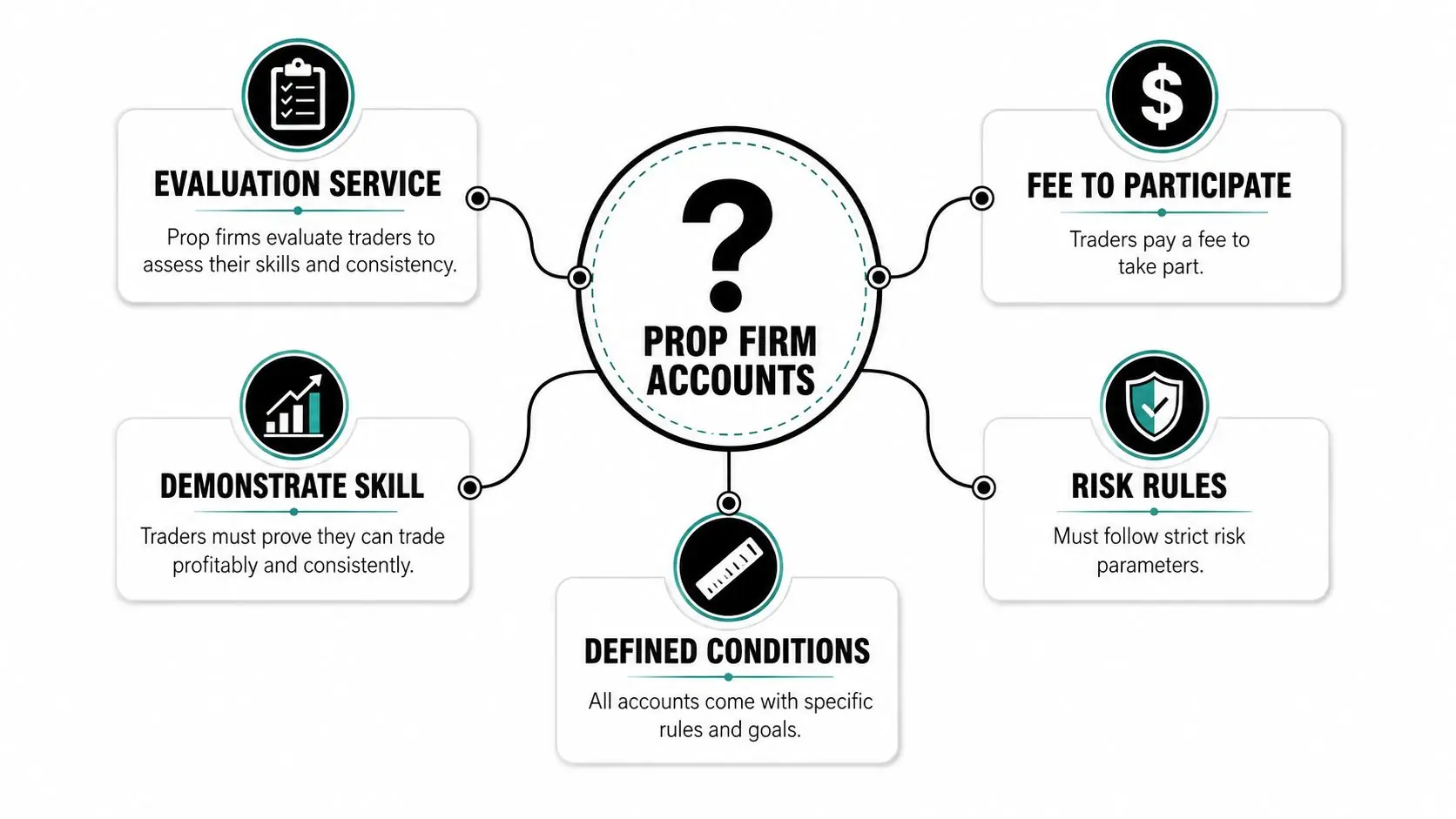
The useful question isn't “How much capital do I get?” It's “What equity path, trading behaviour, and operating conditions does this contract allow?”
The sector has grown beyond a niche product. One market analysis estimates the global forex and prop-trading market at about USD 7.14 billion in 2026, projecting USD 24.55 billion by 2035 and a 10.9% compound annual growth rate over that period, according to Business Research Insights. A separate industry estimate places the broader prop-trading ecosystem near USD 20 billion. Because the estimates describe different market boundaries, compare their definitions before treating them as directly equivalent.
Scale does not remove risk. Public industry summaries report that only 5% to 10% of traders pass an evaluation on their first attempt, while about 7% of challenge buyers receive a payout, according to published prop-firm statistics. Trading involves a substantial risk of loss, and this article is educational only, not financial advice. Review the general model in this prop trading firm overview, then confirm the current rules, automation permissions, loss limits, and payout terms in the provider's agreement.
How the Prop Account Journey Works
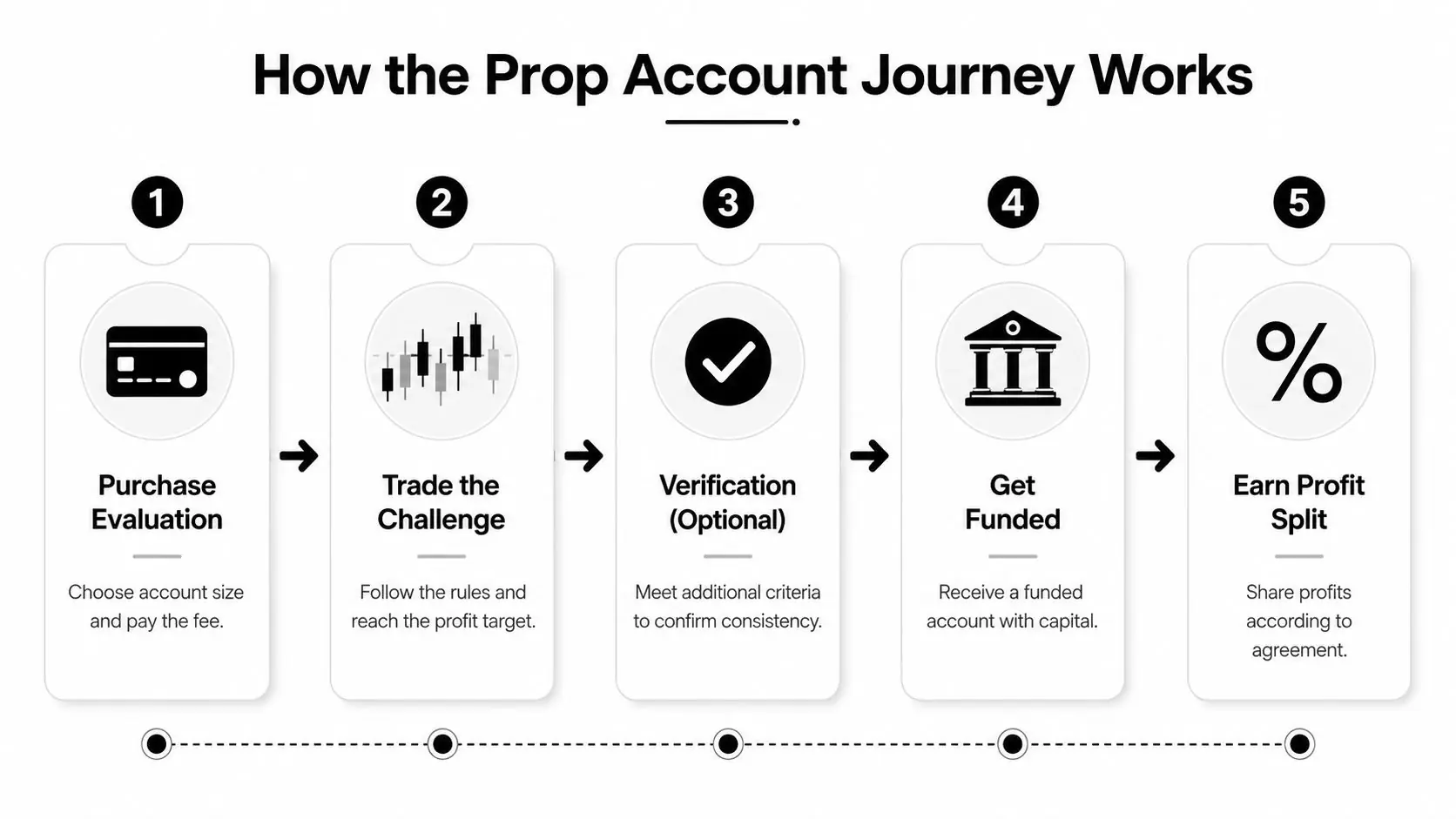
The account journey usually has several gates. You pay for an evaluation, trade within the challenge rules, complete a verification stage if the provider requires one, and then request payouts only after meeting the funded-account conditions.
The stages from purchase to payout
Purchase the evaluation: Choose an account size and pay the fee. The displayed balance is a rule framework, not money you can withdraw or freely lose.
Trade the challenge: The provider measures your equity path against a profit target, daily loss limit, maximum drawdown, and any minimum trading-day or consistency requirements. Evaluations commonly use a phase-one profit target of about 8% to 10%, with a daily loss limit of roughly 4% to 5% and maximum drawdown of about 8% to 12%, as explained in this prop-firm trading guide.
Complete verification if required: Some programs add another stage to check whether your results came from repeatable behaviour rather than one unusually aggressive session.
Receive funded status: You continue trading under the provider's rules. Funded status doesn't remove drawdown limits, prohibited-strategy rules, or payout conditions.
Request a payout: You become eligible according to the account agreement, then receive your share after any minimum trading days, buffer, review, or processing requirements are satisfied.
A minimum trading-day rule can also affect the journey. General guides commonly describe 3 to 5 minimum trading days, while futures-focused programs may use 5 to 10 days, according to this 2026 evaluation-rules breakdown. The purpose is to reduce the chance that one lucky session completes the entire test.
A concrete example
Suppose you buy a $100,000 challenge with an 8% profit target. You'd need to produce $8,000 in qualifying profit before moving forward. If the program uses a 10% trailing drawdown, the account's allowable loss follows its high-water mark rather than remaining fixed at the starting balance.
If the first payout cycle offers a 50% trader split, a $2,000 eligible profit would produce $1,000 for the trader before any provider-specific deductions. That example illustrates why the split can't be judged separately from the drawdown, payout timing, and eligibility rules.
The account may remain simulated even after you reach funded status. Read the agreement carefully to establish whether the provider describes the account as simulated, live, or a combination of simulated trading and internal risk management.
Understanding Drawdown and Loss Rules
Profit targets and headline splits receive attention, but the loss rules decide whether you can keep trading long enough to use either. Read the account through three questions: where is the equity floor, when is loss measured, and does that floor move after profits?
A daily loss limit restricts the amount you may lose during a trading day. A maximum drawdown caps the decline from a starting balance or a high-water mark. Static drawdown keeps its floor fixed against the initial balance, while trailing drawdown raises the floor as equity reaches new highs. The equity floor is the value your account must not cross. Some providers also require positions to be closed at a specified time, so unrealised profit and loss can affect compliance.
Independent education sources describe a common rule stack of a 3% to 5% daily loss cap and an 8% to 12% maximum drawdown cap, as outlined in drawdown-management guidance from TradeZella. Breaching either limit can terminate an evaluation or freeze an account. The agreement controls the actual calculation, including whether the provider uses balance, equity, or another measurement.
How a trailing floor changes
Assume a $100,000 account has a 10% trailing drawdown. At the start, the floor is $90,000. If equity rises to $108,000, the floor moves to $97,200. A later decline below that level can end the account even while the balance remains above its original starting point. For a fuller explanation, see this guide to trailing drawdown mechanics.
| Rule Type | Starting Limit | After Equity Rises to $108,000 | Trader Still Loses If Equity Drops To | Remaining Loss Capacity |
|---|---|---|---|---|
| Static 10% drawdown | $90,000 floor | $90,000 floor | Below $90,000 | $18,000 from $108,000 |
| Trailing 10% drawdown | $90,000 floor | $97,200 floor | Below $97,200 | $10,800 from $108,000 |
| Daily 1.5% loss limit | $1,500 daily loss capacity | Depends on the provider's reset calculation | At the applicable daily threshold | About $1,500 before the daily breach |
The table demonstrates the maths, not a universal rulebook. A provider may calculate limits from balance, equity, or a high-water mark, then reset them at a particular server time.
On a $100,000 account, a 1.5% daily loss limit represents approximately $1,500, including any applicable unrealised loss. That amount should shape position size before an order is placed. One trade that can lose $1,000 plus a correlated trade that can lose another $700 may breach the rule before the session ends.
Personal risk limits should sit below the firm's limits. A provider's maximum is an emergency boundary, not a sensible daily target.
Intraday enforcement adds another source of payout and account risk. Equity can cross the threshold while a position is open, then recover before the session closes. End-of-day enforcement may produce a different result, but a temporary drawdown is not automatically harmless. Weekend gaps, news volatility, spreads, and correlated positions can push equity through the floor. Trading involves risk of loss, and breaking an applicable rule can end the account immediately.
Comparing Instant and Challenge Accounts
The main difference between account models is how quickly you reach tradable capital and how much evaluation friction you accept. No structure is automatically superior. A fast-access model may offer less room for mistakes, while a challenge model may require more patience before you can request a payout.
| Feature | Instant Funding | 1-Step Challenge | 2-Step Challenge |
|---|---|---|---|
| Access | Funded status begins after the provider's entry checks | Access follows one evaluation phase | Access follows evaluation and verification |
| Profit target | Usually no challenge target | One target must be reached | A target applies to the first stage, with further criteria afterward |
| Main demand | Respect funded-account risk rules immediately | Balance target progress with risk control | Demonstrate consistency across separate stages |
| Best fit | Traders who value speed and understand the restrictions | Traders with a tested strategy and moderate evaluation tolerance | Traders who prefer additional confirmation before funding |
| Key concern | Tighter economics or stricter funded conditions may apply | One failed attempt can repeat the entry cost | The longer path creates more opportunities for rule mistakes |
| Style questions | Check news, weekend, automation, and copy-trading permissions | Check target pace and minimum-day rules | Check both phases separately |
Instant Funding skips the normal profit-target phase and grants immediate funded-style access after the provider's vetting process. That can suit a trader who has a tested strategy and dislikes challenge pressure, but immediate access doesn't mean unlimited flexibility. You still need to review drawdown, payout eligibility, and restrictions on news, weekends, EAs, or copied trades.
A 1-Step Challenge reduces the number of gates. It may be attractive to a disciplined scalper or day trader who can reach the target without increasing size. A 2-Step Challenge adds a verification stage, which can suit a strategy builder who prefers a slower test of repeatability.
Instant funding programs can be compared with challenge accounts by looking beyond the advertised split. Calculate the likely cost of failed attempts, the time before the first eligible payout, and the effect of restrictions on your actual strategy. A swing trader may value weekend holding more than rapid access. An algorithmic trader may care more about platform stability and API or EA permissions than about a headline percentage.
MyFundedCapital Account Features
A provider comparison should begin with operating details, not marketing language. Account sizes, loss limits, platforms, instruments, and permissions determine whether your strategy can function inside the program.
MyFundedCapital offers account sizes from $5K to $100K, with scaling paths up to $500K, and supports manual, algorithmic (by agreement with support), and copy trading across 350+ instruments. Its published environment includes forex, crypto, and commodities, with DXtrade and cTrader available and MT5 described as coming soon. These are provider-specific features, so confirm the current terms before purchase.
Features that affect execution
| Account Feature | Details | Practical Notes |
|---|---|---|
| Account sizes | $5K to $100K, with scaling paths up to $500K | Choose based on your risk process, not the displayed balance |
| Loss boundaries | Flat 5% daily loss limit and up to 10% maximum drawdown | Calculate equity exposure before placing correlated positions |
| Optional add-ons | News trading, weekend holding, and faster payouts | Add-ons matter if your strategy depends on event volatility or open positions |
| Platforms | DXtrade and cTrader, with MT5 coming soon | Test charting, order entry, automation, and data behaviour first |
| Instruments | Forex, indices, crypto, and commodities across 350+ instruments | Confirm symbol availability, spreads, and contract specifications |
| Trading styles | Manual, algorithmic, and copy trading | Read the policy on signal duplication, EAs, and account coordination |
| Support | 24/7 multilingual support and Discord community | Test response quality before paying, especially for rule questions |
Consider a $50,000 account. A flat 5% daily loss limit represents $2,500, while a 10% maximum drawdown represents $5,000 from the relevant starting reference. If equity reaches $52,000, the daily limit still needs to be calculated according to the provider's reset rules, and a losing position can reduce available capacity before it closes.
A platform is part of the risk model. If your order workflow, automation, or stop-loss handling feels unfamiliar, the account isn't operationally ready.
Overnight holding, and weekend positions need separate confirmation. A trader holding crypto or swing positions may require weekend permission, while a news-focused system may need a news-trading add-on. A copy trader must check whether the provider permits copying between personally controlled accounts and how it defines prohibited coordination.
The important comparison is practical: can you execute your existing method within the stated boundaries? If not, a higher split won't repair the mismatch.
Profit Splits and Payout Considerations
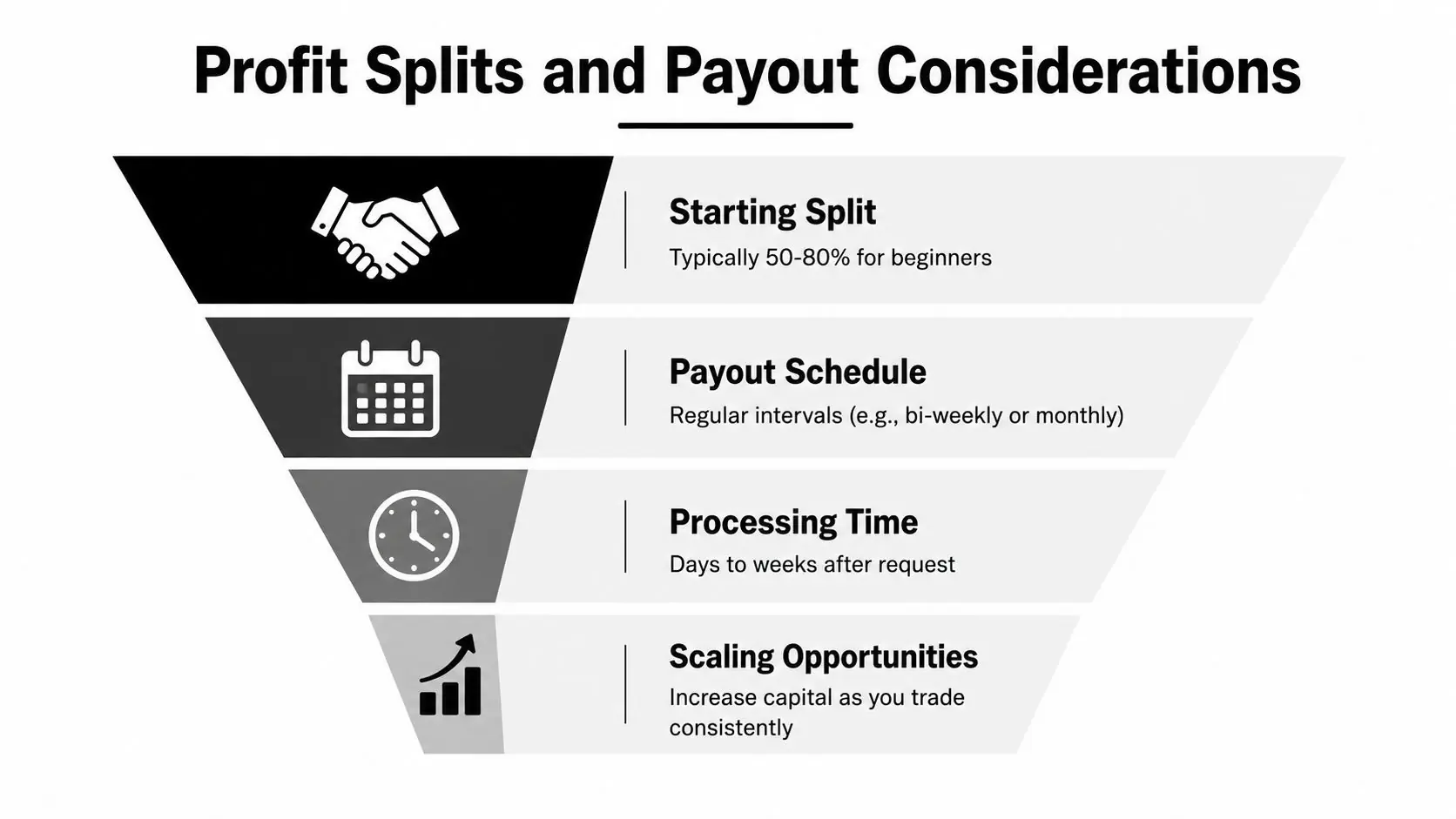
A profit split is only one part of the economics. The amount you keep depends on whether profits qualify, how often you can request them, how long processing takes, and whether the account can survive long enough to build a payout history.
A provider may advertise a high share but apply conditions involving minimum trading days, buffers, cooldown periods, payout frequency, or scaling milestones. You should also check whether the split applies to gross eligible profit, whether refunds are available, and which withdrawal methods are supported.
For a simple illustration, suppose a $100,000 funded account produces $2,000 in eligible profit and the agreement gives the trader 80%. The trader's share would be $1,600 before any applicable deductions. If the request can only be made after a qualifying cycle, that theoretical share isn't immediately available cash.
MyFundedCapital states that profit splits start at 80/20, with upgrades to 90/10 or 95/5, subject to its program terms. It also describes payouts every 7 or 14 days depending on the program, or on demand with the payout add-on, through bank or crypto methods, with average processing around 2 hours. Treat those as published operating terms to verify at the time of purchase, not as a guarantee of future income or approval.
Questions to ask before comparing splits
- Eligibility What trading activity qualifies for withdrawal?
- Timing Is the schedule fixed, on demand, or dependent on a review?
- Processing Does the advertised window begin at request or approval?
- Scaling What performance and capital conditions raise the allocation?
- Friction Are there buffers, cooldown periods, minimums, or refund rules?
A lower split with straightforward access can produce a better real-world experience than a higher split surrounded by delays and restrictions. Compare the full path from trade to bank account.
Choosing a Prop Firm Provider
A headline profit split cannot compensate for unclear rules, delayed access, or a platform that conflicts with your trading method. Read the operating agreement before paying, not after a disputed trade. Marketing pages summarise the offer, while the agreement defines drawdown calculations, prohibited behaviour, payout reviews, and account termination.
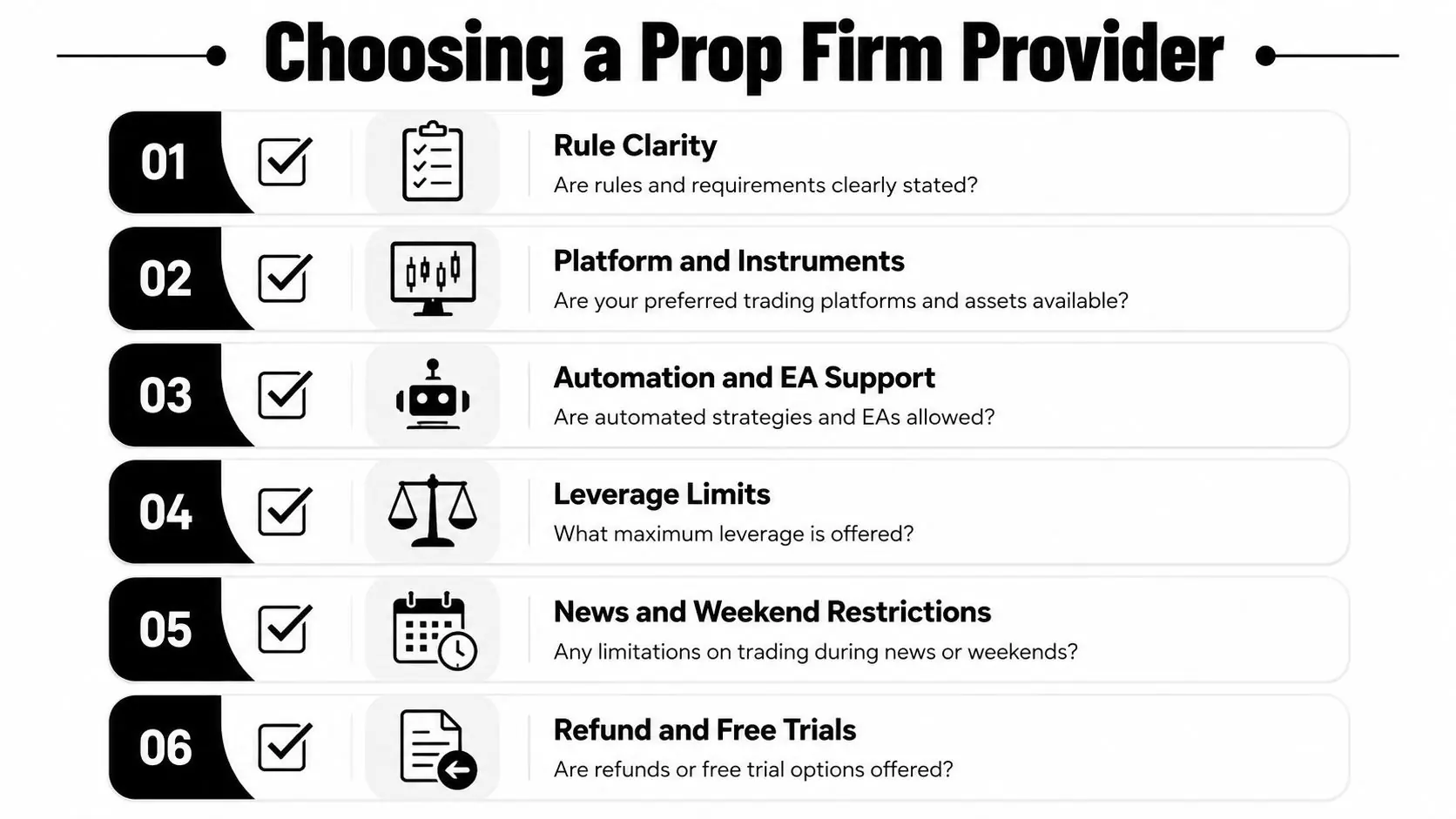
Use the checklist to test the provider's operating fit:
- Rule clarity: Confirm whether losses are measured from balance, equity, or a high-water mark. Write the loss floor in your account currency.
- Platform and instruments: Check that your preferred platform and assets are supported. MyFundedCapital lists MetaTrader, cTrader, TradeLocker, Match-Trader, and NinjaTrader, but verify which options apply to your chosen program.
- Automation and EA support: Ask whether expert advisors, copy trading, automated strategies, and trade managers are permitted. Community assumptions are not a substitute for written rules.
- Margin limits: Compare margin requirements with your strategy. Higher margin can amplify losses and make accidental breaches easier.
- News and weekends: Confirm whether event trading and weekend holding are allowed or require an add-on.
- Refunds and retries: Review challenge refunds, repeat attempts, resets, and the outcome after a rule breach.
- Payout evidence: Examine trader experiences, separating payment evidence from anonymous promotional claims.
- Support quality: Send a specific rules question before purchase. The answer should be clear enough to model in a trade plan.
A no-time-limit evaluation may reduce calendar pressure, while published daily and maximum drawdown boundaries make risk planning easier. Free repeat attempts can reduce restart friction, but they cannot make an unsuitable strategy viable. Trading involves risk of loss, so test whether the account structure supports your method before treating access as an opportunity.
For context on the technical systems that support financial platforms, read these practical insights on fintech software development from ThirstySprout, particularly when assessing platform reliability, automation support, and operational transparency.
A Practical Final Decision Framework
Headline profit splits should come after the operating details. Use three tests before selecting prop firm accounts.
First, match access and rules to your behaviour. Choose an account size and route that fit your experience, risk tolerance, holding period, execution speed, and trading style. A trader who needs weekend positions should not select a program that blocks them. Check whether immediate access or a challenge better suits your preparation and tolerance for evaluation pressure.
Second, calculate the complete cost of reaching a payout. Include the evaluation fee, optional add-ons, likely failed attempts, resets, and time spent meeting payout conditions. Compare that total with a realistic profit split, payout schedule, and withdrawal requirements, rather than an ideal outcome.
Third, test the operating fit. Confirm platform access, instruments, loss-limit calculations, payout timing, and scaling rules. Review automation permissions and the account's trading conditions in writing. A technically attractive account can still fail if its order environment conflicts with your method.
Trading involves risk of loss, including amplified losses. Treat the fee as a risked expense, not an investment with an expected return. This material is educational only and is not financial advice.
Compare current MyFundedCapital funding programs with your written checklist. MyFundedCapital offers Instant Funding, 1-Step, and 2-Step Challenge programs, simulated trading environments, defined loss limits, multiple platforms, and access to forex, crypto, and commodities. Visit MyFundedCapital to review account types, rules, and payout conditions.