Most traders think capital growth strategies mean swinging for a huge month and hoping the account survives. In funded trading, that mindset is usually the fastest route to a breach, because the rules punish sloppy risk long before they reward upside.
The job is more boring and more profitable over time. You need a way to compound edge, keep drawdowns contained, and scale inside hard limits without turning every session into a coin flip.
Why Most Traders Misunderstand Capital Growth
The biggest mistake is treating capital growth like a highlight reel. Traders chase one oversized winner, then call that a strategy, even though funded accounts usually reward consistency, loss control, and the ability to survive the next ten trades.
Growth starts with risk, not size
A trader with a workable edge can still fail if the position size is wrong. A rules-based growth framework starts with per-position risk around 0.5% to 1.0% of equity, then converts that risk into size using ATR-based stop distance or nearby technical levels so volatile names get smaller allocations and calmer names get larger ones. That keeps risk more even across instruments and stops one wild position from dominating drawdown. The framework is laid out in a practical position-management guide from Above the Green Line, which is useful if you want a more technical walk-through of volatility-adjusted sizing, above the green line capital growth management framework.
Practical rule: if you cannot define the loss before you enter, you do not have a growth strategy, you have a hope trade.
The other misconception is that growth has to come from taking more risk. It does not. It comes from making the account more productive over hundreds of trades, then letting winners and payouts recycle into a larger base.
For traders who use automation, even a general AI finance workflow can help with routine tracking and planning, but it will not replace discipline. A useful overview is Superchat's guide to AI finance, especially if you want to see how automation can support, not replace, decision-making.
Why home-run thinking fails in prop accounts
Prop environments add hard limits that retail traders often ignore. A daily loss cap, maximum drawdown, and scaling rules mean one bad stretch can end the journey faster than a bad year would in a personal account.
That is why growth in this setting looks more like professional risk management than gambling on breakout candles. The trader who survives long enough to collect payouts, then repeat the process, is usually the one who grows capital.
A broader market backdrop helps explain why liquidity matters. SIFMA's fact book shows the size and activity of equity and fixed-income markets, along with trading volume that supports repeated deployment and rotation of capital, SIFMA's fact book. Growth-oriented strategies depend on markets where capital can be put to work without constant friction.
Comparing the Major Capital Growth Strategy Families
Different traders talk about growth as if one playbook fits everyone. It doesn't. The right setup depends on how much screen time you have, how much rule complexity you can tolerate, and whether your account allows news trades, weekend holds, or a more flexible holding period.
| Capital Growth Strategy Families Compared | Time Commitment | Prop-Firm Compatibility | Typical Holding Period | Drawdown Risk |
|---|---|---|---|---|
| Active day trading | High | Strong if rules are tight and execution is disciplined | Minutes to hours | High |
| Algorithmic and EA-based systems | Medium to high after buildout | Strong if the system respects loss limits and news filters | Intraday to multi-day | Medium to high |
| Swing trading | Medium | Good if weekend and news rules allow it | Days to weeks | Medium |
| Long-term position investing | Low on a daily basis | Weak in many funded environments because capital is tied up | Weeks to months | Medium |
| Leveraged approaches | Medium to high | Mixed, because leverage magnifies both growth and violations | Varies widely | Very high |
| Income-versus-growth orientations | Medium | Depends on whether the firm rewards payouts or open exposure | Varies | Medium |
What works inside a funded account
Active day trading fits traders who can react quickly and keep losses small. It works when the edge is in execution, not prediction. If you're slow, emotional, or easily distracted, this style will expose it fast.
Algorithmic and EA-based systems can work well if the logic is stable and the risk guardrails are hard-coded. The problem isn't the automation, it's the false confidence traders get after a few clean weeks. One untested market condition can turn a neat curve into a mess.
Swing trading is the most forgiving for many funded traders because it doesn't require constant clicking. The trade-off is overnight exposure, weekend risk, and the need to understand whether your firm allows those holds.
What usually fails
Long-term position investing is hard to reconcile with most prop setups, because the firm isn't paying you to sit on a thesis for months. Debt-financed approaches can also look attractive on paper and still be toxic in practice, because borrowing doesn't create edge, it just magnifies whatever you already have.
Bottom line: choose the family that fits your account rules first, then fit your personality around it. The other way around usually ends in a rule breach.
Income-versus-growth traders need to separate the urge to withdraw every dollar from the need to keep the account compounding. In practice, that means deciding which part of the balance is for payout and which part stays in the engine. That distinction matters more in prop trading than in generic investing discussions, because the rules govern how long the engine stays alive.
Building a Position Sizing Framework That Protects Your Account
A funded account usually dies from oversized entries before it dies from a bad idea. The fix is straightforward in concept and unforgiving in execution, define risk before the trade, then size the position from that risk rather than forcing the risk to fit the trade.
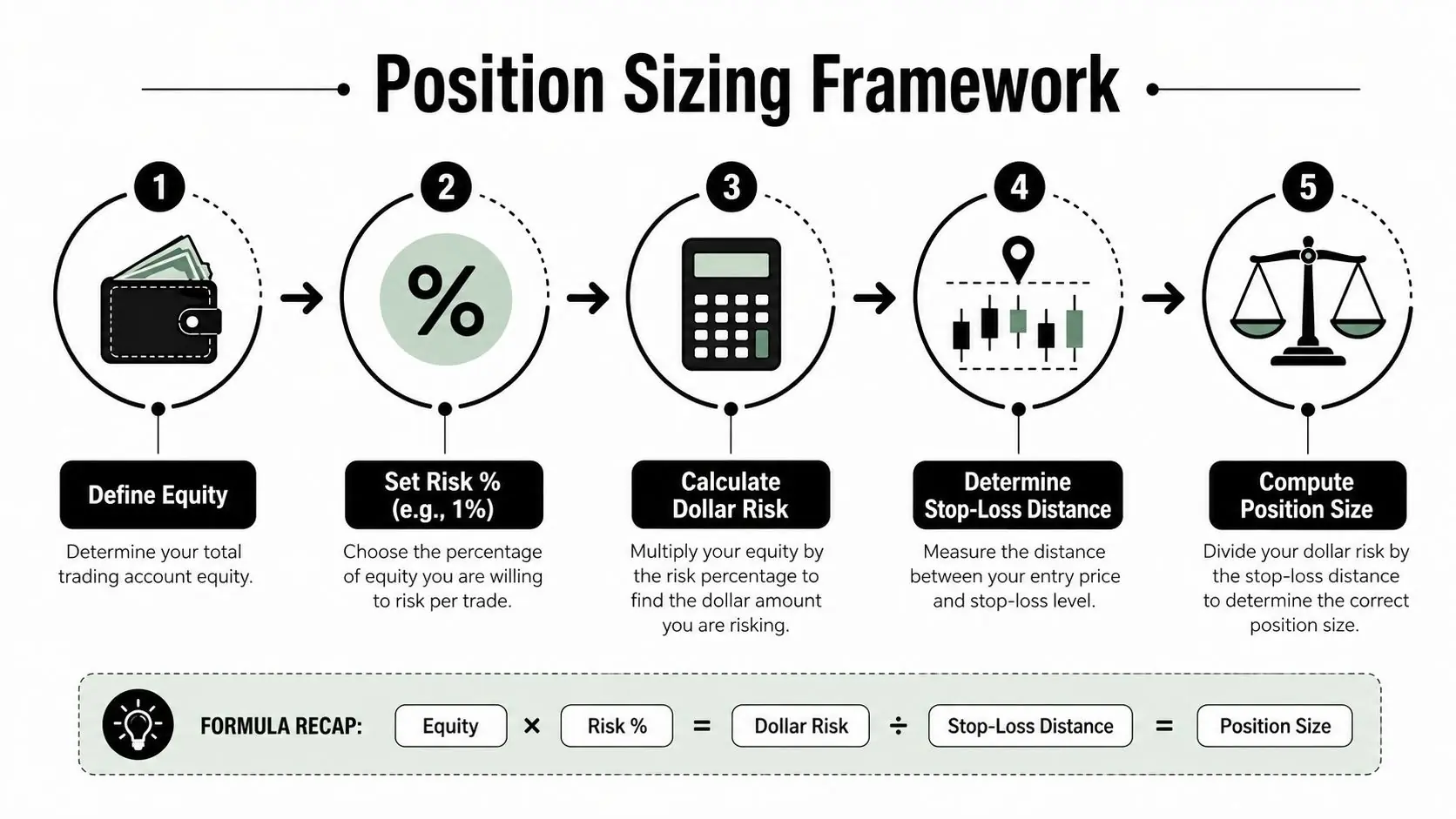
A practical sizing sequence
Start with equity, not hope. If your framework says the trade risks 0.5% to 1.0% of equity, translate that into a dollar figure, then use stop distance to calculate the number of contracts, lots, or shares.
For traders who want a calculator instead of doing the math by hand, the internal tool at MyFundedCapital's position size calculator is a useful starting point.
A clean process looks like this:
- Define equity. Use the account balance, not the amount you wish you had.
- Set risk %. Keep the per-trade loss small enough that a normal losing streak does not force a reset.
- Measure stop distance. Use ATR or a technical level that makes sense on the chart.
- Convert dollar risk into size. Divide the dollar risk by the stop distance per unit.
- Check the total exposure. Make sure the position does not crowd the account or conflict with correlated trades.
Here is the part most traders skip. If volatility is higher, the stop should usually be wider, which means the size should shrink. Fixed lot sizes ignore that reality and make a choppy name or a news-sensitive instrument far more dangerous than it needs to be.
A funded-account example that keeps the math honest
Take a $100K funded account with a 5% daily loss limit. The daily cap is the outer boundary, not the target, so the sizing model should sit well below it. If the framework risks 1% of equity per trade, the account is only exposing a small slice of capital on any single idea, which gives room for normal variance without immediately pressing against the firm's limit.
Good sizing is defensive. It keeps the account alive long enough for the edge to play out, which is the only reason growth ever becomes visible.
A volatility-adjusted method also helps if you trade forex, indices, and commodities in the same account. Those markets do not move the same way, and pretending they do is one of the fastest ways to overload risk.
For traders who also work with prediction market position sizing, the same discipline applies. Risk is set first, then position size follows the stop and the account rules, not the other way around.
Managing Drawdowns and Setting Risk Circuit Breakers
Drawdown management is where many funded traders fall apart. They don't usually fail because the strategy stopped working overnight. They fail because they keep trading after the account has already told them to stop.
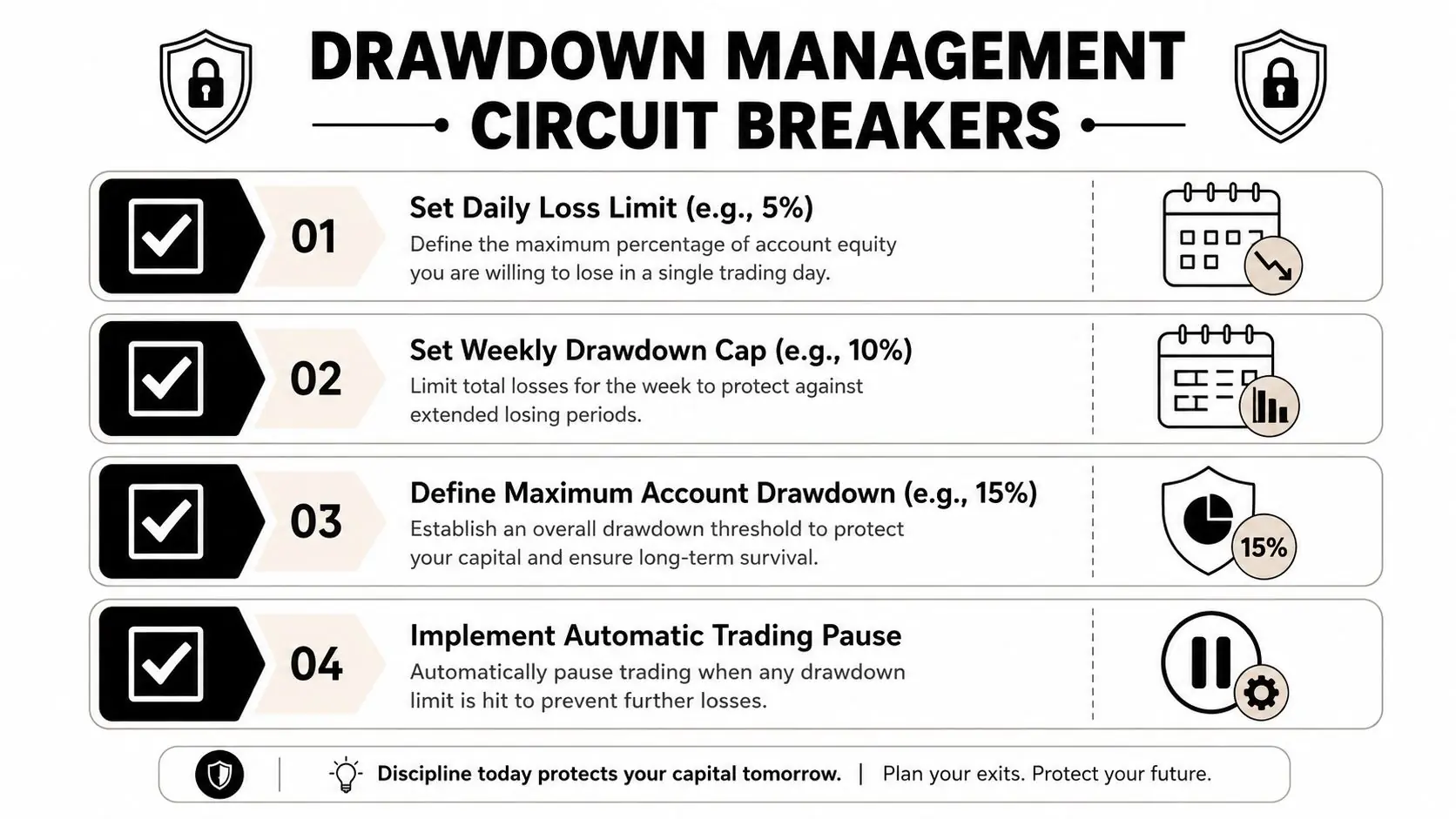
Build limits before you need them
A prop account with a flat 5% daily loss limit and up to 10% maximum drawdown forces a trader to think in layers. The daily cap protects the session, while the max drawdown protects the whole evaluation or funded lifecycle. If your own internal rules are looser than the firm's, you've already made a mistake.
A good personal circuit-breaker system has three parts:
- Daily stop stop trading after a pre-set loss, even if the market still looks tempting.
- Weekly stop pause after a losing stretch so one bad mindset doesn't contaminate the next sessions.
- Strategy stop shut down the model if the trade quality changes, not just the P&L.
The internal logic matters more than the exact number. If you hit the daily stop once, that's variance. If you hit it repeatedly while breaking your own process, that's probably a sizing or execution problem.
Separate normal variance from a broken edge
Traders lie to themselves here. They call every bad stretch “drawdown” and every losing streak “unlucky,” which keeps the problem hidden until the account is gone.
A better rule is to compare what happened against your process. If entries, stops, and size were clean, you can reduce size and continue after review. If you were improvising, revenge trading, or widening stops, you pause completely.
My own preference is to make the pause automatic after a fixed number of losses or after a clear equity dip, because emotion gets less authority when the rule is already written. That doesn't make the day better, but it prevents one ugly session from becoming five.
The guidance on maximum drawdown is worth studying directly if you want the mechanics behind the term, MyFundedCapital's explanation of maximum drawdown.
Scaling Capital Through Funded Account Progression
A funded account only grows if the trader treats payouts and scale-ups as part of the system, not as an afterthought. The account has to be handled like a business line, where survival comes first and progression is earned through repeatable numbers.
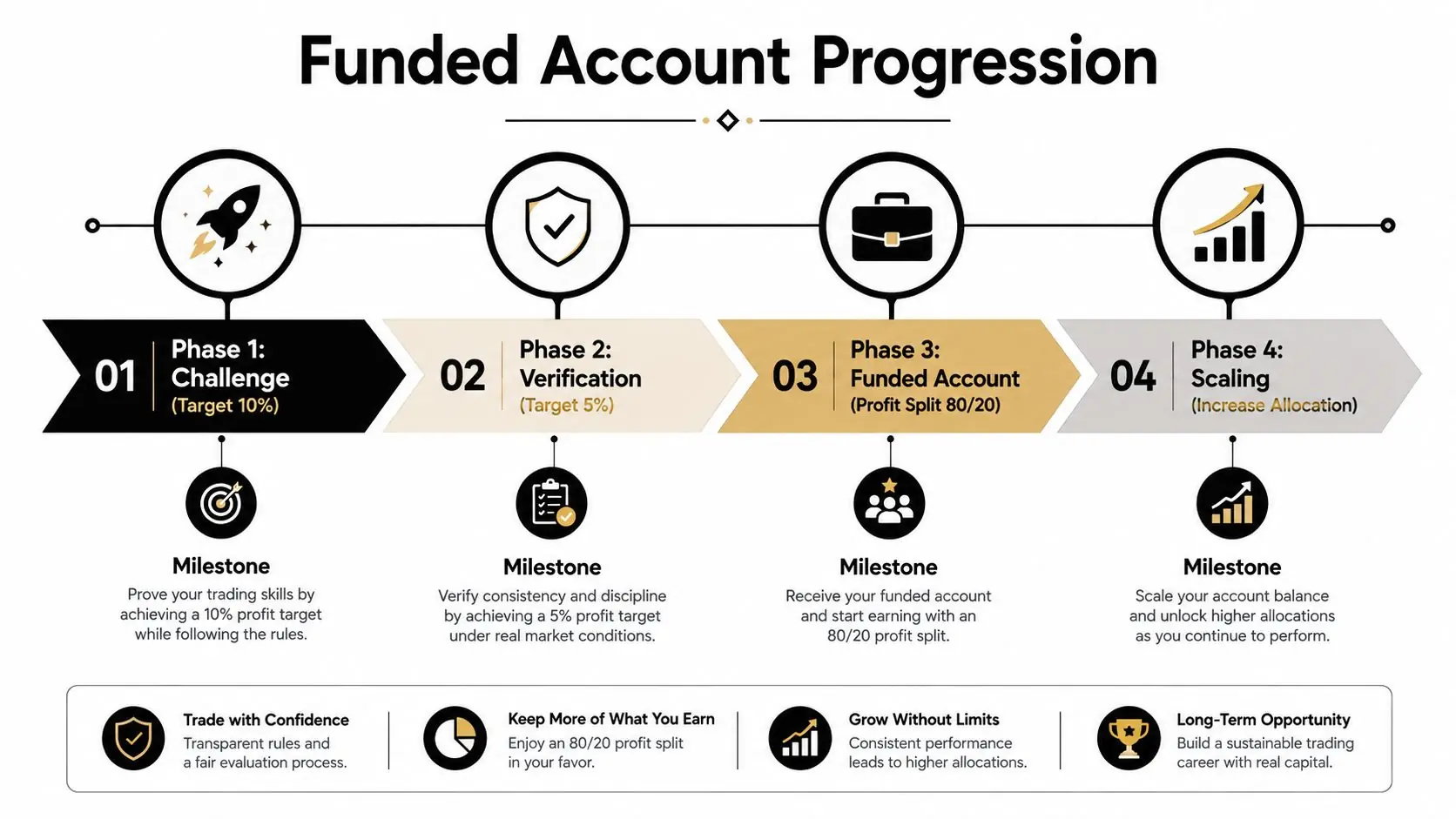
A realistic progression path
A trader might start with a 1-Step or 2-Step Challenge, then move into a funded phase after proving discipline. In that setup, the first payout often starts around an 80/20 split, with room to improve to 90/10 and, in some structures, even higher. MyFundedCapital also offers instant funding, so traders who already have a proven process can skip the evaluation path and focus on execution instead of qualification.
That progression matters because it changes behavior. Early on, the goal is to preserve the account and pass the structure. Once funded, the goal becomes keeping the payout stream alive long enough for scaling to matter.
What compounding looks like in practice
A trader who gets paid, keeps risk tight, and refrains from overtrading can recycle part of the payout into future growth. That's the compounding loop. It isn't glamorous, but it works because each payout reduces pressure and each scale-up increases the amount of capital available to the same edge.
For traders who want to understand how account growth is structured inside a funded setup, MyFundedCapital's scaling explanation is a sensible place to compare the mechanics.
Algorithmic and copy traders can use the same logic. The system still needs stable risk, but once the edge is automated, the job becomes less about emotions and more about keeping the infrastructure clean enough to earn the next step.
Trade like the account matters. Because in a prop environment, it does.
Your Capital Growth Execution Roadmap and KPIs
A capital growth plan only works if it can be measured without guesswork. If the numbers are fuzzy, a trader starts optimizing noise instead of progress, and that is a fast way to waste a funded account.
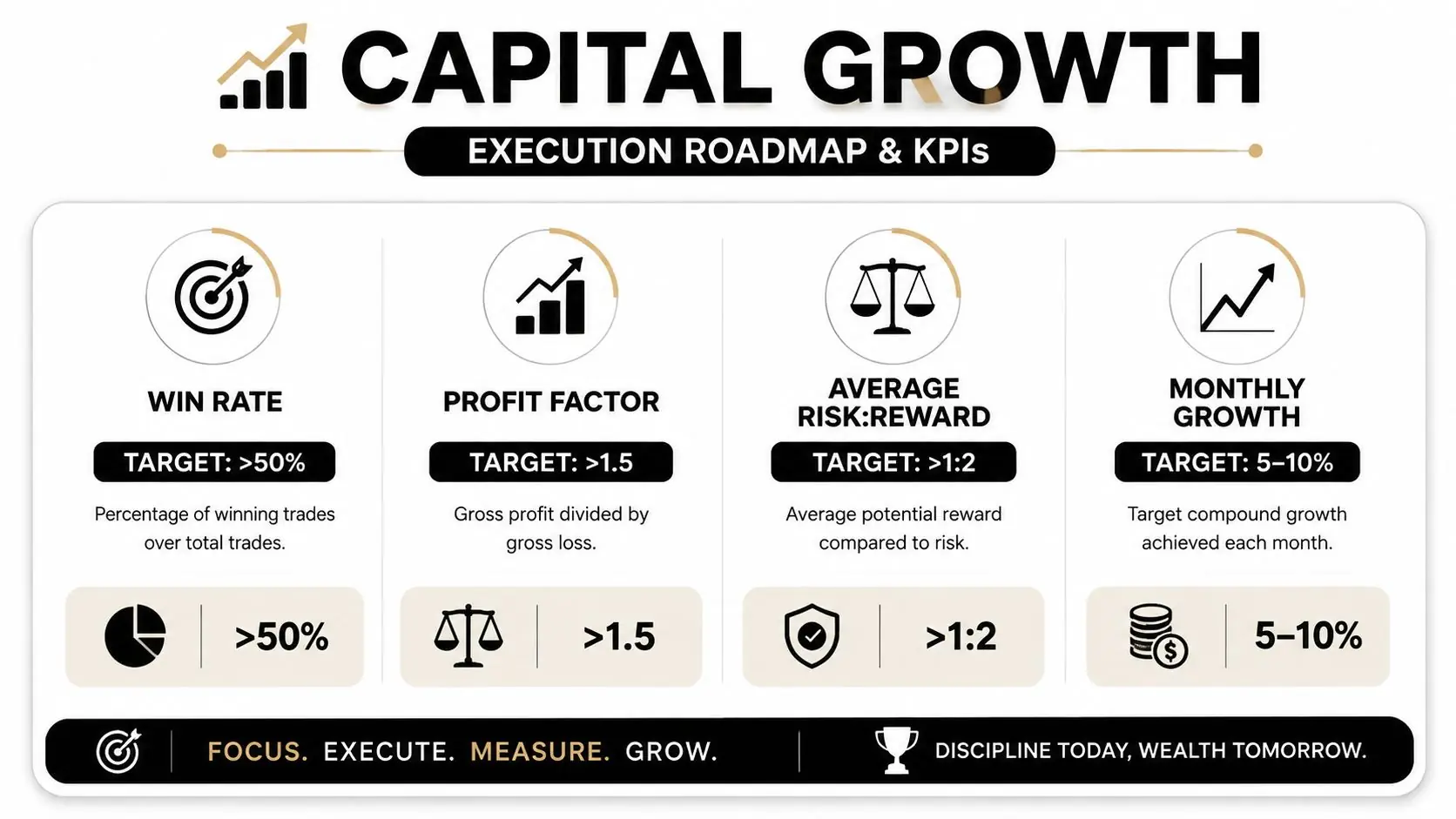
Track the numbers that matter
The main KPIs are simple, but they need context:
- Win rate. Useful only if the exits make sense. A high win rate with poor trade management can still lose money.
- Profit factor. This shows whether gross wins are beating gross losses.
- Average R-multiple. This tells you what each trade returns relative to the risk taken.
- Maximum drawdown percentage. This is the ultimate stress test in funded trading, because every prop account has a line you cannot cross.
- Payout consistency. One good month proves very little. Repeatable payouts show the process is holding up.
I also watch how much intervention the strategy needs. If every trade requires micromanagement, the edge may be weaker than it looks, or the rules may be too loose to survive a scaling plan.
A simple execution checklist
Before live risk goes on, these steps should be in place:
- Edge identification. Know what the setup is and what invalidates it.
- Backtest and forward-test. Do not fund a guess with real risk.
- Demo validation. Confirm the system behaves under live chart conditions, with spreads, slippage, and execution quirks included.
- Challenge selection. Choose the account structure that matches your holding period, drawdown tolerance, and position sizing style.
- First payout discipline. Do not give back the account after the first win because impatience takes over.
Market structure matters too. Broad market activity remains deep enough for disciplined traders, but that depth does not protect sloppy risk management, and it does not care whether you are in a challenge or a scaled account. SIFMA market statistics is a useful reference point for the size and activity of public markets, but the practical lesson is simpler, there is room to grow if your risk stays controlled.
Trading involves risk of loss, and no framework removes that. What it can do is make losses survivable and wins repeatable.
MyFundedCapital gives traders access to instant funding, 1-Step and 2-Step challenges, clear loss limits, and scaling paths that fit a capital-growth approach built around discipline. If you want a prop setup that matches this style of trading, visit MyFundedCapital, compare the account types, and start a challenge only if your process already respects drawdown and sizing rules.