

 AR
AR
 NL
NL
 FR
FR
 DE
DE
 ES
ES
 IT
IT
 PL
PL
 SV
SV
 PT
PT

You may be in a familiar spot. Your trading plan works well enough to take seriously, but your own account size keeps limiting what you can do. Then you search for capital funding in the US and get buried under content about small-business loans, grants, and startup investors that don't fit a trader's situation.
This guide separates those paths clearly. You'll see what traditional funding really means, how prop firm funding differs, and how to decide which route matches your goals and risk tolerance.
What Is Capital Funding and Why Is It So Confusing
If you type “capital funding US” into a search engine, most results assume you're building a company, opening a storefront, or raising money for a startup. That's useful for founders. It's not very useful if you're a trader who already has a method and needs access to more capital.
That mismatch causes most of the confusion.
A lot of US funding content blends together business lending, public programs, venture investing, and trader funding. One reason is that many resources focus on underserved businesses and public financing programs, including microlending and the $10B Capital Projects Fund for infrastructure discussed by Third Way's report on unlocking capital for underserved businesses. That same gap leaves traders unclear on a core point: prop firms can offer simulated capital without traditional debt or equity dilution.
Why traders get the wrong answers
A trader usually asks a simple question: “How do I trade more size without borrowing money or giving away ownership?”
Traditional funding articles answer a different question. They explain:
- How to finance a business entity: loans, grants, investor rounds
- How to prove business viability: revenue history, credit, projections
- How to attract investors: pitch decks, market size, team credibility
That's a different problem set.
If you're trying to raise capital for a startup, a directory that helps you find US investors can be useful. But if your main asset is your trading performance, not a company with employees and a pitch deck, investor search tools often solve the wrong problem.
Practical rule: If the funding process asks for a business plan before it asks how you manage risk, it probably wasn't designed for traders.
The key distinction
There are really two separate worlds:
- Business funding, where capital goes to a company.
- Trader funding, where access to capital depends on trading skill and rule compliance.
Once you separate those, the rest gets much easier to understand.
Traditional Business Funding vs Modern Trader Funding
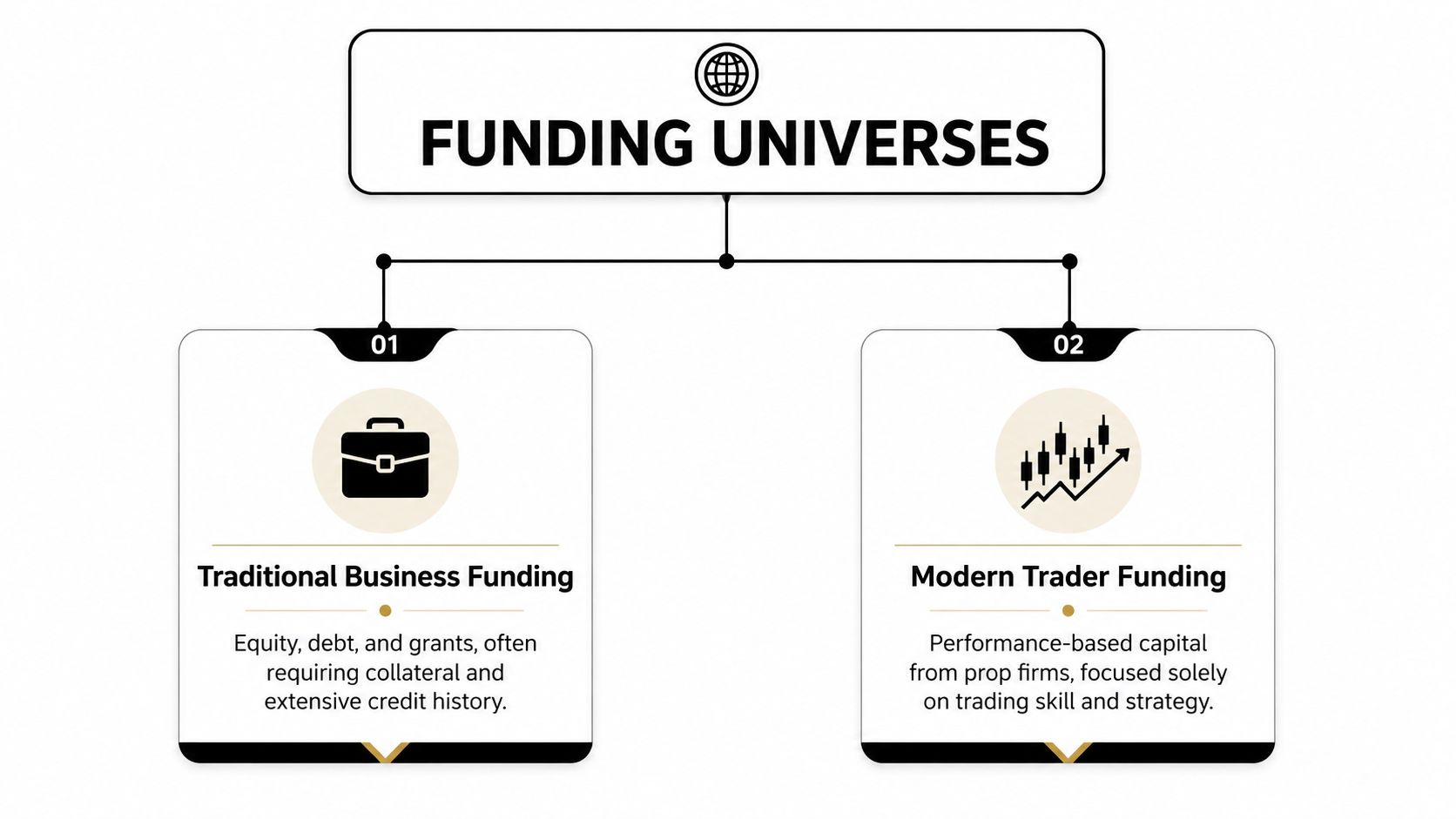
Capital funding is often perceived as a single system. It isn't. It's closer to two different universes that happen to use the same word.
Traditional funding is massive. Market-based financing reached 116% of global GDP by the end of 2023, compared with 71% for credit to non-financial corporations, according to the OECD Corporate Governance Factbook 2025. That tells you how dominant public capital markets are in the broader economy.
For a trader, though, scale doesn't equal fit.
Traditional business funding
This side of the funding world is built around a formal business. The capital provider wants to know what the company does, how it earns money, who runs it, and what protects their downside.
That usually means some mix of:
- Debt funding: bank loans, lines of credit, SBA-backed lending
- Equity funding: angel investors, venture capital, private equity
- Public or institutional capital: larger-scale financing tied to corporations and capital markets
The logic is straightforward. The lender or investor is financing a business idea, business asset, or business growth plan.
Modern trader funding
Trader funding works differently. A prop firm isn't usually asking for your company structure, office lease, or investor deck. It's trying to answer another question: can you trade within defined risk rules and produce consistent results?
That changes the evaluation standard.
Instead of focusing on:
- personal credit history,
- collateral,
- equity ownership,
- or startup projections,
the model centers on:
- trading discipline,
- drawdown control,
- profit target completion,
- and rule adherence.
A bank funds a balance sheet. A prop firm evaluates behavior under market pressure.
Why this matters in practice
A trader may have a solid process and no interest in building a startup around it. In that case, traditional capital funding in the US can feel like forcing a round peg into a square hole.
A founder wants money to build an operating business.
A trader usually wants enough capital to execute a strategy at meaningful size.
That's why the phrase capital funding US leads so many traders astray. The mainstream conversation is still business-centric. The trader path is skill-centric.
A Quick Guide to Bank Loans and Venture Capital
If you're trying to decide whether traditional capital funding fits your situation, it helps to strip away the marketing language and look at the trade-offs directly.

Private capital is huge. Private equity grew from $137 billion in 2004 to roughly $1 trillion by 2021, and accounted for $861 billion in capital formation in 2023, based on the PERI analysis from UMass Amherst. That tells you there's plenty of money in private markets. It doesn't mean that money is accessible to an individual trader.
Bank loans
A bank loan is the most familiar form of funding. You borrow money and agree to repay it under set terms.
For traders, the problem isn't that loans are bad. The problem is that they usually fit a business with predictable income better than a discretionary or systematic trading operation run by one person.
Banks typically want to see:
- Repayment ability: income, cash flow, or business revenue
- Documentation: formal records, returns, statements, legal structure
- Creditworthiness: personal or business credit history
- Clear use of funds: equipment, payroll, expansion, working capital
If you're researching that route anyway, this GoSBA Loans financing guide for entrepreneurs gives a practical look at how SBA-style lending is usually framed.
Where loans clash with trading
A loan creates a fixed obligation. Markets don't.
That means you can be right about your long-term edge and still face pressure from repayment schedules, interest costs, and the emotional burden of trading borrowed money. For many traders, that pressure changes decision-making in a bad way.
Venture capital and investor funding
Venture capital is even less aligned with most individual traders. VC firms usually back companies they believe can scale fast. They want ownership, governance rights, and a path to a larger exit.
That means you're not just taking capital. You're giving up part of the business.
Here's the basic mismatch:
- VC wants equity: they invest in a company, not in your personal trading skill
- VC wants growth narrative: market size, product, team, traction
- VC wants ownership upside: they expect a return tied to the company's value
If you want to understand that founder route in more detail, this overview of how venture capital funding works helps frame what investors usually expect.
If you're a trader, the question isn't “Can I raise money?” It's “Do I want debt, dilution, and outside control attached to it?”
A quick self-check
Traditional funding may fit if you're building an actual trading business with employees, systems, and a broader operating model.
It may be a poor fit if you're:
- trading solo,
- trying to avoid debt,
- unwilling to give away equity,
- and mainly need access to larger buying power rather than startup capital.
That's where prop firm funding becomes relevant.
How Prop Firm Capital Funding Works for Traders
Prop firm funding is easier to understand when you stop comparing it to a loan.
You're not borrowing cash in the usual sense. You're entering a structured evaluation or funded program where the firm gives you access to a trading environment under specific rules. Your role is to show that you can manage risk and generate results within those limits.
Why many prop firms use simulated accounts
This is one of the biggest points of confusion for new traders. They hear “funded account” and assume it works like a retail brokerage account with client funds.
That's often not the case.
In the US, firms that operate as broker-dealers and carry customer accounts face net capital requirements. SEC Rule 15c3-1 mandates a minimum net capital of $250,000 for firms carrying customer accounts, which creates a strong incentive for firms to use demo-only evaluation models, as noted in B2Broker's explanation of starting a prop firm.
That's one reason many firms structure their programs around simulated environments with real market quotes.
What that means for you
It means the firm can assess your decision-making, consistency, and risk control without turning the relationship into a standard customer brokerage setup.
If you're new to this model, a plain-language overview of what a prop trading firm is can help put the terminology in context.
The usual path from evaluation to funded status
Most prop firms use one of two broad approaches:
Challenge model
You trade under preset rules and try to hit a profit target without violating drawdown or loss limits. If you pass, you move into a funded stage under the firm's structure.
Two common examples from MyFundedCapital show how this is framed:
- 1-Step Challenge: requires a single 10% profit target to access funded accounts from $5K to $80K, with a claimed 4.5x higher payout chance than longer evaluation paths, according to the 1-Step Challenge page
- 2-Step Challenge: uses 8% in Phase 1 and 5% in Phase 2, with funded account sizes from $2K to $100K, as listed on MyFundedCapital's challenge details
Instant funding model
Some firms also offer direct entry into a funded-style account structure without a traditional challenge. The trade-off is usually in the account terms and risk framework rather than in an up-front evaluation phase.
Why the rules are strict
New traders sometimes see daily loss limits and maximum drawdown rules as arbitrary. They aren't there just to make passing harder.
They're there because the whole model depends on controlled risk behavior.
Industry-standard risk rules for online prop firms commonly include a daily loss cap of 3–5%, a maximum drawdown of 10–15%, position sizing of 1–2% per trade, and a trading power limit below 4:1. The same source states that accounts violating the 5% daily cap or 10% max drawdown show a 78% higher probability of catastrophic loss within 30 days, according to TradeFundrr's overview of prop trading firm risk parameters.
Risk reality: Trading involves risk of loss. Funding rules don't remove that risk. They simply define it clearly.
What you should focus on before joining
Don't start by asking which firm has the biggest advertised account.
Start with these questions:
- Can you follow hard risk limits every day?
- Does your strategy fit the permitted holding rules and trading style?
- Can you trade the same way under pressure as you do in backtests or on a small personal account?
- Are the payout terms and rulebook clear enough that you understand them before paying for anything?
A prop firm is often a better fit than a loan for a trader because it evaluates process and discipline, not your credit file or startup pitch. But it still requires honesty. If your strategy depends on breaking rules, revenge trading, or oversizing, the model won't save you.
Prop Firm vs Loan vs VC A Side-by-Side Look
The fastest way to compare capital funding in the US is to look at what each option asks from you and what it gives back.
Funding options compared
| Criteria | Proprietary Firm Funding | Bank Loan | Venture Capital |
|---|---|---|---|
| Primary basis for approval | Trading performance, discipline, rule compliance | Credit profile, income, business records | Business model, growth potential, investor appeal |
| Who gets funded | Individual traders or trading-focused applicants under firm rules | Businesses or borrowers who can support repayment | Companies with scale potential |
| Personal debt obligation | Typically not structured like personal borrowing | Yes, repayment obligation applies | No loan repayment, but ownership is given up |
| Equity dilution | None in the usual sense | None | Yes, investors usually want equity |
| Control over your activity | You follow trading rules, but you keep your strategy decisions within those rules | Lender may restrict use of funds through loan terms | Investors often expect reporting, oversight, and influence |
| Best fit for | Traders who want access to capital based on skill | Operators who need business financing | Founders building a scalable company |
| Main downside | Rule breaches can end the account | Debt pressure and repayment risk | Loss of ownership and outside influence |
How to read this table
If you're a trader, the two biggest filters are simple:
- Do you want to take on debt?
- Do you want to give up ownership in exchange for funding?
If the answer to both is no, prop firm funding usually deserves a closer look.
The cleanest fit is often the one that matches the asset you actually have. For many traders, that asset is skill, not a company balance sheet.
One honest warning
Prop firms aren't easier money. They're just a different structure.
A loan tests whether you can repay borrowed funds. Venture capital tests whether you can build a company worth owning. A prop challenge tests whether you can trade with discipline under pressure.
That last point matters because many traders underestimate how different they behave when hard limits are in place.
How to Get Started with a Prop Firm Challenge
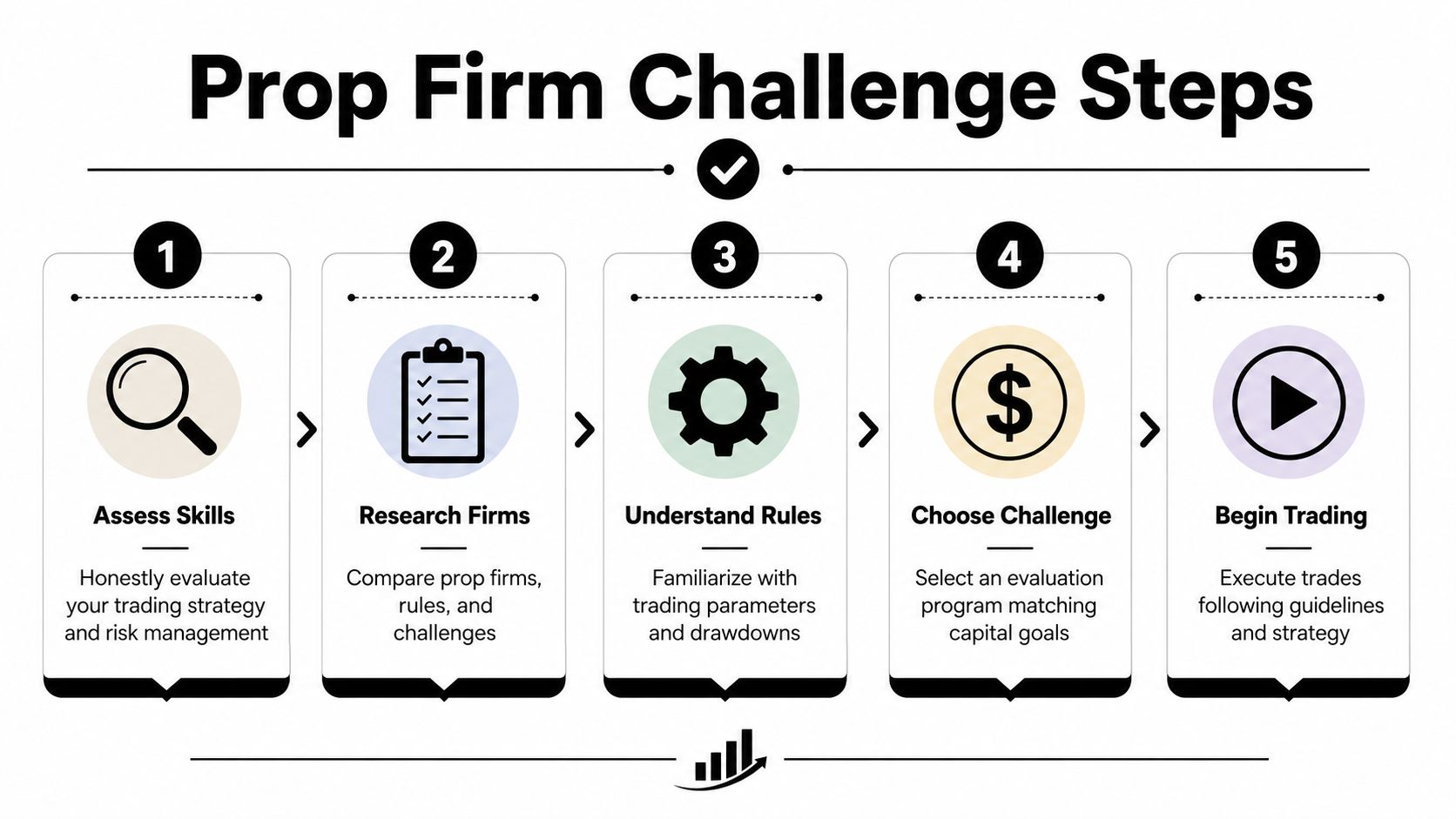
If you think prop funding fits better than a loan or investor route, keep the first steps simple. Don't overcomplicate it.
A practical starting checklist
Review your actual trading records
Don't rely on memory. Look at your recent trades and check whether your edge is real, whether losses cluster after rule-breaking, and whether your sizing stays consistent.Study the firm's rules before the price
Traders often compare fees first. That's backwards. Read the drawdown model, prohibited strategies, payout conditions, and platform details first.Pick the challenge structure that matches your style
The 2-Step Challenge uses 8% in Phase 1 and 5% in Phase 2, with funded account sizes from $2K up to $100K, according to MyFundedCapital's challenge overview. A slower, staged evaluation can suit traders who prefer a more measured path.Practice under the exact rules
If the account has a daily loss limit, rehearse with that limit before you buy anything. The challenge shouldn't be the first time you experience those constraints.Start small enough to stay calm
The right account isn't always the biggest one. It's the one you can trade without forcing setups.
What to look for in one option
One example is MyFundedCapital, which offers simulated funding programs for traders who want to access capital through challenge-based or instant-style models rather than debt or equity financing. The useful question isn't whether a firm sounds exciting. It's whether the rules match your trading style and whether you understand the risk framework before you begin.
Frequently Asked Questions About Capital Funding
Is prop firm funding the same as getting a business loan?
No. A business loan creates debt that you must repay. Prop firm funding is usually a performance-based arrangement tied to trading rules and a funded program structure rather than a traditional borrowing agreement.
Do I need good personal credit to get funded as a trader?
Traditional lenders often care about credit. Prop firms usually focus more on whether you can follow their evaluation rules and trade consistently. You should still read each firm's terms carefully, but the model is generally very different from credit-based lending.
Am I personally responsible for trading losses in a prop firm model?
That depends on the firm's structure and terms, so you should always read the agreement. In many challenge-based prop models, the key consequence of poor performance is loss of account status or failure of the evaluation rather than a personal debt balance like you'd have with a loan.
Is this a salary or guaranteed income?
No. Prop trading payouts are typically performance-based. If you don't trade well, you shouldn't expect income. That's why it's important to approach funded trading as a disciplined skill test, not as a shortcut to easy money.
Trading involves risk of loss. This article is educational only and isn't financial advice.
If you want a trader-focused path instead of another generic business funding article, take a look at MyFundedCapital. You can compare funding programs, review challenge types, and see whether a simulated capital model fits your trading style before committing to anything.
