

 AR
AR
 NL
NL
 FR
FR
 DE
DE
 ES
ES
 IT
IT
 PL
PL
 SV
SV
 PT
PT


Finding enough capital to trade effectively is one of the biggest hurdles for aspiring traders. This guide cuts through the hype to give you a clear, honest look at your options for securing capital funding in the US, focusing on practical steps and real-world examples.
Your Two Paths to Trading Capital
When it comes to funding your trading career, you can either use your own money or someone else's. Each path comes with a different set of opportunities and challenges.
Traditional Funding: Personal Savings & Loans
The traditional route is using your own savings or taking out a personal loan. The main benefit is autonomy—you keep 100% of the profits and have complete control.
However, this freedom comes with a serious downside: you shoulder 100% of the risk. A few bad trades could jeopardize your personal savings or damage your credit score. Trading with an underfunded account often leads to taking on excessive risk to chase meaningful returns, a common recipe for disaster.
The Modern Alternative: Proprietary Trading Firms
Proprietary (prop) trading firms offer a different model. Instead of risking your own money, you pay a small evaluation fee to prove your trading skills in a simulated environment.
If you hit their profit targets while adhering to their risk management rules, they grant you access to a funded account. You trade the firm's capital and keep a significant share of the profits you generate. This model has dramatically lowered the barrier to entry for talented traders who lack a large starting capital.
The Trade-Off: With personal funding, you have total control but also total risk. With a prop firm, you give up a portion of your profits in exchange for eliminating personal financial risk and accessing much larger capital.

Comparing the Two Paths
A solid plan is non-negotiable, regardless of your chosen path. Part of this plan involves clear financial forecasting. While aimed at startups, this founder's guide to financial forecasting offers excellent principles for traders.
Let's break down the key differences:
- Risk Exposure: With personal funds, your savings are at risk. With a prop firm, your risk is typically limited to the evaluation fee.
- Scalability: Growing a small personal account is slow. Prop firms often have clear scaling plans that allow successful traders to manage much larger accounts quickly.
- Psychological Pressure: The fear of losing your own money can lead to emotional trading decisions. Trading a firm's capital can reduce this pressure, allowing you to focus on strategy execution.
There is no single "best" choice; it depends on your situation, risk tolerance, and goals. To see how different firms stack up, check out this detailed breakdown of the best funded trader programs.
How Proprietary Trading Firm Funding Works
Proprietary trading firms are a popular option for traders seeking capital funding in the US. These firms are always looking for skilled traders. They offer their capital, but first, you must prove your ability through an evaluation.
This evaluation, or "challenge," involves paying a one-time fee to trade in a simulated environment. You are given a specific profit target and risk management rules. If you pass, you get a "funded account" and trade the firm's real capital, splitting the profits.
Understanding Evaluation Models
The path to getting funded typically comes in two main formats: 1-Step or 2-Step Challenges.
- 1-Step Challenge: A direct route to a funded account. You have one trading phase to hit a profit target (e.g., 10%) while following all rules. The entry fee is often higher for this faster path.
- 2-Step Challenge: The industry standard. It's broken into two phases (e.g., Phase 1 with a 10% profit target, Phase 2 with a 5% target) to test consistency. These challenges usually have a lower entry fee.
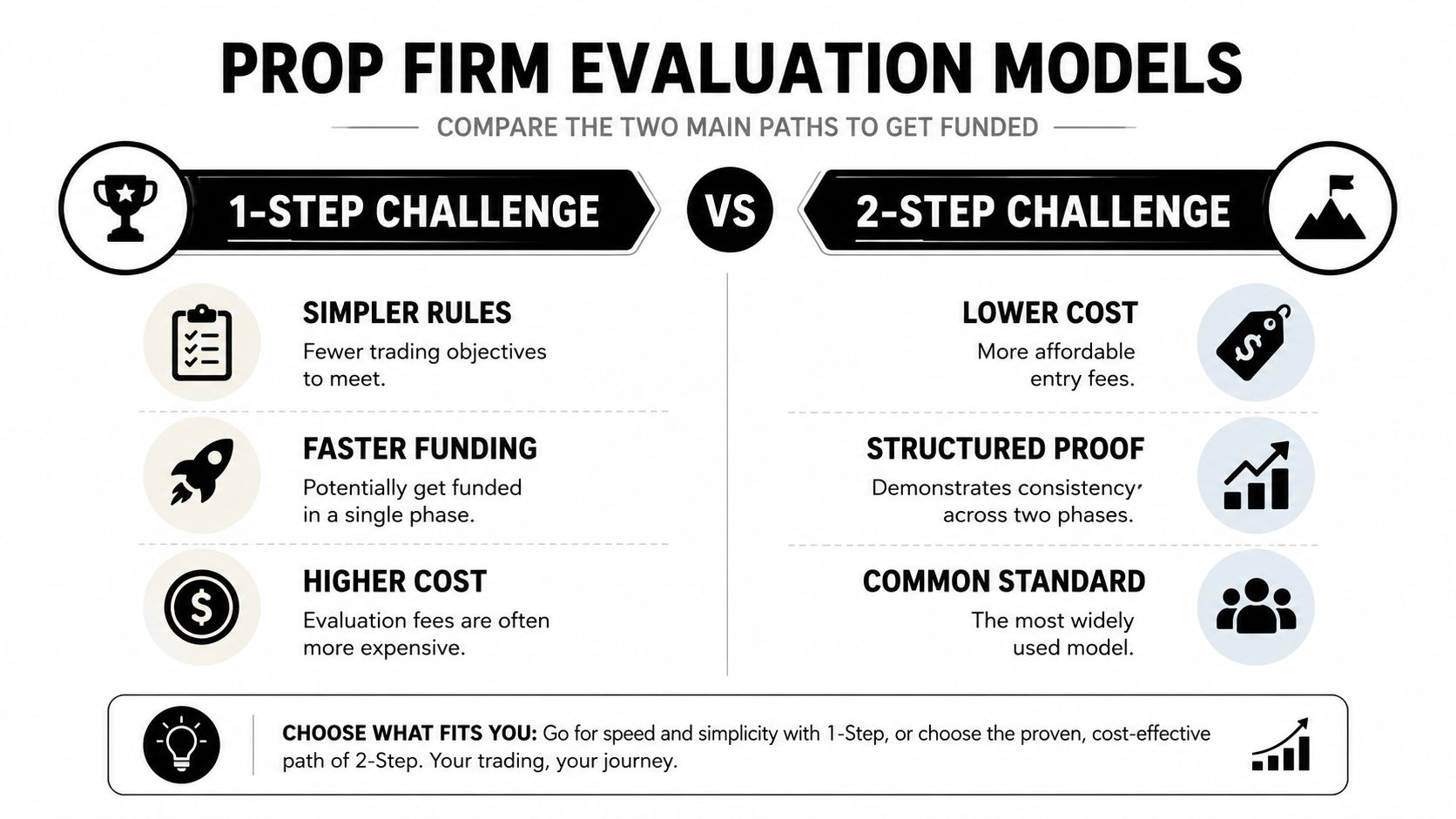
Your choice depends on whether you prefer a quicker, higher-cost evaluation or a lower-cost, two-phase process that demonstrates consistency.
The Rules of the Game
All evaluations have strict rules. These rules aren't designed to make you fail; they exist to protect the firm's capital and ensure they fund disciplined traders, not gamblers.
These risk rules are the foundation of the prop firm model. They force you to trade like a professional, focusing on consistent risk management rather than chasing huge, high-risk home runs.
The two most critical rules are:
- Daily Loss Limit: A cap on how much you can lose in a single day, often 5% of your initial account balance. Breaching this ends the challenge.
- Maximum Drawdown: The absolute floor for your account equity, often 10% of the initial balance. For a $100,000 account, your equity cannot fall below $90,000. Some firms use a "trailing" drawdown, so always read the specific rules.
Passing an evaluation proves you can manage risk professionally, the most valuable skill when seeking capital funding in the US through a prop firm.
Comparing Your Funding Sources Head-to-Head
Choosing how to fund your trading is a significant decision based on your risk tolerance, experience, and goals. Let's compare proprietary firm funding, personal loans, and personal savings side-by-side.

Key Factors to Weigh
Consider these four questions:
- How much personal risk am I taking?
- What are the upfront costs?
- What is my real profit potential?
- How quickly can I grow my capital?
For a trader with a profitable strategy but limited funds, a prop firm can be a game-changer. For a deeper look into how these firms work, check out our guide on what a prop trading firm is and how they work.
The table below breaks down the pros and cons of each funding source.
Capital Funding Options for US Traders Compared
| Feature | Proprietary Firm Funding | Personal Loan | Personal Savings |
|---|---|---|---|
| Personal Risk | Low. Limited to the evaluation fee. Personal assets are not at risk from trading losses. | High. You must repay the loan regardless of trading performance, which can damage your credit score. | Very High. You can lose your entire investment, directly impacting your financial stability. |
| Upfront Cost | Low. A small, one-time fee for access to a large account. | Moderate. No direct fee, but interest payments begin immediately. | High. Requires a substantial amount of cash you are prepared to lose. |
| Profit Potential | High. Keep a large share (often 80%+) of profits on a significant account. | Unlimited. You keep 100% of profits, but this is balanced by extreme personal risk. | Unlimited. You keep 100% of profits, but earnings are limited by your starting capital. |
| Scalability | Fast. Reputable firms have clear scaling plans to grow your account based on performance. | Slow & Difficult. Getting more loans for trading is very difficult and increases personal debt. | Very Slow. Growth is organic and depends on profits, which can take years. |
Your Step-by-Step Guide to Getting Prop Firm Funding
Decided to pursue a funded account? Here is your roadmap for securing capital funding in the US with a prop firm.

Step 1: Choose a Firm That Aligns With Your Strategy
Not all prop firms are the same. Find one that fits how you trade.
- Trading Style: Ensure the firm's rules allow your strategy (e.g., scalping, swing trading, using EAs).
- Instruments: Check if they offer the markets you trade (e.g., forex, crypto, indices).
- Reputation: Research reviews for feedback on rules, payouts, and community support.
Step 2: Select Your Account and Evaluation Model
Choose your account size and evaluation model (1-Step or 2-Step). Starting with a smaller account (e.g., $25,000) can reduce pressure while you learn their system.
Actionable Tip: It’s often smarter to prove your strategy on a smaller account first. Once profitable and comfortable, you can scale up. The goal is to pass, not chase a flashy number.
Step 3: Master the Trading Rules
Know the rules inside and out. One violation ends your challenge. The daily loss limit and maximum drawdown are where most traders fail. For a $50,000 account with a 5% daily loss limit ($2,500) and 10% maximum drawdown ($5,000), your equity can never drop below $45,000. Build your risk plan around these numbers.
Step 4: Manage Your Psychology During the Challenge
An evaluation is a psychological test. The pressure can lead to bad habits like revenge trading.
- Trade Your Plan: Stick to your proven strategy.
- Forget the Target: Focus on executing good trades one at a time.
- Take Breaks: Step away from the charts if you're on a losing streak.
Step 5: Understand What Happens After You Pass
Passing is just the beginning. The firm will verify your results and set you up on a live funded account.
Clarify the profit split (often 80% or more), the payout schedule, and the scaling plan. A good firm offers a clear path to grow your account based on performance.
Understanding the Risks and Realities of Trader Funding
All trading involves a substantial risk of loss, and every funding option has its own risks. With traditional funding like personal loans, you are on the hook for all losses, which can lead to a personal financial crisis.
The Reality of Proprietary Firms
Proprietary firms are not regulated like brokerages because they typically provide access to simulated accounts and do not handle client funds for live trading. This is a legal and common model, but it means you are responsible for vetting the firm.
Be Transparent: The unregulated nature of prop firms isn't necessarily bad, but it means you must do your own due diligence. No government agency is checking up on them for you.
Here's a checklist for vetting a trustworthy firm:
- Transparent Rules: Rules should be easy to find, read, and understand.
- Solid Reputation: Check independent review sites, forums, and social media for feedback, especially on payouts.
- Dependable Payouts: Look for a proven track record of traders receiving their profit splits on time.
While you don't need to be an expert, understanding the principles of risk management, like those used in financial risk modeling for AI companies, can provide a useful perspective.
This content is for educational purposes only and should not be considered financial advice.
Frequently Asked Questions (FAQ)
Are prop firms legal in the US?
Yes, the proprietary trading firm model is legal in the United States. They are structured as evaluation companies that provide demo accounts, not as brokerages that handle client deposits for live trading. This is what allows them to operate legally and fund talented traders.
How are payouts from a prop firm taxed?
When you receive a payout, you are typically classified as an independent contractor. The firm will issue a Form 1099-NEC for your earnings, which you must report as business income. You are responsible for paying self-employment taxes in addition to standard income tax. Always consult a qualified tax professional for advice tailored to your situation.
What happens if I violate a rule on a funded account?
If you break a major rule, like the daily loss limit or maximum drawdown, the firm will immediately close your funded account to protect its capital. However, this doesn't have to be the end. Many firms offer options like an account reset for a smaller fee or the ability to start a new evaluation. Check the firm's specific policies on violations before you begin.
Ready to put your trading skills to the test? At MyFundedCapital, we offer clear rules and a straightforward path to getting funded.
Explore our funding programs and find the right fit for your trading style.
