

 AR
AR
 NL
NL
 FR
FR
 DE
DE
 ES
ES
 PT
PT
 IT
IT
 PL
PL
 SV
SV

You're probably familiar with this setup. You trade well for days, stay patient, then one impulsive session wrecks the challenge. It usually isn't strategy that fails first. It's risk control.
A good risk assessment tool gives you a way to slow down, measure exposure before you click buy or sell, and stay inside rules that don't forgive emotional mistakes. Trading involves risk of loss, and this article is educational only, not financial advice.
Introduction Why Most Traders Fail Funding Challenges
A trader can be right often enough to pass, then still fail in a single afternoon.
It happens like this. You start the week disciplined. Entries are clean. Stops make sense. Then one loss annoys you, a second loss feels unfair, and the third trade is no longer part of your plan. It's revenge trading dressed up as “making it back.” By the end of the day, the challenge is gone.
That's why so many traders fail funding programs even when they know how to read price action. The problem isn't always technical skill. The problem is that they never built a process to control damage when conditions change or emotions take over.
If you're trading under prop firm rules, a loose approach won't last. You need a framework that tells you, before entry, whether the trade fits your limits. If you're still learning how challenge rules work, this breakdown of prop firm challenge basics helps put the risk side in context.
A strong setup can still be a bad trade if the risk doesn't fit the account.
A risk assessment tool is the antidote. Not magic. Not a guarantee. Just a repeatable process that helps you protect capital, stay funded longer, and trade like someone who plans to be here next month.
What Is a Trading Risk Assessment Tool
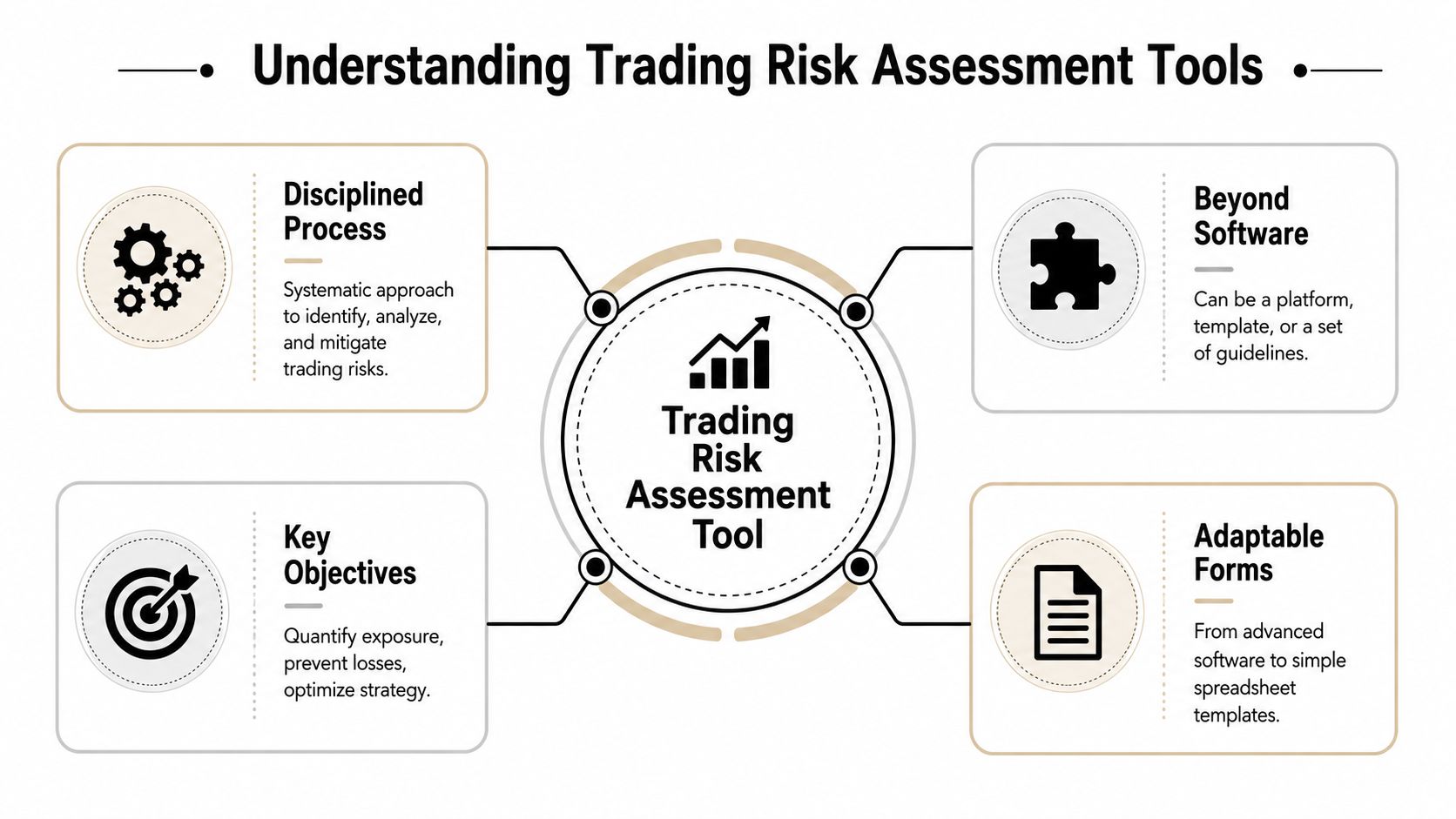
A risk assessment tool in trading isn't just software. It's any structured method you use to identify risk, measure it, and decide whether a trade deserves your capital.
That tool might be:
- A spreadsheet that calculates position size from your stop-loss distance
- A journal template that forces you to rate setup quality before entry
- A platform feature that shows open exposure across positions
- A written checklist beside your monitor
What matters is the process, not the packaging.
Think like a pilot, not a gambler
Pilots use pre-flight checklists because memory gets unreliable under pressure. Traders need the same attitude. A market that moves fast can make you feel certain when you should be cautious.
A trading risk assessment tool answers basic questions before the trade goes live:
- How much can I lose if I'm wrong
- Does that loss fit my daily and overall limits
- Is the stop-loss placed at a logical invalidation point
- Is position size small enough to survive normal market noise
- Am I trading a quality setup or just reacting
That's what separates a decision from a bet.
Why structure matters
Other industries already treat risk this way. In cybersecurity, professional risk assessment tools use risk matrices to rank high-impact threats, and that practice can reduce the probability of security breaches by up to 40% in mature IT environments according to FortifyData's overview of risk assessment tools. Traders can borrow the same logic. You prioritize high-probability setups and prepare for high-impact events instead of reacting after damage is done.
If you want a non-trading example of how teams formalize this thinking, this guide to managing risks for SaaS products is useful because it shows how disciplined teams assess uncertainty before it becomes a costly mistake.
Practical rule: If your process begins after entry, you don't have a risk tool. You have a post-trade excuse generator.
A simple definition that actually helps
Use this working definition:
A trading risk assessment tool is a repeatable system that converts potential loss from a vague feeling into a specific pre-trade decision.
That's why a basic spreadsheet can outperform expensive software in the hands of a disciplined trader. The tool doesn't save you. The habit does.
Key Risk Metrics Every Trader Must Know
Most traders get in trouble because they know patterns better than they know numbers.
A proper risk assessment tool revolves around a small set of metrics. You don't need a quant desk. You do need to understand what each metric tells you before you place size.
Value at Risk
Value at Risk (VaR) is a way to estimate how much your portfolio or position could lose over a given period under normal conditions.
In plain English, it asks: what's my likely downside if today goes badly?
For a trader, the practical use isn't academic precision. It's forcing a limit on total exposure. If you're long multiple positions that all move with the same market theme, your real risk may be larger than each single trade suggests.
A simple way to think about it:
- Single-trade view means you assess one setup in isolation
- Portfolio view means you assess how several trades could lose together
- Decision use means you cut size when combined exposure is too concentrated
If you want help modeling trade-by-trade downside in a practical format, TradeTally's risk analysis is a useful calculator for checking whether the trade structure makes sense before entry.
Maximum drawdown
Maximum drawdown is the largest drop from your peak equity to your lowest point before recovery. This is one of the most important concepts in funded trading because challenge rules are built around drawdown survival.
Many traders only think in terms of “risk per trade.” That's too narrow. You also need to know what a string of losses does to your account.
A few key points matter:
- Daily drawdown tracks how much damage you can absorb in one session
- Overall drawdown tracks how far the account can fall from its peak
- Behavioral value comes from knowing when to stop, not just when to start
If you want the concept explained in a prop-trading context, this article on maximum drawdown in trading is worth reading.
Drawdown isn't just a statistic. It's the line between “still in the game” and “challenge failed.”
Risk per trade
This is your basic position-risk rule. The standard benchmark for funded challenges is risking 1–2% of account balance per trade, and many prop firms cap risk per trade at 2–3% with hard limits, as outlined in FundedFast's risk management guide.
That benchmark matters because it keeps one idea from doing oversized damage.
A clean way to use it:
- If your stop is wide, reduce position size
- If volatility is high, reduce position size again
- If you've already taken losses today, cut size or stop trading
The mistake newer traders make is keeping size fixed while stop distance changes. That results in a subtle increase in risk.
Stress testing
Stress testing asks a different question from normal risk metrics. It asks what happens if conditions become abnormal.
Examples include:
- News shock around major releases
- Spread expansion at session opens or low-liquidity periods
- Platform or execution issues when you can't exit exactly where planned
- Correlated losses when several positions move against you at once
A good risk assessment tool should include a simple stress check before entry:
- What happens if price gaps through the stop?
- What happens if slippage increases the realized loss?
- What happens if two open trades fail together?
You don't need perfect forecasting. You need enough caution to avoid building a fragile account.
Position-sizing algorithms
This sounds complex, but the idea is straightforward. A position-sizing algorithm is just a rule for deciding size from your predefined risk.
Common inputs include:
| Metric | Why it matters |
|---|---|
| Account equity | Determines how much capital you can expose |
| Stop-loss distance | Tells you how far price can move before invalidation |
| Allowed loss per trade | Keeps one trade from harming the account too much |
| Instrument volatility | Prevents oversized exposure in fast markets |
A simple trader's formula is:
Position size = allowed account risk ÷ distance from entry to stop
That one formula solves a lot of bad habits. It stops you from choosing size based on confidence, frustration, or greed.
The point of all these metrics
You don't need to obsess over jargon. You need a process that answers one practical question before every order:
If this trade fails, what exactly happens to my account?
If you can't answer that in seconds, the trade isn't ready.
Applying Risk Tools in a Prop Firm Environment
The moment you enter a funded challenge, risk stops being a personal preference. It becomes a rule set.
That changes the job. You're no longer just trying to find good trades. You're trying to survive inside fixed limits while still performing well enough to qualify. A risk assessment tool becomes your operating system for that environment.
Here's what that looks like in practice.

Translate challenge rules into trading decisions
Across funded account challenges, traders usually need to stay within a maximum overall drawdown between 8% and 12%, and going past that limit typically means disqualification, according to For Traders' breakdown of funded challenge risk rules.
That's the broad industry reality. In a practical prop setting, you also need to respect the firm's own specific limits every day, including daily loss controls and overall drawdown controls.
Your tool should convert those rules into trade filters such as:
- Can this trade's worst-case loss fit inside my remaining daily room
- If this trade loses, does my total equity stay safely above my max drawdown line
- If I'm already down today, does this next trade deserve full size
That's how professionals use rules. They don't complain about them. They design around them.
Why trailing drawdown changes trader behavior
Trailing drawdown punishes careless scaling. If you push size while equity rises, you can tighten the margin for error on the very next losing trade.
That's why many traders need to study how trailing drawdown works in prop trading before they size aggressively. A trailing model changes the relationship between open profit, account high-water mark, and acceptable future loss.
A disciplined risk tool helps by forcing three checks:
Equity check
What's my current account level relative to the drawdown threshold?Trade check
If I lose full planned risk, where does equity land?Sequence check
If I take two losses in a row, am I still trading from strength or from defense?
The trader who survives longest usually isn't the one with the best single trade. It's the one who keeps bad days small.
A prop challenge rewards restraint
This is the part many talented traders resist. Passing a challenge often has less to do with brilliance and more to do with refusing to do damage.
A useful mindset shift is this:
- Your first job is staying eligible
- Your second job is preserving mental clarity
- Your third job is executing only the setups that fit both the market and the account rules
A risk assessment tool gives you objective reasons to say no. That's a competitive advantage in a rule-based environment.
Building Your Own Risk Assessment Template
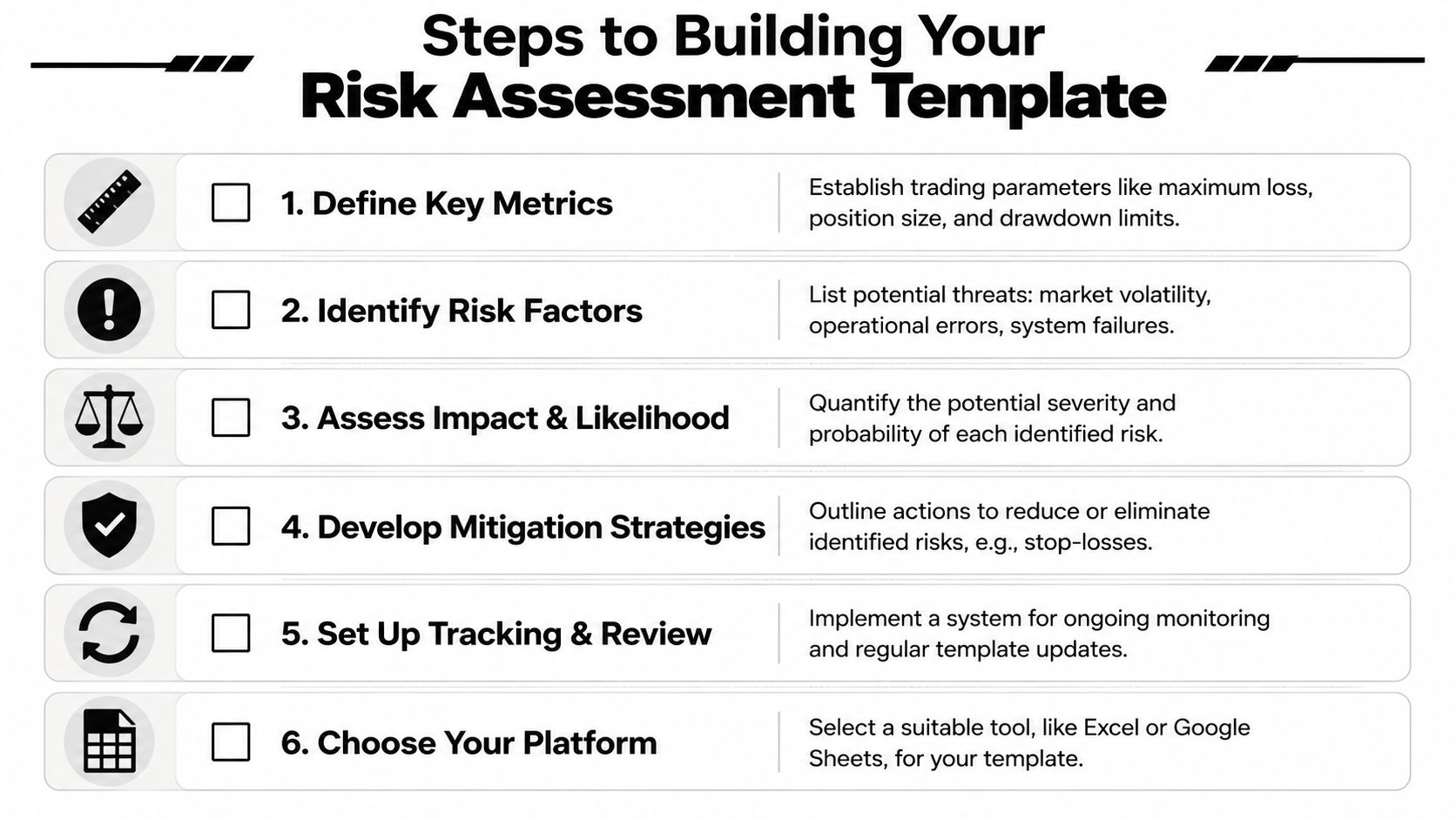
You don't need expensive software to build a solid risk assessment tool. A spreadsheet in Google Sheets or Excel is enough if you use it every time.
The goal is simple. Before you enter a trade, the sheet should tell you whether the idea fits your account rules and your personal limits. That pause alone can save you from a lot of bad trades.
The columns your template needs
Start with one row per trade and include these fields:
| Column | Purpose |
|---|---|
| Instrument | Shows what you're trading |
| Direction | Long or short |
| Entry Price | Planned entry |
| Stop Loss | Your invalidation point |
| Risk per Share or Pip | The distance between entry and stop |
| Position Size | The number of units, lots, or shares |
| Total Dollar Risk | The loss if the stop is hit |
If you trade more than one market, add a notes field for session, catalyst, or setup type. That helps later when you review recurring mistakes.
The basic workflow
Fill the sheet out before the order goes in.
Use this sequence:
Write the instrument and direction
Don't skip the obvious. Naming the trade forces you to be deliberate.Choose the entry and stop-loss
The stop should sit at the price that proves your idea wrong, not at a random distance that feels comfortable.Measure the stop distance
This becomes your risk per share, point, or pip.Set allowed account risk
Use your fixed percentage rule from your own plan.Calculate position size
Divide allowed risk by the stop distance.Check total account impact
Make sure the planned loss fits your daily and overall limits.
Why this structure works
Advanced technology risk platforms use a Configuration Management Database (CMDB) to map dependencies between assets and assign business criticality, as described in LeanIX's explanation of technology risk assessment. A trader's template does something similar on a smaller scale. It maps the dependency between account equity, trade idea, and stop-loss placement so you can judge the criticality of one trade before it goes live.
That sounds technical, but the benefit is very practical. You stop looking at trades as isolated ideas and start seeing them as events that affect the whole account.
Checklist thought: If your stop-loss location and your position size don't agree with each other, the problem isn't the market. It's your prep.
Keep the template simple enough to use daily
The best risk assessment tool is the one you'll complete every session.
A workable template should also include:
- A daily loss tracker so you know when to stop
- An open exposure field if several positions are live
- A setup grade so weak trades stand out during review
- A post-trade result field to compare planned risk with actual execution
If the sheet becomes too complicated, you'll stop using it when markets get busy. That defeats the point. Build something lean, clear, and impossible to misunderstand when pressure rises.
Interpreting Results and Making Go or No-Go Decisions
A risk assessment tool is only useful if it changes behavior.
Many traders still make the same mistake after doing the math. They calculate risk, see that the trade doesn't fit, then take it anyway because the setup “looks too good.” That's not analysis. That's permission-seeking.

Clear no-go signals
Your template should trigger a hard pass when certain conditions appear.
Common red flags include:
- The required position size is too large for the instrument or for your comfort executing it
- The planned loss consumes too much of your daily room
- The stop-loss is so wide that the trade becomes inefficient
- Several open trades depend on the same market move
- You're adjusting numbers to force the trade to fit
These decisions should feel mechanical. The less room you leave for negotiation, the less damage emotion can do.
Personal validation matters
This part gets overlooked. A generic model might be sensible in theory and still fail in your hands.
Validation matters because risk tools can lose predictive accuracy when applied to groups whose behavior differs from the original sample, as discussed in Equivant's article on validating risk and need assessment tools. For traders, that means a generic framework may not reflect the actual risk of your specific style, whether you trade manually, algorithmically, or through copy-trading patterns.
So test your tool against your own history:
- Do your planned risks match realized losses
- Do certain setups slip more than expected
- Do your algorithms behave differently during specific sessions
- Does your swing trading hold more overnight risk than your sheet assumes
Why this improves discipline
When the tool says no, you don't need to debate with yourself. The decision is already made.
That's a significant psychological edge. You move part of the decision-making process out of the emotional moment and into a written framework. Over time, that builds trust in your process. It also exposes whether your real problem is market reading or rule-following.
If a trade fails your risk check, pass on it. There will be another chart.
FAQ and Your Next Steps with MyFundedCapital
A few questions come up almost every time traders start using a formal risk assessment tool.
Frequently Asked Questions About Risk Assessment Tools
| Question | Answer |
|---|---|
| Should I use software or a spreadsheet? | Start with the tool you'll actually use every day. For many traders, a spreadsheet is enough because it's simple, visible, and easy to review. |
| Can a risk assessment tool prevent losses? | No. It helps you manage and limit losses. Trading always involves risk of loss, and no tool guarantees profits. |
| How often should I review my risk settings? | Review them regularly and after meaningful changes in results, strategy, or market conditions. If your execution changes, your tool should be updated too. |
| What's the biggest mistake traders make with risk tools? | They treat the tool as record-keeping instead of decision-making. The numbers need to influence whether you take the trade at all. |
A strong risk process won't make you invincible. It will make you harder to knock out. That's the point.
If you're ready to apply disciplined risk management in a simulated prop environment, compare the funding options, account rules, and challenge paths available at MyFundedCapital. Start with the program that fits your trading style, then use the framework in this article to trade it with structure.
