

 AR
AR
 NL
NL
 FR
FR
 DE
DE
 ES
ES
 IT
IT
 PL
PL
 SV
SV
 PT
PT

You're probably here because stocks feel noisy, crypto feels chaotic, and you want a market that makes more sense if you think in terms of economies, rates, and policy. That's where forex stands out. If you've been asking why trade forex, the answer isn't just “because it's open all day.” It's because currencies let you trade macro themes directly, with trade-offs you need to respect from day one.
The Four Pillars of Forex Trading Appeal
Forex is the market where one currency is exchanged for another. In practice, that means you're trading relative value. You're not asking whether one company will beat earnings. You're asking whether one economy, one central bank, or one policy path is likely to outperform another.
That difference matters more than most beginner guides admit.
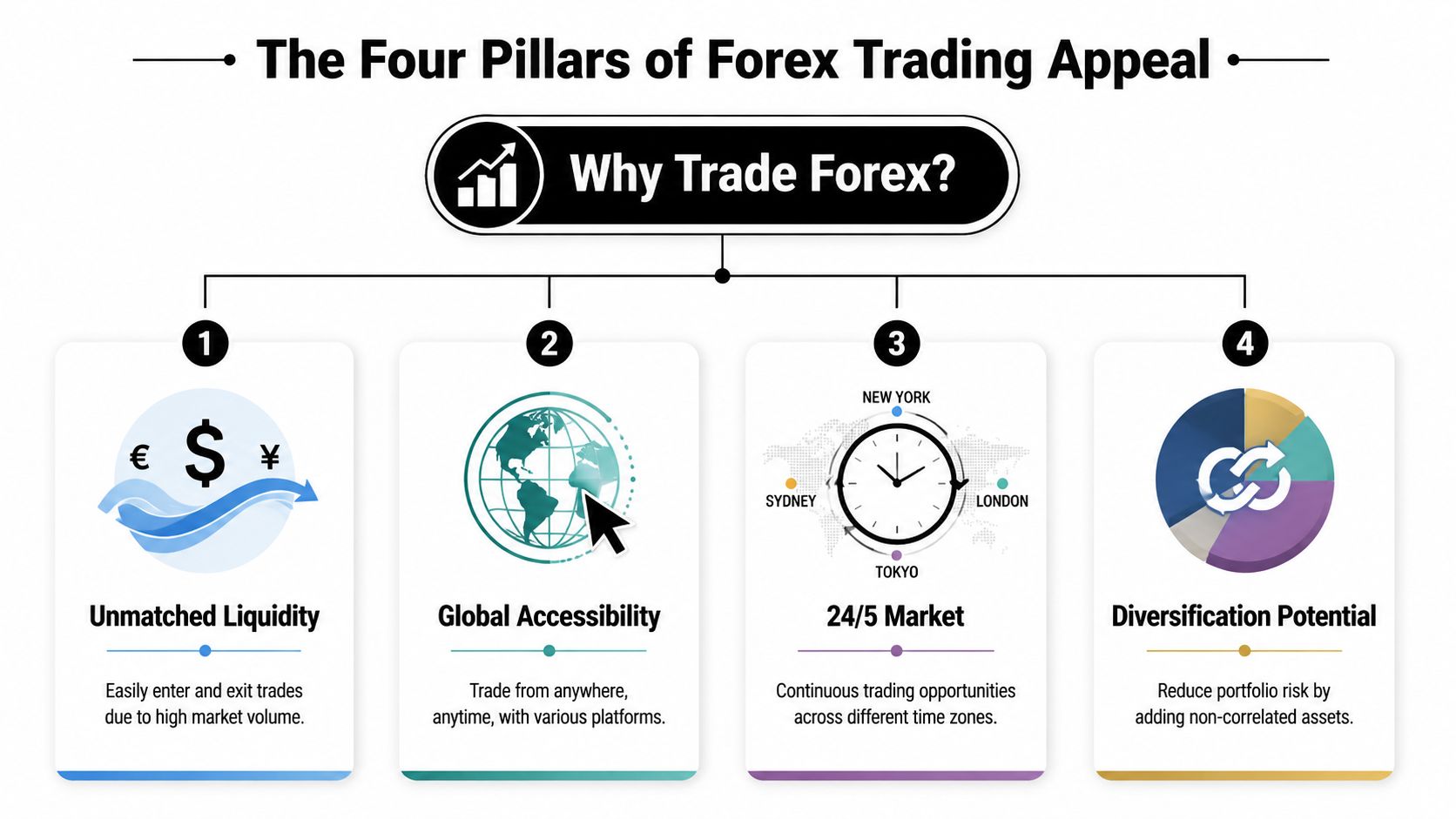
Liquidity is the first practical advantage
Forex is the world's largest financial market, with average daily turnover reported at over USD 7 trillion, rising to USD 9.6 trillion per day in April 2025, while the equity market's daily turnover is noted as less than USD 300 billion according to Saxo's forex market overview.
For a trader, that scale isn't trivia. It affects execution.
When a market is deep, you can usually enter and exit with less friction in major pairs. That often means tighter spreads, more reliable fills, and less slippage than you'd expect in thinner products. If you're trying to take short-term setups, that matters a lot more than flashy indicators.
Practical rule: If your strategy depends on precise entries and exits, market depth matters more than most chart patterns.
The 24 slash 5 schedule gives you flexibility
Forex trades 24 hours a day, 5 days a week according to Saxo's forex trading guide. That changes how you build a routine.
You don't have to force trades into one local market session. You can focus on the session that fits your life and your setup style:
- London session traders often look for cleaner momentum and reaction to European data.
- New York session traders often focus on U.S. releases and overlap volatility.
- Asia session traders often prefer slower conditions or event-specific setups.
That flexibility is useful, but it can also become a trap. A market that's always available makes it easy to overtrade.
Leverage helps only if risk control comes first
The ability to magnify trading capital is one reason many traders come to forex. This enhances capital efficiency and enables two-way trading, allowing you to trade rising or falling moves.
That's the positive version. The actual version is harsher.
Amplified trading power magnifies mistakes just as fast as it magnifies gains. A bad entry with oversized risk can damage your account quickly. New traders often treat this power like an advantage by itself. It isn't. This power is a tool that only works when position size, stop-loss placement, and trade selection are already under control.
A few practical rules help:
- Risk small per idea: Keep any single trade small enough that one loss doesn't change your behavior.
- Use a stop before entry: Don't decide where you're wrong after price moves against you.
- Avoid stacking correlated trades: Holding several USD-driven positions can create more risk than it appears.
Costs are usually lower where liquidity is concentrated
Another reason traders ask why trade forex is cost. In active major pairs, the market's scale often helps keep transaction friction relatively low compared with thinner instruments.
That doesn't mean all forex trading is cheap. Costs still depend on the pair, the time of day, the event calendar, and your broker structure. But if you focus on liquid sessions and major pairs, your spread cost usually works more in your favor than if you chase illiquid products or off-hours moves.
The short version is simple:
- Liquidity supports better execution.
- 24/5 access gives scheduling flexibility.
- Trading on margin creates efficiency but raises danger.
- Lower friction in major pairs can help active strategies survive.
Forex vs Stocks vs Crypto A Head-to-Head Comparison
A lot of traders don't need the “best” market. They need the market that fits how they think, how much time they have, and what kind of risk they can handle.
Forex, stocks, and crypto each reward different habits. If you're deciding where to focus, compare the market itself, not the marketing around it.
The practical differences
| Feature | Forex | Stocks | Crypto |
|---|---|---|---|
| Market hours | Trades across global sessions during the business week | Tied to exchange hours, with some extended trading | Runs continuously |
| Main driver | Relative growth, inflation, rates, and policy expectations | Earnings, guidance, sector rotation, market sentiment | Narrative shifts, liquidity flows, adoption themes, sentiment |
| Trade direction | Naturally built for long and short views | Long is straightforward, shorting depends on product and access | Usually easy to trade both ways on many platforms |
| Execution style | Often strongest in major pairs with deep liquidity | Can vary widely by stock and market cap | Can be smooth in majors, uneven in smaller coins |
| Noise level | Lower company-specific noise | High company-specific event risk | Very sentiment-driven |
| Best fit | Traders who like macro and relative-value thinking | Traders who like business analysis and stock selection | Traders who tolerate fast sentiment swings |
Why some traders migrate to forex
Stocks make sense if you enjoy reading businesses. If you want to understand margins, management quality, product cycles, and valuation, equities give you a huge field to work in.
Crypto suits a different type of trader. It can offer constant opportunity, but it also demands strong emotional control. If you already trade digital assets and want a cleaner way to monitor Bitcoin holdings, that kind of portfolio tracking can help you separate investment exposure from your active trading book.
Forex sits in the middle in an interesting way. It's active, but the logic is often cleaner. You're usually tracking central banks, inflation trends, relative growth, and risk appetite instead of one CEO comment or one token narrative.
A lot of developing traders improve when they move from “What stock is hot?” to “Which economy is strengthening relative to another?”
How to choose the right market for your style
Use this quick filter:
- Choose forex if you like macro releases, session structure, and relative-value trades.
- Choose stocks if you enjoy company research and can wait for selective setups.
- Choose crypto if you can handle continuous volatility and sentiment-driven moves.
- Trade more than one only if you can keep separate playbooks for each.
Many funded traders eventually work across several asset classes, but they usually start by mastering one. If you want to see how firms group these products, review the list of markets funded traders can access.
The mistake is trying to use the same strategy logic everywhere. Breakout trading in EUR/USD doesn't behave like earnings trading in equities, and neither behaves like a weekend crypto move. Treat them as different games.
Beyond the Basics The Macro Trader's Perspective
The strongest answer to why trade forex is rarely “because there are lots of setups.” A better answer is this: forex gives you a direct way to express a macro view.
That's a big upgrade in thinking.
Currencies are relative by nature
Experienced traders often use forex to trade views on relative growth, inflation, and interest-rate differentials, which lets them express opinions on policy divergence rather than single-company earnings or broad equity beta, as described in Axiory's discussion of trading without relying only on charts and indicators.
That last part is important. Forex is not just a fast chart market. It's a market built around comparison.
If one central bank looks tighter than another, or one economy looks more resilient than another, that can create a structured currency view. You're not buying “the market.” You're trading one country's path against another's.
Why this can feel cleaner than equities
Stocks carry several extra layers of noise:
- Company risk: Earnings misses, guidance cuts, management changes.
- Sector risk: Even good companies get dragged by weak sector sentiment.
- Index flow risk: Strong businesses can still fall when broad equity beta turns negative.
Forex strips out much of that. Not all of it, but much of it.
A trader who thinks in terms of central banks, inflation persistence, labor markets, and policy divergence often finds currencies more honest. Hard, yes. But honest. The thesis usually has a clearer line from macro view to instrument choice.
Macro lens: A currency pair can be a cleaner expression of a policy view than an index or a single stock.
What a macro-aware forex trader actually tracks
A junior trader doesn't need a giant economics model. Start with a shortlist:
- Central bank tone: Is one bank tightening, pausing, or signaling cuts sooner?
- Inflation trend: Is price pressure easing at the same pace in both economies?
- Growth momentum: Which economy is surprising to the upside or downside?
- Relative expectation shifts: What changed this week that the market may need to reprice?
Forex becomes a thinking trader's market. You're building a structured view, then using price action to time it. That's a better long-term foundation than chasing random movement because a pair “looks active.”
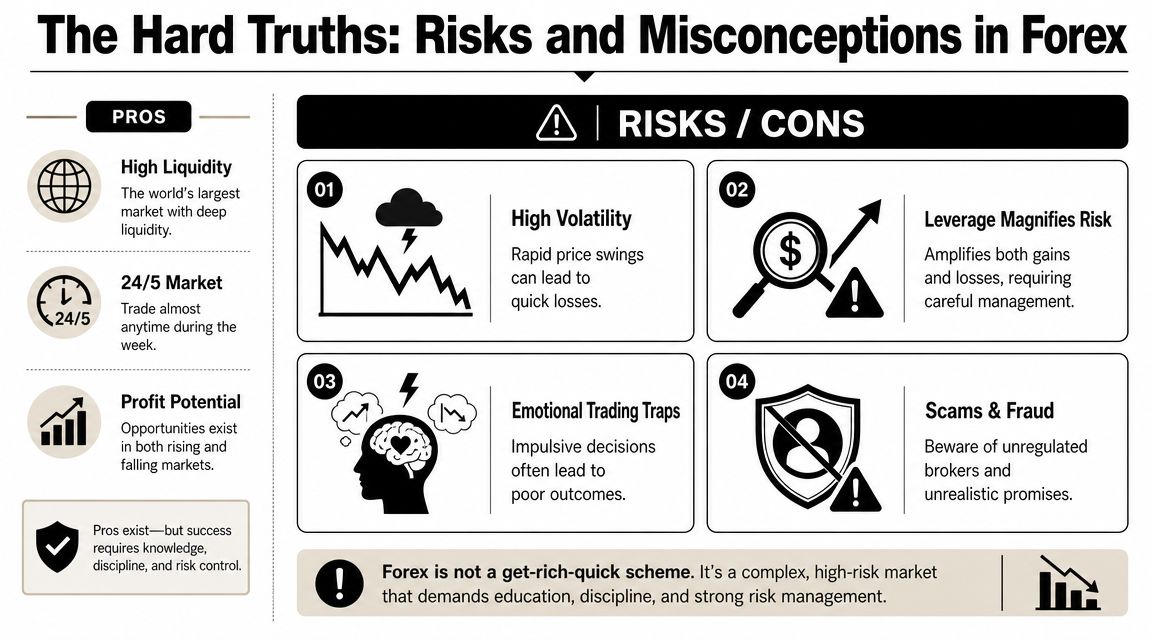
The Hard Truths Risks and Common Misconceptions
Forex gets marketed badly. Too many people present it like a shortcut to fast money. It isn't. It's a competitive market where poor risk management gets exposed quickly.
If you want the honest version of why trade forex, you also need the honest version of why many traders fail in it.
The biggest misconception is that leverage creates edge
It doesn't. Edge comes from a repeatable process. Financial amplification only changes the speed and size of outcomes.
Broker-neutral discussion of forex often places daily turnover around $5 trillion to $6.6 trillion, linking that depth to tight spreads and fast execution. The same source also makes a crucial warning clear: improperly managed positions with amplified exposure can generate significant losses just as quickly as gains, as noted in Dukascopy's overview of forex trading benefits and risks.
That's why traders blow up on good ideas. The idea wasn't always wrong. The size was wrong.
What actually hurts new traders
Most account damage comes from a short list of habits:
- Overtrading: Taking mediocre setups because the market is available.
- Oversizing: Risking too much because the stop looks “small.”
- Moving stops: Refusing to accept that the trade thesis failed.
- Revenge trading: Trying to win back losses immediately.
- Ignoring event risk: Entering just before major releases without a plan.
These aren't technical mistakes. They're decision-making mistakes.
Scams, false expectations, and poor preparation
Another problem is the industry around forex. Some brokers, signal sellers, and social media accounts sell certainty. They show perfect entries, unrealistic lifestyles, and no real discussion of drawdown, discipline, or survival.
If you're evaluating whether forex is legitimate or whether the offer in front of you is the problem, it helps to read a grounded take on forex trading scams and how to think about them.
If someone sells forex as easy money, they're not teaching the market. They're selling a fantasy.
A serious trader expects losing streaks, changing conditions, and psychological pressure. If that sounds uncomfortable, good. It should. Respect for risk is what keeps you in the game long enough to improve.
Trading involves risk of loss. Educational content can help, but it won't remove the need for discipline.
How to Start Trading Forex The Smart Way
Most beginners don't need more indicators. They need a better sequence. The fastest way to waste time in forex is to start with live money, random entries, and no rules.
The market has expanded dramatically over time. One industry compilation reports average daily turnover grew 432.19% between 2001 and 2019, and more recent market research cites USD 9.6 trillion per day in April 2025, reflecting a deeper and more globally accessible market for new participants, according to Moneyzine's forex trading statistics summary.
Start with a narrow learning loop
Don't try to trade everything.
Pick one or two major pairs. Learn how they behave during your chosen session. Track the same economic releases every week. Write down why you entered, where the trade was invalidated, and whether you followed your rules.
That gives you feedback you can use.
Build a simple process before you add money
Use this progression:
Learn the market structure
Understand sessions, major pairs, order execution, and event risk.Demo trade one setup
Don't test five strategies at once. Test one setup until you know its strengths and weak spots.Write a trading plan
Include entry conditions, invalidation, target logic, and risk per trade.Review execution, not just results
A winning trade taken outside your rules is still bad process.
Non-negotiable: You need a written plan before you need a bigger account.
Solve the capital problem carefully
A lot of capable traders hit the same wall. They can trade reasonably well, but they don't want to risk too much of their own savings. That's where evaluation-based prop models can fit.
One option is MyFundedCapital, which provides simulated funded accounts for traders who want to trade forex and other instruments under defined risk parameters. That doesn't remove risk. It changes the capital structure and adds rule-based accountability.
If you're still exploring different ways traders participate in markets, you may also want to read this review of copy trading platforms. Not because copying replaces skill, but because it helps clarify the difference between following someone else's decisions and building your own repeatable process.
The smart way to start is boring. Study one market. Trade one plan. Risk small. Keep records. That's how traders last.
Frequently Asked Questions About Forex Trading
Is forex better than stocks for beginners
Not automatically. Forex is better for beginners who prefer macro themes, session-based routines, and two-sided trading. Stocks may fit better if you enjoy company analysis and can wait longer for setups. The right market is the one you can understand and manage consistently.
Can you trade forex part-time
Yes. Forex can work well for part-time traders because the market runs across global sessions during the week. The key is to choose one session and one style that matches your schedule. Part-time trading works when you trade selectively, not when you try to monitor the market all day.
Why do experienced traders use forex for macro views
Because currencies let them express views on relative economic conditions. If a trader believes one central bank will stay tighter than another, or one economy is weakening faster than another, a currency pair can reflect that view more directly than a stock or index.
Is leverage necessary to trade forex
No. Amplified capital is available, but it isn't required to trade responsibly. In fact, many traders improve once they stop thinking about amplified capital as the reason to trade. Process, timing, and risk control matter more than account aggression.
Trading involves risk of loss, and this article is for educational purposes only. It isn't financial advice.
If you want to put these ideas into practice with rule-based evaluation and funded account options, take a look at MyFundedCapital. Compare the account types, review the risk parameters, and start a challenge only if your process is already defined.
