

 AR
AR
 NL
NL
 FR
FR
 DE
DE
 ES
ES
 IT
IT
 PL
PL
 SV
SV
 PT
PT

Feeling like your trading strategy is solid but your account size is holding you back? Funded trader programs offer a solution, giving skilled traders access to significant capital without risking their own savings. This guide explains how they work, what rules to watch out for, and how to choose the right firm for you.
You pay a fee, prove you can trade profitably while managing risk, and in return, you trade the firm's capital and keep a large share of the profits.
What Are Funded Trader Programs and How Do They Work?
A funded trader program is an arrangement where a proprietary trading firm provides capital to a trader. The concept is straightforward: if you can demonstrate consistent profitability and solid risk management in a simulated environment, a prop firm will fund you with a live account and split the profits with you.
Think of it as a tryout. A trader pays an evaluation fee to enter a "challenge" with specific rules. You must hit profit targets while staying within strict risk limits. Pass the evaluation, and you become a funded trader, typically keeping up to 90% of the profits you generate.
The Business Model Explained
This model aligns the interests of the firm and the trader. The prop firm is looking for talented traders who can generate returns without taking excessive risks. The process usually follows these steps:
- Evaluation Fee: You pay a one-time fee to access an evaluation account. This covers the firm's operational costs and filters for serious candidates.
- The Challenge: You trade on a simulated account with clear objectives, such as reaching an 8% profit target without exceeding a 5% daily drawdown limit. This is how the firm assesses your skill. You can learn more about how proprietary trading firms operate in our detailed guide.
- Funded Status: After successfully passing the challenge, you are offered a funded account. You can then begin trading with the firm's real capital and become eligible for profit payouts.
This creates a merit-based system where trading skill, not personal wealth, determines your access to capital. It's crucial to remember that all trading involves significant risk, and past performance is not indicative of future results.
Choosing Your Path: Evaluation vs. Instant Funding
Funded trader programs generally come in two main types: evaluation challenges and instant funding. Both paths lead to trading with firm capital, but they suit different types of traders. The right choice depends on your confidence, trading style, and budget.
The Evaluation Challenge Model
The most common path is the evaluation challenge. You must prove your trading ability on a demo account before receiving a live one. This model allows firms to vet traders for consistency and discipline. Most challenges are structured in one or two phases:
- Phase 1: Hit a specific profit target, often 8-10%, while adhering to risk parameters like a maximum daily loss of 5%.
- Phase 2 (for two-step challenges): Prove your initial success wasn't a fluke. The profit target is usually lower, around 5%, with the same risk rules.
Passing both phases earns you a funded account. The entry fee is relatively low, but the pressure to meet the targets can be high.
The Instant Funding Model
For experienced traders confident in their strategy, instant funding offers a direct route. You pay a higher one-time fee for immediate access to a funded account, skipping the evaluation process entirely.
This option is designed for those who don't want to spend weeks proving their skills. However, this immediate access comes with a trade-off. Instant funding accounts often start with stricter rules, such as tighter drawdown limits, because the firm is taking on more initial risk.
The main benefit is the ability to earn real profits from your first trade. For disciplined traders ready to begin, it's a much faster path to potential withdrawals. See how our instant funding programs work at MyFundedCapital to decide if this direct approach fits your style.
Evaluation Challenge vs. Instant Funding Comparison
Which path should you choose? The decision depends on your personal risk tolerance, confidence, and financial situation. This table breaks down the key differences to help you decide.
| Feature | Evaluation Challenge | Instant Funding |
|---|---|---|
| Upfront Cost | Lower fee to enter the challenge. | Higher fee for immediate access. |
| Time to Funding | Can take weeks, depending on performance. | Immediate access upon payment. |
| Initial Rules | Standard profit targets and drawdown limits. | Often stricter drawdown limits initially. |
| Psychological Pressure | High pressure to perform and pass phases within a time limit. | Pressure to protect capital from day one. |
| Best For | Traders on a budget or those wanting to prove their strategy under firm conditions. | Confident traders with a proven track record who want to start earning immediately. |
There is no universally "correct" answer. An evaluation is a low-cost way to prove your skills, while instant funding is a fast track for those ready to perform from day one.
Understanding the Rules of Funded Trading
To succeed in a funded trader program, you must know and follow the rules. Breaking a single rule, even by a small margin, can result in losing the account. Understanding these rules allows you to trade with confidence.
Think of it like a professional sport: you have the freedom to execute your strategy, but you must stay within the boundaries. Going out of bounds results in a penalty. In prop trading, that penalty is often account closure, so knowing the rules is non-negotiable.
The Most Important Rule: Drawdown
Drawdown is the single most critical concept to master. It's the primary way prop firms manage risk, and violating a drawdown rule is the most common reason for failure. There are typically two types of drawdown limits.
The Daily Drawdown caps the maximum loss your account can incur in a single day, usually set at a percentage like 5% of your starting balance. This acts as a circuit breaker to prevent a single bad day from ending your challenge.
The Maximum Drawdown is the total loss limit your account can sustain. Your account equity must never fall below this level. It is often a "trailing" drawdown, which can be confusing.
How Drawdown Works: A Practical Example
Let's use a $100,000 account with a 5% daily drawdown and a 10% maximum drawdown.
- Daily Drawdown: Your daily loss limit is $5,000 (5% of $100,000). If your account starts the day at $100,000, its equity cannot drop below $95,000.
- Maximum Drawdown: The absolute floor for your account equity is $90,000 ($100,000 – $10,000).
The "trailing" aspect is important. If you make a profit of $2,000, bringing your balance to $102,000, your trailing maximum drawdown limit also moves up. Your new floor becomes $92,000 ($102,000 – $10,000). The floor rises with your profits to lock in gains for the firm. Understanding this mechanic is vital for long-term success.
Profit Targets and Trading Days
While drawdown is your defense, profit targets are your offense. These are the specific gains required to pass an evaluation or become eligible for a payout.
- Profit Target: A common target for a one-phase evaluation is 10%. For two-phase challenges, it might be 8% for Phase 1 and 5% for Phase 2.
- Minimum Trading Days: Some firms used to require a minimum number of active trading days (e.g., 5 or 10) to ensure profits weren't from a single lucky trade. Many modern firms, including MyFundedCapital, have removed this rule for greater flexibility.
These strict rules create a challenging environment. Data shows that pass rates for funded trader programs are often low, with only a small percentage of traders successfully completing an evaluation. You can find more details on the realities of prop trading pass rates on funderpro.com.
Other Common Trading Restrictions
Firms often impose other restrictions to manage risk and prevent exploitation of the simulated trading environment. Common rules include:
- News Trading: Some firms prohibit opening or closing trades around major economic news releases (e.g., NFP) due to extreme volatility.
- Holding Over the Weekend: Many programs require all positions to be closed before the market closes on Friday to avoid gap risk over the weekend.
- Copy Trading: Using third-party signal services is almost always banned. However, copying trades between your own accounts may be permitted.
Always read a firm's terms and conditions carefully. Understanding the specific rulebook is the foundation of a successful career in funded trading.
Understanding Profit Splits, Payouts, and Scaling Plans
Passing the evaluation is just the beginning. The goal is to generate a consistent income, which requires a clear understanding of profit splits, payouts, and scaling plans. These components determine how much you earn and how quickly your account can grow.
How Profit Splits Work
The profit split is the percentage of the profits you keep. It is one of the biggest advantages of trading a funded account. Instead of making small gains on a personal account, you earn a large share of profits from a much larger capital base.
- Most reputable firms offer a profit split that heavily favors the trader, typically starting at 80%.
- Example: If you generate $10,000 in profit on a funded account, you would receive $8,000, and the firm would keep the remaining $2,000.
Some firms increase the split to 90% or higher for consistently profitable traders as a way to reward top performance.
Payout Schedules and Methods
Understanding the payout process is essential. Firms operate on a structured withdrawal cycle rather than processing payouts after every winning trade. Common schedules include:
- Bi-Weekly: A popular standard where you can request a payout every 14 days.
- Monthly: Some firms operate on a 30-day cycle.
- Weekly or On-Demand: Faster payout options may be available, sometimes as an add-on. We offer these flexible payout options at MyFundedCapital.
Withdrawals are typically processed via bank transfer or cryptocurrency. Always check a firm's terms to understand the eligibility requirements and timeline for your first payout.
The Power of a Scaling Plan
A scaling plan is a firm's system for increasing your account size as you meet performance targets. This is how you can progress from trading a $50,000 account to a $500,000 or even $1 million+ account.
To scale, you must consistently demonstrate profitable trading while adhering to the risk rules.
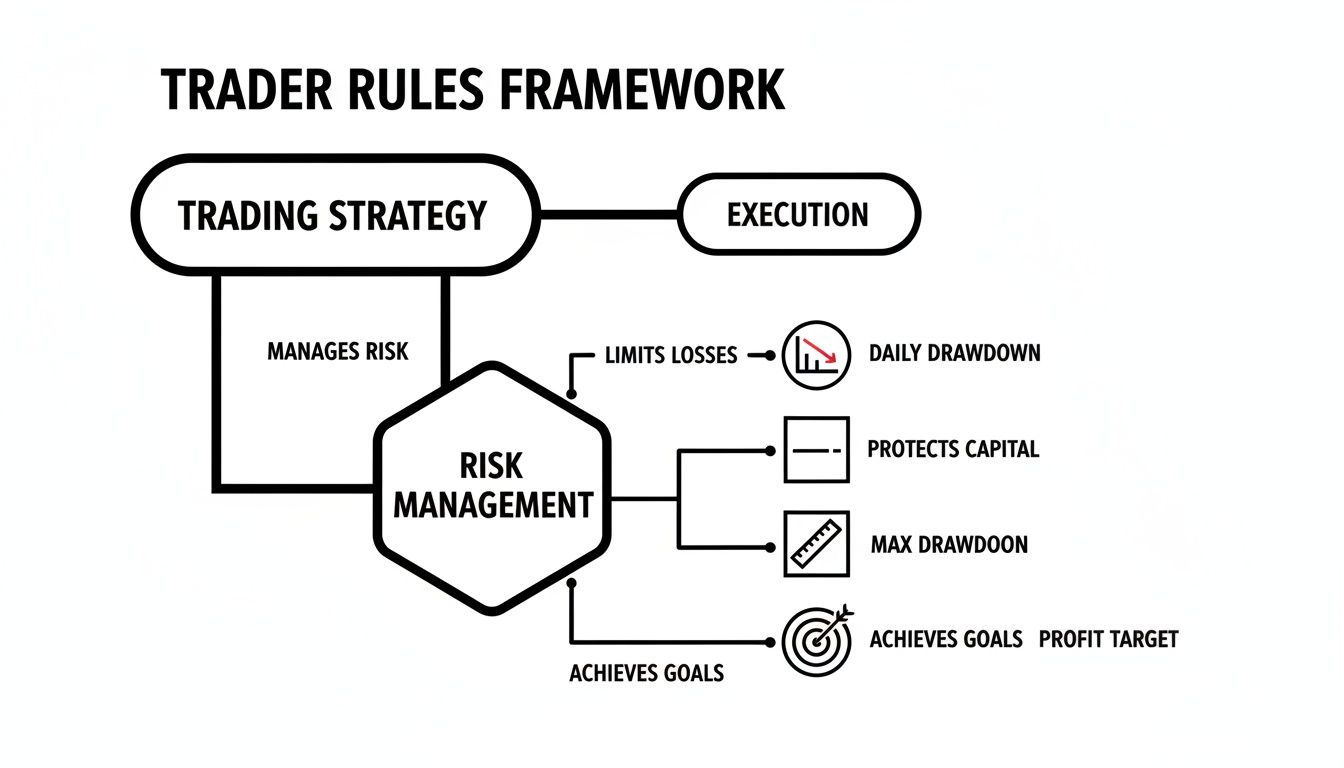
Scaling plans typically have clear criteria. For example, a firm might require you to achieve a 10% profit over a three-month period without any rule violations. If you meet these conditions, they may double your account balance. This process allows your capital and earning potential to grow without you risking any additional personal funds.
How to Choose the Right Prop Firm for Your Strategy

With many funded trader programs available, choosing the right one is critical. A firm that suits a scalper may not work for a swing trader. This section provides a practical checklist to help you find a prop firm that aligns with your trading style.
Step 1: Check Reputation and Transparency
Before looking at profit splits, investigate the firm's reputation. A flashy website doesn't guarantee reliability.
- Read reviews on independent sites like Trustpilot.
- Look for consistent feedback on payout speed and customer support.
- Ensure the terms and conditions are clear and easy to understand. Vague rules can be a red flag.
This initial research helps you filter out unreliable firms and focus on credible partners.
Step 2: Align the Rules with Your Strategy
Find a firm whose rules fit your natural trading style instead of forcing you to change it. Key considerations include:
- Drawdown Model: Does the firm use a static or trailing drawdown? A static drawdown provides a fixed loss limit, which may be better for swing traders. A trailing drawdown adjusts with your account high, which can be more restrictive.
- News Trading: If your strategy relies on news events, ensure the firm permits it.
- Weekend Holding: Can you hold positions over the weekend? This is a deal-breaker for many swing traders. At MyFundedCapital, we offer add-ons to provide this flexibility.
- Available Instruments: Confirm the firm offers the assets you trade, such as specific forex pairs, indices, or commodities.
Step 3: Verify Platforms and Payouts
The technical and financial aspects are just as important as the trading rules.
- Trading Platform: Ensure the firm offers a platform you are comfortable with, such as MT4 or MT5.
- Payout System: A high profit split is meaningless if the withdrawal process is difficult.
- Frequency: Can you withdraw bi-weekly, monthly, or on-demand?
- Methods: Do they support convenient withdrawal options like bank transfers or crypto?
- Timeline: How long must you wait for your first payout? This can range from a week to over 30 days.
A firm with a transparent and reliable payout system treats you like a business partner.
Prop Firm Evaluation Checklist
Use this checklist to compare firms and make an informed decision.
| Evaluation Criteria | What to Look For | Red Flags to Avoid |
|---|---|---|
| Reputation | Positive reviews, active community, clear company info. | Vague terms, no social proof, payout complaints. |
| Trading Rules | Rules that align with your style (drawdown, news trading, etc.). | Restrictions that force you to change your core strategy. |
| Platforms | Industry-standard platforms like MT4 or MT5. | Unreliable or proprietary platforms with poor reviews. |
| Payouts | Clear schedules, fast processing, multiple withdrawal options. | Complicated withdrawal process, long waiting periods. |
| Support | Responsive, 24/7 support from real people. | Slow responses, automated answers, no live support. |
By using a structured approach, you can choose a funded trader program that provides a solid foundation for your trading career.
Frequently Asked Questions (FAQ)
Here are answers to some common questions about funded trader programs. This content is for educational purposes only and is not financial advice. Trading involves substantial risk of loss.
Is it realistic to make a living with a funded trader program?
Yes, it is possible, but it requires discipline, skill, and treating trading like a business. It is not a "get rich quick" scheme. Success depends on consistent profitability, robust risk management, and the mental strength to handle pressure. Since payouts are typically bi-weekly or monthly, you must also manage your personal finances effectively between withdrawals.
What happens if I fail a challenge?
Failing a challenge is a common part of the learning process. If you break a rule, your evaluation account will be closed, and you will lose the fee. However, most firms offer ways to try again:
- Resets: Many firms allow you to reset your account mid-challenge for a smaller fee, letting you start over.
- Discounts: If you fail, you will often receive a discount to purchase a new evaluation.
Use a failed attempt as a learning opportunity to analyze what went wrong, refine your approach, and improve.
Are funded trader programs legitimate?
Yes, the funded trader model is a legitimate business. Reputable firms provide a genuine opportunity for skilled traders to access capital and earn income. However, as with any industry, there are unreliable operators. A legitimate firm's success depends on finding genuinely profitable traders. Look for firms with a strong reputation, clear rules, achievable targets, and a proven track record of timely payouts.
Do I need to pay taxes on my profits?
Yes, you are responsible for paying taxes on all earnings from a prop firm. In most jurisdictions, you are considered an independent contractor, not an employee. This means the firm does not withhold taxes from your payouts. You receive the full profit split and must report it as income according to your local tax laws. Tax regulations are complex and vary by country. It is essential to consult with a qualified tax professional in your area to ensure you comply with all legal requirements.
Take the Next Step in Your Trading Journey
You now have a clear roadmap for navigating funded trader programs, from understanding the core models to selecting a firm that fits your strategy. Success in this field depends on discipline, a well-defined trading plan, and partnering with a supportive prop firm. Trading always involves risk, and it's important to be realistic about the challenges involved.
This information is for educational purposes and should not be considered financial advice. Past performance does not guarantee future results.
If you are ready to prove your skills, explore the programs we offer at MyFundedCapital. We have designed our challenges to reward consistent and disciplined traders. Your journey starts with a single step.
Start your challenge today and show us what you can do.
