

 AR
AR
 NL
NL
 FR
FR
 DE
DE
 ES
ES
 PT
PT
 IT
IT
 PL
PL
 SV
SV

Guessing your trade size or using a fixed lot on every trade is one of the fastest ways to blow a trading account. This guide explains how to use a position size calculator to manage risk like a professional, ensuring you stay in the game long enough for your strategy to work. You’ll learn the simple math behind it, see practical examples, and understand why this tool is non-negotiable for serious traders.
Why Position Sizing Is a Trader’s Superpower
Inconsistent risk is a common mistake that sabotages developing traders. You might decide to risk 1% per trade, but that number is meaningless without correct position sizing. A trade with a 50-pip stop loss carries a completely different dollar risk than one with a 100-pip stop if you use the same lot size.
When your risk is inconsistent, your profit and loss swings become chaotic and unpredictable. A position size calculator removes the guesswork from the equation. All trading involves substantial risk of loss and is not suitable for every investor. This content is for educational purposes only and is not financial advice.
Making Your Risk Consistent
The purpose of a position size calculator is to ensure you risk the exact same percentage of your account on every single trade. It doesn’t matter if your stop loss is tight or wide; the calculator adjusts your position size so the potential dollar loss remains constant.
Adopting this methodical approach is a game-changer for your trading.
- It keeps your emotions in check. You’ll no longer be tempted to oversize a trade that “feels” like a sure thing—a classic recipe for disaster.
- You’ll have consistent exposure. You always know exactly how much you stand to lose, which means no more surprise losses from a trade going against you.
- It ensures you survive. By controlling your downside, you can weather the inevitable losing streaks. This longevity is what allows your trading edge to play out over time.
A trader’s number one job isn’t making money; it’s managing risk. Profits are a byproduct of doing that job well. Using a position size calculator is the first, most crucial step.
Ultimately, this is about ditching erratic risk-taking and embracing a calculated, professional approach. We’re not looking for a magic formula that guarantees profits. Instead, we’re building a defensive wall around your capital to give you a real shot at a sustainable trading career.
The Simple Math Behind Every Smart Trade
The formula behind a position size calculator isn’t a complex financial algorithm. It’s simple logic designed to do one thing: protect your capital. Think of it as setting a strict budget for every trade you take, making sure you never risk more than you’re comfortable with. Once you understand the components, you’ll have the confidence to manage risk effectively.
At its core, the calculation only requires three numbers. Each one is a critical part of standardizing the dollar amount you put on the line for any given trade.
The Three Pillars of Position Sizing
The entire formula is built on these three inputs. Getting them right is the foundation of disciplined trading.
- Account Equity: This is your total account balance right before you place the trade. It’s the starting point for calculating what you can afford to risk.
- Risk Percentage (%): This is the most important decision you make. Most experienced traders stick to risking between 0.5% and 2% of their account on any single trade. On a $10,000 account, a 1% risk means you’ve decided you’re willing to lose $100 if the trade hits your stop loss.
- Stop-Loss Distance: This is the gap between your entry price and your stop-loss price, measured in pips (Forex), points (indices), or dollars (crypto). It’s the point where you accept your trade idea was wrong.
All the calculator does is take the dollar amount you’re willing to risk (Account Equity x Risk %) and divide it by the distance to your stop loss. The result tells you exactly how big your position can be while staying inside your risk limit.
By defining your maximum acceptable loss before you even think about hitting the ‘buy’ or ‘sell’ button, you switch from an emotional, reactive trader to a strategic, proactive one. This single habit is what separates amateurs from professionals.
Why It Works for Any Instrument, Any Timeframe
This simple mathematical relationship is what makes position sizing so effective. It guarantees that a 1% risk is always a 1% risk, no matter how wide or tight your stop loss is.
For example, on a $10,000 account with 1% risk ($100), a scalping trade with a tight 20-pip stop loss will require a larger position size than a swing trade with a wide 200-pip stop. The key is that if either trade hits its stop, the loss is identical: $100.
This consistency is what keeps you in the game long-term, especially when managing a funded account with strict drawdown rules. You can learn more about how to calculate the maximum trailing drawdown in our FAQ.
The Formula in Action
Automating this process was a huge leap for retail traders. Position-size calculators on websites and trading platforms run the classic formula: Lot size = (Account Balance × Risk %) / (Stop-loss in pips × Pip value). This took risk management from a theoretical exercise to a practical, repeatable step, drastically cutting down on costly manual errors. You can find excellent examples of these tools over at myfxbook.com.
Understanding this formula demystifies risk management. It’s not about predicting the future; it’s about controlling your exposure for the times you will inevitably be wrong. Nail this simple math, and you’ve taken a giant step toward ensuring you have the capital to trade another day.
How to Calculate Position Size in Different Markets
Knowing the theory is one thing, but applying it across different markets is where it really counts. The core logic is universal: whether you’re trading Forex, indices, commodities, or crypto, the same principles protect your capital. The only thing that changes is how you adapt the inputs for each market.
Let’s walk through a few practical examples. In every scenario, we’ll use a $10,000 account and a firm 1% risk rule, capping our maximum loss per trade at $100. This consistency is the bedrock of professional trading.
The process is always the same: start with your account equity and risk percentage, then factor in the specific stop-loss for that trade.
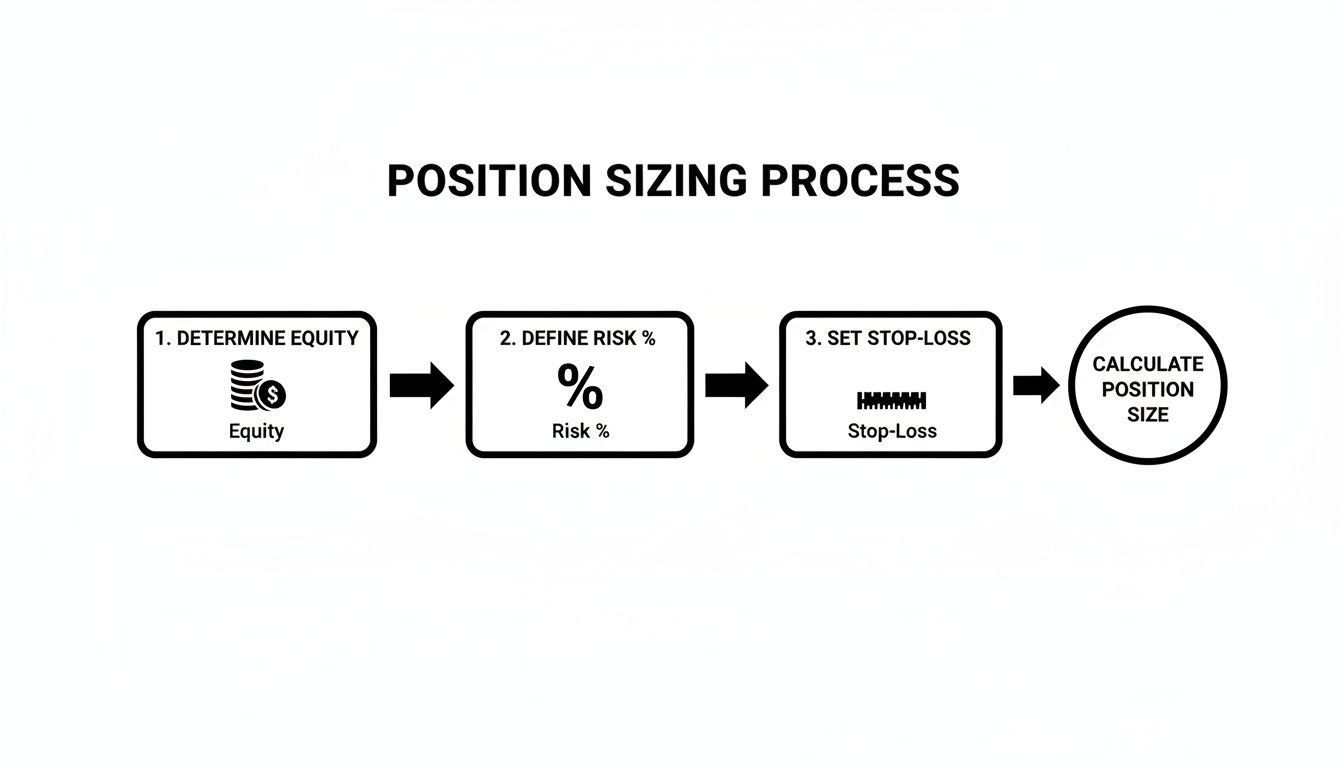
This simple workflow is your best friend in risk management. Define your capital, set your risk, measure your stop, and then calculate.
Forex: A EUR/USD Example
Forex is a common starting point. Price movements are measured in pips, and the value of a pip changes based on the currency pair and your position size. For EUR/USD, a standard lot (100,000 units) typically has a pip value of $10.
Let’s say we spot a long setup on EUR/USD.
- Account Equity: $10,000
- Risk Percentage: 1% ($100)
- Entry Price: 1.0750
- Stop-Loss Price: 1.0730
- Stop-Loss Distance: 20 pips (1.0750 – 1.0730)
Our stop-loss is 20 pips away. To keep our risk at $100, we calculate the required value per pip:
$100 Risk / 20 Pips = $5 per Pip.
Since a standard lot gives us a $10 pip value, we need half of that. This means our position should be 0.50 standard lots, or 50,000 units. A good calculator does this for you instantly.
Indices: A US30 (Dow Jones) Example
Indices like the US30 move in points. The value of each point depends on the contract size. With many brokers, 1 lot of US30 might equal $1 per point—but you must confirm this with your broker.
Imagine we want to short the US30.
- Account Equity: $10,000
- Maximum Dollar Risk: $100
- Entry Price: 39,500
- Stop-Loss Price: 39,550
- Stop-Loss Distance: 50 points (39,550 – 39,500)
- Value per Point (for 1 lot): $1
With a 50-point stop, we need to find a position size where that move costs no more than $100.
$100 Risk / 50 Points = $2 per Point
If 1 lot gives $1 of exposure per point, then to get $2 of exposure, we need to trade 2.0 lots. This locks our risk on this index trade to the exact same dollar amount as our Forex trade.
This is the real power of a position size calculator. It makes risk a constant. It translates your 1% rule into a specific lot size for any asset, giving you a standardized defense no matter the market conditions.
Commodities: A Gold (XAU/USD) Example
Gold is priced in US dollars per ounce. For XAU/USD, a move from $2,350.00 to $2,351.00 is a $1 move. With a standard lot (100 ounces), that $1 price change translates to a $100 profit or loss.
Let’s plan a long trade on Gold.
- Account Equity: $10,000
- Maximum Dollar Risk: $100
- Entry Price: $2,350
- Stop-Loss Price: $2,345
- Stop-Loss Distance: $5 (2350 – 2345)
Our stop distance is a simple $5 move. We need to calculate a position size where this $5 move results in our $100 maximum loss.
$100 Risk / $5 Move = $20 per $1 Price Change
We know a standard 1.0 lot (100 ounces) gives us a $100 P&L change for every $1 move. To hit our target of $20 per dollar move, we need to adjust the lot size.
The calculation is: ($20 Target / $100 Standard) = 0.20 lots. This ensures that if the price drops $5 to our stop-loss, our total loss is capped at exactly $100.
Crypto: A BTC/USD Example
Cryptocurrencies are volatile, making proper position sizing non-negotiable. A small miscalculation here can lead to a much larger loss than intended. Since BTC/USD is priced in dollars, the stop distance is measured directly in dollars.
Imagine a short setup in Bitcoin.
- Account Equity: $10,000
- Maximum Dollar Risk: $100
- Entry Price: $65,000
- Stop-Loss Price: $65,500
- Stop-Loss Distance: $500 (65,500 – 65,000)
A $500 stop might seem wide, but it’s common for an asset like Bitcoin. The key is that our risk can remain locked at $100.
$100 Risk / $500 Stop Distance = $0.20 per $1 Price Change
This means for every $1 Bitcoin moves against our position, we should only lose $0.20. Assuming trading 1.0 BTC means you gain or lose $1 for every $1 price change, the position size is simply 0.20 BTC.
Position Sizing Examples Across Different Markets
This table summarizes the inputs and results for each scenario, based on a $10,000 account risking 1% ($100) per trade.
| Asset | Entry Price | Stop-Loss Price | Stop Distance | Calculated Position Size |
|---|---|---|---|---|
| EUR/USD | 1.0750 | 1.0730 | 20 pips | 0.50 lots |
| US30 | 39,500 | 39,550 | 50 points | 2.0 lots |
| Gold (XAU/USD) | $2,350 | $2,345 | $5 | 0.20 lots |
| Bitcoin (BTC/USD) | $65,000 | $65,500 | $500 | 0.20 BTC |
Notice how different the position sizes are, yet the financial risk ($100) is identical for all four. This is the power of disciplined risk management in action.
Using Sizing Tools on cTrader, DXtrade, and Match-Trader
Knowing the math is one thing, but fumbling with a calculator while a setup is forming is a sure way to miss an entry or make a mistake.
Modern platforms do the heavy lifting for you. They build these calculations right into the order ticket, bridging the gap between risk management theory and real-time execution.
Platforms like cTrader, DXtrade, and Match-Trader have these features baked in. Instead of punching in a lot size and hoping for the best, you can define your risk first and let the software do the rest.
Finding the Calculator in cTrader
cTrader’s design is clean and intuitive. When you open a new order ticket, you’ll see the usual fields for entry, stop-loss, and take-profit. The real power is in how you define your volume.
Simply click on the volume field and change the input from “Lots” to “USD” (or your account currency). Now, you can type in the exact dollar amount you’re willing to risk—for example, $100.
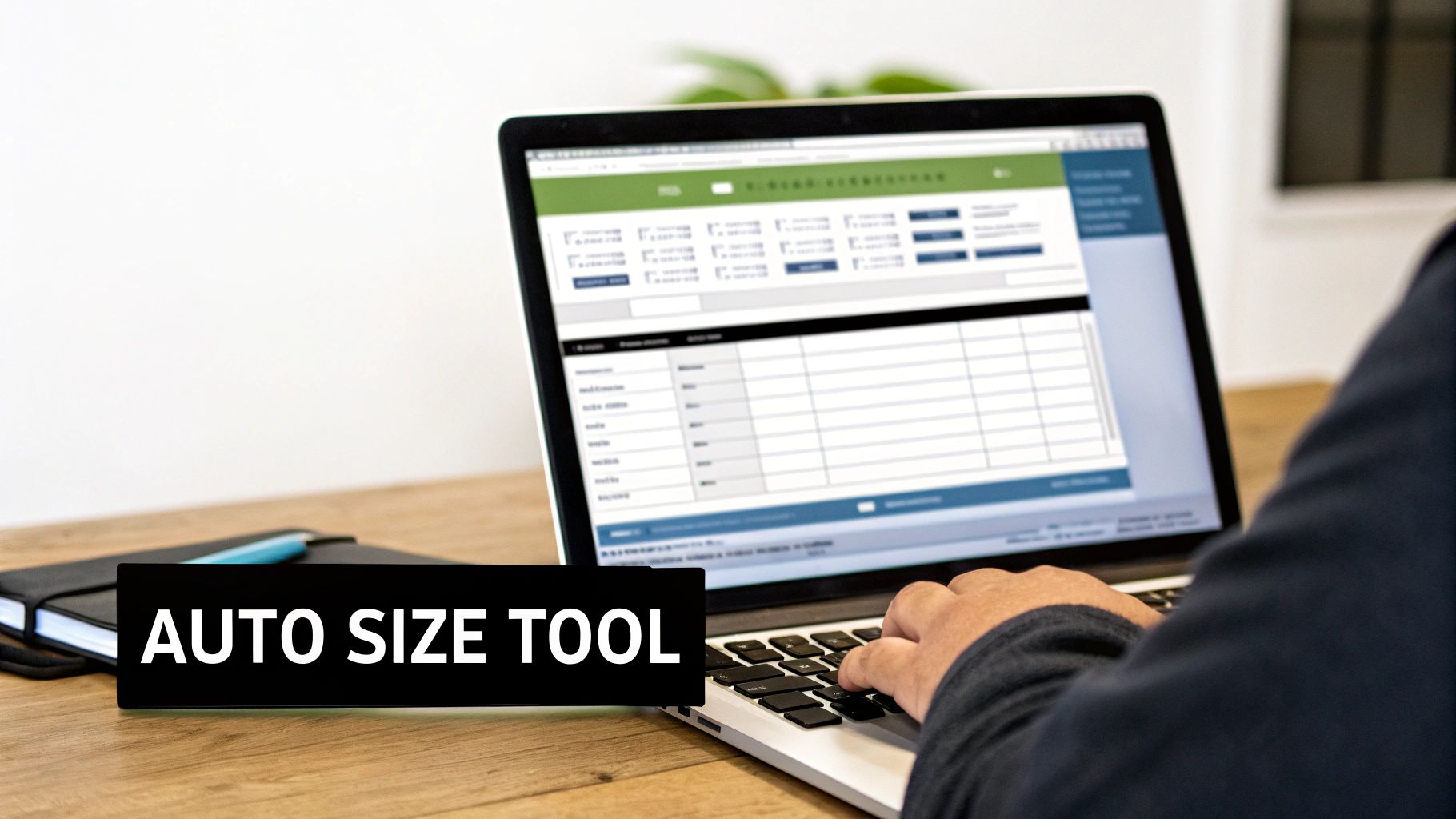
Once your stop-loss is set, cTrader instantly calculates the precise lot size that matches your $100 risk. It removes the guesswork and potential for error.
Sizing Your Trades in DXtrade
DXtrade offers a similar, efficient workflow. The platform’s order panel includes an advanced risk management section where you can define your stop-loss by a price level, a number of pips, a percentage of your account, or a specific cash value.
This allows you to set your stop and then tell the platform, “I only want to risk X amount on this trade.” DXtrade automatically adjusts the trade volume to ensure your potential loss never exceeds that limit.
The real advantage here is the blend of speed and accuracy. In a fast-moving market, being able to set your risk and execute in seconds is a massive edge.
Leveraging Match-Trader’s Tools
Match-Trader also has robust risk management tools in the order window. Like the others, it lets you set your stop-loss and immediately see the potential loss in your account’s currency before you place the trade.
The platform displays all key parameters, including the margin required and the exact cash loss if your stop is hit. By tweaking the volume, you can dial in your position until the “Cash Loss” figure matches your plan.
For our traders at MyFundedCapital, having access to these platforms is a huge advantage. You can get all the details on which platform you can trade on with our programs.
No matter which platform you use, the core process is the same:
- Define Your Stop-Loss: First, identify the price where your trade idea is proven wrong.
- Specify Your Risk: Use the built-in tools to set your risk in cash, pips, or percentage.
- Execute with Confidence: The platform does the math, calculating the perfect position size so your risk is standardized every time.
Mastering these integrated tools is one of the simplest yet most powerful things you can do to become a more disciplined, consistent trader.
Applying Position Sizing to Prop Firm Challenges
When you’re trying to get funded, proper position sizing isn’t just a good habit—it’s the key to survival. The strict rules of a prop firm challenge, especially the maximum daily and total drawdown limits, make risk management an absolute make-or-break skill.
Guessing your trade size or using a fixed lot is the fastest way to fail an evaluation. A position size calculator is your most trusted tool in this environment. It ensures every trade is a calculated decision, not a gamble.
Navigating Drawdown Limits with Precision
In any prop firm challenge, the daily drawdown and maximum drawdown are the most important rules. If you breach them, your account is closed. A position size calculator is your best line of defense against hitting those limits.
Let’s consider a practical scenario. Imagine a $100,000 challenge account with a 5% daily drawdown limit ($5,000). If you consistently risk 1% of your starting equity ($1,000) on every trade, you could take five full losses in a row before approaching that daily limit.
In contrast, if you risk 3% ($3,000) on a single trade, just two consecutive losses would take you out for the day. The calculator forces you to make your risk a conscious choice.
A professional trader’s primary job in a prop firm challenge isn’t to hit the profit target; it’s to protect the account from the drawdown limits. If you do that successfully, hitting the profit target takes care of itself.
This approach gives you a psychological edge. Knowing you have a cushion of several potential losses lets you execute your strategy with confidence, even during a losing streak. For a deeper dive, check our guide on understanding the prop firm challenges.
The Statistical Edge of Small, Consistent Risk
The difference between risking 1% and 2% may not sound like much, but its impact on your account’s survival is enormous.
The numbers tell the story. If you stick to a fixed risk of 1% per trade, it would take approximately 69 consecutive losses to draw your account down significantly. If you increase that risk to 2%, it only takes around 35 consecutive losses to do the same damage. You can find more data on this at TradingDiaryPro.com.
Simply cutting your risk from 2% to 1% effectively doubles your account’s lifespan during a bad run. A position size calculator turns this simple choice into a real statistical advantage.
Building a Long-Term Funded Career
Using a position size calculator in a prop firm setting helps build professional habits. It forces you to think defensively and prioritize capital protection above all else. This is the discipline prop firms look for.
Key takeaways for your challenge:
- Always Calculate Before You Execute: Make it a non-negotiable part of your pre-trade checklist.
- Align Your Risk with Drawdown Rules: Your risk-per-trade must give you plenty of room from the daily and max loss limits.
- Stay Consistent: Don’t increase your risk after a few wins or “revenge trade” with a bigger size after a loss. Consistency is what gets you funded.
By framing every trade through the lens of your drawdown limits and using a calculator to enforce your rules, you shift your focus from chasing profits to mastering risk. That mindset is the foundation of a successful career as a funded trader.
FAQ: Position Size Calculator
Here are answers to some common questions about using a position size calculator in your trading.
How does leverage affect my position size?
Leverage does not change your position size calculation. Your position size is determined by your account equity, risk percentage, and stop-loss distance. Leverage only determines the margin required to open that position. Think of it this way: position sizing controls your risk, while leverage provides buying power. A disciplined trader never lets leverage dictate their risk per trade.
What if my account isn’t in USD?
A good position size calculator will handle this for you. Simply specify your account’s base currency (e.g., EUR, GBP, AUD) in the calculator’s settings. It will automatically use current exchange rates to calculate the correct pip or point value, ensuring your risk remains consistent without needing manual currency conversions.
Should I risk the same percentage on every trade?
For most beginner and intermediate traders, sticking to a fixed risk percentage (e.g., 1%) is the best approach. It builds discipline and removes emotion from the decision-making process. Some advanced traders may vary their risk based on the quality of the setup (e.g., risking 0.5% on a standard trade and 1% on a high-conviction trade), but this requires a well-tested strategy and significant experience.
So, Where Do You Go From Here?
Mastering position sizing is a transformative step in a trader’s journey. It isn’t a secret formula for guaranteed profits, but rather your most reliable defense—the tool that stands between a single bad trade and a blown account.
By integrating this calculation into your pre-trade routine, you remove guesswork and emotion. You make a conscious decision to manage your downside, giving your strategy the room it needs to perform over the long term. This is the bedrock of treating trading like a serious business.
If there’s one thing to remember, it’s this: A position size calculator gives you control. It ensures no single trade has the power to take you out of the game. That’s how you survive to trade tomorrow, next week, and for years to come.
You now have the knowledge to manage risk like a professional. The next step is to apply these skills where it counts.
Ready to prove your skills? Explore MyFundedCapital’s programs, find an account that fits your trading style, and start a challenge today.
