

 AR
AR
 NL
NL
 FR
FR
 DE
DE
 ES
ES
 IT
IT
 PL
PL
 SV
SV
 PT
PT

Choosing between Contracts for Difference (CFDs) and futures contracts can feel overwhelming, but it's a critical decision that shapes your trading strategy, costs, and risk. This guide breaks down the practical differences between these two popular derivatives. You will learn how each instrument works, their true trading costs, and which one is better suited for different trading styles, especially for those seeking a funded trading account.
What Are CFDs and Futures Contracts?
At their core, both CFDs and futures allow you to speculate on an asset's price without owning it, but they operate in fundamentally different ways. Understanding this distinction is crucial for managing your risk and costs.
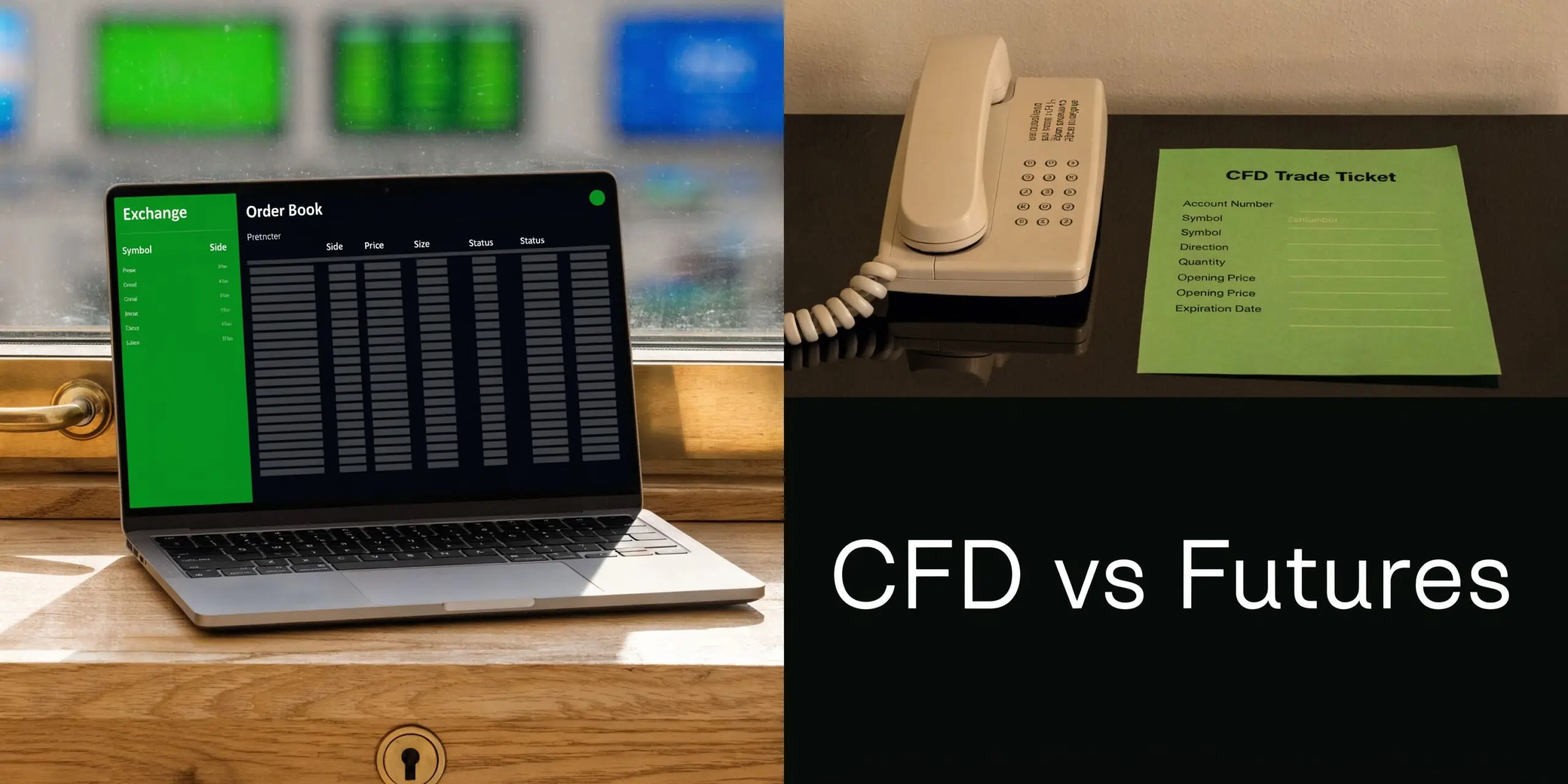
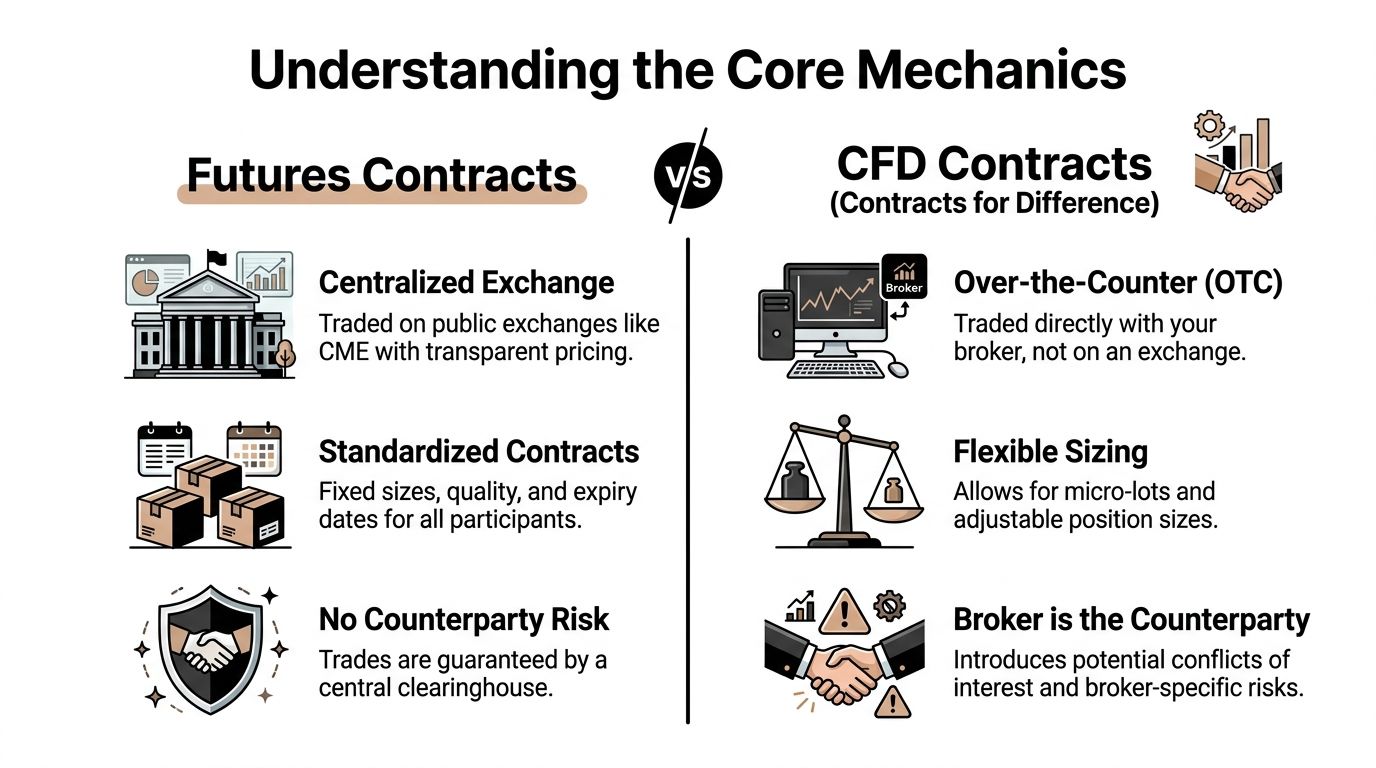
A Futures Contract is a standardized, legally binding agreement to buy or sell a specific asset at a predetermined price on a future date. These are traded on regulated, centralized exchanges like the CME Group, where all participants see the same transparent order book and pricing.
A Contract for Difference (CFD) is a private, over-the-counter (OTC) agreement between you and your broker. You agree to exchange the difference in an asset's price from when you open the position to when you close it. Your broker is the counterparty to your trade.
The key difference is the market structure. Futures trading is a public, regulated activity. CFD trading is a private arrangement where your broker sets the terms and pricing. This guide will explore the practical implications for you as a trader.
Key Differences: CFD vs Futures at a Glance
This table offers a side-by-side comparison of the most critical distinctions between futures and CFDs.
| Feature | Futures Contract | Contract for Difference (CFD) |
|---|---|---|
| Market Type | Centralized Exchange (e.g., CME) | Over-the-Counter (OTC) via Broker |
| Pricing | Transparent, single market price | Broker-dependent pricing (can vary) |
| Regulation | Highly regulated by exchanges | Varies by broker and jurisdiction |
| Contract Specs | Standardized (fixed size, expiry) | Flexible (micro-lots, adjustable sizes) |
| Counterparty | Exchange Clearinghouse | Your Broker |
| Expiry Date | Yes, fixed expiration dates | Typically no expiration (perpetual) |
| Trading Costs | Commission + Raw Spread | Wider Spread + Overnight Swap Fees |
| Best For | Swing/Position Trading, Specialists | Day Trading, Small Accounts, Asset Hopping |
Understanding Core Mechanics and Transparency
To decide which instrument is right for you, you must understand the environment where you are trading. This single factor affects everything from the prices you see to the risks you take. One market is a public, regulated arena; the other is a private arrangement with your broker.
Futures: The Centralized Exchange Model
Futures contracts are traded on large, centralized exchanges like the CME Group. This creates an open marketplace where every participant—from individual traders to large institutions—sees the exact same data at the same time.
- Transparent Pricing: You get a live order book showing all bids and offers, so the price is the same for everyone.
- Standardized Contracts: A contract for E-mini S&P 500 futures, for example, has a fixed size and set expiration dates (March, June, September, December), ensuring uniformity.
- No Counterparty Risk: A central clearinghouse guarantees every trade. If the party on the other side of your position defaults, the clearinghouse steps in, effectively eliminating the risk of your counterparty failing to pay.
CFDs: The Over-the-Counter (OTC) Model
CFDs are over-the-counter (OTC) instruments, meaning you trade directly with your broker, not on a public exchange.
- Broker as Counterparty: Your broker creates the contract and sets the price, which is based on the underlying market but often includes a markup in the spread. When you buy a CFD, your broker sells it to you; when you sell, they buy it back.
- Flexibility: Because contracts aren't standardized, brokers offer incredible flexibility. You can trade micro-lots and other fractional sizes, which is ideal for smaller accounts and precise risk management.
- Counterparty Risk: Your trade's security is tied to your broker's financial health. If the broker fails, your funds could be at risk, which is why choosing a well-regulated broker is essential.
This distinction is crucial: with futures, you trade through your broker on an exchange. With CFDs, you trade with your broker.
Analyzing the True Cost of Trading
Many traders are drawn to the "commission-free" model of CFDs, but this doesn't tell the whole story. The true cost of trading involves spreads, commissions, and financing fees.
Spreads and Commissions
- Futures: You pay a transparent, fixed round-turn commission (e.g., $4-$5) to open and close a position. You also trade on the raw market spread, which is often very tight for liquid products (e.g., 0.25 points for E-mini S&P 500).
- CFDs: Most CFD brokers don't charge a commission. Instead, their fee is built into the bid-ask spreads in trading, which they widen from the raw market price. This spread can be significantly larger than the futures equivalent, creating an immediate cost on every trade.
The Hidden Cost: Overnight Financing Fees
The biggest cost difference, especially for swing or position traders, is the overnight financing fee, or swap fee.
- CFD Swap Fees: Brokers charge this fee on any CFD position held open past the daily market close. It's calculated on the total value of your leveraged position, not just your margin. These daily debits can quickly erode profits or magnify losses on a trade held for several days or weeks.
- Futures Holding Costs: Futures contracts do not have swap fees. The cost of holding the position over time (the "cost of carry") is already priced into the contract itself. This makes futures far more cost-effective for any strategy that isn't purely intraday.
Concrete Example: Holding an Index Position for One Month
Imagine you go long on the S&P 500 and hold for a month.
- Futures Trade: You might realize a profit of $8,635 after a small commission. There are zero swap fees.
- CFD Trade: The initial profit might look higher, say $9,350. However, daily swap charges could accumulate to over $2,000 for the month. Your net profit would drop to $7,350.
The futures trade is clearly more profitable for holding periods longer than a day.
How Leverage and Margin Shape Your Risk
Leverage is a double-edged sword that can amplify both gains and losses. How futures and CFDs handle leverage and margin is a core difference in their risk profiles. All trading involves substantial risk of loss and is not suitable for all investors.
Futures Margin: A Good-Faith Deposit
In futures trading, margin is not a loan. It's a performance bond—a good-faith deposit held by the exchange clearinghouse (CME Group) to ensure you can cover potential daily losses.
- Initial Margin: The amount required to open a position.
- Maintenance Margin: The minimum equity you must maintain in your account. If your account drops below this level, you'll receive a margin call, forcing you to add funds or have your position liquidated.
This standardized, two-tier system enforces discipline and protects the market's integrity. It prevents traders from taking on excessive risk they can't manage.
CFD Leverage: High-Risk, High-Reward
CFD brokers offer leverage as a direct feature, allowing traders to control large positions with a small amount of capital. While this can lead to large profits, it also dramatically increases risk.
A Practical Warning: With 100:1 CFD leverage, a mere 1% market move against your position will wipe out 100% of your margin capital.
Let's use a $2,000 account as an example:
- Futures Scenario: To trade one Micro E-mini S&P 500 contract (notional value ~$25,000), the exchange might require ~$1,300 in initial margin. Your $2,000 account can handle this, but it forces disciplined position sizing.
- CFD Scenario: With 100:1 leverage, your $2,000 margin could control a $200,000 position. A tiny 0.5% adverse move would result in a $1,000 loss—50% of your entire account.
The structured margin system in futures promotes a more sustainable approach to risk management, a critical skill for any serious trader. Learn more in our guide on what a trade margin is and how it works.
Which Instrument is Right for Your Strategy?
The best instrument depends entirely on your trading style, account size, and timeline. Here are some practical scenarios.
Scenario 1: The Active Day Trader
If you're a scalper or active day trader who jumps between different markets (e.g., forex, indices, crypto) for quick profits, CFDs are often the better tool.
- Flexibility: A single CFD account provides access to thousands of markets.
- Precise Sizing: Micro-lots allow you to manage risk with surgical precision, which is essential for meeting prop firm drawdown rules.
- No Swap Fees: Since you close all positions before the end of the day, overnight financing fees are not a concern. The wider spread is simply a cost of doing business.
Scenario 2: The Swing or Position Trader
If your strategy involves holding a position for several days, weeks, or months to capture a larger trend, futures are the clear winner.
- Cost-Effective: The absence of daily swap fees is a massive advantage, preventing costs from eating into your profits over time.
- Transparency and Liquidity: For major markets like oil or agricultural commodities, futures offer deep liquidity and transparent, market-driven pricing.
- Security: The exchange clearinghouse eliminates counterparty risk, providing security for longer-term trades.
For more insights tailored to prop firm traders, see our guide comparing forex and futures trading environments.
Why Prop Firms Primarily Use CFDs
Most modern prop firms, including MyFundedCapital, are built around CFD trading. This is for practical reasons:
- Operational Simplicity: CFDs allow firms to offer a vast range of markets through a single platform.
- Granular Risk Management: The ability for traders to use micro-lots is essential for adhering to strict drawdown rules.
- Technological Efficiency: Integrating with CFD liquidity providers is simpler and more cost-effective than managing connections to dozens of global futures exchanges.
For aspiring prop traders, this means mastering CFD trading within a rule-based environment is the most direct path to getting funded. The discipline learned from futures is invaluable, but the skill that gets you paid is excelling on the firm's CFD platform.
Frequently Asked Questions (FAQ)
Which is better for beginners, CFD or futures?
For absolute beginners with small capital, CFDs are often more accessible. The ability to trade micro-lots allows new traders to experiment with very small position sizes and limited risk. However, it's crucial to understand the high risks associated with leverage and to choose a well-regulated broker.
Can I lose more than my deposit with futures or CFDs?
Yes, it is possible with both, though it is rare with modern broker protections. In highly volatile market conditions, a rapid price move could cause your losses to exceed your account balance. Many CFD brokers offer "negative balance protection" to prevent this. With futures, a margin call is the primary defense, but extreme "gap down" events could theoretically lead to a negative balance. Always be aware that trading involves a high degree of risk.
Are futures more transparent than CFDs?
Yes, absolutely. Futures are traded on a centralized exchange with a public order book (Level 2 data), meaning all participants can see the buy and sell orders. This creates a high level of price transparency. CFDs are traded OTC, where the broker sets the price based on the underlying market, which can be less transparent.
Why do professional traders often prefer futures?
Many professional and institutional traders prefer futures for three key reasons: transparency, liquidity, and security. The centralized market provides a clear, fair price, deep liquidity ensures large orders can be filled without significant slippage, and the exchange clearinghouse eliminates counterparty risk.
Ready to apply this knowledge and prove your trading skills? The choice between CFD vs futures contract depends on your strategy, but mastering risk management is universal.
Explore our funding programs to find the account that fits your trading style and start your journey to becoming a funded trader today.
