

 AR
AR
 NL
NL
 FR
FR
 DE
DE
 ES
ES
 IT
IT
 PL
PL
 SV
SV
 PT
PT


Silver is one of the few markets where a long-term forecast can change how you trade next week. Current long-range models do not point to a quiet, mean-reverting metal. They point to a market that could behave more like a strategically constrained industrial input than the old cyclical silver traders remember.
That is why a serious silver price prediction 2040 matters. Not because you can predict an exact print fourteen years out, but because the right framework helps you decide when to press, when to fade, and when to stay flat. For traders working in products that involve borrowed capital, especially CFDs, that distinction matters every day. If you trade multiple instruments, these funded trader markets show where silver fits inside a broader macro watchlist.
Why Silver's Past Is Key to Its Future
Silver has never traded like a simple precious metal. It behaves like two assets sharing one ticker. One side is monetary. The other is industrial. That split is the reason long-term forecasts for silver always look wider, less stable, and more path-dependent than gold.

Silver does not trend on one narrative
When inflation fear dominates, traders often treat silver as a cheaper, higher-beta version of gold. When manufacturing, electronics, and energy expansion dominate, traders price silver as an input metal with relatively sticky demand. Those two regimes can reinforce each other, but they can also conflict.
That matters because a 2040 forecast is not just a question of demand growth. It is a question of which identity of silver dominates for the longest stretch.
A useful way to think about the past is this:
- Risk-off periods: silver can benefit from monetary demand, but it can also suffer if industrial expectations weaken.
- Growth periods: silver can rally with production expansion, especially when technology demand rises.
- Inflationary periods: silver often attracts both commodity and hard-asset buyers, which can increase volatility in both directions.
- Dollar-sensitive periods: silver can react sharply when the dollar, rates, and real-yield expectations change.
The lesson is not that silver always goes up in crisis or always rises with growth. The lesson is that it responds to interacting drivers, which is why simplistic forecasts usually fail.
The range shift matters more than the exact high
One of the most important historical clues in any silver price prediction 2040 is not a single spike. It is the market’s ability to hold at a higher long-run range after repricing.
According to long-term models summarized by KuCoin, silver established a new support floor at $80 to $82 per ounce in early 2026, described as a permanent shift from the prior $20 to $30 range, with the change tied to the sixth straight year of supply-demand gaps and stronger demand from AI hardware and next-generation solar cells (KuCoin silver price prediction).
That changes how a trader should read silver’s history.
If a market spends years oscillating around one valuation band, then breaks into a much higher structural band and starts building support there, the old “it always comes back” trade becomes dangerous. Mean reversion still exists, but the mean itself may have moved.
Key takeaway: In long-term commodity analysis, regime changes matter more than old anchor prices. If the market reprices its floor, your bearish targets need a new base assumption.
The gold-to-silver ratio still frames upside
Long-term silver models continue to watch the gold-to-silver ratio because silver often carries more upside when that ratio compresses. KuCoin’s summary notes that institutional models project $145 by 2030 conservatively, with potential escalation to $300 if the gold-to-silver ratio reverts toward historical norms, which is part of the setup for a 2040 scarcity story.
You do not need to predict the exact ratio to use that insight. You only need to understand its trading implication:
- If gold leads and silver lags, silver can look cheap on a relative basis.
- If silver starts outperforming gold, trend traders often treat that as confirmation of a stronger metals cycle.
- If ratio compression happens during a supply-constrained period, silver can move faster than traders expect.
What past behavior tells a prop trader
Historical behavior does not give you a destination. It gives you a map of possible routes.
For a trader using borrowed capital, silver’s past suggests three practical rules:
- Respect volatility. Silver can overshoot fair-value narratives in both directions.
- Trade the regime, not your opinion. If the market is acting like an industrial scarcity asset, do not force a pure safe-haven framework onto it.
- Watch for floor changes. A repriced support zone can matter more than an old all-time reference point.
That last point becomes central when you build long-range scenarios.
The Four Pillars Driving the Silver Price to 2040
A credible silver price prediction 2040 needs more than a bullish headline. It needs drivers that can persist for years, survive normal business cycles, and interact with one another.

Industrial demand is the first pillar
This is the most concrete part of the bull case. Silver is not just held. It is used.
Forecasts compiled by CoinCodex emphasize industrial inelasticity and the green-energy transition. The same source notes projections of $76.17 by end-2026 and $91.55 by 2030, while LiteFinance-style bullish cases in the same forecast set reach $151.51 by 2030, with optimistic long-range models pointing to $673 by 2037 and potential triple-digit averages by 2040 (CoinCodex silver forecast).
The important phrase there is industrial inelasticity.
That means some buyers cannot easily cut silver use just because the metal gets more expensive. For traders, that changes how you judge pullbacks. In many commodities, higher prices destroy demand quickly. In silver, some parts of demand may bend less than expected.
Think of silver as an industrial vitamin. Small amounts can be critical to the final product. If that remains true in solar, electronics, and advanced hardware, buyers may tolerate higher prices longer than the market initially expects.
Monetary demand is the second pillar
Silver is less pure than gold as a monetary asset, but it still benefits when traders look for hard assets outside fiat systems. This side of the market matters most when inflation pressure, debt concerns, or confidence stress push investors toward metals.
The monetary case is difficult to model precisely because it is sentiment-heavy. But its trading value is clear. It can accelerate moves that already started for industrial reasons.
When both pillars align, silver can stop behaving like a slow commodity and start behaving like a fast macro trade.
That is one reason the long-range forecasts vary so widely. The market is not just asking whether silver will be needed. It is asking whether investors will also chase it as protection.
Supply constraints are the third pillar
A bullish silver thesis fails if supply can scale smoothly. Current forecasts argue the opposite.
Several long-term models now frame silver as moving toward a strategic rationed resource, not just a mined commodity with normal cyclical tightness. In the forecast set summarized by KuCoin, base-case projections for 2040 sit at $149 to $224 per ounce, while hyper-bullish “Moonshot” outcomes reach $500 to $700.
That language is important. “Strategic rationed resource” implies a market where allocation becomes part of the pricing process. In plain terms, some buyers get metal only by paying significantly more.
For traders, supply stress usually shows up in price action before it appears in mainstream narrative. You will often see:
- sharper dip-buying
- shallower corrections
- breakout follow-through
- failed bearish continuation setups
Those are not proof of scarcity by themselves. But when they appear alongside structural supply stories, they deserve more weight.
Trading tip: In a supply-constrained commodity, the cleanest short setups often fail first. If breakdowns do not hold, the market may be telling you the bigger trend is still shortage-driven.
Investment access and liquidity are the fourth pillar
The fourth pillar is less discussed, but it matters. Access changes participation.
Long-range commentary in the verified material notes that tokenization of reserves has unlocked 24/7 liquidity, which can amplify institutional inflows in silver-linked exposure. Whether a trader uses tokenized products or not, the implication is straightforward. More pathways into the metal can mean faster repricing when sentiment changes.
Market structure thus enters the forecast. A commodity can have bullish fundamentals for years and still move slowly if access is clunky. Better access can compress the timeline between narrative and price.
For a CFD trader, this matters in two ways:
- momentum can build faster once a macro theme catches on
- reversals can also become more violent because participation broadens
Why these pillars matter together
Any single pillar can weaken for a period. Industrial demand can cool. Monetary demand can fade. Liquidity can dry up. Supply headlines can disappoint. The stronger case for long-term silver comes from the interaction among all four.
Here is the practical hierarchy I use:
| Pillar | Why it matters | Trading implication |
|---|---|---|
| Industrial demand | Creates the core long-term bid | Favors buying pullbacks in strong macro uptrends |
| Monetary demand | Adds reflexive upside during stress | Increases breakout risk and headline sensitivity |
| Supply constraints | Limits the market’s ability to rebalance | Makes deep bearish conviction less reliable |
| Investment access | Speeds up repricing | Supports momentum and sharper volatility |
When traders talk about silver becoming “different,” this is usually what they mean. Not one catalyst. A stack of catalysts that can reinforce each other over time.
Modeling Scenarios for a 2040 Silver Price Prediction
A long-term forecast is only useful if it shows what must happen for each outcome. Single-number targets create false confidence. Scenario thinking creates better trading discipline.
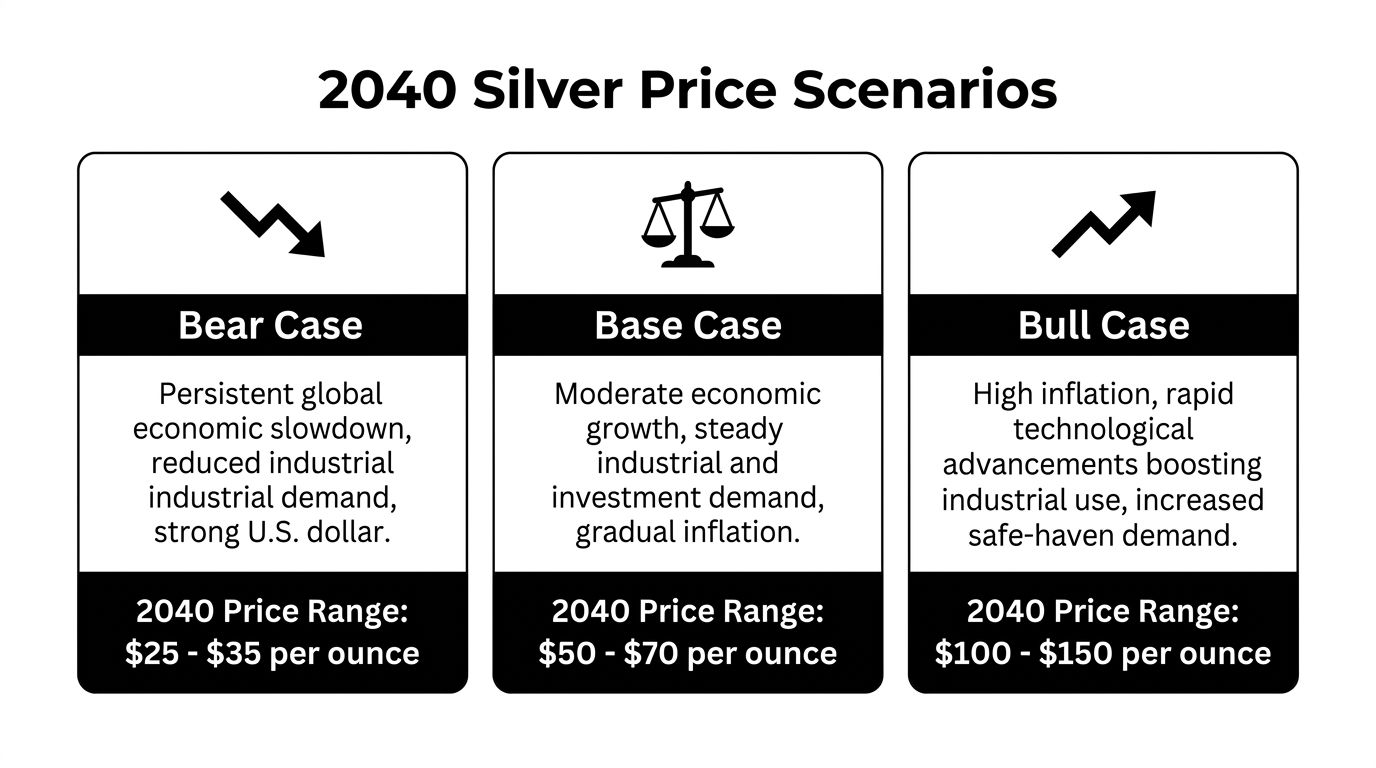
The infographic above presents one generic way markets often frame possible ranges. For trading decisions, though, I would put more weight on forecast bands drawn from the verified long-term silver models, especially because some of those models assume the market has already shifted to a much higher structural floor.
A useful way to frame the distribution
The cleanest way to build a silver price prediction 2040 is to divide outcomes into three buckets:
- Recycling-capped outcome
- Structural scarcity base case
- Full scarcity plus monetary panic case
This is more useful than a simple bull-bear split because the main downside risk in current silver forecasting is not “silver becomes worthless.” It is “silver stays valuable, but supply adaptation caps the upside.”
For traders, that distinction matters. A capped-upside market trades very differently from a collapsing market.
Scenario summary table
| Scenario | Key Assumptions | 2040 Price Target (USD/oz) | Implied Market Environment |
|---|---|---|---|
| Recycling-capped case | Circular economy scales well, recycled supply absorbs part of the shortage, industrial demand remains strong but less price-explosive | $100 to $150 | Tight market, but not a disorderly squeeze |
| Structural scarcity base case | Supply-demand gaps persist, industrial inelasticity remains, silver holds its higher regime and reprices further as a strategic material | $149 to $224 | Sustained bull market with periodic deep corrections |
| Moonshot bull case | Severe supply pressure combines with stronger monetary demand, weaker confidence in fiat systems, and stronger scarcity pricing | $500 to $700 | High-volatility supercycle with sharp trend expansions |
The recycling-capped case
This is the contrarian scenario many bullish traders skip. It is not bearish in the traditional sense. It is bullish, but restrained.
Bitpanda’s forecast discussion highlights silver recycling as a major variable and notes that if circular economy initiatives become very efficient, with recycled supply reaching 40% by 2040, prices could be capped in the $100 to $150 per ounce range rather than the more aggressive $200+ outcomes (Bitpanda silver price forecasts).
This scenario assumes demand remains solid. What changes is the market’s ability to respond.
Under this outcome, traders should expect:
- trend persistence, but fewer blow-off moves
- more two-way price action inside broad ranges
- stronger resistance near narrative-driven breakout zones
- more value in swing trading than in permanent long bias
If you trade from charts, this is the market where breakout failure and mean reversion setups become more attractive after sentiment surges. If you need a refresher on reading those setups, this guide to technical analysis for beginners is a practical starting point.
The structural scarcity base case
This is the most investable long-term framework in the current data set.
KuCoin’s long-range summary places the base case at $149 to $224 per ounce by 2040, grounded in depleting terrestrial mines, stronger industrial demand, and the idea that silver is shifting toward a strategic resource.
This is the case I would treat as the market’s central tension. Not because it is guaranteed, but because it explains why silver could keep repricing higher even without a full monetary panic.
The assumptions are straightforward:
- industrial demand stays durable
- supply remains difficult to expand quickly
- the market accepts that the old silver range is gone
- investment flows continue to reinforce scarcity pricing during bullish phases
For traders, this base case does not mean “buy and hold forever.” It means maintaining a structural bias that favors:
- buying major pullbacks instead of chasing breakdowns
- holding part of a winning position for extension
- using macro catalysts to add only when price confirms
The Moonshot bull case
This is the outcome people love to post and usually fail to trade well. The number is dramatic, but the path would be difficult.
The verified forecast set allows $500 to $700 per ounce in hyper-bullish 2040 scenarios. That requires more than tight supply. It likely needs multiple reinforcing stresses at once: industrial scarcity, stronger investment demand, and a broader loss of confidence in fiat purchasing power.
A trader’s mistake here is assuming this path would be clean. It would likely come with violent reversals, crowded longs, and periods where price moves too far too fast for sensible entries.
Key takeaway: The highest long-term target is not necessarily the best trading environment. Extreme bull markets can be profitable, but they also punish size, impatience, and late entries.
What I would conclude from these scenarios
A serious silver price prediction 2040 does not point to one magic number. It points to a skewed distribution.
The lower end of plausible long-term outcomes in the verified material still sits well above silver’s old multi-year reputation. The middle outcome implies structural repricing. The upper outcome implies supercycle behavior.
For a trader, that leads to one non-obvious conclusion: the best edge may not come from predicting the final 2040 print. It may come from recognizing that long-term upside skew changes how much you should short silver during cyclical weakness.
Navigating Key Risks and Sensitivity Factors
The bullish case for silver is strong enough that many traders stop asking the hard questions. That is a mistake. The main risk to a long-term silver bull thesis is not that demand disappears overnight. It is that the market adapts better than expected.

Recycling is the biggest underpriced variable
The most important sensitivity factor in the verified data is silver recycling. The World Silver Survey 2025 figure cited in Bitpanda’s analysis shows recycling supplied 181.5 Moz in 2024, equal to 27% of total supply. That same analysis notes a path where recycling could reach 40% of supply by 2040, which could cap prices near $100 to $150 per ounce rather than allowing a move into more aggressive $200+ territory.
Recycling changes the shape of scarcity.
If recycled supply grows significantly, silver can still stay expensive without becoming disorderly. For traders, that means upside may remain intact while the slope of the trend becomes less explosive.
Technology can solve part of the shortage
Another risk to high silver targets is substitution. If manufacturers find ways to reduce silver intensity in key applications, demand becomes less inelastic than current bulls assume.
I would not overstate this risk. The present forecast set leans strongly on durable industrial use. But any long-term model running to 2040 has to allow for engineering adaptation. Markets do not face shortages forever without adaptation.
Consider this practical approach:
- No substitution and weak recycling: strongest upside case
- Partial substitution and stronger recycling: capped upside
- Fast adaptation: long-term bull survives, but with flatter repricing
Upside risks still exist
The opposing sensitivity is straightforward. If supply disruption gets worse while monetary demand strengthens, current bullish forecasts could still prove conservative.
This situation requires intellectual honesty from traders. The same silver market that can be capped by better recycling can also overshoot fair-value models if buyers start treating physical and strategic access as the priority.
How to use sensitivity analysis in live trading
Sensitivity analysis is not just for long-term investors. It changes what you do on the chart.
Use it like this:
- When supply headlines dominate: give breakouts more room.
- When recycling or efficiency stories gain traction: reduce target expectations on longs.
- When silver rallies on both macro fear and industrial demand: expect trend acceleration, but lower your position size if volatility expands too fast.
- When the market starts debating “how much supply can be recovered” instead of “whether there is a shortage”: shift from thesis trading to level trading.
Practical rule: The stronger your long-term conviction, the more important it is to monitor evidence that can disprove the most aggressive version of your thesis.
That is how you avoid becoming a permanent bull trapped inside a cyclical drawdown.
Trading Silver CFDs With a Long-Term View
A long-term silver thesis only matters if it improves your short- and medium-term execution. Most traders do not need to hold a position until 2040. They need a way to use the 2040 framework to filter trades now.
Start with bias, not prediction
The right use of a silver price prediction 2040 is to build a directional bias hierarchy.
For example:
- If you believe the market is in a structural scarcity regime, you treat sharp declines as potential opportunities first, not automatic short signals.
- If price is moving inside a broad consolidation, you focus on breakout quality and failed breakdowns.
- If macro news weakens the trend but does not invalidate the bigger scarcity narrative, you trade shorter-term countertrend setups with smaller ambition.
This keeps the long-term view in the background without forcing every trade to be a swing long.
Match timeframe to market condition
Silver can suit several styles, but each works best in a different environment.
- Trend continuation trades: best when price reclaims support after a correction.
- Breakout trades: best when silver compresses under resistance and macro catalysts align.
- Mean reversion trades: best when sentiment gets overheated in a recycling-capped or range-like environment.
If you are comparing slower trade management styles, this breakdown of position trading vs swing trading helps clarify which approach fits silver’s personality better.
A practical setup framework for XAG/USD
I would build a silver CFD process around four checks.
Check 1. Define the structural backdrop
Ask one question first. Is silver currently trading as a scarcity asset, a macro metal, or a range-bound commodity?
Do not force a trade before answering that. The same candlestick pattern means different things in different regimes.
Check 2. Trade around levels, not headlines
Long-term forecasts create bias. Entries still come from price.
Good silver trades usually start from one of these areas:
- reclaim of a broken resistance level
- retest of major support after a broad pullback
- breakout from compression with follow-through
- failed breakdown that traps shorts
Check 3. Keep risk small enough to survive silver’s noise
Silver is volatile. That is useful only if your position size respects it.
For prop-style risk management, the logic is simple:
- risk a small fraction of your allowed daily loss on any single idea
- avoid stacking correlated entries
- do not add to a loser in a fast market
- reduce size when event risk can widen intraday swings
A trader with clear loss limits should think in sequences, not heroic single trades. One clean silver setup is never worth damaging the month.
Check 4. Scale out before the market forces you to
Silver often rewards partial profit-taking. It can trend hard, then reverse fast enough to erase open profit if you hold everything for the home run.
A balanced approach:
- take partials at the first logical expansion
- move risk to a more defensive position only after the market earns it
- keep a reduced runner only if the macro backdrop still supports extension
What the long-term thesis changes in practice
The biggest tactical benefit of a bullish 2040 framework is not blind optimism. It is better selectivity.
It tells you when to avoid low-quality shorts.
It tells you to respect upside continuation after corrections.
It tells you that silver can remain expensive longer than old textbook commodity logic suggests.
That does not mean every dip is a buy. It means your default question changes from “why is silver so high?” to “has the reason for structural strength changed?”
A short checklist for active traders
- Bias check: Is the market still acting shortage-sensitive?
- Catalyst check: Is the next move likely driven by macro, industrial narrative, or sentiment unwind?
- Level check: Are you entering at support, on confirmation, or in the middle of noise?
- Risk check: Can this trade lose without damaging your next decisions?
- Exit check: Where do you take partials if silver spikes and snaps back?
Educational only. Not financial advice. Trading involves risk of loss, especially in products that use borrowed capital, like CFDs.
FAQ Your Silver Trading Questions Answered
Is silver likely to be higher by 2040
The verified long-term forecast set leans bullish overall, but the range is wide. Current models include outcomes from $100 to $150 if recycling efficiency materially caps shortages, $149 to $224 in structural scarcity base cases, and **$500 to $700 in extreme Moonshot scenarios. The practical takeaway is not certainty. It is that the long-run distribution appears skewed upward rather than flat.
What is the biggest risk to a bullish silver price prediction 2040
The biggest clearly identified risk in the verified data is recycling efficiency. If circular-economy systems and urban mining scale well enough, recycled supply could absorb more of the shortage than many bullish models assume. That would not necessarily destroy the bull case, but it could limit how far prices reprice.
Should traders use a 2040 forecast for day trading
Yes, but only as a filter. A long-term forecast should shape your bias, not your entry. If the structural case remains bullish, you may prefer buying pullbacks and confirmed breakouts over aggressive trend-fighting shorts. But execution still has to come from current price action, risk control, and market context.
Is silver better traded as a trend market or a range market
It can be both. In a strong scarcity narrative, silver often rewards trend-following entries and patient holding of partial positions. In periods where adaptation stories, recycling, or macro uncertainty flatten momentum, silver may trade better as a wide range with sharp reversals. The key is to identify which regime you are in before choosing the setup.
Conclusion Turning Prediction into Preparation
A useful silver price prediction 2040 is not a promise. It is a framework. The verified long-term outlook points to a market with real upside skew, driven by industrial demand, supply stress, and silver’s recurring role as a hard-asset alternative.
The less obvious takeaway is this. The best use of that forecast is not to anchor on one future price. It is to change how you handle today’s pullbacks, breakouts, and failed shorts. Traders who understand the difference between a cyclical correction and a structural reset make better decisions under pressure. A proper framework can help here.
Silver can offer major opportunity, but it can also punish oversized conviction. Keep the thesis. Trade the evidence. Educational only, not financial advice. Trading involves risk of loss.
If you want to apply this kind of risk-managed market framework with funded capital, explore MyFundedCapital. You can compare challenge models, account sizes, and platform options, then choose a path that fits your trading style and risk discipline.
