

 AR
AR
 NL
NL
 FR
FR
 DE
DE
 ES
ES
 IT
IT
 PL
PL
 SV
SV
 PT
PT


Struggling with prop firm rules that force you to trade when your strategy says to wait? This guide dives deep into "3 day rule reviews," analyzing whether this common requirement helps or hinders traders. You'll learn how the rule works, its impact on different trading styles, and what your options are.
What is the 3 Day Rule in Trading?
The "3 Day Rule" is a policy used by some proprietary trading firms that requires a trader to place at least one trade within any three-consecutive-day period. The goal is to ensure traders remain active and consistently engaged with the market. However, this rule can clash with strategies that rely on patience, such as swing trading or waiting for specific high-probability setups.
Understanding this rule is critical. It can force you into low-quality trades just to meet an activity quota, potentially leading to unnecessary losses and undermining a disciplined approach. All trading involves substantial risk of loss, and rules like this add another layer of complexity to manage.
1. Trustpilot – Analyzing Trader Sentiment
Trustpilot is a go-to platform for honest, unfiltered feedback. While there isn't a specific page for the "3 Day Trading Rule," traders often mention it in their reviews of prop firms that enforce it. Analyzing these reviews gives you a direct look at how the rule impacts real traders' experiences.
What to Look For:
- Negative Reviews: Search for reviews mentioning "3 day rule," "inactivity," or "minimum trading days." Pay attention to traders explaining how the rule led to account breaches or forced them into bad trades.
- Company Replies: A prop firm’s response to these complaints is telling. Do they offer a clear explanation, or is the reply generic? This reveals a lot about their customer support and transparency.
- Common Themes: Are multiple traders complaining about the same issue? Consistent feedback about the 3-day rule being unfair to swing traders is a major red flag if that's your style.
Actionable Steps:
- Go to the Trustpilot page of a prop firm you're considering.
- Use the search bar on the review page to look for "3 day rule."
- Read both the 1-star and 5-star reviews mentioning the rule to get a balanced view.
This process helps you understand the practical consequences of the rule beyond what's written in the terms and conditions.
Website: https://www.trustpilot.com/review/www.threedayrule.com
2. Yelp – Localized Feedback and Service Issues
Yelp provides a local, ground-level view of customer experiences. While you won't find a review for a trading rule, you can analyze reviews for a matchmaking service with the same name. This exercise hones your ability to spot patterns in service delivery and unmet expectations—skills crucial for vetting any company, including a prop firm.
What to Look For:
- Mismatched Expectations: Look for reviews where customers felt the service didn't deliver what was promised. In trading, this parallels a prop firm's rules not aligning with a trader's real-world strategy.
- Communication Breakdowns: Complaints about poor communication are a universal red flag. If a company is unresponsive to a dating client, it's likely a prop firm with similar habits will be unresponsive to a trader's payout request.
- High Review Volume: A large number of reviews provides a bigger data set. Look for trends over time—has the service quality improved or declined?
Actionable Steps:
- Scan for reviews detailing the initial sales pitch versus the final outcome.
- Pay attention to how the business responds to negative feedback, if at all.
- Note any mentions of contract terms or costs that surprised the customer.
This analysis helps you practice the due diligence needed to avoid prop firms whose marketing doesn't match their reality.
Website: https://www.yelp.com/biz/three-day-rule-santa-monica
3. Better Business Bureau (BBB) – Formal Complaints and Disputes
The BBB is where you go to see how a company handles formal disputes. Analyzing the BBB profile for "Three Day Rule Matchmaking" provides a masterclass in evaluating a company's integrity when things go wrong. For traders, this is like checking a prop firm's track record for resolving payout issues or contract disagreements.
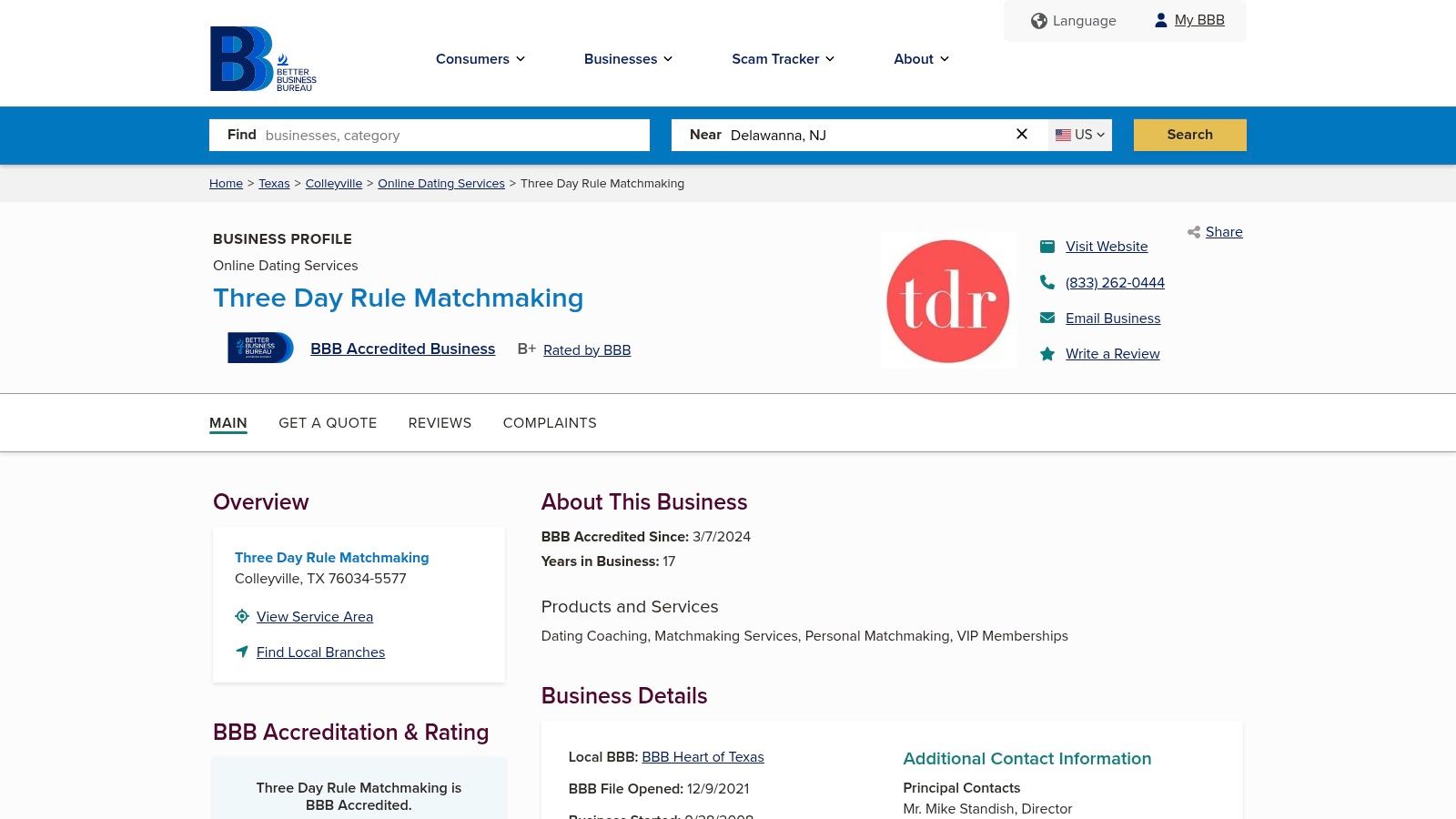
What to Look For:
- Complaint Type: Focus on complaints related to "Contract Issues" or "Billing/Collection Issues." These are the most relevant parallels to potential problems with a prop firm.
- Resolution Status: Does the company resolve complaints to the customer's satisfaction? A pattern of unresolved or ignored complaints is a major warning sign.
- Company Responses: Read the detailed narratives. The company's official response shows how they interpret their own rules when challenged, giving you insight into how they might handle a trading rule violation.
Actionable Steps:
- Navigate to the "Complaints" tab on the BBB profile.
- Analyze the number and nature of complaints over the last 12 months versus the last 3 years.
- Read at least three full complaint threads, including the customer's issue, the company's response, and the final outcome.
This structured review process helps you assess a firm's reliability under pressure.
4. Healthy Framework – 2026 Editorial Review Breakdown
Professional editorial reviews offer structured, in-depth analysis. Healthy Framework's 2026 review of the Three Day Rule matchmaking service is a perfect example. It breaks down pricing, process, and value proposition—similar to how a detailed prop firm review would dissect evaluation rules and profit splits.
What to Look For:
- Price vs. Value: The review details specific package costs. This helps you practice cost-benefit analysis—a critical skill when paying for a prop firm challenge. Is the potential reward worth the fee and the restrictive rules?
- Process Transparency: A good review outlines the entire customer journey. For a prop firm, this would mean explaining the challenge, verification, and funded stages in detail.
- Objective Scoring: The review uses a clear scoring system. This teaches you to look for objective metrics rather than just emotional opinions when evaluating a service.
Actionable Steps:
- Identify the key pros and cons listed in the summary.
- Compare the stated costs with the services included to determine the value proposition.
- Cross-reference the findings with user-generated reviews on Trustpilot or Reddit to see if real-world experiences align with the editorial analysis.
Learning to dissect professional reviews helps you make more informed decisions and avoid marketing hype.
Website: https://healthyframework.com/three-day-rule-review/
5. Reddit – Unfiltered Community Discussions
Reddit is the ultimate source for raw, peer-to-peer insights. In subreddits like r/proprietarytrading or r/forex, traders openly discuss their experiences with specific prop firm rules, including the 3-day rule. These threads are a goldmine of candid feedback and practical advice.
What to Look For:
- Strategy Clashes: Look for posts from swing traders or position traders who failed a challenge due to the 3-day inactivity rule. Their stories provide concrete examples of the rule's pitfalls.
- Specific Firm Names: Traders often name the specific prop firms they are discussing. This allows you to build a list of firms with restrictive rules to avoid if they don't fit your style.
- Workarounds and Advice: Other traders in the comments often share how they deal with the rule or recommend firms without it. This is practical, actionable advice from fellow traders.
Actionable Steps:
- Use the Reddit Threads Finder tool or Reddit's own search to find discussions on "3 day rule," "minimum trading days," or "inactivity rule" in trading subreddits.
- Focus on threads where users describe their trading style and how the rule affected them.
- Take note of any prop firms that are repeatedly mentioned in a negative context regarding this rule.
Reddit gives you the ground truth you won't find in polished marketing materials.
Website: https://www.reddit.com/r/datingoverthirty/comments/1avqarr
6. Three Day Rule – Official Testimonials as a Case Study
Analyzing a company's own marketing materials is a crucial step in due diligence. The testimonials page for the "Three Day Rule" matchmaking service shows you what the company wants you to believe. By studying it, you can learn to identify a company's ideal customer profile and its core selling points.
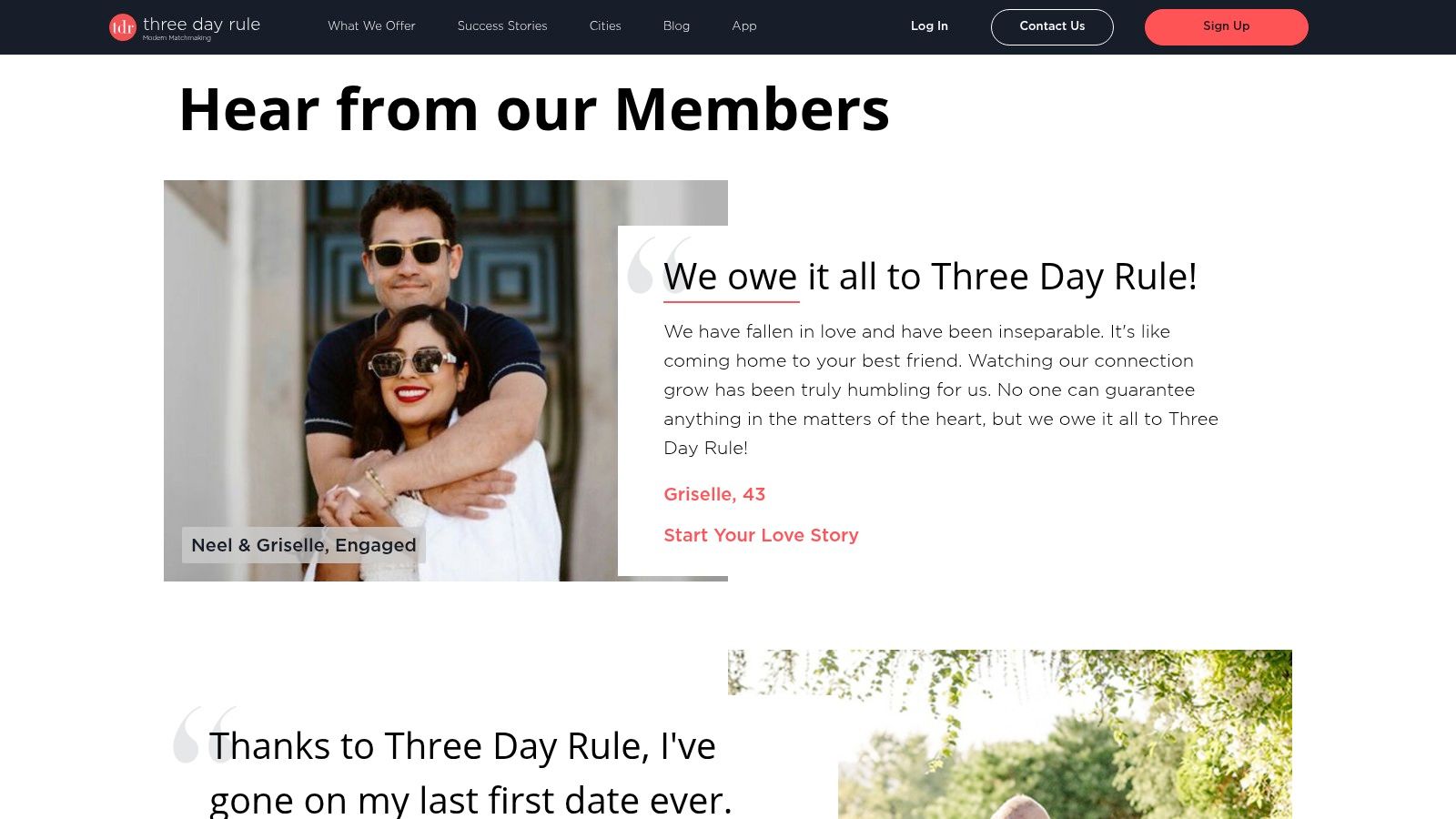
What to Look For:
- The "Ideal" Outcome: Testimonials showcase the best-case scenario. For a prop firm, this would be featuring traders who passed their challenges and received large payouts.
- Highlighted Features: Note what aspects of the service the testimonials emphasize. Do they talk about a hands-on process? This tells you what the company sees as its main strengths.
- Language and Tone: The language used reveals the brand's identity. Is it professional and serious, or casual and friendly? This helps you gauge if the company culture is a good fit for you. Compare this with their strategies for responding to positive reviews.
Actionable Steps:
- Read two or three testimonials and identify the common narrative arc.
- Compare the "ideal" journey described in the testimonials with the problems cited in negative reviews on other platforms.
- Ask yourself: Does the success story they are selling align with my own goals and methods? For traders, learning more about programs like the GOAT Funded Trader can show what different rule sets offer.
This critical analysis of marketing materials helps you separate brand promises from reality.
Website: https://www.threedayrule.com/testimonials
7. BuzzFeed – A First-Person Narrative Review
First-person editorials provide a detailed, narrative-driven look at a service. BuzzFeed's article, "I Had A Professional Matchmaker Set Me Up On Dates And Here's What Happened," offers a step-by-step walkthrough of the client experience. This is like reading a trader's detailed journal of their prop firm challenge.

What to Look For:
- Expectation vs. Reality: The article clearly outlines the author's hopes versus the actual process. This is a great parallel for a trader managing expectations during a funding challenge.
- The Feedback Loop: How did the service provider use feedback to improve the outcome? This is analogous to how a good prop firm should offer support or data to help a trader succeed.
- The Human Element: The narrative captures the emotional journey—the excitement, the disappointment, and the lessons learned. This provides context that quantitative reviews lack.
Actionable Steps:
- Read the article and map out the author's journey from start to finish.
- Identify the key points where the service succeeded or failed to meet expectations.
- Think about how this narrative journey compares to what you'd expect from a prop firm during an evaluation.
Reading a detailed case study like this helps you anticipate the real-world experience of using a high-stakes service.
Website: https://www.buzzfeed.com/jarrylee/three-day-rule
Is the 3 Day Rule Right for Your Trading Strategy?
After reviewing feedback from multiple sources, it's clear the 3-day rule is not inherently good or bad—its impact depends entirely on your trading style.
- Scalpers and Day Traders: This rule is unlikely to affect you. Your high-frequency style means you will naturally meet the activity requirement without even thinking about it.
- Swing and Position Traders: This rule is a potential account-killer. Your strategy is built on patience. Being forced to trade every three days can lead to taking low-probability setups, which introduces unnecessary risk and goes against your disciplined approach.
Your Action Plan:
- Analyze Your Trading Journal: Review your last 6 months of trading. What's the longest you've gone without placing a trade? If it's more than 3 days, a firm with this rule is a bad fit.
- Understand Your "Why": If you had gaps, was it because you were avoiding bad market conditions or waiting for a perfect setup? A rule that punishes patience is a rule that punishes good trading.
- Compare Prop Firm Rules: Don't just look at the profit split and drawdown. Scrutinize the fine print for rules like minimum trading days, consistency rules, and news trading restrictions. Choose a firm whose rules align with your proven strategy.
The best prop firm is one that empowers your existing edge, not one that forces you to change it. Your strategy is your most valuable asset; protect it by choosing a trading environment where it can thrive.
FAQ: 3 Day Rule Reviews
What is the "3 Day Rule" in prop trading?
The 3 Day Rule, also known as a minimum trading days or inactivity rule, is a policy some prop firms use that requires traders to execute at least one trade within a 3-day period to keep their account active. It's intended to ensure consistent trading but can be problematic for strategies that involve long periods of waiting.
Why is the 3 Day Rule a problem for swing traders?
Swing trading relies on holding positions for several days or weeks to capture larger market moves. This often involves waiting patiently for the right entry setup, which can take longer than three days. A strict 3-day rule can force a swing trader to take a suboptimal trade just to meet the activity requirement, undermining their entire strategy.
Do all prop firms have a 3 Day Rule?
No, many modern prop firms have eliminated this rule. Firms like MyFundedCapital recognize that professional trading requires discipline and patience, and they do not enforce a 3-day activity rule, giving traders the flexibility to trade only when their strategy dictates.
How can I find out if a prop firm has an inactivity rule?
The best way is to thoroughly read the firm's FAQ, terms and conditions, or rules page before signing up. Look for keywords like "inactivity," "minimum trading days," or "account dormancy." If it's not clear, ask their support team directly for a written confirmation.
Tired of restrictive rules that penalize your disciplined trading style? At MyFundedCapital, we believe in empowering traders with flexibility. We have no 3-day activity rule, allowing you to wait patiently for the high-quality setups your strategy demands. Explore our funding programs and discover a prop firm built for real-world trading.
