Choosing between trading forex and futures is a common dilemma for traders, and there's no single right answer. This guide will break down the practical differences to help you decide which market fits your trading style, risk tolerance, and goals. We'll cover market structure, contract details, and actionable strategies so you can make an informed choice.
Choosing Your Market: Forex and Futures Explained
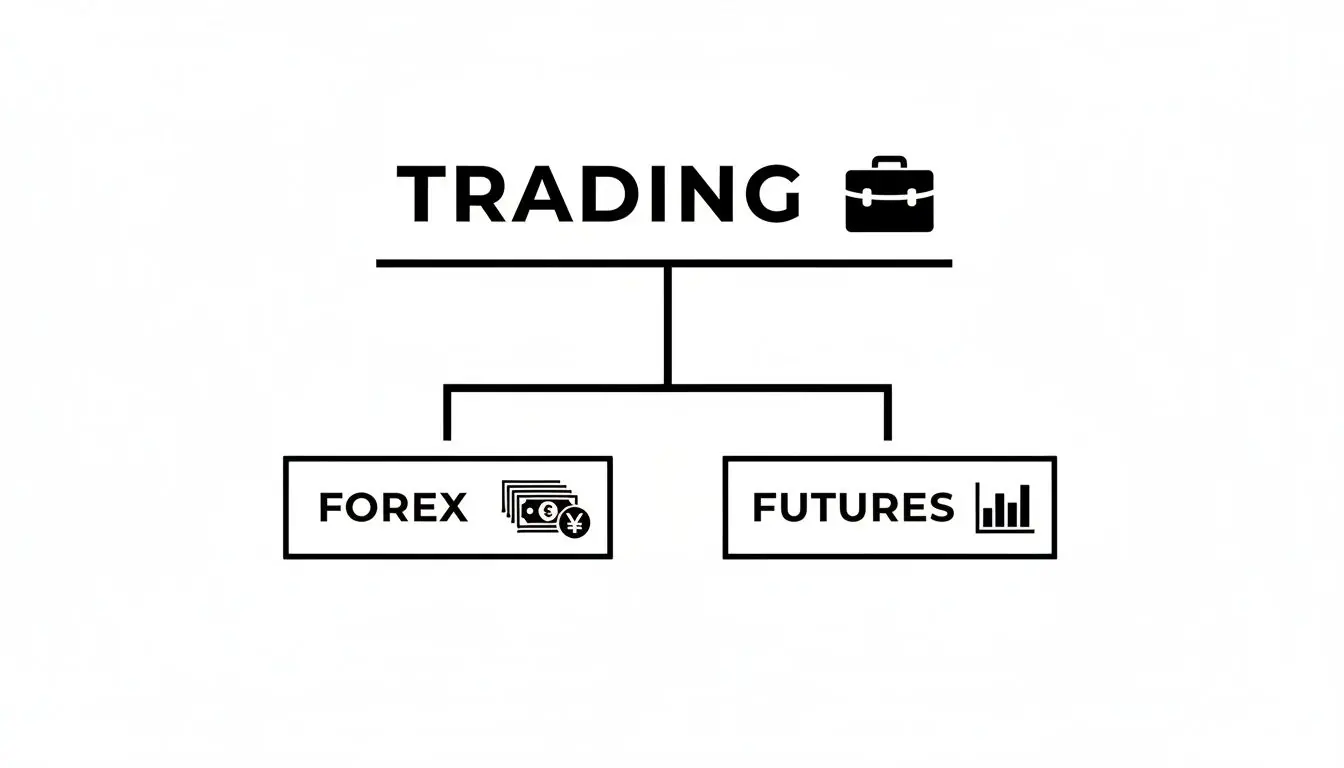
Think of forex and futures as two different tools. Both allow you to speculate on price movements, but their mechanics are worlds apart. The most fundamental difference is what you're trading and where.
- Forex (Foreign Exchange) This is a decentralized, over-the-counter (OTC) market where you directly exchange one currency for another (e.g., buying Euros with US Dollars).
- Futures These are standardized contracts to buy or sell an asset (like crude oil, gold, or a stock index) at a predetermined price on a future date. They trade on a centralized, regulated exchange.
Disclaimer: Trading involves a significant risk of loss and is not suitable for all investors. The content in this article is for educational purposes only and should not be considered financial advice.
Key Differences at a Glance
This choice impacts everything from your trading hours and capital requirements to the leverage you can use. Understanding these distinctions is crucial for building a sustainable trading plan.
| Feature | Forex Market | Futures Market |
|---|---|---|
| Structure | Decentralized (Over-the-Counter) | Centralized (On-Exchange) |
| Trading Hours | 24 hours / 5 days a week | Specific exchange hours with daily breaks |
| Price Transparency | Prices from broker's liquidity pool | Single, universal price from the exchange |
| Contracts | Non-standardized (variable lot sizes) | Standardized (fixed contract size, expiry) |
| Regulation | Varies by country and broker | Highly regulated by a central authority |
| Counterparty | Your broker or their liquidity provider | The exchange's clearinghouse |
How Forex and Futures Markets Work
To trade effectively, you must understand your environment. The forex market is like a global, non-stop web of currency dealers, while the futures market is more like a traditional auction house with set hours and a single auctioneer. This centralized vs. decentralized structure is the root of most differences you'll experience.
Forex: The Over-The-Counter (OTC) Giant
The forex market is famously decentralized. There isn't one physical exchange; it's a vast electronic network connecting banks, institutions, and brokers. This is what's known as an over-the-counter (OTC) market.
The EUR/USD price on your screen isn't from a single source; it’s an aggregate quote from your broker's liquidity providers. This is why forex can run 24 hours a day, 5 days a week—as one major financial center closes, another opens. With a daily volume over $7.5 trillion, liquidity is massive, meaning it’s easy to enter and exit trades on major pairs. The trade-off is that you don't have perfect price transparency, as quotes can vary slightly between brokers.
Futures: The Centralized Exchange Model
Futures markets are the opposite: fully centralized. Every trade for a specific contract, like the E-mini S&P 500 (ES), must pass through a single, regulated exchange like the CME Group.
This centralized structure provides key benefits for traders:
- Total Price Transparency Everyone—from retail traders to large hedge funds—sees the exact same price, volume, and order book data (Level 2).
- Standardized Contracts A futures contract is uniform. The September Crude Oil contract has the same size, quality, and expiration for everyone trading it.
- Limited Trading Hours Trading is restricted to the exchange's official hours, with clear opening and closing times.
The key takeaway is that a centralized futures market offers a single source of truth for price and volume. The exchange’s clearinghouse also guarantees every transaction, eliminating the counterparty risk found in OTC markets.
Decoding Contracts, Leverage, and Margin
This is where the practical differences between forex and futures become clear. The rules governing contracts, leverage, and margin directly impact your buying power, risk exposure, and overall strategy.
Contract Size: Forex Lots vs. Futures Standardization
In forex, position size is measured in lots, offering high flexibility for precise risk management.
- Standard Lot 100,000 units of the base currency (e.g., a standard lot of EUR/USD controls €100,000).
- Mini Lot 10,000 units.
- Micro Lot 1,000 units.
This system allows you to fine-tune your position to your exact risk tolerance, trading as little as 0.01 lots.
Futures operate on rigidly standardized contracts. You can only trade in whole numbers—one contract, five contracts, etc. For example, one Euro FX futures contract ("6E" on the CME) represents €125,000. You cannot trade a fraction of it, which offers less sizing flexibility.
Leverage and Margin: Two Different Worlds
Leverage allows you to control a large position with a small amount of capital, but it magnifies both gains and losses.
- Forex Leverage: Retail forex brokers often offer high leverage ratios like 100:1 or 200:1. A 100:1 ratio means $1,000 in your account can control a $100,000 position. Margin is typically a simple percentage of your position size. You can learn more about how forex margin is calculated to understand the mechanics.
- Futures Leverage: Futures leverage is determined by the margin requirement set by the exchange, which is typically more conservative. There are two types: initial margin (the deposit needed to open a position) and maintenance margin (the minimum balance required to hold it). Falling below the maintenance margin triggers a "margin call," requiring you to add funds or close the position.
These different systems mean risk management must be tailored to the specific market you are trading.
Mastering Liquidity, Volatility, and Trading Hours
Every market has a unique rhythm. Understanding when a market is active versus quiet is critical for managing risk and finding opportunities.
Forex: The 24-Hour Market
The forex market's 24/5 schedule provides incredible liquidity, especially for major pairs like EUR/USD. However, not all hours are equal. The most active periods occur during session overlaps, when multiple major financial centers are open.
The London-New York overlap (approx. 8 AM to 12 PM EST) is widely considered the most liquid and volatile part of the trading day. This is prime time for day traders seeking tight spreads and significant price moves.
Futures: Defined Hours and Concentrated Action
Futures markets operate on specific exchange schedules. For example, the popular E-mini S&P 500 futures (ES) have a primary session and a short daily maintenance break. This structure concentrates most of the trading volume into specific windows.
This concentration provides predictability but also introduces gap risk. If major news breaks while the market is closed, the price can open significantly higher or lower, jumping past your stop-loss. In forex, your stop-loss is always active, a crucial difference in risk management between forex and futures.
Actionable Trading Strategies for Forex and Futures
Theory is one thing, but execution is everything. Here are some practical strategy frameworks for both markets. Remember, these are not guaranteed profit systems; they require discipline, risk management, and adaptation.
Strategy 1: Forex Scalping (Short-Term)
Scalping involves capturing small, frequent profits and is well-suited for the deep liquidity of the forex market.
- Instrument Major pairs like EUR/USD.
- Timing London-New York session overlap for maximum volume and tightest spreads.
- Example Setup
- Use a 1-minute or 5-minute chart.
- Identify short-term overbought/oversold conditions using an indicator like the RSI or Stochastic Oscillator.
- Enter a trade with a tight stop-loss (e.g., 5-10 pips).
- Set a small, predefined profit target, often aiming for a 1:1 risk-to-reward ratio.
This strategy requires intense focus and a platform with fast execution.
Strategy 2: Futures Data for Forex Swings (Long-Term)
Futures data can provide a powerful edge for longer-term forex trades.
- Tool: The Commitment of Traders (COT) report, published weekly by the CFTC, shows the positions of large speculators in currency futures.
- Example Setup:
- Analyze the COT report for Euro FX futures.
- If large speculators ("Non-Commercials") build an extreme net-long position, it can be a contrarian signal that the trade is crowded and ripe for a reversal.
- Use this long-term bearish bias to look for short-selling opportunities on the EUR/USD spot forex pair using technical analysis on your daily or 4-hour chart.
This approach combines fundamental positioning data from the futures market with technical execution in the forex market. To see the markets we offer, check our funded trader markets.
FAQ: Forex and Futures Trading
Which market is better for a beginner?
Forex is often more accessible for beginners due to lower capital requirements and flexible position sizing (micro lots). However, the high leverage can be dangerous if not managed properly. Futures have a steeper learning curve but their centralized, regulated structure can instill good trading habits from the start.
Can I use the same strategy for both forex and futures?
Not directly. While core principles like support and resistance apply to both, a strategy must be adapted to each market's unique characteristics. A scalping strategy designed for the 24/5 liquidity of EUR/USD would likely fail in a futures market with different hours, contract sizes, and volume patterns.
How do prop firms offer futures trading?
Most prop firms, including MyFundedCapital, provide access to futures markets via Contracts for Difference (CFDs). You trade an instrument that perfectly mirrors the price of a futures contract (e.g., US500 for the S&P 500) without needing a specialized futures brokerage account. This allows you to trade forex and futures-based CFDs from a single platform. For more detail, read our guide on futures prop trading.
Why trade with a prop firm?
Prop firms allow you to trade with significant capital without risking your own money. The structure, with clear rules like daily loss limits and maximum drawdown, enforces discipline. It's an ideal environment to apply your skills and earn a substantial profit share based on your performance.
Put Your Knowledge to the Test
You now have a solid understanding of the differences between forex and futures. The next step is to apply that knowledge in a real trading environment. Prop firm challenges are designed to test your ability to execute a profitable strategy while managing risk effectively.
Whether you're a forex day trader or a futures swing trader, proving your skills on a funded account is the ultimate test.
Ready to trade with our capital? Explore MyFundedCapital's funding programs to find a challenge that fits your strategy and start your journey as a funded trader.