

 AR
AR
 NL
NL
 FR
FR
 DE
DE
 ES
ES
 IT
IT
 PL
PL
 SV
SV
 PT
PT

If you're hitting a wall with inconsistent results, the problem isn't the market—it's the lack of a plan. This guide explains why a strategy for trading forex is non-negotiable and gives you actionable steps to build, test, and execute one within prop firm rules. Trading is inherently risky, and this content is for educational purposes only, not financial advice.
Why a Trading Strategy Is Your Most Important Asset
Trading without a defined strategy is just gambling. It's an emotional rollercoaster where fear and greed call the shots, a combination that almost always leads to blown accounts. A solid strategy trading forex takes emotion out of the equation and gives you a logical framework for navigating the markets with discipline.
Think of your strategy as the blueprint for your trading business. Just like any serious company needs an effective strategic planning process, your trading career demands a concrete set of rules. This plan defines exactly what you trade, when you enter, and how you manage your money.
The goal isn't to find a "holy grail" that wins 100% of the time—that's a myth. The real objective is to develop a statistical edge that you can test, refine, and execute consistently. A well-thought-out plan is your single best tool for managing the inherent risks of trading.
The Benefits of a Rule-Based Approach
For traders aiming to get funded by a prop firm like MyFundedCapital, having a documented strategy is absolutely critical. Prop firms aren't looking for lucky one-hit wonders; they need to see you can consistently follow rules and protect capital.
A clear strategy helps you:
- Trade with Confidence: When you know your exact entry trigger, exit target, and stop-loss level before you click "buy," you can act decisively without hesitation.
- Manage Risk Systematically: Your strategy dictates your position size and where to place your stop-loss, ensuring no single trade can breach a firm’s daily or maximum drawdown limits.
- Improve Over Time: With a consistent approach, you can track what works and what doesn't, allowing you to make smart, data-driven adjustments instead of reacting to your last trade.
A strategy transforms trading from a speculative guessing game into a repeatable, professional process. It’s the foundation you need to prove you have what it takes to manage a funded account.
Understanding Core Forex Trading Styles
Before building a strategy for trading forex, you must figure out which trading style fits you. This is less about charts and more about your personality, schedule, and how you handle pressure. Many traders fail because they force a style that doesn't match their life.
Trading styles are defined by how long you hold a trade—from seconds to years—and each requires a different mindset. Let's look at the four main styles: scalping, day trading, swing trading, and position trading.
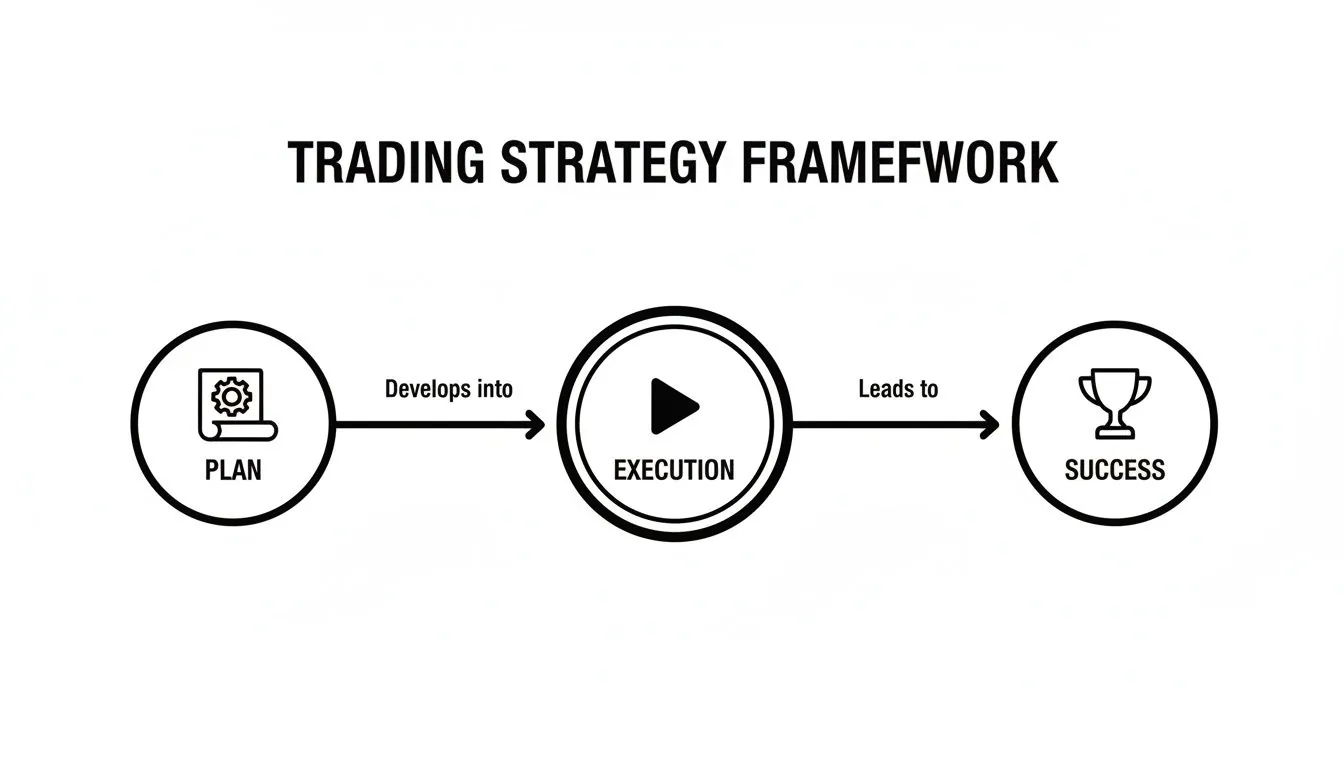
You need a structured plan before you can execute effectively; only then does consistent success become possible.
Comparing Forex Trading Styles
This table gives a quick snapshot of how the styles stack up. Think about your own routine and temperament as you review it.
| Strategy Type | Timeframe | Holding Period | Best For Trader Who Is… |
|---|---|---|---|
| Scalping | 1-Minute to 5-Minute Charts | Seconds to Minutes | Highly decisive, calm under pressure, and has several hours of uninterrupted focus. |
| Day Trading | 5-Minute to 1-Hour Charts | Minutes to Hours | Disciplined, analytical, and prefers to end each day with a clean slate. |
| Swing Trading | 4-Hour to Daily Charts | Days to Weeks | Patient, has a full-time job or other commitments, and can detach from the screen. |
| Position Trading | Daily to Monthly Charts | Months to Years | A long-term thinker with deep macro-economic knowledge and extreme patience. |
Finding your fit is the crucial first step. Now, let's explore what each style feels like in practice.
Scalping
Scalping is high-speed trading, requiring intense focus and razor-sharp decisions. Scalpers grab tiny profits, often just a few pips, by jumping in and out of the market dozens or even hundreds of times a day.
- Time Commitment: Extremely demanding. You need several hours of dedicated screen time during volatile market sessions.
- Psychology: You must thrive in a high-stress environment and make snap judgments. A small loss can't faze you.
- Suitability for Prop Firms: Scalping can work, but high volume means commissions and spreads add up. A fast platform like DXtrade or cTrader with near-instant execution is essential.
Day Trading
Day traders also operate on a short timeline, but their trades have more room to breathe. The golden rule is that all positions are opened and closed within the same trading day. You go to bed flat, with no open trades exposed to overnight news.
A huge part of day trading is discipline. The urge to hold a losing trade overnight, hoping it will turn around, is a trap that blows up countless accounts, especially in a prop firm setting with strict daily drawdown rules.
The sheer size of the forex market makes short-term styles possible. According to reports, daily forex trading volume is projected to reach $9.6 trillion by 2026, as detailed in this analysis of the forex market's daily volume on bestbrokers.com. This massive liquidity ensures tight spreads and precise execution.
Swing Trading
Swing traders step back and look at the bigger picture. They aim to catch the "swings" in price that play out over several days or weeks, typically analyzing 4-hour or daily charts. This style is far less frantic, making it a favorite for traders with full-time jobs. For a more detailed breakdown, check out our guide on position trading vs. swing trading.
Position Trading
Position trading is the ultimate long game, with trades staying open for months or even years. Position traders focus on long-term macroeconomic trends, not daily noise. This approach requires tremendous patience and a solid grasp of global economics, which can be challenging to balance with the shorter-term profit targets and drawdown limits of most prop firm challenges.
How to Build a Trend-Following Forex Strategy
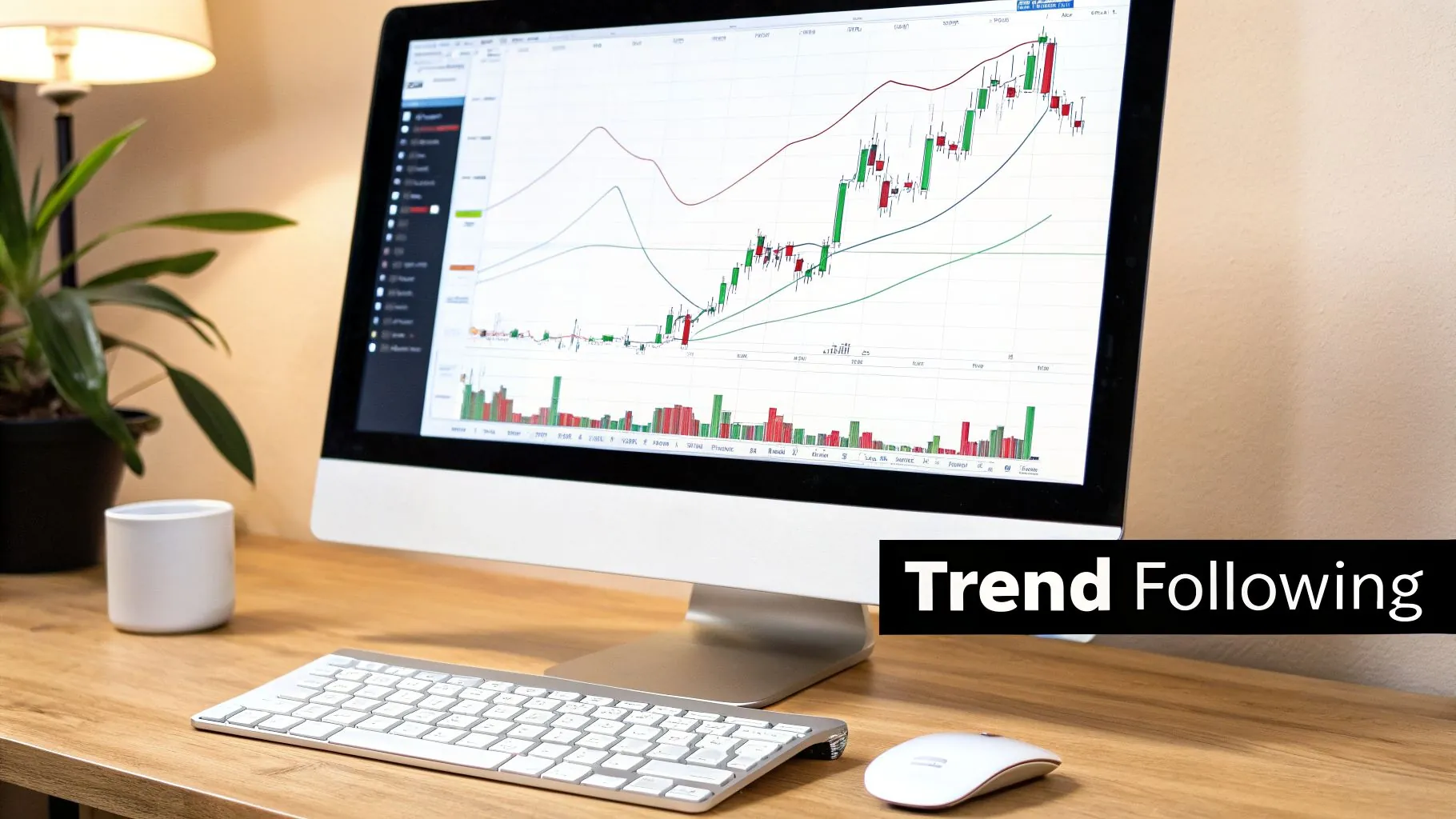
Now that you have a feel for different styles, let's build a complete strategy for trading forex from the ground up. We’ll start with trend-following, a classic approach that is straightforward and powerful. The idea is to spot an established trend and ride it for as long as it lasts.
This strategy uses just two common indicators on the daily chart: the 50-period and 200-period Exponential Moving Averages (EMAs). Think of the 200 EMA as the long-term "tide" and the 50 EMA as the shorter-term "wave." When the wave flows with the tide, a good setup may be forming.
Defining Your Non-Negotiable Rules
A strategy is nothing without strict rules. This keeps emotion out of your trading and provides a repeatable plan. For this trend-following system, let's define the exact conditions.
Your Trading Ruleset:
- Instrument: Major forex pairs (e.g., EUR/USD, GBP/USD, USD/JPY)
- Timeframe: Daily (D1)
- Indicators: 50 EMA and 200 EMA
With these building blocks, we can flesh out the core logic. You must follow these rules to the letter—no exceptions.
Entry and Exit Rules
This is the heart of the system. Your entry and exit criteria tell you precisely when to act.
Entry Rules (for a long/buy trade):
- Trend Confirmation: The 50 EMA must be trading above the 200 EMA, signaling a clear uptrend.
- Entry Trigger: Price must pull back and touch the 50 EMA. This allows you to buy the dip within the larger trend.
Exit Rules (for a long/buy trade):
- Stop-Loss: Place your stop-loss 20 pips below the most recent swing low that formed before the price touched the 50 EMA. This defines your risk.
- Take-Profit: Aim for a 1:2 risk-to-reward ratio. If your stop-loss is 100 pips from your entry, your take-profit target is 200 pips away.
Think of these rules as your trading constitution. They are not suggestions. The discipline to follow them, especially after a losing streak, is what separates successful traders from the rest.
Tying it to Prop Firm Risk Management
Executing this strategy in a prop firm like MyFundedCapital adds a critical layer: position sizing. Your primary job is to ensure no single loss gets you near the firm's risk limits, like the 5% daily drawdown on a $100,000 account (a hard stop at $5,000).
Let’s walk through a concrete example.
Example Trade Walkthrough: EUR/USD
- Account Size: $100,000
- Maximum Daily Loss: $5,000 (5%)
- Risk Per Trade: We'll risk 1% of the account per trade, which is $1,000. This gives a solid buffer; five straight losses wouldn't hit the daily drawdown limit.
Trade Setup:
- Trend: On the EUR/USD daily chart, the 50 EMA is above the 200 EMA. Uptrend confirmed.
- Trigger: Price pulls back and touches the 50 EMA. Enter a long position at 1.08500.
- Stop-Loss: The most recent swing low is at 1.07500. Following our rule, we place the stop-loss 20 pips below it at 1.07300.
- Risk in Pips: The distance between entry (1.08500) and stop-loss (1.07300) is 120 pips.
Position Size Calculation:
Now, calculate position size based on fixed dollar risk.
- Maximum risk for this trade: $1,000.
- Stop-loss distance: 120 pips.
- For EUR/USD, the pip value per standard lot is roughly $10.
- Risk per lot = 120 pips * $10/pip = $1,200 per standard lot.
- Position Size = Total $ Risk / $ Risk per Lot = $1,000 / $1,200 = 0.83 lots.
You would open a buy trade for 0.83 lots at 1.08500. Your stop is at 1.07300 (a max loss of ~$1,000). With a 1:2 risk-to-reward ratio, the take-profit is set 240 pips above entry (120 pips * 2) at 1.10900 for a potential $2,000 gain. This systematic approach to a strategy trading forex is how you build a sustainable trading career.
How to Trade Range-Bound and Mean Reversion Markets
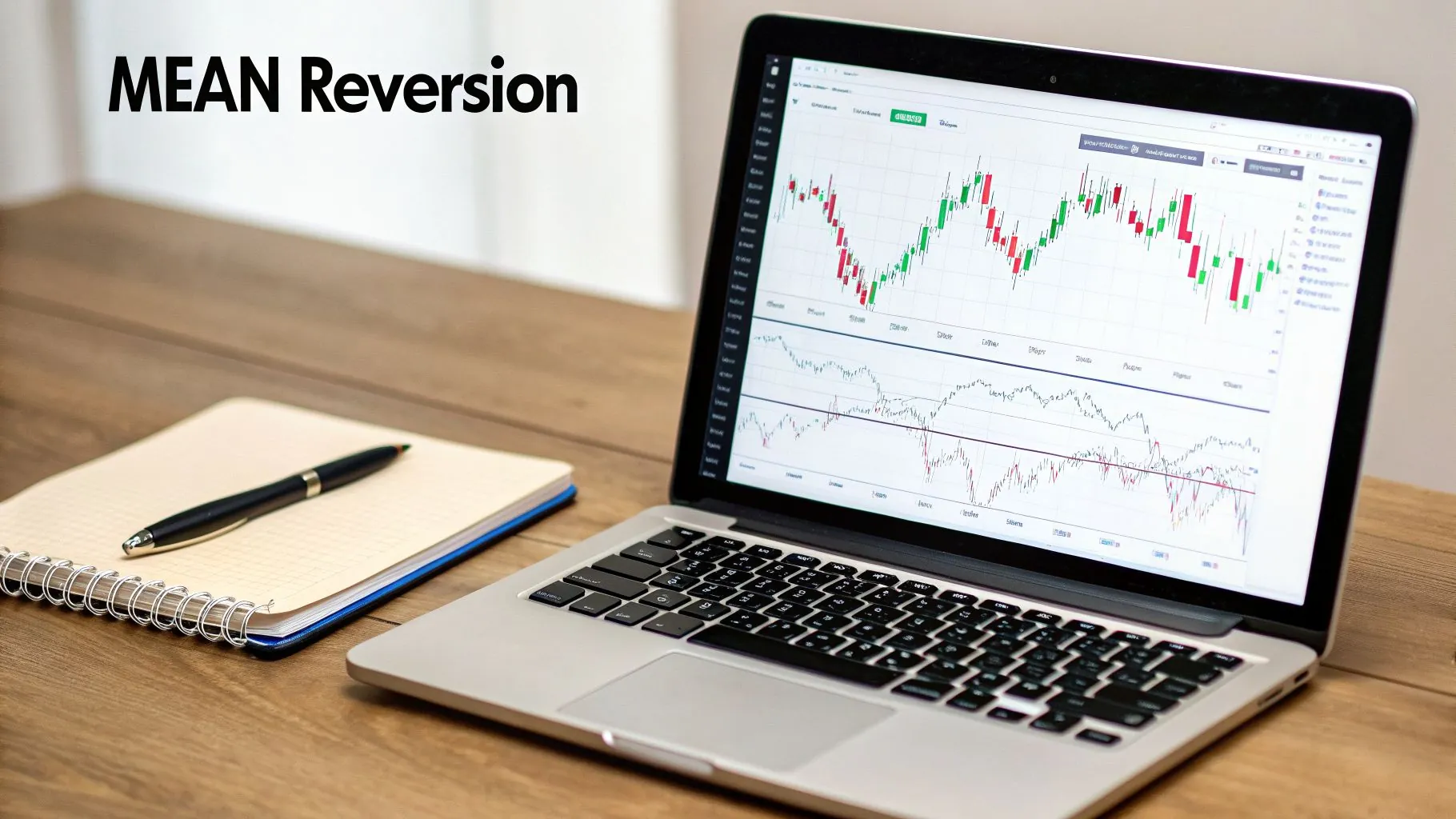
Markets spend a huge amount of time chopping sideways, where trend-following strategies fail. A mean reversion strategy, however, is built to find profits in these non-trending environments. The idea is that after a price stretches too far from its average, it tends to snap back.
This section shows you how to spot and trade these reversions using two common indicators—Bollinger Bands and the Relative Strength Index (RSI)—to define clear entry and exit points.
The Psychology of Mean Reversion
Mean reversion is about market psychology. When a price is pushed to an extreme—overbought or oversold—it’s like stretching a rubber band. The further you pull it, the more tension builds for an eventual snap-back to its statistical average, or mean. Our job is to identify when the rubber band is stretched to its limit.
Key Indicators for Mean Reversion
To trade mean reversion consistently, you need clear signals. We’ll combine Bollinger Bands and the RSI to filter for high-probability setups.
Bollinger Bands (20, 2): These bands form a dynamic price channel. The middle line is a 20-period simple moving average (the "mean"). The outer bands are set two standard deviations away. When price hits an outer band, it's a sign it has moved far from its average and could reverse.
Relative Strength Index (RSI, 14): This momentum indicator shows how overbought or oversold a currency pair is. A reading above 70 signals "overbought," and a reading below 30 suggests "oversold."
The magic happens when you get a signal from both. If price hits the upper Bollinger Band and the RSI is above 70, you have a strong, confirmed signal that the move up is exhausted. We are looking to sell at the top of the range when buyers are exhausted and buy at the bottom when sellers are.
Concrete Rules for a Mean Reversion Strategy
Ambiguity is a trader's enemy. Here are exact, mechanical rules for this strategy, which works well on ranging pairs like AUD/NZD.
Your Trading Ruleset:
- Instruments: Ranging forex pairs (e.g., AUD/NZD, EUR/CHF)
- Timeframe: 4-Hour (H4)
- Indicators: Bollinger Bands (20, 2) and RSI (14)
Entry Rules (for a short/sell trade):
- Overbought Condition: Price must touch or move just above the upper Bollinger Band.
- Momentum Confirmation: At the same time, the RSI must read above 70.
Exit Rules (for a short/sell trade):
- Stop-Loss: Place your stop-loss 15-20 pips above the high of the candle that triggered the entry signal.
- Take-Profit: Your target is the middle Bollinger Band (the 20-period moving average).
These rules give you a complete plan before you risk a dollar, which is critical for staying disciplined under prop firm drawdown rules.
Mean Reversion and Prop Firm Risk
Let's walk through how this works within a prop firm’s risk limits. Your number one job is to protect capital.
Example Trade: Selling AUD/NZD
- Account Size: $50,000
- Maximum Total Drawdown (10%): $5,000
- Risk Per Trade: A conservative 0.5% of the account per trade, which is $250. This sizing keeps you well clear of the 10% total drawdown limit.
Trade Setup on DXtrade or cTrader:
- The Signal: On the AUD/NZD 4-hour chart, price hits the upper Bollinger Band at 1.09200. The RSI is above 70.
- The Entry: We enter a short position at 1.09200.
- The Stop-Loss: The signal candle's high was 1.09250. We place our stop-loss 20 pips above it at 1.09450. Our total risk is 25 pips.
- The Take-Profit: The middle Bollinger Band is at 1.08700. This is our target, giving a potential profit of 50 pips.
Position Size Calculation:
- Risk in dollars is $250.
- Risk in pips is 25 pips.
- Pip Value per Lot (on AUD/NZD): Let's say it's ~$6 USD.
- Risk per Lot = 25 pips * ~$6/pip = ~$150.
- Position Size = Total $ Risk / $ Risk per Lot = $250 / $150 = 1.67 lots.
You’d place a sell order on your platform (like DXtrade, cTrader, or Match-Trader) for 1.67 lots. A loss is capped at about $250 (0.5% risk), while a win nets around $500. This strategy trading forex provides a clean 1:2 risk-to-reward ratio and fits perfectly within a disciplined risk plan.
Why You Must Backtest Your Forex Strategy
A strategy idea, no matter how brilliant, is just an idea until you prove it with data. This process is called backtesting, and it's non-negotiable for serious traders. Backtesting is your flight simulator; it lets you "fly" your strategy through years of market conditions without risking a single dollar.
Gaining a Statistical Edge
The point of backtesting isn't to find a perfect system that never loses—that doesn't exist. The goal is to understand your strategy's performance characteristics. By running your rules over past data, you uncover the hard numbers that define your statistical edge.
You'll discover critical performance metrics:
- Win Rate: What percentage of trades are profitable?
- Average Risk-to-Reward Ratio: How much do you win on average compared to how much you lose?
- Maximum Drawdown: What’s the biggest peak-to-trough drop your account equity experienced? For a prop firm trader, this number is everything.
- Profit Factor: Gross profit divided by gross loss. Anything above 1.5 is a sign of a healthy system.
These figures shift you from hoping a trade works to knowing you have a mathematical advantage over time.
The Backtesting Process Step-by-Step
A solid backtest needs a clear, methodical process. Here’s a practical breakdown.
- Find High-Quality Data: Use a platform like cTrader that offers years of detailed historical price data. You need enough data to cover different market environments.
- Make Your Rules Mechanical: Write down your rules with zero ambiguity, as if programming a robot. For instance: "Enter long on H4 when 50 EMA crosses above 200 EMA and RSI is above 50."
- Execute the Test: You can do this bar-by-bar, manually scrolling through charts and logging trades in a spreadsheet. Or, if you can code, you can automate it. Our guide on choosing the right back-test software can help.
- Analyze the Results: After logging at least 100-200 trades, crunch the numbers. Calculate your win rate, average profit/loss, and maximum drawdown.
Applying Backtesting to Prop Firm Rules
This is where the rubber meets the road for prop firm traders. Your mission is to find a strategy that operates profitably within the firm's risk parameters, like the 5% daily and 10% total drawdown limits at MyFundedCapital.
A proper backtest will tell you if your strategy would have historically breached those rules. If your backtest shows a 15% maximum drawdown, it's not a viable strategy for a prop firm with a 10% limit—no matter how profitable it seems. History provides context; volatility during events like the 2008 financial crisis saw major pairs swing dramatically, as data from sources like the Federal Reserve shows (discover more about forex volumes and volatility on newyorkfed.org).
Backtesting builds unshakeable confidence. When you know your strategy has historically respected the rules, you can execute with discipline when real money is on the line.
Making Your Strategy Work Within Prop Firm Rules
A profitable strategy is useless if you can't execute it within a prop firm’s rigid risk framework. This is what separates traders who get and stay funded from those who keep failing challenges. Your entire plan must respect the firm's hard drawdown limits. If you breach them, your account is gone.
Calculating Position Size to Stay in the Game
Your most powerful tool is position sizing. Get this right, and no single loss will ever threaten your account.
Let's make it real. On a $100,000 account with a 5% daily drawdown limit, you cannot lose more than $5,000 in one day.
Example Calculation:
- Account Size: $100,000
- Strategy Stop-Loss: Your strategy calls for a 50-pip stop-loss on GBP/USD.
- Risk Per Trade: You decide to risk a conservative 0.5% of your account, or $500.
- Value per Pip: On GBP/USD, a standard lot has a pip value of roughly $10.
- Position Size Formula: (
$ Risk/ (Stop-Loss in Pips*Pip Value)) =Lots
Plugging in the numbers: ($500 / (50 pips * $10)) = 1.0 lots.
By trading 1.0 standard lot, a stop-loss hit results in a clean $500 loss. That's just one-tenth of your daily drawdown limit, giving you an enormous cushion. A disciplined trading strategy is about making risk arithmetically survivable.
Navigating the Maximum Drawdown Rule
The 10% maximum drawdown filters for long-term consistency. A string of small, mismanaged losses can kill an account. You need a plan for losing streaks—every trader has them. This is even more critical for accounts with a trailing drawdown; learn more about what trailing drawdown is in our detailed article.
Backtesting shows why firms enforce these rules. A simple moving average crossover strategy on EUR/USD can be profitable with a 45-55% win rate if the risk-to-reward ratio is at least 1:2 and losses are capped.
Before every trade, run through this mental checklist:
- Risk Per Trade: Is my position size perfectly calculated for my risk limit (e.g., 0.5% or 1%)?
- Daily Drawdown: How many consecutive losses can I sustain today before hitting the 5% daily stop?
- Maximum Drawdown: How close am I to my 10% max drawdown, and how does this trade's potential loss affect that buffer?
Answering these questions forces you to align your strategy with the firm's rules, transforming risk from a threat into a manageable part of your business.
FAQ: Your Top Questions Answered
What is the best forex strategy for a beginner?
There's no single "best" strategy. The right fit depends on your personality and schedule. However, beginners often succeed with swing trading on daily charts. This approach avoids the noise of lower timeframes and builds the patience and discipline needed to pass a prop firm challenge by focusing on high-quality setups.
How much capital do I need to start trading forex?
This is the problem prop firms solve. Instead of needing a large personal bankroll, you can prove your skills and gain access to simulated trading capital from $5,000 up to $100,000. The focus shifts from how much money you have to how well you execute a plan and manage risk according to the rules.
How do I know if my forex strategy is not working?
Every strategy has losing streaks. The key is to tell the difference between a normal drawdown and a broken strategy. If your live results diverge dramatically from your backtested data over a sample size of 20-30 trades, it's a red flag. The biggest warning sign is when your live drawdown exceeds the maximum drawdown from your historical testing, suggesting your edge may have disappeared.
Time to Put Your Strategy to the Test
You have the theory, but theory alone doesn't make a profitable trader. The real test is applying that knowledge under live market pressure. A prop firm challenge is the proving ground for your discipline. Can you stick to your rules, manage risk effectively, and execute your plan when performance is on the line?
Learn more about our funding programs and discover how our challenges can help you take the next step in your trading career. Compare our account types and start a challenge today.
