Struggling to find the right instrument on your trading platform? You look for Gold, but one platform calls it XAUUSD, while another lists it as GOLD.pro, causing confusion and potentially costly mistakes. This guide demystifies these symbols of trade, breaking down how they're built, why they vary, and how you can find the exact instrument you need on any platform.
Remember, all trading involves significant risk and is not suitable for all investors. This content is for educational purposes only and should not be considered financial advice.
What Are Trading Symbols?
Trading symbols, or "tickers," are short codes that act as unique identifiers for every tradable asset. They tell your platform precisely which instrument you want to analyze and trade. Without a standardized system of symbols, executing an order would be impossible.
Think of it like an airport code. 'JFK' on a ticket instantly tells you it's John F. Kennedy International Airport in New York. In the trading world, the symbol 'EURUSD' points to one specific instrument: the Euro priced against the U.S. Dollar.
These symbols of trade are essential for navigating the markets. This principle extends across all asset classes, from crypto, where concepts like public and private keys define ownership, to traditional stocks. Understanding these codes is a critical step for anyone looking to trade the full range of markets available to funded traders.
How Ticker Symbols Are Constructed
While a market watch list might look like a random jumble of letters, most symbols of trade follow a logical pattern. Once you understand the structure, you can identify instruments on sight and navigate any trading platform much faster.
The Basic Logic: Forex Pairs
The forex market provides the clearest example of symbol construction. A currency pair's symbol is created by combining the two currencies' three-letter ISO codes.
- Example: To get the symbol for the Euro against the U.S. Dollar, you combine EUR (Euro) and USD (U.S. Dollar) to create EURUSD.
It’s that simple. The first currency is the "base," and the second is the "quote." You can find more examples by checking out the best forex currency pairs to trade.
Extending the Logic to Other Assets
Other asset classes follow similar, predictable structures, though each has its own unique conventions.
Standard Symbol Construction by Asset Class
| Asset Class | Construction Logic | Example Symbol |
|---|---|---|
| Forex | Combines the three-letter codes of the base and quote currencies. | GBPUSD (British Pound vs. U.S. Dollar) |
| Indices | Often a country abbreviation followed by a number representing the top stocks. | US30 (Top 30 U.S. stocks, Dow Jones) |
| Metals | Typically uses the official ISO 4217 standard code against a currency. | XAUUSD (Gold vs. U.S. Dollar) |
| Crypto | A short, unique 3-4 letter abbreviation for the cryptocurrency against a currency. | BTCUSD (Bitcoin vs. U.S. Dollar) |
| CFDs (Stocks) | The official stock ticker symbol, sometimes with a suffix. | AAPL (Apple Inc.) |
This system is constantly evolving. As new financial products like stock tokenization emerge, so do new symbol formats.
Decoding Platform-Specific Symbol Variations
If you've switched brokers, you've likely seen the same asset listed with different symbols, like US30, US30.pro, or US30#. These suffixes or prefixes are added by brokers to provide important details about the specific contract you are trading.
- A .pro suffix might indicate an instrument with lower spreads or a different commission structure, often linked to a specific account type.
- A .micro suffix usually denotes a smaller contract size.
Accidentally trading the wrong variant can impact your risk management and profitability, so learning to read these symbols of trade is a crucial skill.
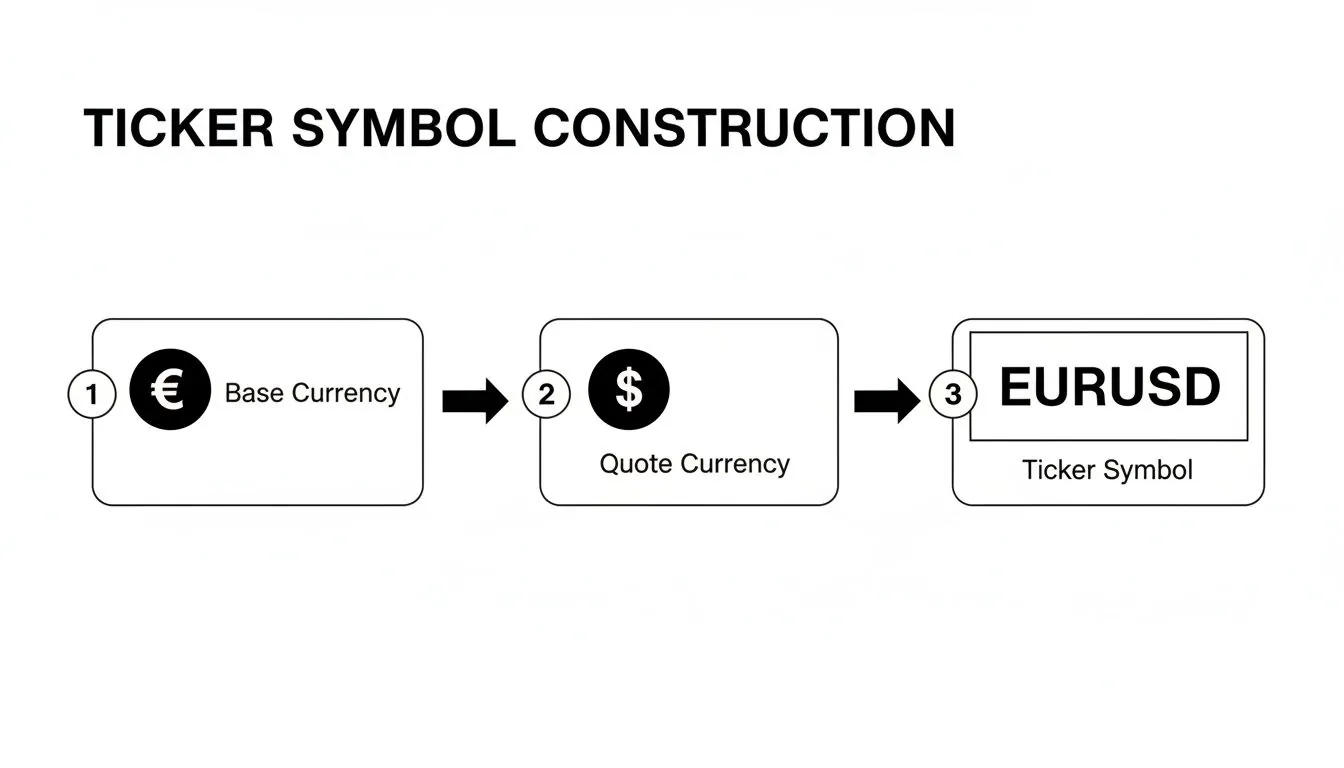
As you can see, the base ticker is a simple combination of two currency codes. Brokers then add their own unique identifiers to this core symbol to differentiate between contract types.
Practical Steps for Managing Your Watchlist
A cluttered watchlist leads to confusion. Professional traders organize their instruments long before the market opens to ensure they can execute trades efficiently when opportunities arise. Here are some actionable steps:
- Create Focused Lists: Don't dump all available symbols into one list. Create separate watchlists for specific strategies or sessions, such as ‘London Session Pairs,’ ‘US Indices,’ or ‘Major Crypto Pairs.’ This keeps your workspace clean and your mind clear.
- Verify Contract Specifications: Before trading a symbol, always check its contract specifications in your platform. Look for details like lot size, margin requirements, commission, and swap fees. A common mistake is trading a standard lot on an instrument priced per 100 units, which can lead to a position 100x larger than intended.
- Standardize Your Naming: If your platform allows it, use consistent naming conventions. This is especially helpful if you use multiple platforms.
- Do a "Dry Run": On a demo account, practice finding and opening trades with the specific symbols you plan to use. This helps you confirm you understand the contract details before risking real capital. For example, a 1.00 lot on US30 is very different from a 1.00 lot on US30.micro.
One of the most common and costly mistakes I see is a trader accidentally opening a position on a micro-lot contract (like US30.micro) when they meant to trade the standard version. It seems small, but that single slip-up can completely wreck your risk-to-reward on a trade. For anyone in a prop firm challenge, this level of precision isn't just good practice—it's essential for protecting your account and staying within drawdown limits.
Trading Symbols FAQ
Why does my broker have multiple symbols for the same asset, like XAUUSD and GOLD?
Brokers often use different symbols to distinguish between contract types. For example:
- XAUUSD might be the standard spot gold contract.
- GOLD or GOLD.c could refer to a Gold CFD (Contract for Difference).
- XAUUSD.pro might be a version with different trading conditions (like lower spreads) for specific account types.
Always check the instrument's specifications on your platform to understand what you are trading.
What's the difference between a symbol like US30 and US30.micro?
The difference is typically the contract size. A ".micro" or ".mini" suffix indicates a smaller contract. For example, 1 lot of US30 might have a notional value of $350,000, while 1 lot of US30.micro could be just $35,000. Trading the wrong one can drastically alter your position size and risk exposure.
Where can I find the official list of ticker symbols?
There isn't one single "official" list for all assets and all brokers.
- Forex ISO 4217 is the international standard for currency codes.
- Stocks Ticker symbols are set by the exchanges where they are listed (e.g., NASDAQ, NYSE).
- Indices/Commodities/Crypto Symbols can vary more between platforms. The best practice is to always refer to your broker's own instrument specification list.
How do I add the correct symbols to my MetaTrader (MT4/MT5) platform?
In MetaTrader, right-click anywhere in the "Market Watch" window and select "Symbols" (or press Ctrl+U). This opens a window where you can browse all available instruments, categorized by asset class (e.g., "Forex," "Indices"). Find the symbol you need and double-click it to add it to your Market Watch.
Take the Next Step
Mastering symbols of trade is about building precision into your trading process. By eliminating confusion around instrument names, you can focus on what truly matters: executing your strategy flawlessly. You now have the knowledge to navigate any platform's instrument list with confidence.
Ready to put that precision to the test? Learn how to calculate your position size accurately with our lot size calculator and prove you have what it takes to manage risk like a professional.
Compare our account types and start your funding challenge today.