

 AR
AR
 NL
NL
 FR
FR
 DE
DE
 ES
ES
 IT
IT
 PL
PL
 SV
SV
 PT
PT

Choosing a trading style isn't just a technical decision—it's a lifestyle choice. Are you looking to capture quick, intraday price fluctuations, or are you more comfortable playing the bigger moves that unfold over several days? This guide will break down the practical differences between day trading and swing trading to help you find the approach that best fits your personality, schedule, and goals.
Swing Trading vs Day Trading: A Quick Comparison
The path you choose between swing and day trading defines your entire approach to the markets. It’s not just about strategy; it's about finding a rhythm that fits your personality, schedule, and psychological makeup. Each style demands a unique skillset and a very different level of daily commitment.
- Day trading is an active, hands-on job. It requires you to be at your screen during market hours, constantly scanning for opportunities and executing trades that open and close the same day.
- Swing trading offers more flexibility. You analyze charts and manage positions that last for days or weeks, making it a popular choice for those who can’t commit to full-time trading.
While many newcomers wonder if it's even possible to make a living from intraday moves, the reality is that success in either style comes down to discipline and a well-honed strategy. You can dive deeper into this specific topic in our guide on whether day traders can make money.
At a Glance: Key Differences
To put it all into perspective, here’s a high-level comparison of the most critical differences between swing trading and day trading.
| Attribute | Day Trading | Swing Trading |
|---|---|---|
| Time Horizon | Seconds to hours; all positions closed daily. | Several days up to a few weeks. |
| Time Commitment | High; often a full-time activity. | Low to moderate; fits part-time schedules. |
| Trade Frequency | High (5-50+ trades per day). | Low (2-10 trades per week). |
| Primary Risk | Intraday volatility and emotional over-trading. | Overnight gap risk and weekend news events. |
There is no "better" style—only the one that’s a better fit for you. Success hinges on mastering the specific demands of your chosen approach and executing it with consistency. Remember that all trading involves significant risk, and this material is for educational purposes only, not financial advice.
A Detailed Breakdown of Trading Styles
When you’re starting out, the lines between day trading and swing trading can seem blurry. But they are fundamentally different disciplines. Your choice dictates how you find your edge, the tools you'll need, and the mental battles you'll face. Let's break down what separates the intense focus of a day trader from the patient perspective of a swing trader.
The Core Difference: Timeframe and Chart Focus
The most visible distinction between swing trading vs day trading comes down to the charts. The timeframe a trader uses shapes every single decision they make.
- Day traders live on lower timeframes: the 1-minute, 5-minute, and 15-minute charts. The goal is to capture small, fast price moves that play out within a single trading day. This requires intense focus on real-time price action and volume spikes.
- Swing traders zoom out to the 4-hour, daily, and weekly charts. They look to ride larger "swings" in the market that unfold over several days or weeks. For them, minute-by-minute blips are just noise; they're hunting for the underlying trend.
A day trader is a sprinter, profiting from intraday volatility. A swing trader is a marathon runner, aiming to profit from a sustained trend over a longer distance.
Strategic Approach and Finding Your Edge
Because they operate on different timelines, day traders and swing traders develop their edge in completely different ways.
A Day Trader’s Edge often comes from:
- Momentum & Volatility: Jumping on sudden bursts of buying or selling, often after a news release or the break of a key intraday level.
- Order Flow Analysis: Using tools like the order book (Level 2) and Time & Sales to see supply and demand in real time, trying to get ahead of short-term moves.
- Scalping: An extreme form of day trading that involves a high volume of trades for tiny profits—sometimes just a few pips—that add up by the end of the day.
A Swing Trader’s Edge typically relies on:
- Trend Following: Identifying a strong directional move on the daily chart, waiting for a natural dip or "pullback" to a support level or moving average, and then entering in the direction of the trend.
- Mean Reversion: Finding an asset that has moved too far, too fast away from its average price. The swing trader then places a bet that it will "revert to the mean," or snap back toward its historical average.
- Multi-Day Chart Patterns: Identifying classic patterns like head and shoulders or flags that take several days to form and signal a potential major move.
Trade Frequency and Lifestyle Impact
The number of trades you place has a massive impact on your daily life. A busy day trader might execute anywhere from 10 to 50+ trades in a single session. This isn't a casual hobby; it's an incredibly intense environment that is, for all practical purposes, a full-time job.
A swing trader operates on a completely different rhythm, placing only 2 to 10 trades per week. Their process is more methodical. Analysis can be done in the evenings or on weekends, making it much easier to balance with a 9-to-5 job. If you're interested in an even longer-term approach, you might want to read our guide on position trading vs swing trading.
The Psychological Gauntlet of Each Style
Trading is a mental game, and each style presents unique psychological challenges.
Common Hurdles for a Day Trader:
- Decision Fatigue: Making dozens of high-stakes decisions under pressure is mentally draining and can lead to burnout.
- FOMO (Fear of Missing Out): With constant price action flashing on the screen, the temptation to chase moves and jump into bad trades is immense.
- Revenge Trading: After a quick loss, the emotional urge to dive right back in and "win it back" is a recipe for disaster.
Common Hurdles for a Swing Trader:
- Impatience: The biggest challenge is learning to do nothing. It can be agonizing to sit on your hands for days, waiting for that perfect setup to finally appear.
- Overnight & Weekend Anxiety: Holding trades overnight exposes you to "gap risk"—where news can cause the market to open far from where it closed.
- Second-Guessing Your Plan: When a trade goes against you for a day or two, it's easy to doubt your analysis and close a potentially great trade too early.
Comparing Risk Management and Profit Potential
The real question isn’t which style is “more profitable.” Success hinges entirely on how you manage risk within your chosen timeframe. Let's look at the numbers. Sustainable trading is a game of probability and iron-clad risk control.
Day Trading Risk: A Game of Small Margins
Day trading is built on stacking small, repeatable wins. Because you’re taking so many trades, your risk on any single one has to be incredibly small. A disciplined day trader typically risks a tiny fraction of their capital, often between 0.25% and 0.5% per trade.
- Trade Objective: To capture quick, intraday price fluctuations.
- Example Risk: On a $50,000 account, risking 0.5% means a hard stop-loss at $250.
- Target Risk-to-Reward Ratio (R:R): Usually aiming for 1:1.5 or 1:2. That $250 risk would target a $375 to $500 profit.
Swing Trading Risk: A Game of Larger Moves
Swing trading involves far fewer trades, so you need each one to have the potential for a bigger payoff. This means using wider stop-losses, which requires risking a larger portion of your account on each trade—typically 1% to 2%.
- Trade Objective: To capture a single, major "swing" in price over multiple days.
- Example Risk: On a $50,000 account, risking 2% means a stop-loss at $1,000.
- Target Risk-to-Reward Ratio (R:R): Significantly higher, often 1:3 or more. That $1,000 risk would target a $3,000+ profit.
At a Glance: Risk and Profit Metrics
This table shows how the numbers differ and why win rate isn't everything.
| Metric | Day Trading | Swing Trading |
|---|---|---|
| Risk per Trade | 0.25% – 0.5% | 1% – 2% |
| Target R:R | 1:1.5 to 1:2 | 1:3 or higher |
| Stop-Loss Size | Very tight (intraday) | Wide (daily chart) |
| Required Win Rate | Often needs to be higher (50%+) | Can be profitable with a lower win rate (<50%) |
A day trader relies on a higher win rate with smaller gains, while a swing trader can be profitable even if they lose more trades than they win, as long as their winners are significantly larger than their losers. Learning to navigate these risks is a core part of what we teach about effective risk management in forex trading.
Which is Better for Prop Firm Trading?
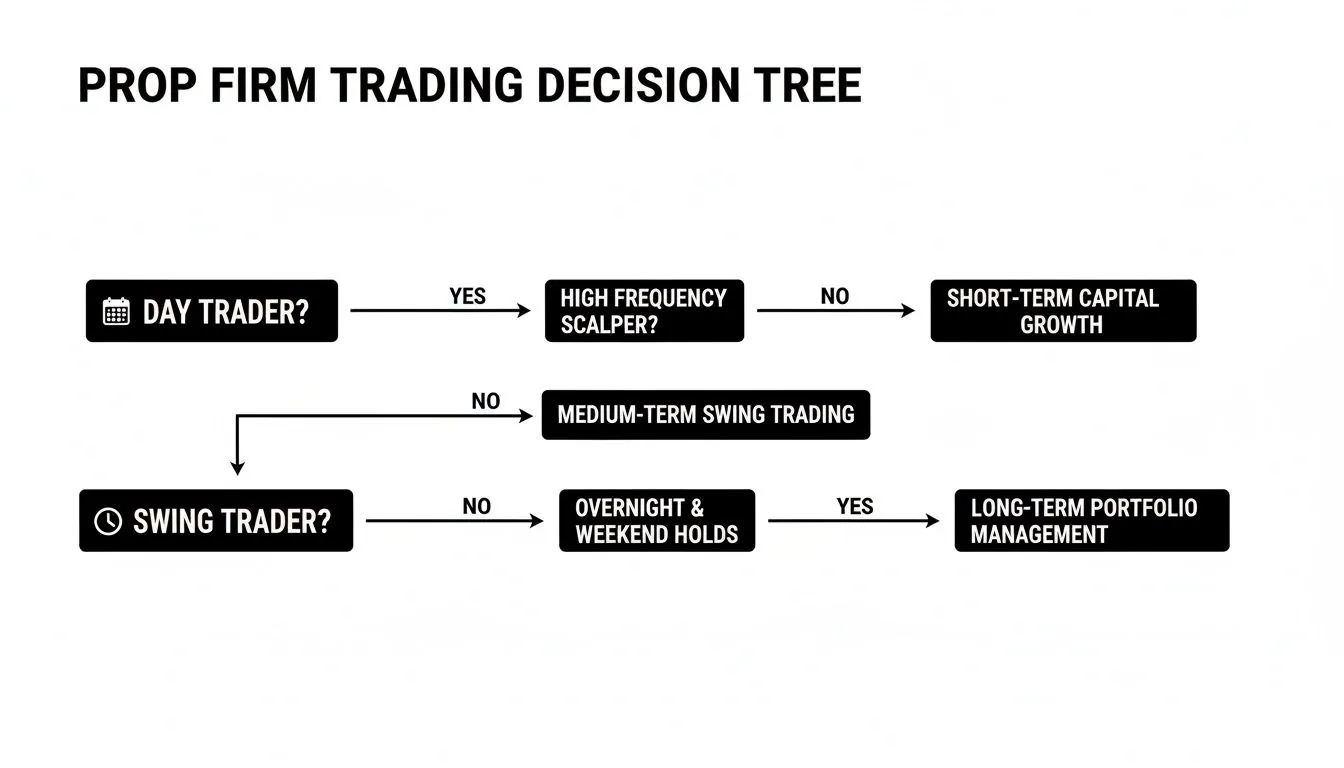
Getting funded by a prop firm like MyFundedCapital is about proving you can execute your strategy within the firm’s specific risk framework. This is where many traders slip up—they fail to adapt their style to the rules of the game.
Daily Drawdown vs. Maximum Drawdown
You'll hear two terms over and over: Daily Drawdown and Maximum Drawdown. They represent different challenges for each trading style.
- The Daily Drawdown (often 5%) is a hard stop on how much you can lose in one day. This is the biggest threat to a day trader. A couple of bad trades or a moment of frustration can end your evaluation.
- The Maximum Drawdown (often 8-10%) tracks your total loss from your account's peak value. This is the number that keeps swing traders up at night. Because trades span multiple days, you must ensure your combined drawdown never trips this wire.
Practical Tips for Passing an Evaluation
Whether you're day trading or swing trading, success in a prop firm challenge boils down to aligning your strategy with these key rules.
Checklist for Day Traders:
- Set a personal daily loss limit. If you hit two or three losses in a row, shut it down for the day. Live to trade tomorrow.
- Keep risk small. On a $100k account with a $5,000 daily loss limit, risking 1% ($1,000) is too aggressive. Risking 0.25% to 0.5% ($250-$500) per trade gives you breathing room.
- Check news trading rules. Many prop firms restrict trading during major news events. Don't get disqualified on a technicality.
Checklist for Swing Traders:
- Confirm weekend holding rules. If your strategy needs to hold over a weekend, make sure your account allows it. MyFundedCapital offers add-ons for this.
- Size for gaps, not just stops. When holding overnight, consider sizing down slightly. This ensures a surprise gap doesn't instantly violate your drawdown limits.
- Focus on the max drawdown. Your daily P&L will be choppy. Your focus must remain on the overall 8-10% max drawdown. As long as your total risk stays clear of that line, you're playing the game correctly.
How to Choose the Right Trading Style for You
The best trading style isn't the one with the most hype; it’s the one you can actually execute day in and day out without burning out. This framework is designed to help you find the approach that genuinely fits your life.
1. Assess Your Personality and Psychology
Your innate temperament is a massive factor. Be honest with yourself.
- How do you handle pressure? If you enjoy a fast-paced environment and can make sharp calls with money on the line, day trading might be for you. If you prefer to analyze charts without a ticking clock, the slower rhythm of swing trading will feel more natural.
- What's your patience level? Day trading provides instant feedback, which appeals to the impatient. Swing trading is a masterclass in patience, as you might wait days for a setup and weeks for it to play out.
2. Evaluate Your Lifestyle and Time Commitment
Your daily schedule is a hard boundary. Be realistic about how much focused time you can dedicate to the charts.
- Do you have a full-time job? If you work 9-to-5, active day trading is likely off the table. Swing trading was practically designed for this exact situation. You can do your analysis and place trades in the evenings or on weekends.
- How much screen time can you handle? Day trading demands being glued to your screens for hours at a time. Swing traders, by contrast, might only need an hour or so each day to manage positions.
3. Test Both on a Demo Account
There's no substitute for direct experience. Before you risk a single dollar or start an evaluation, practice both styles.
- Dedicate one full week to day trading. Get a real feel for the speed, pressure, and focus required.
- Dedicate two weeks to swing trading. Hunt for setups on the daily chart, place trades with wider stops, and practice the art of walking away.
After this trial run, you’ll have a much clearer picture of which style feels less like a chore and more like a natural extension of who you are.
FAQ: Common Questions About Day Trading vs. Swing Trading
Here are straight answers to the most common questions traders ask when comparing these two styles.
Can I do both day trading and swing trading?
Technically, yes, but it’s not recommended for beginners. The mental switch between a patient, multi-day perspective and rapid-fire decision-making is incredibly difficult. It is far better to master one style first, prove you can be consistent, and then consider a hybrid approach once you are highly experienced.
Which trading style is more profitable?
Neither style is inherently more profitable. Your profitability depends on your skill, discipline, and having a solid strategy you can execute consistently. A great day trader can stack up small wins into large gains, while a great swing trader can capture a few massive moves. Success comes from finding the style that fits you and allows you to trade without emotional mistakes. Remember, all trading carries a substantial risk of loss.
How much capital do I need to start?
For stock traders in the US, the Pattern Day Trader (PDT) rule requires a $25,000 minimum account balance for frequent day trading. Swing trading does not have this requirement, making it more accessible with smaller capital. However, this is why prop firms are a game-changer. They allow you to sidestep these large capital requirements by trading the firm's money after you pass an evaluation challenge.
Ready to put your skills to the test? At MyFundedCapital, we provide the funding and platform to support your strategy, whether you're a day trader or a swing trader.
Explore our funding programs and compare account types to find the one that fits you best.
