

 AR
AR
 NL
NL
 FR
FR
 DE
DE
 ES
ES
 IT
IT
 PL
PL
 SV
SV
 PT
PT


Struggling to find consistent profits in the market? Many traders think the secret is finding the perfect entry, but this is only one small piece of the puzzle. This guide will show you how to master the entire trading life cycle—a structured process that professionals use to build discipline, manage risk, and achieve long-term success.
Sustainable profitability isn't about a single brilliant move. It's about a repeatable system that transforms trading from a series of high-stress gambles into a calm, professional operation.
What Is the Trading Life Cycle and Why It Matters
The trading life cycle is the complete end-to-end process of a trade, from initial idea to post-trade review. It’s a structured framework that provides clarity and removes emotion from your decision-making. Following this cycle is what separates disciplined professionals from inconsistent amateurs.
Without a defined process, it’s easy to fall into common traps:
- Impulsive Entries: Jumping into trades based on gut feelings or social media hype, with no real strategy.
- Poor Risk Management: Deciding on your position size or stop-loss after you’re in a trade and emotions are high.
- Repeating Mistakes: Never truly learning from your losses (or wins) because you lack a formal review process.
The trading life cycle consists of a simple but powerful loop: Prep, Execute, and Review.
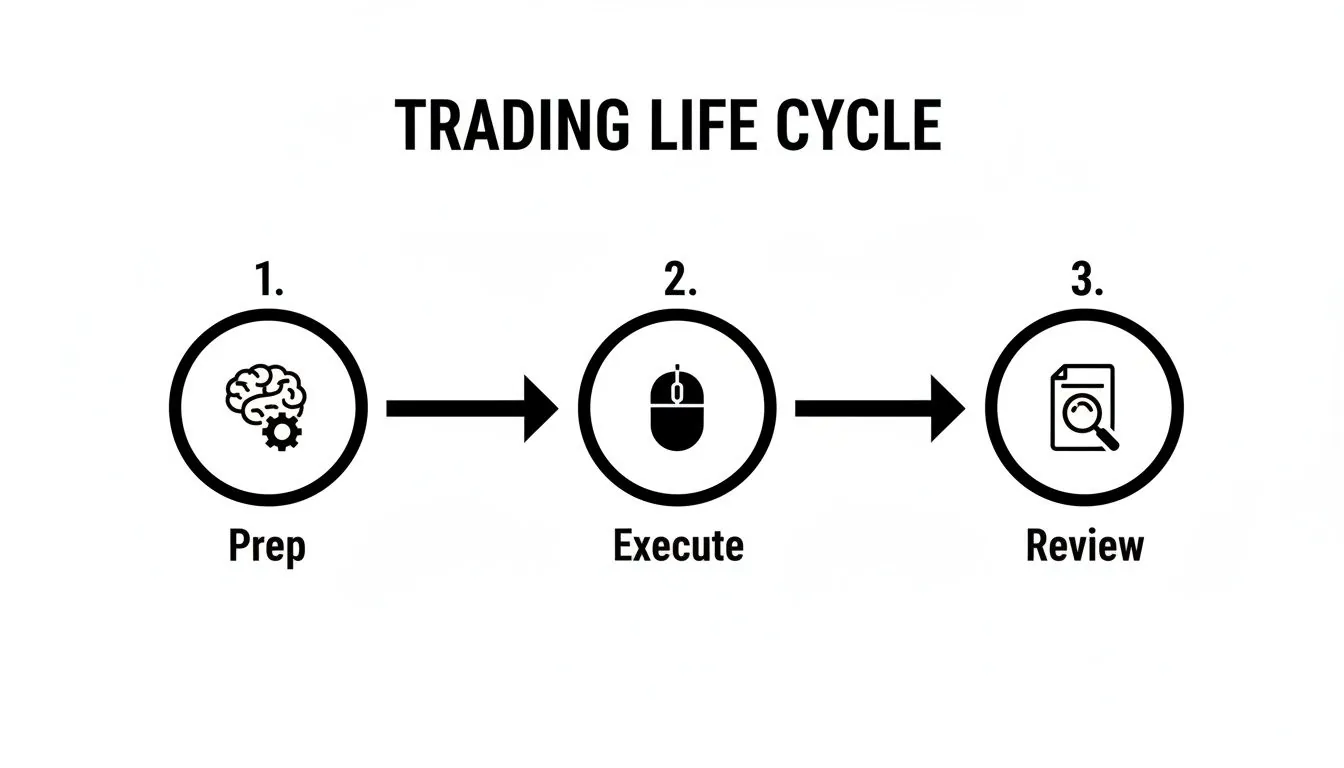
Each stage feeds into the next. Your review of past trades sharpens your preparation for future ones, creating a feedback loop that drives constant improvement. When you treat every trade as part of this cycle, you start building the habits required for long-term success, especially in a prop firm environment where strict rules are non-negotiable.
This guide breaks down each stage with practical steps and examples to help you build your own professional trading life cycle. Please remember that all trading involves substantial risk of loss and this content is for educational purposes only, not financial advice.
Stage 1: Pre-Trade Preparation
Every successful trade starts long before you click "buy" or "sell." The preparation phase of the trading life cycle is where you do the homework to replace emotional guesswork with a data-driven plan. Trading without this prep work is a recipe for disaster.
For a funded prop trader operating with strict rules like a 5% daily drawdown limit, this phase is non-negotiable. Your pre-trade plan is your first line of defense against blowing your account.
Turning an Idea into an Actionable Plan
A trade begins with an idea, but an idea alone is not a strategy. You must turn a general observation, like "EUR/USD looks bullish," into a concrete plan with specific rules.
Your plan must answer these questions with zero ambiguity:
- Entry Criteria: What precise conditions must be met to enter? For example, "Price must close above the 1.0850 resistance level on the 1-hour chart."
- Position Size: How much capital will you risk? For instance, "I will risk 0.5% of my account balance on this trade."
- Stop-Loss: Where is your invalidation point? Example: "My stop-loss will be placed at 1.0830, 20 pips below my entry."
- Profit Target: Where will you take profits? Example: "My first profit target is at 1.0890, a 2:1 risk-to-reward ratio."
Defining these parameters beforehand is crucial for maintaining discipline. To build a solid framework, you can use our trading plan template.
The Pre-Market Checklist
Professionals follow a consistent pre-market routine to prepare for the session. Think of it like a pilot's pre-flight check; it's a systematic process to ensure you're ready for the day.
Your daily checklist should include:
- Check the Economic Calendar: Identify high-impact news events (e.g., CPI, FOMC) that could cause volatility.
- Identify Key Price Levels: Mark major support and resistance zones, pivot points, and the previous day's high and low on your charts.
- Review Your Strategy: Confirm that your chosen strategy is appropriate for the current market conditions (e.g., avoid a trend-following strategy in a choppy, range-bound market).
Stage 2: Trade Execution and Management
With your preparation complete, it's time to execute. This stage of the trading life cycle is where your plan meets the live market, and where discipline is tested. Success here requires precision and emotional control.
You have to trust the rules you set for yourself, even when your gut is screaming to do the opposite.
Choosing the Right Order Type
Knowing your tools is essential. Using the wrong order type can sabotage a well-planned trade.
- Market Order: Buys or sells immediately at the best available price. Use when speed is critical, but be aware of slippage (the difference between the expected price and the execution price) in volatile markets.
- Limit Order: Lets you set the exact price you are willing to trade at. It guarantees your price but does not guarantee the order will be filled. A go-to for executing strategies based on specific levels.
- Stop Order: Becomes a market order once a specific price is reached. Used to enter breakouts or, most importantly, as your stop-loss to exit a losing position.
A common mistake is using market orders for everything. Professional traders often lean on limit orders to enforce discipline and ensure their trades meet the pre-defined risk-to-reward parameters.
In-Trade Management
Once your trade is live, the psychological battle begins. The urge to snatch small profits or move your stop-loss on a losing trade can be overwhelming. Your only defense is your pre-trade plan.
Here are practical management steps based on your plan:
- Move Stop-Loss to Breakeven: When a trade reaches a pre-defined target (e.g., a 1:1 risk-to-reward), consider moving your stop-loss to your entry price. This removes all risk from the trade.
- Take Partial Profits: If it's part of your strategy, you can close a portion of your position (e.g., 50%) at your first target. This secures a profit and allows you to let the rest of the position run.
- Respect Your Stop-Loss: Your stop-loss is an unbreakable rule. If the market hits it, the trade is invalidated. You must exit without hesitation. Respecting your stop is the most critical habit for long-term survival, as trading always involves a substantial risk of loss.
To explore strategies for defining these price points, our guide on the VWAP trading strategy is a great resource. You can also use tools like lunabloomai's trading app to support your trade management.
Stage 3: Post-Trade Analysis and Record Keeping
You've closed the trade, but the job isn't done. This "back-office" stage of the trading life cycle is where professionals separate themselves from gamblers. It begins with reconciling your records to ensure your data is accurate.
Reconciling Your Records
Match your personal trading journal with your platform's official statements. This non-negotiable habit helps you catch errors, understand your true trading costs, and build a reliable dataset.
Your daily check should verify:
- Execution Price: Did the trade fill at the intended price?
- Profit/Loss: Does the P&L in your journal match the statement?
- Trading Costs: Have you accounted for all commissions, spreads, and swap fees?
Analyzing Your Performance Data
With clean data, you can begin analyzing your performance. The goal is to turn your trading history into a searchable database of your own behavior. For a quick overview, a dedicated profit and loss analyzer can help visualize your results.
For every trade, log these details in your journal:
- Strategy Used: (e.g., breakout, mean reversion)
- Reason for Entry: (e.g., "Broke and retested 4H support")
- Emotional State: (e.g., patient, anxious, FOMO)
- Chart Screenshots: Capture the setup at entry and exit.
This data moves you beyond asking, "Did I make money?" to asking, "Why did this trade work or fail?" This detailed information is the fuel for the final stage of the cycle: the performance feedback loop.
Stage 4: The Performance Feedback Loop
This final step is what drives continuous improvement. Instead of just glancing at your P&L, a structured review helps you turn raw data into an actionable plan for the future.
This is where you uncover the habits—both good and bad—that are actually driving your results.
Key Performance Metrics to Track
To get an unbiased look at your trading, track these key performance metrics (KPMs):
- Win Rate: The percentage of your trades that are profitable. A high win rate isn't necessary if your winners are significantly larger than your losers.
- Risk-to-Reward (R:R) Ratio: Compares your average winning trade to your average losing trade. An R:R of 2:1 means your winners are, on average, twice as large as your losers—a strong foundation for profitability.
- Maximum Drawdown: The largest peak-to-trough decline in your account. This is a critical metric for prop firm traders to monitor.
- Average Hold Time: Compare how long you hold winners versus losers. If you cut winners short and let losers run, this metric will expose it.
Your Weekly Review Template
A structured weekly review is your opportunity to analyze performance with a clear head. Treat it as a non-negotiable meeting with yourself.
Here is a simple template to get started:
- Performance Snapshot:
- Total P&L for the week:
- Number of trades taken:
- Win rate for the week:
- Biggest winner and biggest loser:
- Rule Adherence (for Prop Firm Traders):
- Did I approach my daily or max drawdown limits? If so, why?
- Did I follow all firm rules (e.g., news trading, holding over weekend)?
- Behavioral Analysis:
- What was my best trade and why did it work (good plan vs. luck)?
- What was my worst trade and what went wrong (bad plan vs. poor execution)?
- What is one thing I did well this week to continue doing?
- What is the biggest mistake I made this week to avoid repeating?
This review completes the trading life cycle, feeding hard-won lessons from this week directly into your preparation for the next.
FAQs about the Trading Life Cycle
What's the most common sticking point in the cycle?
The handoff between preparation and execution is where most traders fail. They create a solid plan but abandon it the moment a trade is live and emotions like fear or greed take over. Mastering the discipline to follow your plan is the biggest challenge.
How does this cycle apply to prop firm trading?
The core stages remain the same, but the stakes are higher due to the firm's rules. Your preparation must include a "rule check" to ensure a losing trade won't violate drawdown limits. Your review process must also audit your adherence to these rules, not just your P&L. For more on this, see how discipline impacts success by understanding the prop firm challenges.
If I could only master one habit, what should it be?
Consistent journaling and an honest weekly review. This is the engine of improvement. Without objective data on what you did and why, you are simply guessing. A good journal turns trading from a gamble into a data-driven business.
Ready to apply a professional trading life cycle in an environment that rewards discipline? Our clear rules and realistic targets are designed for consistent traders.
Learn more about our funding programs and start your journey today.
