Before you hit the "buy" or "sell" button, you need to decide on your lot size—the amount of an asset you will trade. This single choice dictates your position size, which determines your potential profit or loss and is the foundation of sound risk management. This guide will show you how to calculate and apply the correct lot size to manage risk effectively in any market.
Think of it like choosing the right gear on a bike. Pick the right one, and you can climb a steep hill with steady, controlled effort. Pick the wrong one, and you'll either spin your wheels going nowhere or grind to a complete halt. Getting your lot size right is the key to navigating the markets without burning out your account.
Free resources: Forex & Prop Trading Glossary (drawdown, breach, lot, pip and the rest in plain words), and the free Position Size Calculator.
Why Lot Sizing Is Your Most Important Trading Decision

At its core, lot sizing is about deciding how much of an asset you're going to trade. In the financial markets, a "lot" is simply a standardized unit of measurement. It’s how we quantify the volume of our trades, whether we’re dealing with currencies, indices, or commodities.
This isn’t just technical jargon; it's the bedrock of effective risk management in forex trading. If your position size is too large, even a normal market fluctuation against you can trigger a significant loss. If your size is too small, a great trade idea might only return pocket change, making it difficult to grow your account.
Disciplined lot sizing is what separates professionals from gamblers. It’s about having a plan and sticking to it on every trade. Trading involves a substantial risk of loss and is not suitable for all investors. This content is for educational purposes only and is not financial advice.
The Four Main Lot Sizes in Forex
In forex trading, position sizes are broken down into four main categories. Each one represents a different volume and is designed for different account sizes and risk appetites.
Here’s a practical breakdown of how these standardized units work.
| Lot Type | Units of Base Currency | Typical Pip Value (EUR/USD) | Best For |
|---|---|---|---|
| Standard Lot | 100,000 | ~$10 per pip | Institutional traders or very large retail accounts. |
| Mini Lot | 10,000 | ~$1 per pip | Intermediate traders comfortable with moderate risk. |
| Micro Lot | 1,000 | ~$0.10 per pip | Beginners looking to trade live with minimal risk. |
| Nano Lot | 100 | ~$0.01 per pip | Testing new strategies or those with very small capital. |
A one-pip move on a standard lot has 100 times the financial impact of the same move on a micro lot. This is why you must calculate, not guess.
This system of standardized lots has been the industry benchmark for decades, creating a common language for risk that underpins a market where daily forex turnover has hit $7.5 trillion. You can learn more about the impact of lot sizes in trading on axiory.com to see how this framework applies across the board.
Understanding the Math Behind Your Trades
Let's get practical and look at the actual numbers that drive your trades. This is where the idea of "risk" gets translated into dollars and cents—the math that protects your capital. Getting this right is essential for any serious trader.
The first piece of the puzzle is figuring out what a single pip is worth in real money for the asset you're trading. This value changes depending on your lot size and the currency pair itself.
How to Calculate Pip Value
The pip value is how much money you gain or lose for every one-pip move in price. Here is the straightforward formula to calculate it for any forex pair.
Pip Value Formula: (Pip in decimal form / Exchange Rate) * Lot Size in Units
Let's run through an example with EUR/USD, using an exchange rate of 1.0800.
- Standard Lot (100,000 units) (0.0001 / 1.0800) * 100,000 = $9.26 per pip.
- Mini Lot (10,000 units) (0.0001 / 1.0800) * 10,000 = $0.926 per pip.
- Micro Lot (1,000 units) (0.0001 / 1.0800) * 1,000 = $0.0926 per pip.
See how the lot size directly scales the financial impact of each pip? A standard lot has 10x the impact of a mini, and 100x the impact of a micro.
For pairs where the USD is the second currency listed (like EUR/USD), the math is simple. If the USD is the base currency (like USD/JPY) or not in the pair at all (like EUR/JPY), there's one extra step: converting the final value back into US dollars. A deeper understanding of risk often involves statistical tools like standard deviation, which measures volatility and can directly influence these risk calculations.
Demystifying Contract Value
While pip value tells you the profit or loss per tick, the contract value reveals the total size of the position you're controlling.
Contract Value Formula: Lot Size in Units * Current Market Price
Let's stick with our EUR/USD example at a price of 1.0800:
- Standard Lot 100,000 units * 1.0800 = $108,000
- Mini Lot 10,000 units * 1.0800 = $10,800
- Micro Lot 1,000 units * 1.0800 = $1,080
Those numbers might look large, and that's the power of leverage at work. You aren't putting up $108,000 to open a standard lot; you're using a much smaller amount of margin to control that position. Knowing the contract value is a constant reminder of the scale you're operating on and why tiny price movements can lead to significant outcomes.
The Position Size Formula Every Trader Needs
Now it’s time to put it all together with the most important equation in your trading plan: the position size formula. This is the practical tool that separates disciplined professionals from gamblers by taking emotion and guesswork out of the equation.
The formula is straightforward. It lets you figure out the precise lot size for any trade by balancing your account size, risk appetite, and stop-loss distance.
Position Size (in Lots) = (Account Equity * Risk %) / (Stop Loss in Pips * Pip Value)
Using this formula means that if a trade hits your stop-loss, you’ll lose exactly the dollar amount you planned for. It transforms risk from a scary unknown into a controlled constant.
Putting The Formula Into Practice: A Concrete Example
Let's walk through a real-world example to see how this plays out.
Imagine you have a $100,000 account. Your rule is to never risk more than 1% of your capital on a single trade. You've found a setup on GBP/JPY and your analysis shows the perfect stop-loss is 20 pips away from your entry. For a standard lot of GBP/JPY, the pip value is about $6.50.
Here’s the step-by-step calculation:
Define Your Maximum Risk in Dollars:
- $100,000 (Account Equity) × 0.01 (1% Risk) = $1,000 max loss.
Calculate the Risk Per Lot:
- 20 (Stop-Loss in Pips) × $6.50 (Pip Value) = $130 of risk for every 1.00 lot traded.
Determine Your Ideal Position Size:
- $1,000 (Your Max Risk) / $130 (Risk per Lot) = 7.69 standard lots.
To stick to your 1% risk rule, you would open a trade for 7.69 lots. If the market moves against you by 20 pips, your loss is capped at exactly $1,000. No surprises.
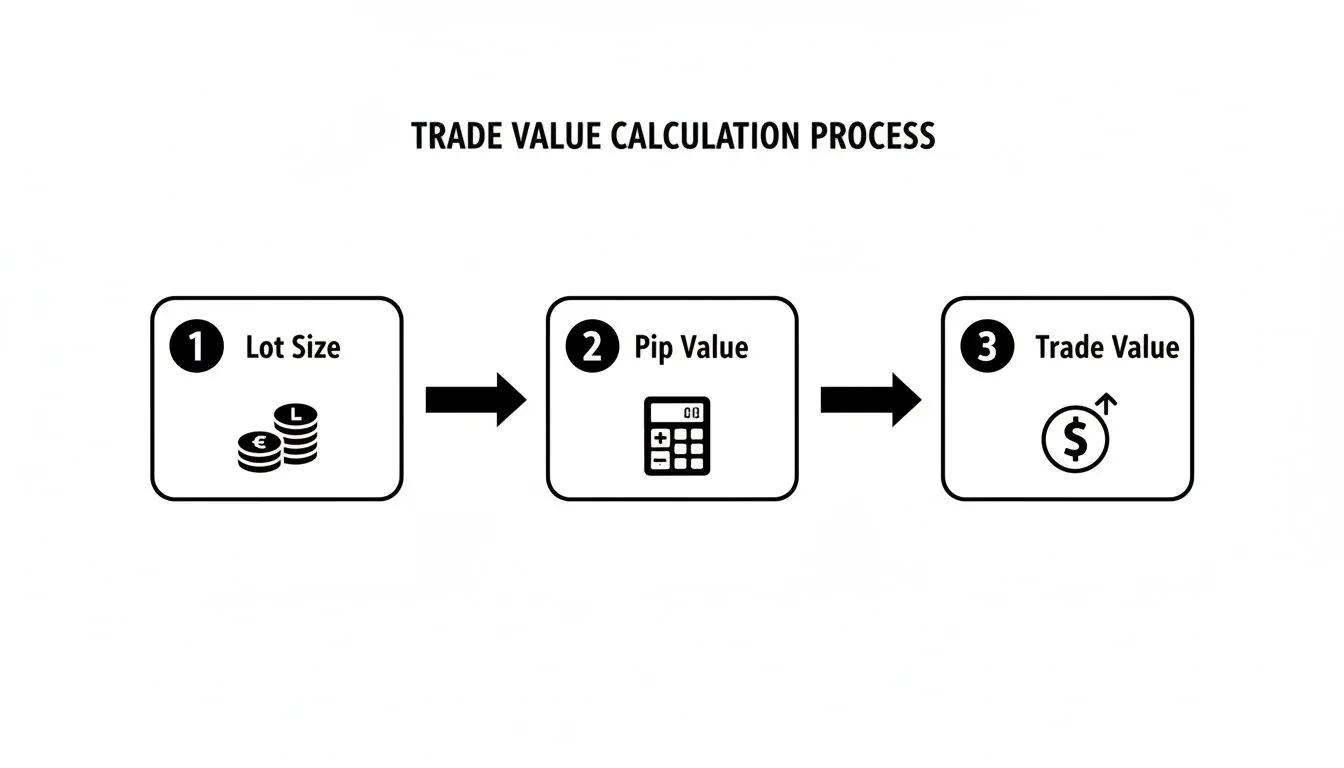
Of course, using a dedicated lot size calculator can automate this for you in seconds. But don't skip over understanding the math yourself. Internalizing this process is what builds the discipline to prevent costly mistakes.
How Lot Sizing Works Across Different Markets
While forex gets most of the attention, the principles of solid risk management are universal. Whether you're trading currencies, indices, metals, or crypto, the discipline is the same. The trick is learning how a "lot" translates to risk in each market.
A lot is just a standard unit of measure, whether that's 100,000 units of a currency, 100 ounces of gold, or one Bitcoin. Your job is always to answer the same question: "How many lots can I trade to risk just 1% of my account on this specific setup?"
Forex Lot Sizing Example
As we've covered, the standard in the Forex market is the 100,000-unit lot.
- Instrument EUR/USD
- Contract Size 1 standard lot = 100,000 EUR
- Scenario You're trading a $100,000 account and want to risk 1% ($1,000). Your stop-loss is 25 pips away, and the pip value for a standard lot is about $10.
- Calculation
- Risk per lot: 25 pips * $10/pip = $250
- Position size: $1,000 / $250 = 4.0 standard lots
Indices Lot Sizing Example
With indices like the US30, we talk about points, not pips.
- Instrument US30
- Contract Size For many brokers, 1 lot is 1 contract, and each point of movement is worth $1.
- Scenario On that same $100,000 account, you're risking 1% ($1,000) with a 50-point stop-loss.
- Calculation
- Risk per lot: 50 points * $1/point = $50
- Position size: $1,000 / $50 = 20 lots
Metals Lot Sizing Example
For precious metals like Gold (XAU/USD), a standard lot typically means you're controlling 100 troy ounces.
- Instrument XAU/USD
- Contract Size 1 standard lot = 100 ounces. A $1 move in the price of gold equals a $100 change in your position's value.
- Scenario With your $100,000 account and 1% ($1,000) risk, you've identified a trade with a $5 stop-loss (e.g., from an entry at $2,350 down to $2,345).
- Calculation
- Risk per lot: $5 price move * $100/move = $500
- Position size: $1,000 / $500 = 2.0 standard lots
You can dive deeper into the full range of over 300 instruments, from metals to exotic pairs, by checking out our list of available markets at MyFundedCapital.
Interestingly, this idea of standardized lots isn't new. The ongoing shift in equity markets from "round lots" to actual share-based quoting, set for full implementation by November 2025, shows how the industry is moving toward greater precision. This mirrors the flexibility CFD traders already enjoy, which is vital for managing risk within tight prop firm rules. You can read more about these regulatory changes at Schwab.com.
Crypto Lot Sizing Example
Last, let's look at crypto. With an instrument like Bitcoin (BTC/USD), one lot is usually one coin.
- Instrument BTC/USD
- Contract Size 1 lot = 1 Bitcoin, so a $1 price move equals a $1 change in value.
- Scenario You're on your $100,000 account, risking 1% ($1,000). You've planned for a $500 stop-loss (e.g., from an entry at $68,000 down to $67,500).
- Calculation
- Risk per lot: $500 price move * $1/move = $500
- Position size: $1,000 / $500 = 2.0 lots
Lot Sizing Examples By Asset Class
To see how the math changes from one market to another, let's put these examples side-by-side. The table below uses the same account size and risk parameters to show how different contract specifications directly influence your final position size.
| Asset Class | Example Instrument | Contract Specification | Calculated Lot Size for 1% Risk on $100k Account |
|---|---|---|---|
| Forex | EUR/USD | 100,000 units per lot | 4.0 lots (with 25-pip stop) |
| Indices | US30 | $1 per point movement | 20.0 lots (with 50-point stop) |
| Metals | XAU/USD (Gold) | 100 oz. per lot ($100 per $1 move) | 2.0 lots (with $5 stop) |
| Crypto | BTC/USD | 1 coin per lot ($1 per $1 move) | 2.0 lots (with $500 stop) |
As you can see, the final lot size can vary dramatically. This is why you must do the math every single time to ensure your risk stays consistent.
Using Lot Sizing to Respect Prop Firm Rules

For a prop firm trader, understanding lot sizing isn't just academic—it's the most important skill for survival. In the world of funded accounts, rules like the 5% daily drawdown and 10% maximum drawdown are hard lines you cannot cross.
Disciplined position sizing is your first line of defense. One sloppy calculation could end your challenge before it begins. When you get this right, risk becomes a calculated, manageable part of your trading business, not a threat.
A Practical Workflow for Prop Firm Trading
So, how do you put this into practice every day? Here is a simple, repeatable checklist to keep you safely within the rules of a firm like MyFundedCapital.
Imagine you're trading a $100,000 account. The rules are clear:
- Daily Loss Limit $5,000 (5% of $100k)
- Maximum Loss Limit $10,000 (10% of $100k)
Your primary job is to use lot sizing to ensure you never get close to these limits. A professional standard is to risk a small, fixed percentage—often 1% of your equity—on any single trade.
Actionable Steps:
- Set Your Risk Decide on your maximum risk per trade (e.g., 1% of $100,000 = $1,000).
- Find Your Stop-Loss Determine the price level where your trade idea is proven wrong.
- Calculate the Distance Measure the stop-loss distance in pips or points.
- Calculate Your Lot Size Use the position size formula to get the exact lot size that matches your $1,000 risk limit.
This structured approach makes it very difficult for one bad trade to blow up your account. With a $1,000 risk cap, you would need five consecutive losing trades just to hit your daily drawdown limit.
Why Every Detail Matters
Lot sizing has a real impact on the market itself. In 1997, the Chicago Mercantile Exchange cut the lot size of its S&P 500 futures contract in half but doubled the tick size, resulting in a significant drop in market liquidity and trading volume.
This is a powerful reminder that the numbers matter. Matching your position size to risk parameters like the 5% daily and 10% max drawdown isn’t just about following rules—it’s about keeping your trading efficient. For a deeper dive, you can read the full research on how lot and tick sizes affect futures markets on nasdaq.com.
Mastering this skill is what gives you the confidence to execute your plan, knowing your risk is always under control.
FAQ: Answering Your Top Questions on Lot Sizing
Here are answers to some of the most common questions we get from traders learning about what is lot sizing.
What is the best lot size for a beginner?
For a beginner, the best starting point is a micro lot (0.01). This keeps the risk per pip incredibly low (often just cents), creating a safe environment to gain live market experience, test a strategy, and build good habits without the fear of a devastating loss. Once you are consistently profitable with micro lots, you can consider scaling up to mini lots.
How does leverage affect my lot size choice?
Leverage allows you to control a position much larger than your account balance, but it does not determine your lot size. Your lot size should always be decided by your risk management formula, not the maximum leverage offered. Leverage makes the trade possible, but your risk plan dictates what is lot sizing for that specific entry. Relying on max leverage without a risk plan is one of the fastest ways to lose an account.
Do I recalculate my lot size for every single trade?
Yes, every single time. This is non-negotiable for disciplined trading. Market volatility changes, and your ideal stop-loss placement will be different for every trade. Since the stop-loss distance is a key variable in the position size formula, failing to recalculate means you are not truly controlling your risk.
Ready to apply these principles with real capital? At MyFundedCapital, our funded accounts are designed for traders who understand risk. Test your strategy in a 1-step or 2-step challenge, or get funded instantly. Compare our account types and start your journey today.