Trying to figure out what a trading firm actually is and how you can get involved? This guide breaks down how they work, the different types you'll encounter, and the practical steps to getting funded. We'll give you a clear, honest look at the pros, cons, and what it takes to succeed.
Free resources: Forex & Prop Trading Glossary (drawdown, breach, lot, pip and the rest in plain words).
What Is a Trading Firm and How Do They Work?
If you've ever felt held back by the size of your personal trading account, you understand the core problem trading firms solve. At its heart, a trading firm is a company that provides the capital and technology for traders to buy and sell financial instruments. Their purpose is to find skilled traders and give them the financial muscle to operate at a scale they couldn't achieve alone.
Think of it as a partnership: the firm puts up the capital, and the trader brings the strategy and skill. It's a performance-based model where profits are shared. The industry has evolved from chaotic trading floors to sophisticated electronic systems, with firms playing a massive role in today's markets. For example, a major firm like Citadel Securities handles a significant portion of all US retail stock trades, showing the scale of these operations in the global financial markets on Statista.com.
How Trading Firms Differ from Banks and Hedge Funds
The term "trading firm" is broad and can be confusing. It's important to distinguish between different types of financial institutions.
- Investment Banks & Hedge Funds: These giants typically manage client money or their own massive balance sheets. Getting a job there usually requires an extensive academic and professional background.
- Proprietary (Prop) Firms: Modern prop firms have opened the door for talented individuals without a traditional Wall Street resume. They trade with 100% of the firm's own money—never client funds. Their only goal is to profit from the markets through the skills of their traders. You can learn more about how funded trading accounts work to see this model in detail.
Types of Financial Trading Entities at a Glance
This table breaks down the key differences between the types of firms you’ll encounter. Notice where a prop firm fits in—it’s a unique model built for a specific type of trader.
| Firm Type | Primary Capital Source | Main Business Model | Typical Client |
|---|---|---|---|
| Investment Bank | The bank's own capital and client assets | Mergers, acquisitions, underwriting, and trading | Large corporations, governments, institutional investors |
| Hedge Fund | Capital from high-net-worth and institutional investors | Active portfolio management using diverse strategies | Accredited investors and institutions |
| Brokerage | None (acts as an intermediary) | Facilitating trades for retail and institutional clients for a commission or fee | Individual traders and investors |
| Proprietary (Prop) Firm | The firm's own capital | Funding skilled traders and sharing in the profits generated | Independent and retail traders |
Prop firms occupy a special niche. They aren't serving massive corporations; their focus is squarely on empowering individual traders to succeed based on skill, not credentials.
The Different Types of Trading Firms Explained
The trading world is diverse, and not all firms operate the same way. Understanding the differences is the first step for any aspiring trader trying to find their place. Each type has its own business model and plays a unique role in the market.
Market Makers: The Pillars of Liquidity
Market makers are the backbone of the financial markets. Their job is to provide liquidity by always being willing to both buy and sell a particular asset. This ensures that trades can be executed smoothly and efficiently.
They make money on the bid-ask spread—the small difference between their buying price (bid) and selling price (ask). While the profit per trade is tiny, they execute millions of trades daily. Giants like Virtu Financial are masters of this game, and you can learn more about the biggest market makers globally to appreciate their scale.
Quantitative Firms: The Algorithm Architects
Quantitative trading firms, or "quant" firms, are high-tech, data-driven powerhouses. Instead of relying on human discretion, quants use sophisticated mathematical models and powerful computers to make trading decisions automatically.
These firms recruit PhDs in math, physics, and computer science to build algorithms that can find subtle patterns and execute trades in microseconds, a practice known as high-frequency trading (HFT). Names like Two Sigma and Jane Street are legendary in this space, operating at a technological level far beyond individual traders.
Proprietary Trading Firms: The Opportunity for Individuals
This is where things get interesting for retail traders. Proprietary (prop) trading firms trade with their own money, but with a unique twist: they actively scout and partner with talented traders from all over the world.
This model gives skilled individuals a genuine shot at managing serious capital. Prop firms are built around one core principle: identifying proven trading talent.
A proprietary trading firm essentially outsources its trading activity to a global pool of skilled individuals. They provide the capital and risk management framework, while the trader provides the strategy and execution.
It’s a performance-based system. If you can prove you can trade profitably while managing risk through an evaluation, they'll back you with their capital. This direct pathway is what makes prop firms a powerful opportunity for traders looking to overcome the limitations of their own small accounts.
How Modern Prop Trading Firms Operate
So, how does this work in practice? For most traders, the journey starts with an evaluation process, often called a "challenge." This is the firm's way of vetting your skills. You pay a one-time fee to access a simulated trading account where you must prove you have a consistent edge while following specific rules.
The Evaluation: Your Gateway to a Funded Account
Think of the evaluation as a practical job interview. The firm gives you a clear set of rules you have to follow to pass. These rules aren't arbitrary; they’re designed to protect the firm's capital and instill the discipline every professional trader needs.
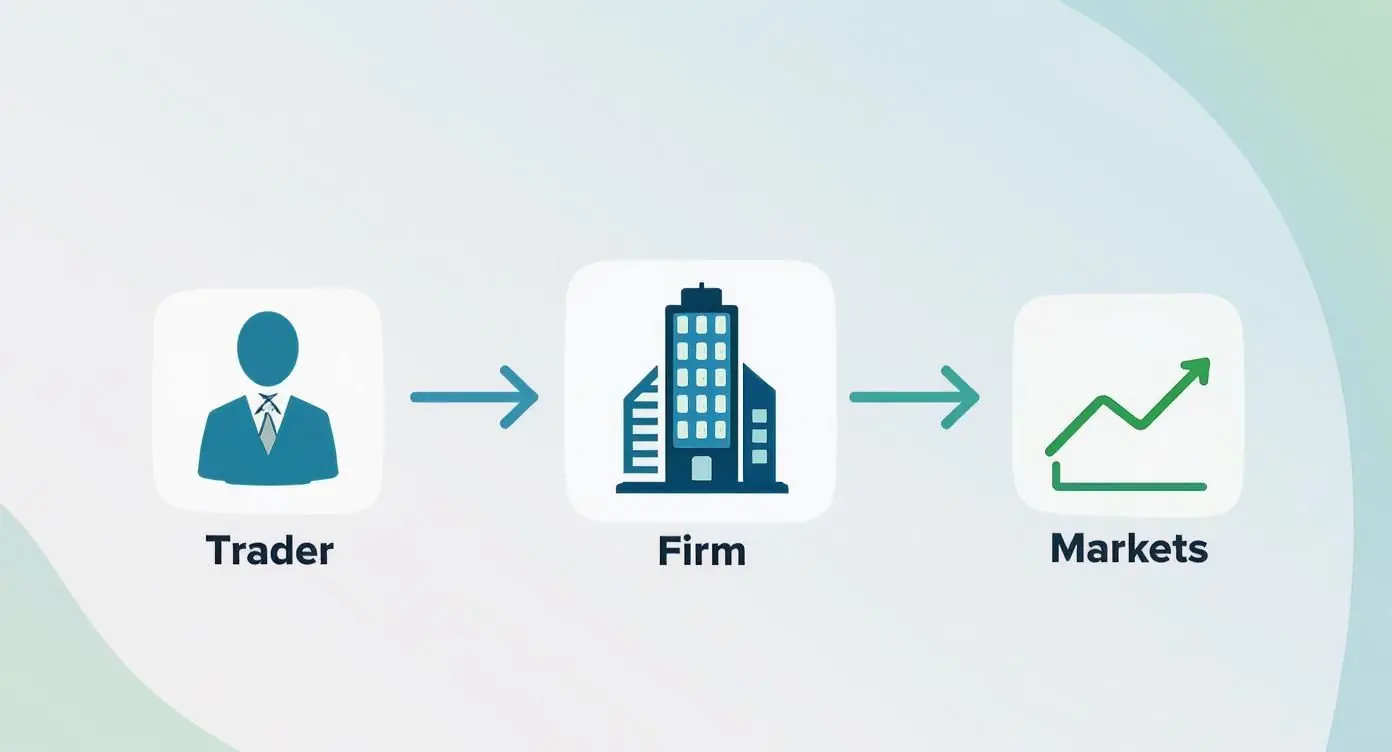
The core idea is a partnership. The firm provides the capital and infrastructure, and you bring the trading talent to navigate the markets.
Understanding the Core Rules: Profit Targets and Drawdowns
Every evaluation boils down to two critical rules: the profit target and the drawdown limit.
- Profit Target The minimum profit you need to hit to prove your strategy works.
- Drawdown Limit The maximum loss your account can take before you are disqualified. This is the firm’s safety net.
Let's walk through a concrete example.
Example: You sign up for a $100,000 two-step challenge.
Step 1: Your profit target might be 8% ($8,000).
Step 2: The target in the second step is often lower, perhaps 5% ($5,000).
Throughout both stages, you must stay above a maximum loss limit, typically around 10% ($10,000) of your starting balance.
These numbers are designed to show you can perform consistently while forcing you to protect capital. Breaching these limits is the fastest way to fail an evaluation.
Life After the Challenge: The Profit Split
Once you pass the evaluation, you get a funded account. You’re now trading with the firm’s capital, and any profits you generate are split between you and the firm. This is the primary appeal of the prop firm model.
The profit split is the percentage of the profits you keep. Today's prop firms offer generous splits, typically between 70% to 90% for the trader.
This model aligns everyone’s goals. The firm only makes money when you make money, creating a powerful opportunity for you to scale your earnings beyond what would be possible on your own.
Disclaimer: Trading involves substantial risk of loss and is not suitable for all investors. Past performance is not indicative of future results. This content is for educational purposes only and should not be considered financial advice.
The Pros and Cons of Joining a Prop Firm
Partnering with a prop firm can accelerate your trading career, but it’s crucial to understand both the benefits and the drawbacks.
This isn’t just about getting more capital; it’s a commitment to a structured, high-stakes environment.
The Upside: Serious Capital and Limited Personal Risk
The biggest draw is access to substantial trading capital. This lets you scale your strategy significantly.
- A 2% return on a $5,000 personal account earns you $100.
- That same 2% return on a $100,000 funded account brings in $2,000.
- With an 80% profit split, you take home $1,600.
Equally important is the reduction in personal financial risk. The firm assumes the risk of capital loss on the live account. Other major benefits include:
- Professional Tools Access to top-tier trading platforms and data feeds.
- Structured Environment Clear rules force discipline and hone risk management skills.
- High Profit Splits You keep the majority of what you earn, typically 70-90%.
The Downside: Intense Pressure and Rigid Rules
The prop firm world is a high-pressure environment. You're constantly evaluated, and the consequences for breaking rules are immediate. Passing the evaluation is the first hurdle, requiring consistent profitability under strict risk limits. You can learn more by understanding the prop firm challenges.
The core trade-off is freedom for capital. You gain financial leverage but must operate within the firm's rules.
Here are the main cons to consider:
- Non-Refundable Fees The evaluation fee is your skin in the game. If you fail, you don't get it back.
- Strict Risk Rules Maximum drawdown limits are non-negotiable. One bad day can end your challenge.
- Trading Restrictions Some firms forbid holding trades over the weekend or trading during major news events.
Success requires not just a profitable strategy but the mental toughness to execute it flawlessly under pressure.
How to Choose the Right Trading Firm for You
With the explosion of prop firms, choosing the right one is critical. It’s about finding a firm whose rules and structure fit your trading style. A rushed decision can lead to a lost evaluation fee.
Key Factors to Consider Before Choosing a Firm
Use this checklist to vet firms and improve your chances of finding a long-term partner:
- Reputation and Payout History: A firm's reputation is built on consistent and timely payouts. Look for real trader reviews on sites like Trustpilot and check online trading communities. A firm with a proven history of paying its traders is a firm you can trust.
- Evaluation Structure and Rules: Not all challenges are the same.
- Evaluation Steps Is it a one-step or two-step challenge?
- Profit Targets Are the goals realistic for your strategy?
- Time Limits Does the firm offer unlimited time? This flexibility allows you to wait for high-quality setups instead of forcing trades.
- Drawdown Rules (Static vs. Trailing): This is one of the most critical details.
- Trailing Drawdown This follows your account's high-water mark, which can feel like a moving target and adds psychological pressure.
- Static Drawdown This is a fixed loss limit based on your initial balance. It provides a stable and predictable risk buffer, which many traders find less stressful.
- Allowed Trading Strategies and Support: Ensure the firm's rules align with your trading style.
- Can you trade during news events?
- Are Expert Advisors (EAs) allowed?
- Can you hold trades over the weekend?
- How responsive is customer support?
For a deeper dive, check out this guide on how to select the ideal forex proprietary firm.
Frequently Asked Questions About Trading Firms
Here are answers to some of the most common questions about prop firms.
Are proprietary trading firms legitimate?
Yes, the majority of prop firms are legitimate businesses. However, you must do your due diligence. A reputable firm is transparent about its rules, has a proven track record of paying traders, and maintains a positive reputation in the trading community. Be wary of promises of guaranteed profits or overly complex terms.
How much can you realistically make with a prop firm?
Your earnings are directly tied to your skill, strategy, and risk management. There are no guarantees in trading. A disciplined trader with a $100,000 account and an 80% profit split could generate a significant income by achieving consistent returns (e.g., 2-5% per month), but this is not guaranteed. Focus on a repeatable process, as your performance determines your profit.
Do I need a finance degree to join a prop firm?
No. Modern prop firms operate on a merit-based system. They care about your trading ability, not your academic background. The evaluation challenge is your opportunity to prove you can trade profitably while adhering to their risk management rules.
What happens if I fail the prop firm challenge?
If you breach a rule, such as the maximum drawdown, the challenge account is closed. The evaluation fee is typically non-refundable. However, most firms allow you to try again, often at a discounted rate. Many successful funded traders did not pass on their first attempt; persistence and learning from mistakes are key.
Ready to prove your skills and trade with serious capital? At MyFundedCapital, we offer flexible one-step and two-step evaluation programs designed for traders like you. Compare our account types and start your challenge today.