

 AR
AR
 NL
NL
 FR
FR
 DE
DE
 ES
ES
 IT
IT
 PL
PL
 SV
SV
 PT
PT


Is your trading strategy solid, but your account size is holding you back from generating meaningful returns? This is a common frustration, and a funded trading account is designed to solve it. This guide will explain how funded accounts work, the different types available, and what you need to know to succeed.
How a Funded Trading Account Actually Works
A funded trading account is a partnership between you and a proprietary (prop) trading firm. The firm provides significant trading capital—often $100,000 or more—and you provide the trading strategy. Your goal is to generate profits while adhering to the firm’s risk management rules.
This isn’t a traditional job or investment. The firm shoulders 100% of the financial risk on trades, freeing you to focus on strategy. In return for a one-time fee to enter an evaluation or instant funding program, you get to keep a large portion of any profits you make. Trading involves a substantial risk of loss and is not suitable for every investor.
The Role of Simulated Trading
A key detail to understand is that you will almost always be trading on a simulated account, even after getting “funded.” This is not a bait-and-switch; it’s a fundamental part of how modern prop firms manage risk across thousands of traders.
The firm uses advanced software to mirror your trades from the simulated account onto its live, corporate trading account. When your simulated trade profits, the firm’s live trade profits, and your payout is your share of those real earnings. For you, the experience is identical to live trading—real price feeds, real execution, and real psychological pressure—but your personal capital is never at risk beyond the initial fee.
Key Benefits of This Model
This structure offers several powerful advantages for developing traders:
- Limited Personal Risk: The maximum amount you can lose is the initial fee you paid for the program. The prop firm absorbs all trading losses.
- Access to Significant Capital: A funded account gives you the leverage to potentially earn a significant income that could take years to build with a small personal account.
- Psychological Freedom: Trading without the fear of losing your own savings can lead to clearer, more rational decision-making.
- Structured Environment: Rules like daily loss limits and maximum drawdown force you to adopt the strict risk management that professional traders use, helping you build disciplined habits.
Instant Funding vs. Challenge Accounts: Which Path Is for You?
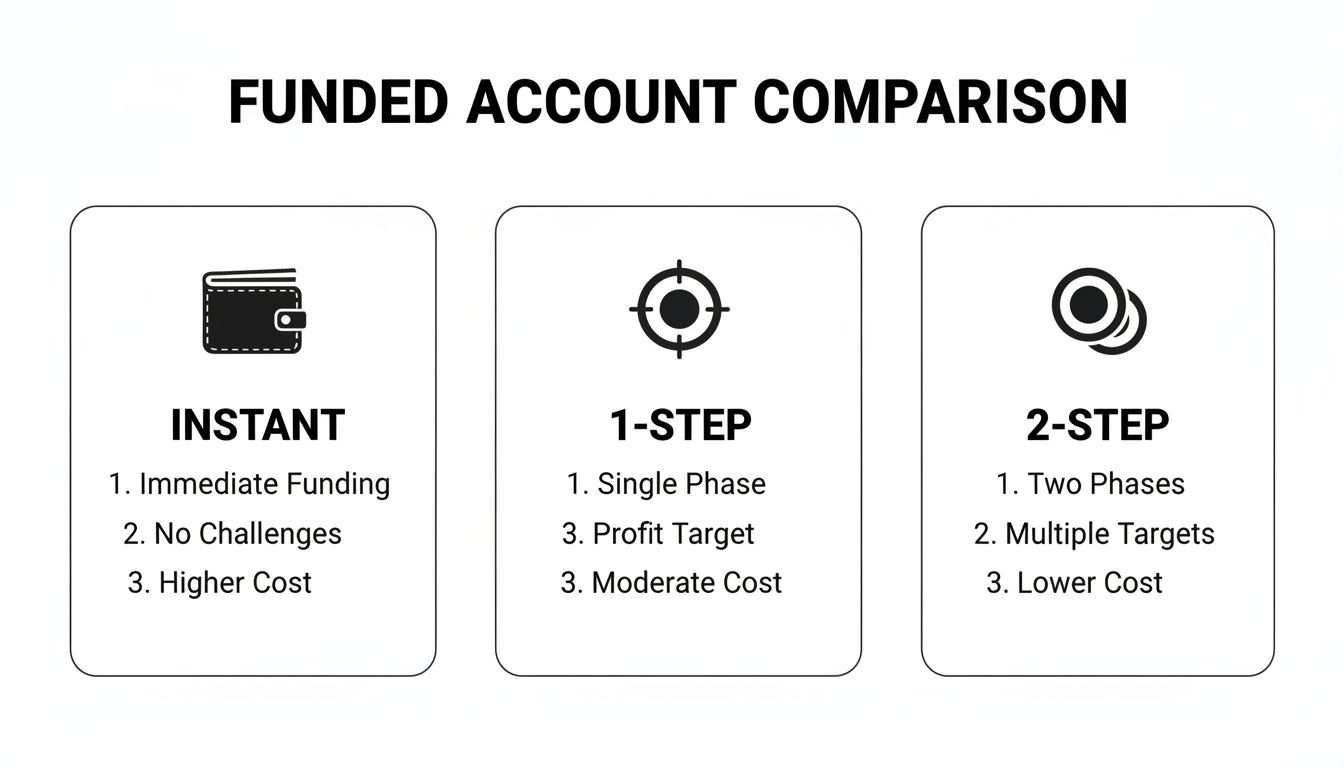
Choosing the right type of funded account is your first critical decision. The two main paths are Instant Funding and Challenge Accounts. Both lead to a funded account, but they cater to different types of traders and levels of confidence.
What Is An Instant Funding Account?
Instant Funding is the most direct route to trading with a firm’s capital. You pay a one-time fee and gain access to a funded account almost immediately, skipping any evaluation phases.
This model is designed for experienced traders who are confident in their strategy and want to start earning right away. There are no profit targets to hit or minimum trading days required. However, this speed comes with a trade-off: instant funding accounts typically have stricter drawdown rules to manage the firm’s immediate risk.
To see if this direct approach fits your style, check out our deep dive into prop firm instant funding.
Understanding Challenge Accounts
Challenge accounts are the industry standard. They require you to pass an evaluation to prove you can trade profitably and manage risk before you’re given a funded account.
1-Step Challenge
In a 1-Step Challenge, you must hit a single profit target, such as 10%, without violating any risk rules. Once you achieve the target, you get your funded account.
- Pro: It’s simpler and faster to complete than a 2-Step Challenge.
- Con: The profit target is generally higher.
2-Step Challenge
The 2-Step Challenge divides the evaluation into two phases. For example, Phase 1 might require an 8% profit target, while Phase 2 has a lower 5% target. You must pass both stages to get funded.
- Pro: The smaller profit targets in each phase can feel more manageable.
- Con: It takes longer to complete and requires sustained consistency.
Instant Funding vs Challenge Accounts at a Glance
This table breaks down the core differences to help you decide which model aligns with your trading profile.
| Feature | Instant Funding | Challenge Account (1-Step/2-Step) |
|---|---|---|
| Time to Get Funded | Almost immediate | A few weeks or more, depending on performance |
| Upfront Cost | Generally higher one-time fee | Lower initial fee |
| Evaluation Required? | No | Yes, must pass 1 or 2 phases |
| Risk Rules (Drawdown) | Typically stricter | Often more lenient, offering more room |
| Profit Split | Starts from your first profitable trade | Begins only after passing the challenge |
| Best For | Confident, consistently profitable traders | Traders who want to prove their skills first |
Ultimately, the “best” choice is the one that fits your strengths, confidence level, and trading style.
Navigating the Rules of Funded Trading
Getting a funded account is only the first step; keeping it requires discipline. Success depends on executing your strategy within a specific set of rules. These rules are designed to protect both you and the firm from significant losses and enforce professional risk management.
The most critical rules you must master are related to drawdown.
The Two Most Important Rules: Daily and Maximum Drawdown
Nearly every prop firm builds its risk model around two core pillars: Daily Drawdown and Maximum Drawdown. Violating either of these rules will typically result in the immediate closure of your account.
- Daily Drawdown: This is the maximum your account can lose in a single day, typically 5%. It’s crucial to know how your firm calculates this. Some use the starting balance of the day, while others track your live equity (balance +/- open positions).
- Maximum Drawdown: This is the total loss your account can sustain from its peak. For a $100,000 account with a 10% max drawdown, your equity can never drop below $90,000. If your account grows to $105,000, your new floor becomes $95,000.
A Practical Example of a Rule Violation
Let’s see how easy it is to violate a rule. Imagine you have a $100,000 account with a 5% ($5,000) daily drawdown.
- You enter a trade that quickly moves against you, creating an unrealized loss of $5,100.
- Your account equity has now dropped below the daily loss limit, triggering a violation.
- Even if you close the trade for a smaller loss of $4,000, it doesn’t matter. The violation occurred the moment your equity dipped too low.
A practical rule of thumb is to risk no more than 1% to 1.5% of your account on any single trade. This helps you stay well clear of the daily loss limit and absorb a string of losses without hitting your maximum drawdown.
Other Common Rules and Add-Ons
Beyond drawdown, firms have other rules you need to know. For a complete list, you should review the rules for live accounts here at MyFundedCapital. Common rules include:
- Profit Target: For challenges, the profit percentage you must achieve.
- Minimum Trading Days: Some firms require a minimum number of trading days in an evaluation.
- News Trading Restrictions: Many firms prohibit holding positions during major news events due to extreme volatility.
- Weekend Holding: Restrictions on holding trades over the weekend to avoid gap risk.
The strictness of these rules is why industry data shows evaluation pass rates are low, often between 5% and 10%. These figures aren’t meant to discourage you; they highlight that prop firms reward disciplined, consistent traders who prioritize risk management.
Cashing In: How Profit Splits, Payouts, and Scaling Actually Work
The ultimate goal of a funded account is to generate a consistent income. Understanding profit splits, payout schedules, and scaling plans is what turns trading from a hobby into a potential career. Let’s look at how you get paid.
How Profit Splits Work
The profit split is the percentage of the profits you earn that you get to keep. The industry has become highly competitive, with firms now offering splits of 80%, 90%, or even higher to the trader.
- Example: You are trading a $100,000 account and make a $5,000 profit. With a 90% profit split, your payout is $4,500. The firm retains the remaining $500.
Payout Schedules and Methods
Every firm has its own schedule for withdrawals. The trend is toward faster and more frequent payouts.
- First Payout: Typically available after a set period, such as 14 days from your first trade.
- Ongoing Payouts: After the first withdrawal, you can often move to a bi-weekly or even weekly payout schedule.
- Payout Methods: Top firms can process withdrawals via bank transfer or cryptocurrency (like USDC) in just a few hours.
To learn more about how firms are being compared, check out how data-driven rankings are shaping prop firm standards.
The Path to Growth: Scaling Your Account
A scaling plan is a firm’s system for rewarding consistent traders with more capital. This is a powerful tool for long-term growth. If you can prove you can profitably manage a $100,000 account, the firm will trust you with more.
Here’s a typical scaling process:
- Meet the Criteria: Achieve a specific profit goal (e.g., 10% over three months) while following all rules.
- Show Consistency: Demonstrate that your profits are steady (e.g., two of the three months were profitable).
- Receive More Capital: The firm automatically increases your account size, often by 25-30%, at no extra cost to you.
This cycle can repeat, allowing a disciplined trader to grow their account into the hundreds of thousands or more, turning a funded account into a long-term career path.
How to Choose the Right Prop Firm
Choosing the right prop firm is the most important decision you will make. A good partner can accelerate your career, while a bad one can be a waste of time and money. Focus on transparency, rules that fit your strategy, and reliable technology.
Prop Firm Evaluation Checklist
Use this checklist to compare firms and find a reliable partner.
| Evaluation Criteria | What to Look For | Why It Matters |
|---|---|---|
| Trust & Reputation | Verifiable payout proofs, positive community feedback, clear contact info. | Ensures the firm is legitimate and pays its traders on time. |
| Trading Rules | Reasonable drawdown limits (e.g., 5% daily/10% max), clear profit targets. | Fair rules give you a realistic chance to pass challenges and get funded. |
| Flexibility & Add-ons | Options for news trading, weekend holding, and no-stop-loss rules. | Allows you to trade your strategy without unnecessary restrictions. |
| Platforms & Tech | Modern platforms like cTrader, DXtrade, Match-Trader; low latency. | Reliable technology is crucial for precise execution and analysis. |
| Tradable Assets | Wide range of forex pairs, indices, commodities, and crypto. | More instruments mean more opportunities across different market conditions. |
| Customer Support | Fast, knowledgeable, and helpful support via live chat, email, or Discord. | Good support is vital when you have an urgent account or trade issue. |
| Payout System | Clear profit split, regular payout schedule (e.g., bi-weekly), multiple withdrawal methods. | You need to know how and when you’ll get paid for your successful trading. |
The prop firm industry has grown rapidly, with search interest increasing by over 600%. This competition benefits traders by pushing firms to offer better terms. You can find more analysis on the top prop firms and industry trends on tttmarkets.com. To understand the business model more deeply, read our guide on what proprietary trading firms are and how they work.
Frequently Asked Questions (FAQ)
Can I lose more than the fee I paid?
No. Your maximum financial risk is strictly limited to the one-time fee you pay for the program. The prop firm covers 100% of all trading losses, so your personal capital is never on the line.
Are funded trading accounts legitimate?
Yes, the funded trader model is a legitimate business, but due diligence is essential. Reputable firms have a proven track record of payouts, transparent rules, and active communities. Always research a firm thoroughly before committing.
What is the most common reason traders fail challenges?
The number one reason is poor risk management. Many traders fail by violating the daily or maximum drawdown rules, often by “revenge trading” with oversized positions after a loss. Consistent discipline is more important than a perfect strategy.
Do I need to be a full-time trader?
Not at all. The flexibility of funded trading makes it ideal for part-time traders. Success is determined by the quality of your strategy and your discipline in executing it, not the number of hours you spend in front of the charts.
This content is for educational purposes only and should not be considered financial advice. All trading involves risk.
Ready to take the next step in your trading career? At MyFundedCapital, we provide the capital, platforms, and support you need to succeed.
Explore our funded account programs and start your journey today.
