

 AR
AR
 NL
NL
 EN
EN
 FR
FR
 ES
ES
 IT
IT
 PL
PL
 SV
SV
 PT
PT

You're probably staring at a shortlist of brokers or prop firms that all claim tight spreads, fast payouts, strong platforms, and trader-friendly rules. Most of them look fine on the surface. The problem is that a broker can look good in marketing and still be a terrible fit for the way you trade.
Knowing how to pick a broker comes down to due diligence, not branding. The traders who avoid preventable problems usually run the same checks every time: safety first, then true cost, then platform fit, then rule alignment, then a hard-nosed shortlist comparison.
Your Broker Is Your Most Important Trading Partner
A broker isn't just a place to click buy and sell. It's the operating layer sitting between your strategy and the market, or between your strategy and a prop evaluation. If that layer is weak, your edge gets distorted by friction you didn't plan for.
That friction shows up in obvious ways, like bad execution, clunky withdrawals, or rules that don't match your trading style. It also shows up in quieter ways. A platform that crashes during active sessions, a support team that goes silent during verification, or a risk policy that looks simple until your strategy runs into it.
Practical rule: If a broker forces you to change a strategy that already works, it's probably the wrong broker.
This is why experienced traders don't start with the lowest advertised spread. They start with disqualification. If a broker or firm fails basic trust checks, there's nothing left to discuss. After that, the process becomes practical:
- Safety first: Is the firm legitimate, transparent, and accountable?
- Cost second: What do trades cost after spreads, commissions, swaps, and slippage?
- Platform fit: Does the tech support manual trading, EAs, APIs, or copy execution the way you need?
- Rule alignment: Can your strategy survive the firm's drawdown and trading restrictions?
- Final scoring: Which option wins when you compare it systematically instead of emotionally?
That's the framework professionals use because it cuts through hype. It also keeps you from picking a broker based on one attractive feature while ignoring the part that can damage performance.
First Filter Your Non-Negotiables for Safety

A trader passes evaluation, funds an account, lines up a strategy for NFP or CPI, then finds out the firm blocks news trading, voids fills around volatility, or delays withdrawals behind vague compliance checks. By that point, the problem is no longer pricing or platform preference. It is counterparty risk.
Start there.
Safety checks are not about marketing badges. They are about whether the broker or prop firm can be verified, whether the operating rules are clear, and whether the firm behaves predictably when money is on the line. For active traders, that includes a few checks generic broker roundups usually miss. Can you confirm the legal entity? Are trading restrictions written clearly enough for an EA, copier, or news strategy? Do payout terms, drawdown rules, and account reviews leave room for arbitrary decisions?
Verify the entity, not the brand
Never stop at “regulated” or “trusted by thousands.” Pull the regulator record yourself. Match the legal company name, license number, and website domain. If the register shows a different domain, or the site you are using is missing from the official record, that is enough to disqualify the firm.
Check these points directly:
- Legal entity name: The trading brand and the licensed company are often different.
- Domain match: Clone sites and lookalike domains are a common failure point.
- Permission scope: Some licenses do not cover every product or region the firm advertises.
- Client money disclosures: The firm should explain how funds are held and what protections apply.
- Contact trail: Real firms publish support, compliance, and complaints channels that are easy to find.
A serious operator answers direct operational questions without getting defensive.
Brokers and prop firms fail in different ways
For a retail broker, the first concern is custody and execution integrity. You need to know who holds client funds, how withdrawals are processed, and whether the firm gives straight answers about order handling.
For a prop firm, the first concern is rule enforcement. The account may be simulated, but the risk is still real if the firm can fail you or deny a payout under loose language. Read the rulebook like a trader, not like a shopper. Check whether daily drawdown is based on balance or equity, whether trailing drawdown locks in, whether lot size scaling is restricted, and whether latency arbitrage, copy trading, API access, weekend holds, or high impact news entries are limited. Those details decide whether your strategy fits before you pay a fee.
That same preference for verified process shows up in other online deals. Teams working with remote counterparties often use crypto escrow for developers because clear release conditions reduce trust risk. Broker and prop firm due diligence works the same way. Clear rules beat promises.
If a firm cannot explain how it handles disputes, rule breaches, or withdrawals, assume the problem will show up when your account matters most.
Required disqualifiers before any deeper comparison
Use this screen before you spend time on spreads, platforms, or funded account offers:
- No verifiable legal entity: Reject it.
- No public rulebook or terms that are too vague to test against your strategy: Reject it.
- No clear explanation of withdrawals, payout review, or account security: Reject it.
- Restrictions on EAs, APIs, news trading, or copy execution buried in fine print: Reject it.
- Inconsistent public handling of disputes, failed payouts, or slippage complaints: Investigate hard before proceeding.
- Sales pressure instead of direct answers from support or risk staff: Reject it.
If you want a grounded explanation of where risk usually sits, this piece on spotting scams in forex trading is worth reading. The issue is usually not the market itself. It is the operator, the contract terms, or the way the offer is presented.
Calculate Your True Cost of Trading
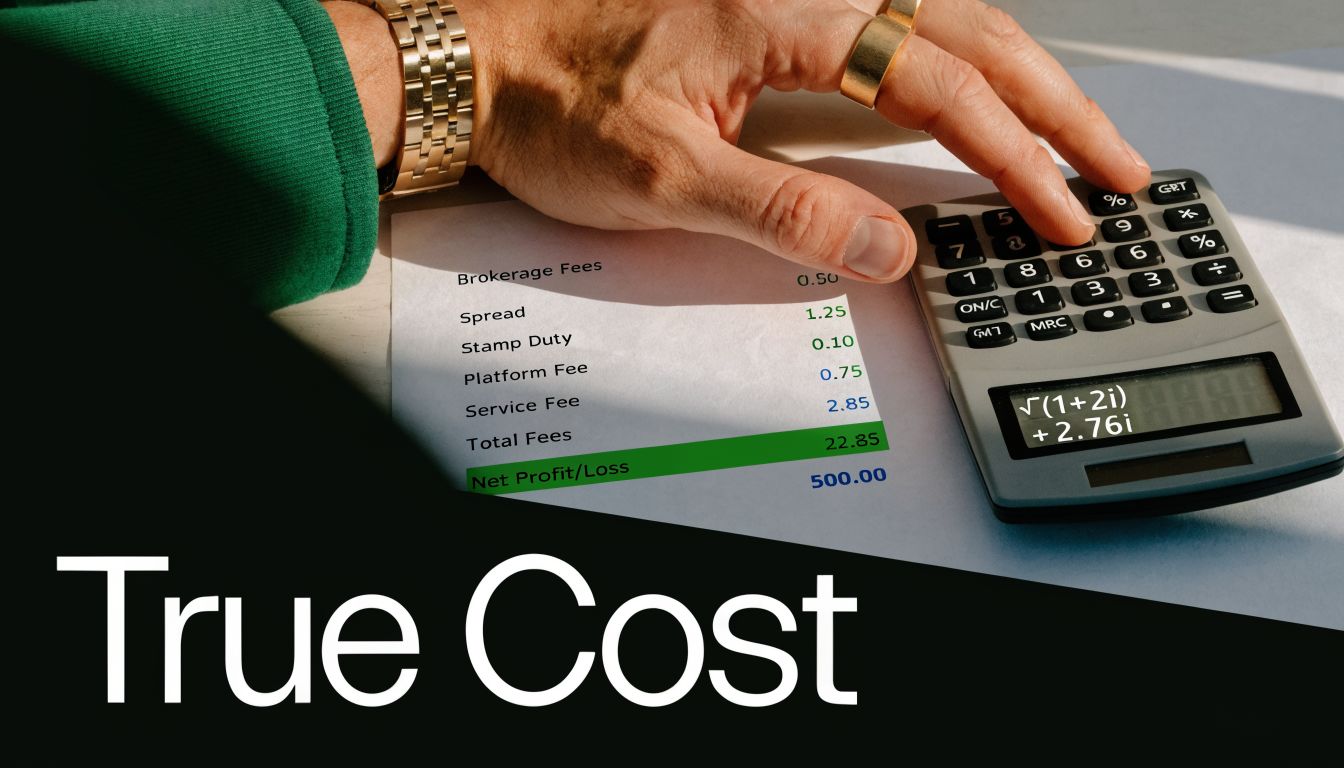
A broker can advertise low spreads and still be expensive. That happens all the time because traders focus on the number that's easiest to market, not the full cost of getting in, managing the trade, and getting out.
Your real cost includes more than spread. It includes commission structure, overnight financing, execution quality, and whether the broker creates friction around deposits or withdrawals. In brokerage operations generally, cost discipline matters more than many people realize. CREtech notes that the average Operating Expense Ratio ranges between 24% and 27% of revenue, and that a firm paying average broker splits of 65% with an Opex Ratio of 29% is left with only 6% operating profit margins in that example, which shows how thin margins can get when costs are handled poorly in brokerage businesses (CREtech KPI discussion).
That doesn't tell you what your broker charges on a trade. It tells you something just as useful. Firms under cost pressure have incentives you need to understand.
Build your all-in cost checklist
Most traders should track costs in a simple journal for each broker they test.
Include these items:
- Spread at entry and exit: Record it on the instruments you trade, not the headline pair on the homepage.
- Commission per side or round turn: Some firms look cheap until commission is added.
- Swap or overnight fees: These matter a lot for swing traders and weekend holders.
- Slippage during active conditions: News, opens, and fast markets expose the truth.
- Deposit and withdrawal friction: Fees, delays, or repeated compliance requests all count as cost.
- Inactivity or platform charges: Small line items add up if you're testing multiple venues.
A useful breakdown of pricing mechanics is in this guide to spreads in trading. Don't read it as theory only. Use it to build your own comparison sheet.
Don't judge execution from a handful of trades
Execution quality is one of the easiest things to misread because short samples lie. One clean fill proves nothing. One ugly fill also proves nothing.
According to FXReplay's KPI guide for backtesting and performance assessment, you need a minimum of 100–200 trades before performance statistics become meaningful, and any conclusion based on fewer than 20 trades is statistically worthless because of random variance.
That standard is useful for broker testing too.
What to track over a real sample
Keep it simple. Over a meaningful trade sample, log:
| Item | What you're checking |
|---|---|
| Entry quality | Whether market or limit orders fill where expected |
| Exit quality | Whether stops and targets behave consistently |
| Session behavior | Whether execution degrades during the times you trade |
| Cost drift | Whether actual cost stays close to what was advertised |
| Platform stability | Whether lag, disconnects, or freezes appear under pressure |
Test the broker under the conditions that matter to your strategy. A calm mid-session fill tells you little if you trade breakouts, news, or session opens.
What usually doesn't work
Traders get this part wrong in predictable ways:
- They test on random pairs: Your broker test should match your strategy universe.
- They ignore holding costs: Fine for scalpers. Dangerous for anyone holding longer.
- They compare screenshots instead of statements: Marketing views aren't evidence.
- They chase the cheapest headline spread: Cheap and tradeable aren't the same thing.
When you're learning how to pick a broker, cost analysis should feel boring and repetitive. That's a good sign. It means you're looking at what affects survival instead of what sells well on social media.
Match Platforms and Technology to Your Strategy

Platform choice matters more than most beginners think. If your platform fights your workflow, you'll either make operational mistakes or start altering a strategy just to fit the software. Both are expensive.
This isn't about brand loyalty. It's about matching the platform to the job.
Compare the platform to the way you trade
Here's the practical version:
| Trading style | What matters most |
|---|---|
| Manual day trading | Fast order entry, clean charting, stable execution, easy trade management |
| Algorithmic trading | API access, automation support, stable environment, reliable order handling |
| Copy trading | Consistent execution logic, account syncing, low operational friction |
| Swing trading | Easy position management, clear financing visibility, holding-rule support |
If you're deciding between common options, the useful questions are straightforward.
cTrader
cTrader tends to appeal to traders who want cleaner order management and a stronger environment for systematic or advanced discretionary trading. If your workflow depends on precision and a less cluttered interface, it's often worth testing seriously.
DXtrade
DXtrade is common in the prop space because it feels modern and easy to use. That doesn't automatically make it right for you. Check how it handles your specific execution flow, especially if you scale in, manage partials, or use external tools.
MT5
MT5 remains familiar to a huge number of traders. Familiarity helps, but don't confuse “I know where the buttons are” with “this is the best fit for my strategy.”
A broader overview of workflow differences is covered in this guide to the best FX trading platform. Use that kind of comparison as a starting point, then test the details yourself.
Risk rules must fit your actual edge
Many traders often fail broker selection even after choosing a decent platform. They don't compare the firm's rules to the behavior of their own system.
A critical step in broker selection is aligning the broker's risk rules with your strategy's historical performance. If your strategy's expected drawdown exceeds the broker's limit, success becomes a statistical impossibility, as noted in this discussion on matching broker choice to your needs.
That matters a lot in prop trading because rule breaches can invalidate otherwise good trading.
A simple alignment test
Ask these questions before opening an account:
- How deep does your strategy normally draw down?
- How often does it cluster losses in one session?
- Does it require holding through news or over the weekend?
- Does it perform best with manual discretion or automation?
- Does it need copy execution across multiple accounts?
If the honest answer doesn't fit the rulebook, don't rationalize it.
If your tested strategy needs room the broker won't allow, the issue isn't discipline. The issue is mismatch.
One broker can be right for one trader and wrong for another
This is why generic “best broker” lists are weak. A discretionary EUR/USD scalper, an index trader holding through events, and an EA trader running automation are not solving the same problem.
For example, one prop option in the market is MyFundedCapital, which supports 350+ instruments, offers DXtrade and cTrader, and uses published risk parameters including a 5% daily loss limit and up to 10% maximum drawdown, with optional add-ons for news trading and weekend holding according to the firm's published materials. That may fit some active traders well and rule others out immediately. That's exactly how you should think about every broker or prop firm.
The point isn't to find a universally perfect platform. It's to find the one that doesn't interfere with the way your edge works.
Evaluate Instrument Coverage and Trading Conditions
A trader passes the safety checks, likes the platform, and sees a long product list. Then problems emerge. The broker offers the symbol, but not during the session they trade. The spread blows out during the open. News orders get rejected. The API supports basic routing but not the order logic their system needs. On paper, the market is available. In practice, the setup is dead.
That is the filter here. Instrument coverage only matters if the product is tradable under conditions your strategy can survive.
Coverage has to match actual use
Broker review frameworks often score firms on product range, fees, platform quality, support, and account features. Fair enough. Active traders need a narrower check. The question is whether the broker or prop firm supports the exact instruments, sessions, order types, and position management rules the strategy uses.
A broad list of CFDs, futures, spot FX pairs, or crypto markets can still be a poor fit. I care less about the headline count and more about the practical subset I can trade repeatedly without workarounds.
Review coverage through that lens:
- Forex traders: Check your primary pairs, your trading session, average spread behavior, and whether execution changes around rollover or major releases.
- Index traders: Verify the exact index products offered, trading hours, margin treatment, and whether fast markets trigger restrictions.
- Crypto traders: Confirm weekend access, overnight holding rules, and how the firm handles pricing, spread changes, and forced closures.
- Commodity traders: Check rollover handling, contract mapping, financing or swap treatment, and whether the product tracks the underlying market cleanly enough for your method.
A listed market can still be unusable
This is common with prop firms and with brokers that advertise flexibility but apply tight operational controls once volatility picks up.
News trading is the first thing I check. Some firms permit it. Others allow trading near data releases but reserve broad discretion on fills, slippage complaints, or profit validity. If your edge depends on breakouts around CPI, NFP, central bank decisions, or inventory data, vague policy language is a real risk.
Weekend holding is another fault line. Swing traders and crypto traders need a clear answer before funding an account. If positions must be closed before the weekend, or if holding is allowed only on selected instruments, the strategy may need to be rebuilt from scratch.
Then check session behavior. A broker can look fine in quiet conditions and break down exactly when your setup appears. Spreads widen, margin treatment changes, market orders slip hard, or the platform lags during the open. None of that shows up in a product catalog.
Algorithmic traders need a different level of detail
Retail comparison tables rarely cover the questions that matter to system traders. They should.
If you run EAs, scripts, or external execution tools, test the actual infrastructure:
- API and automation support: Is there an API, bridge, or platform environment that fits your stack?
- Order handling: Can you place stop, limit, bracket, partial close, and modification logic the way your system requires?
- Latency and stability: Does execution remain consistent during the periods you trade, not just at midday when nothing is happening?
- Copy trading or multi-account execution: If you mirror trades across accounts, is that allowed and operationally realistic?
- News and high-frequency restrictions: Some firms tolerate automation until it trades too fast, too often, or too close to scheduled events.
A platform can be good for discretionary trading and wrong for automated execution. Those are different evaluations.
Support is part of trading conditions
Support gets dismissed as a soft factor by traders who have not had an account frozen, a payout questioned, or a rule interpretation change after a strong week.
I test support before I deposit anything meaningful. Ask a specific question that matters to your method. For example: “If I hold XAU/USD through NFP using an EA that modifies stops, is that permitted, and where is the rule written?” A useful firm answers directly, points to the policy, and stays consistent if you ask again later. A weak one replies with generic sales language or leaves room to reinterpret the rule after the fact.
Look for four things:
- Precision: Do they answer your exact scenario?
- Timing: Are they available during your market hours?
- Consistency: Do different agents give the same answer?
- Escalation: Can someone competent handle platform, execution, or compliance questions?
Good support does not rescue bad trading conditions. It does reduce the chance of expensive surprises.
What to test before committing
Skip generic review surfing for a moment and run a short due diligence drill:
- Trade or demo the exact instruments you plan to use.
- Test the hours that matter to your strategy, especially opens, closes, and data releases.
- Ask direct questions about news trading, weekend holds, automation, copy trading, and payout treatment.
- Read the product specifications and policy language line by line.
- Check whether the firm's restrictions line up with your average hold time, trade frequency, and execution style.
Brokers and prop firms distinguish themselves quickly. The right choice is usually the one that lets your process run as tested, with clear rules, stable access, and no hidden friction where your edge is supposed to show up.
The Final Decision Matrix Scoring Your Shortlist
When you've narrowed the list down, stop browsing and score the candidates. At this point, gut feel gets traders into trouble. A firm with a polished website can still lose to a less flashy option once you compare what matters.
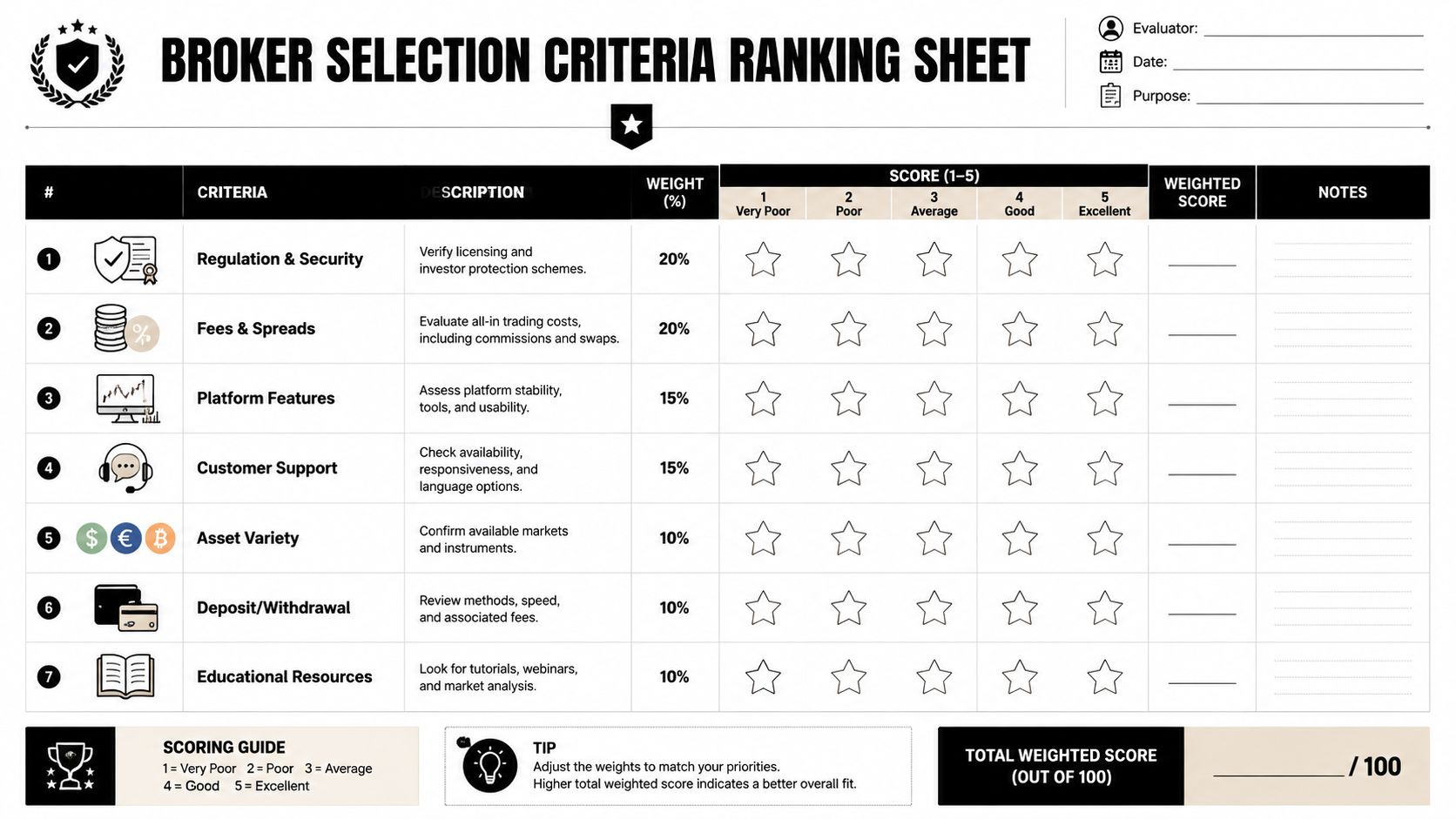
Professional risk managers use a standardized Broker Selection Criteria Ranking Sheet that scores candidates numerically across weighted factors such as technical competence, market access, and financial condition, rather than relying on subjective impressions, as described in this broker selection ranking framework.
A simple ranking sheet that works
Create a sheet with two columns for each broker:
| Criterion | Weight based on your style |
|---|---|
| Safety and transparency | High |
| All-in trading cost | High |
| Platform fit | High |
| Rule alignment | High |
| Instrument access | Medium to high |
| Support responsiveness | Medium |
| Payout and withdrawal process | Medium to high |
Then score each broker against each criterion using one consistent scale. The exact scale matters less than consistency.
Two trader examples
Discretionary forex day trader
This trader should weight execution quality, platform responsiveness, and intraday rule clarity heavily. Weekend holding may matter less. API access may matter very little.
Crypto swing trader
This trader should weight weekend holding rules, financing clarity, and support responsiveness more heavily. A clean-looking platform matters less than whether the firm allows the positions the strategy requires.
The mistake is using someone else's weighting system. A broker that wins for a manual intraday trader may lose badly for an algo or swing trader.
The best broker for you is the one that scores highest against your process, not the one with the loudest marketing.
If you want a cleaner answer, make the process more objective. The more specific your scorecard is, the less likely you are to choose a broker you'll regret three weeks later.
Frequently Asked Questions
What's the difference between a retail broker and a prop firm
A retail broker gives you market access to trade your own capital. A prop firm gives you access to a simulated funding model and pays you a share of profits if you trade within its rules. The practical difference is that prop firms usually add tighter operating rules around drawdown, payout eligibility, and trading behavior.
Is an unregulated broker ever worth the risk
For most traders, no. If there's no meaningful oversight, your options in a dispute are weaker and the trust burden shifts entirely onto the operator. That's not a smart place to start.
How much does platform choice really matter
A lot. Platform choice affects order entry, management, automation, copying, and your day-to-day error rate. A platform doesn't need to be famous. It needs to fit your workflow.
Should I switch brokers quickly if I'm unsure
Not based on a few trades or one bad session. Test properly, review your journal, and make the decision from evidence. If the problem is structural, switch. If the problem is random short-term variance, more data usually clears that up.
Trading involves risk of loss. This article is for educational purposes only and isn't financial advice.
If you want to apply this checklist to a prop environment, explore MyFundedCapital and compare its funding programs, account types, platform options, and rule set against your own strategy before starting a challenge.
