ES
ES
 DE
DE
 FR
FR
 AR
AR
 IT
IT
 NL
NL
 PL
PL
 SV
SV

Electrician work is one of the strongest answers to what is the hardest trade to learn, with most U.S. apprenticeships lasting four or five years and involving about 2,000 paid training hours each year. For active traders, however, the hardest “trade” isn't a single market. It's the style that taxes the skill you haven't built yet.
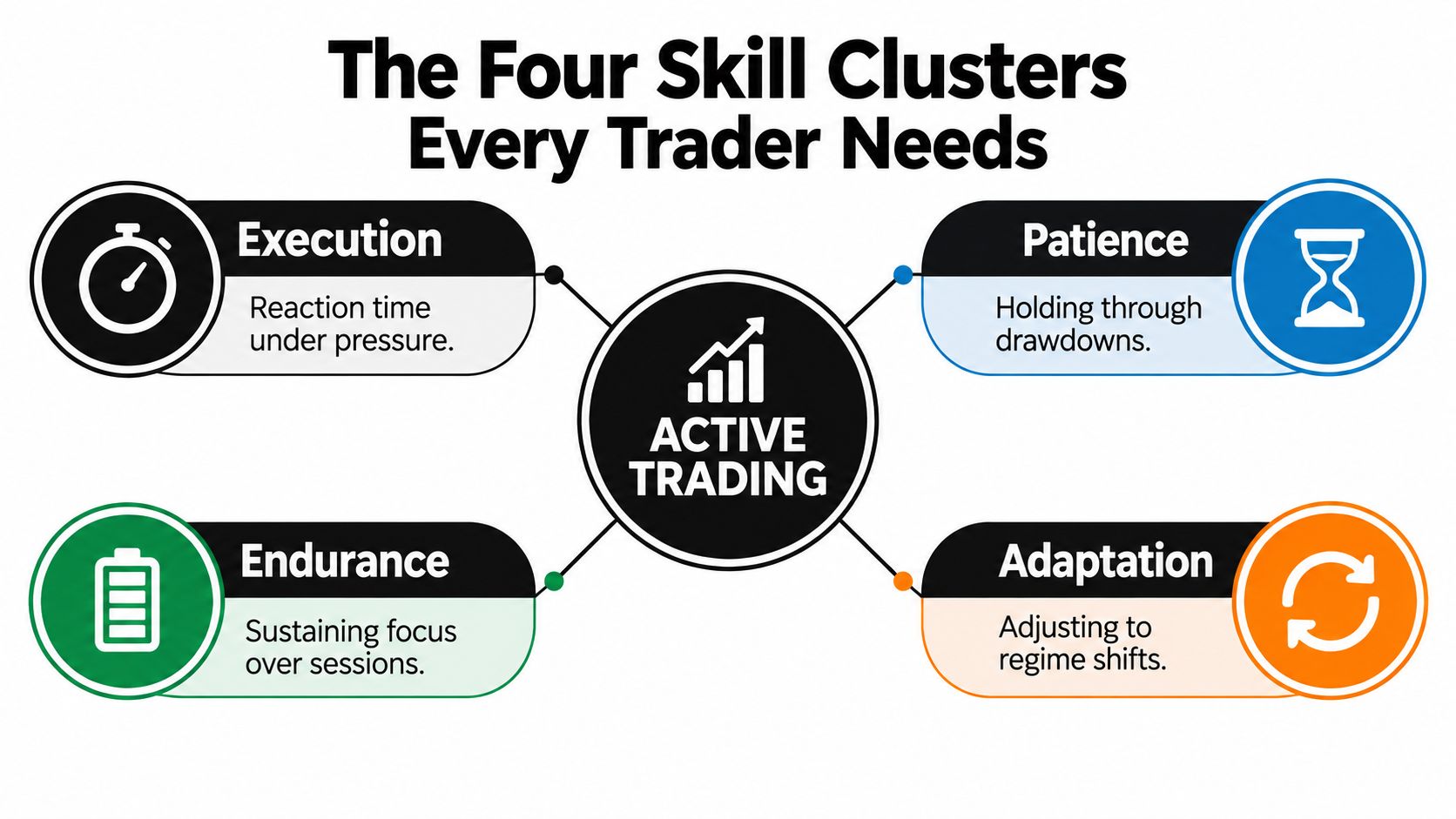
That distinction matters if you're choosing between scalping, short-dated options, macro swing trading, event trading, crypto, or a prop-firm evaluation. We'll compare them through four skill clusters: psychology, execution, edge development, and risk math. Scalping and short-dated options usually filter beginners fastest on execution, while macro swing and event trading expose weaknesses in patience and probabilistic thinking.
Why Asking the Hardest Trade Gets the Wrong Answer
A market doesn't become difficult merely because its chart looks complicated. Difficulty comes from the interaction between the instrument, the trading tempo, the size of the decisions, and the person making them.
Electrical work offers a useful comparison. The U.S. Bureau of Labor Statistics says most electricians complete a four- or five-year apprenticeship, with each year typically including about 2,000 hours of paid on-the-job training. That means a conventional path represents roughly 8,000 to 10,000 workplace hours before independent qualification. The work combines mathematics, theory, blueprint reading, diagnostics, safety procedures, and legal code requirements, which is why it makes a strong benchmark for a difficult skilled trade (U.S. Bureau of Labor Statistics electrician profile).
Trading has the same layered structure, but the layers look different.
- Execution Can you enter, manage, and exit without hesitation when the price moves?
- Probabilistic thinking Can you act on an edge without pretending the next outcome is certain?
- Emotional regulation Can you follow your rules after a loss, a missed trade, or a winning streak?
- Risk mathematics Can you calculate position size, borrowed capital, payoff, margin, and drawdown before the order goes live?
Your background changes the answer
Ask yourself one diagnostic question: Which part of trading makes you uncomfortable before you even place an order?
A coder may enjoy structured risk math but struggle with uncertainty. A nurse may stay calm during fast decisions yet dislike sitting through an open position. A former athlete may tolerate repetition and pressure but become overconfident after a winning streak. A patient analyst may build a strong thesis but interfere with it when the market takes days to confirm it.
That's why the same trading book can help one person become a disciplined scalper and push another toward overtrading. The material isn't the whole system. Fit between the trader and the market's tempo matters just as much.
The hardest trade to learn, then, is the one that overloads your weakest cluster. A fast market exposes slow execution. A long holding period exposes impatience. A margin-intensive derivative exposes weak risk math. A news release exposes traders who confuse a plausible story with a measured probability.
Practical rule: Don't ask which market is hardest in general. Ask which market makes your current weakness expensive.
Use that question before you open a new platform or buy another strategy. Score yourself on execution speed, patience, uncertainty tolerance, and mathematical fluency. Then choose a style that challenges one weakness without overwhelming all four.
Scalping and Short-Dated Options Demand Execution Most
The common assumption is that scalping is easy because positions are closed quickly. The opposite is usually true. A short holding period gives you less time to correct a bad entry, poor sizing, a missed fill, or a delayed exit.
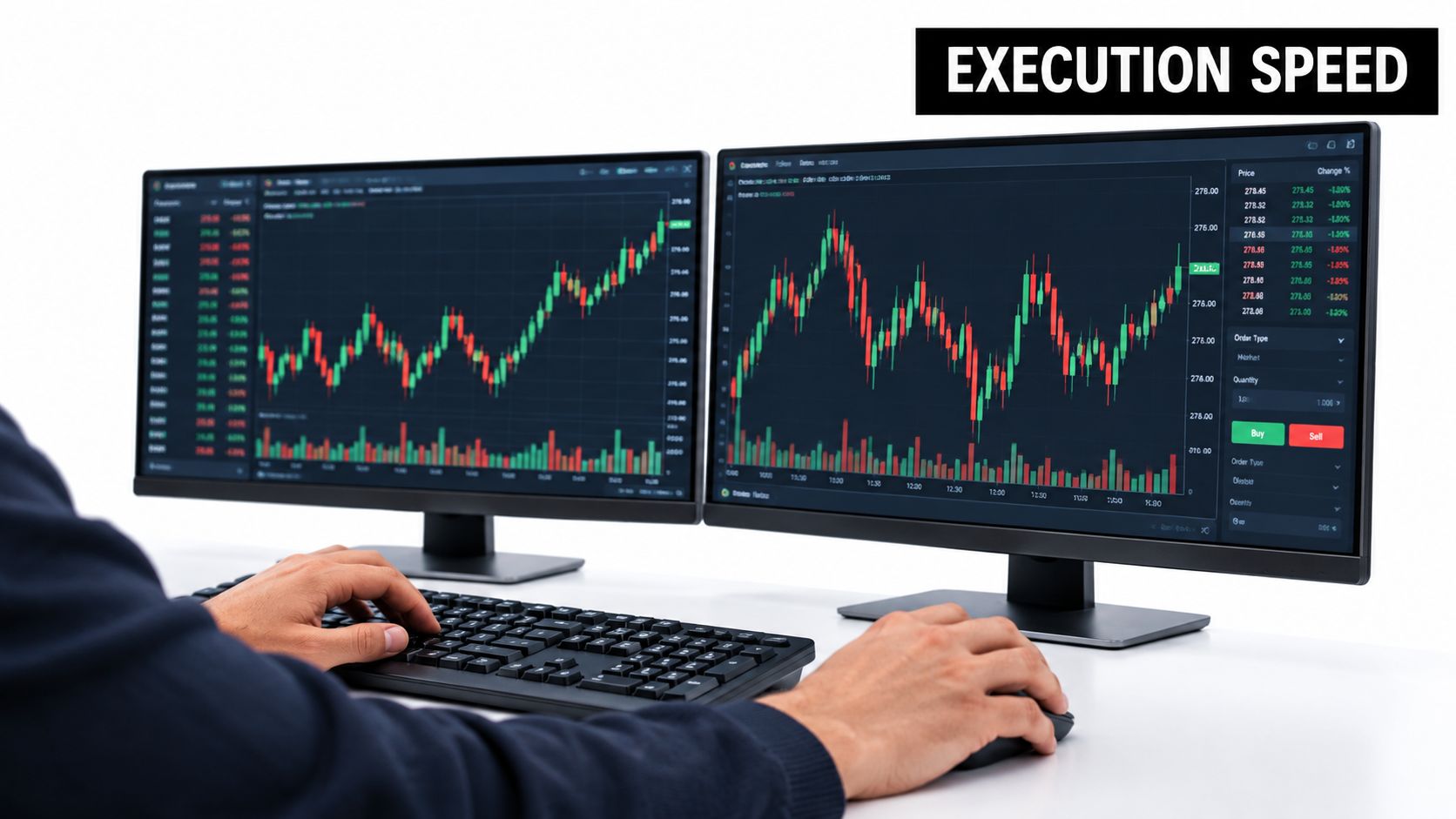
A scalper repeats the same micro-decision loop:
- Read the market context.
- Identify the setup.
- Calculate size and invalidation.
- Enter without chasing.
- Manage the position.
- Exit according to the plan.
- Record the fill and the result.
On a tight timeframe, those decisions may happen within seconds. The problem isn't only reaction speed. Every small execution error changes the trade's expectancy, and repeated errors can turn a sound idea into a poor process.
A simple example shows why. Suppose a trader operates a $25,000 account and misses a planned stop by 2 ticks on five scalps per day over a typical month. The dollar impact can't be stated without knowing the instrument, tick value, number of sessions, and position size. The lesson is still clear: a small execution mistake becomes material when repeated, especially if the trader increases size to recover from it.
Short-dated options add a second layer. A trader can correctly anticipate direction and still lose because the option's price depends on more than direction. Gamma, implied volatility, time decay, spread, and the path of the underlying all matter. A call can move in the expected direction while losing value if implied volatility falls sharply after the event.
Drills that build speed without gambling
Use practice to isolate execution from emotional exposure.
- Simulator repetition Trade one setup in a simulator until you can explain the entry, invalidation, and exit without improvising.
- Fill journal Record intended price, actual fill, spread, slippage, and the reason for every delay.
- Tape review Rewatch the same market segment and mark the first valid signal, the chase point, and the point where the setup failed.
- Options decomposition Before trading a short-dated contract, write down the directional thesis, volatility assumption, time horizon, and maximum acceptable loss.
- Hard stop testing Test whether your platform, order type, and connection behave as expected before relying on them with capital.
For foreign exchange, market mechanics create another learning hurdle. The Bank for International Settlements reported that global over-the-counter FX turnover averaged $7.5 trillion per day in April 2022, up from $6.6 trillion in 2019. FX swaps represented 51% of that turnover, which shows why contract structure matters alongside chart reading (BIS Triennial Survey release).
A useful execution checklist is simple:
- Calculate pip value before entry.
- Calculate margin and account risk.
- Define stop distance.
- Check spread and likely slippage.
- Know whether you're trading spot, a forward-style product, or a swap-based instrument.
A detailed scalping strategy for forex can help organize that process, but no strategy removes execution risk. Trading involves risk of loss, and margin can magnify losses as well as gains.
Macro Swing and Position Trading Demand Patience Most
Swing trading looks calmer than scalping because the trader isn't clicking constantly. That calm is deceptive. The central test is whether you can leave a valid position alone while the market moves against you without invalidating the thesis.
Consider a weekly crude oil swing with a 600-pip stop and a 1,500-pip target. If the position takes three weeks to resolve, the challenge isn't just finding the setup. The trader must sleep while the trade fluctuates, resist checking every candle, and avoid widening the stop because the unrealized loss feels uncomfortable.
Those figures describe an example, not a universal crude oil setup. The broader point is that a wide stop and extended holding period demand emotional endurance that a fast trader may not possess.
The decision matrix
Before entering a swing or position trade, grade the setup on three separate questions:
- Edge What repeatable condition gives this trade a positive expectation?
- R-multiple Is the potential reward large enough relative to the defined risk?
- Time efficiency Is the expected return worth tying up attention and capital during the holding period?
| Style | Execution Speed | Probabilistic Thinking | Emotional Endurance | Risk Math |
|---|---|---|---|---|
| Scalping | Very high | High | High during sessions | High |
| Short-dated options | High | Very high | High | Very high |
| Macro swing | Moderate | High | Very high | High |
| Event trading | High around releases | Very high | High | Very high |
| Crypto trading | Varies by regime | High | Very high | Very high |
Swing traders also face a quieter temptation: over-trading between setups. A trader who expects action every day may force entries just because the intended market is inactive. That behavior replaces patience with activity and makes a strategy difficult to evaluate.
The better question isn't whether you can predict the next candle. It's whether you can define the invalidation point, accept the risk, and leave the thesis untouched until new information genuinely changes it.
The hardest part of position trading is often not analysis. It's refusing to edit a valid plan because the market has become emotionally uncomfortable.
For a fuller comparison of holding periods and trade management, review position trading versus swing trading. The right choice depends on whether your temperament can tolerate time in trade, not on which style looks more impressive.
News and Event Trading Demand Probabilistic Thinking Most
Event trading punishes traders who mistake a strong narrative for an edge. Before CPI, FOMC, NFP, earnings, or a major crypto token release, the market has already formed expectations. The release matters through the gap between the actual result and what participants had priced in, followed by the reaction across related assets.
A useful event process starts before the headline:
- What is already priced in?
- What second-order reaction could follow the initial move?
- Where are the clustered strikes, stops, or liquidity zones?
- What is my time stop if the move doesn't develop?
An FOMC session can show why direction alone isn't enough. The S&P 500 might initially spike 1% on the statement and then reverse 2% by the press conference. A trader who bought the first move may lose despite being directionally aligned with the initial reaction. A properly structured directional straddle could benefit from a large move, but the outcome would still depend on premium, implied volatility, timing, and execution.
Those figures are a market-shape example, not a claim about a particular historical session. The important principle is that event trades contain multiple phases, and the first move isn't necessarily the final information response.
Write the probability before the order
Before entering, state a probability estimate in plain language. For example:
- There is a moderate chance of an upside continuation if the release beats expectations and yields confirm.
- There is a meaningful reversal risk if the initial move isn't supported by rates or breadth.
- If neither condition appears within the defined time window, the position gets closed.
This process forces you to separate scenario planning from prediction. If you can't describe what would increase or decrease the odds, you're reacting to a story.
Sleep also affects decision quality during high-pressure sessions. Traders who work late or monitor every time zone can review practical guidance on how to improve decision fatigue through sleep before building an event routine.
News trading can be especially difficult for prop traders because the firm's rules may restrict releases, spreads, or holding conditions. A structured news trading forex strategy should therefore include the permitted event window, order behavior during volatility, and the maximum loss if liquidity disappears.
Event trading is closer to gambling when a trader enters without an explicit probability, invalidation, and time stop. The chart may look compelling, but conviction isn't a substitute for a defined distribution of outcomes.
Crypto Volatility and 24-7 Markets Demand Endurance Most
Crypto removes the natural closing bell. That changes the psychological burden before it changes the chart. A trader can hold a position through overnight news, a weekend liquidity pocket, an exchange problem, or a liquidation cascade without receiving a clean pause.
A Bitcoin funding-rate flip and a $500 million long liquidation can disrupt a technically valid setup. Those events can force price through nearby levels, trigger stops, and create a wick that makes a normal chart pattern look broken. The size of the liquidation is an illustrative scenario, not a claim that every funding-rate change produces that outcome.
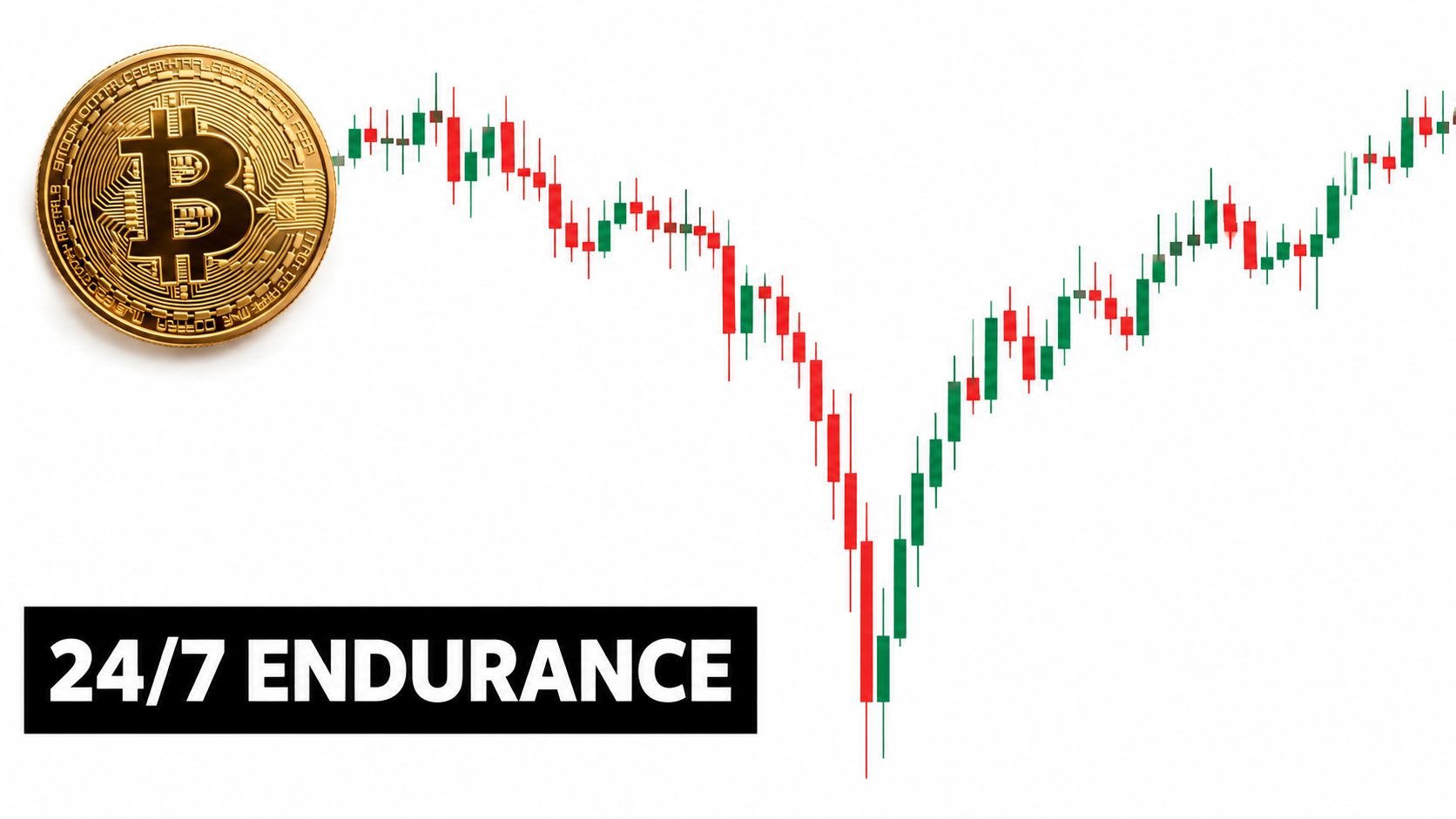
Consider a long ETH scalp triggered by a valid four-hour breakout. A large market order on a thin venue could create a flash wick, stop the trade, and then allow price to recover. The technical signal wasn't necessarily irrational. The trader's venue selection, stop placement, position size, and assumption about liquidity were incomplete.
A crypto survival checklist
- Funding rates Track whether positioning is becoming crowded before adding borrowed funds.
- Exchange health Check maintenance notices, outages, withdrawal conditions, and unusual spreads.
- Venue liquidity Compare the depth and execution quality of the venue you're using.
- Weekend exposure Default to smaller size when liquidity and participation change.
- Liquidation distance Know how far price can move before forced closure becomes possible.
- Correlation risk Treat several positions with the same directional exposure as one larger risk.
Prop firms may offer weekend-holding add-ons because continuous markets create a different exposure profile from weekday-only trading. Risk parameters such as a 5% daily loss limit and 10% maximum drawdown are designed to stop a trader from turning one volatility event into an account-ending sequence. They don't make a strategy profitable. They create boundaries around the damage a poor decision can cause.
Endurance means more than watching charts for longer. It means choosing when not to participate, reducing size when conditions are unstable, and accepting that missing a weekend move is cheaper than carrying uncontrolled risk through it.
Where Each Style Filters Traders Out
Every style has a predictable failure point. Identifying it early is more useful than memorizing a universal ranking.
| Style | Common filter | What the trader must control |
|---|---|---|
| Scalping | Poor fills and overtrading | Entry quality and trade frequency |
| Short-dated options | Mis-sized convexity exposure | Premium, gamma, volatility, and time |
| Swing trading | Mid-trade interference | Stops, position size, and patience |
| Event trading | Misreading consensus | Expectations, scenarios, and time stops |
| Crypto | Weekend exposure and stacked leverage | Venue, size, and liquidation risk |
Score yourself from 1 to 5 on four abilities:
- Execution speed How quickly can you act without chasing?
- Patience Can you wait through inactivity and drawdown?
- Uncertainty tolerance Can you follow a plan when several outcomes remain possible?
- Math fluency Can you calculate risk, payoff, margin, and exposure before entry?
Then match your two strongest scores to a style. High execution and math may point toward structured intraday trading. High patience and uncertainty tolerance may fit macro swing or position trading. A high score in only one category isn't enough. Short-dated options, for example, demand both rapid execution and strong risk math.
The same idea appears in other demanding fields. Aviation training involves decisions under workload, stress, changing conditions, and limited time. Research on flight simulation found that cognitive reflection, accumulated flight time, and task load significantly predicted decision-making performance, with cognitive reflection also affecting how experience translated into performance (flight-simulation decision-making research).
Electrical work shows the training-pipeline side of the problem. A general electrician apprenticeship standard specifies 8,000 hours of continuous employment, while residential and limited-energy pathways require about 4,000 and 4,800 hours respectively (electrical apprenticeship standard). The lesson applies to trading: competence isn't proven by understanding a concept once. It's built through supervised repetition, fault analysis, and consistent decision-making.
Picking a Starting Style That Fits Your Wiring
Choose your first style based on how you learn, not on what is trending online.
The fast thinker
You learn by doing and can make quick decisions without freezing. Start with a simulator, one liquid instrument, one session, and a single setup. Your danger is overconfidence, so your journal should emphasize missed trades, impulsive entries, and execution quality rather than only profit.
The analytical patient trader
You learn through review and can wait for a defined condition. Swing trading may give you enough time to calculate size and document the thesis. Your danger is interference. Set a review schedule so you aren't constantly searching for reasons to move the stop.
The macro thesis builder
You learn by reading and connecting economic conditions across markets. Position or event trading may suit you, but your process needs a probability table. Write what the market expects, what would surprise it, and what evidence would invalidate the thesis.
Paper trading and simulated challenges make sense before real capital. Use a fixed session time, a defined risk budget, and limits modeled on prop-firm evaluations, such as a 5% daily loss limit and up to 10% maximum drawdown. Those parameters are guardrails, not permission to risk the full amount.
Account structure also changes the learning experience. Instant Funding provides immediate live-style trading under the firm's rules, while a 1-Step or 2-Step Challenge gives you an evaluation path before access to a larger account. Smaller account sizes, such as $5K to $25K, can provide a more controlled calibration of process and feedback. A stated 80/20 profit split may be appropriate when the priority is learning how you behave under rules rather than maximizing nominal account size.
For U.S. equity day traders, regulatory constraints matter too. The SEC summarizes FINRA rules stating that a pattern day trader generally executes four or more day trades within five business days, with those trades representing more than 6% of total trades in the margin account. That classification requires at least $25,000 in account equity and limits buying power to four times maintenance-margin excess (SEC investor bulletin on day trading).
Build the Right Foundation Before You Risk Real Capital
A serious starting plan should measure behavior before it measures ambition.
| Phase | Weeks | Focus | Metric to Track |
|---|---|---|---|
| Process | 1 to 4 | One style, instrument, session, and risk budget | Rule adherence |
| Evaluation | 5 to 8 | Simulated or funded practice with a fault log | R-multiple, win rate, duration |
| Scale or pivot | 9 to 12 | Change one variable at a time | Stability across trades |
Weeks 1 to 4
Pick one style, one instrument, and one session time. Record every trade in R-multiples, including trades you skipped and trades you entered outside the plan. Your objective is not to prove that the strategy works in every condition. It's to discover whether you can execute the same process repeatedly.
Weeks 5 to 8
Move into a simulated evaluation or a carefully selected funded environment. Track R-multiple, win rate, average trade duration, maximum adverse excursion, and rule violations. Keep a fault log with five fields: symptom, measurement, probable cause, correction, and verification.
Weeks 9 to 12
If the process remains stable, increase size slowly. If it doesn't, change one variable, such as session, setup, or stop method. Don't replace the entire system after a small sample of outcomes. A full reset prevents you from learning which part failed.
Trading involves risk of loss. Borrowed capital magnifies losses as well as gains, and no educational article can make a volatile market safe or guarantee a payout. Treat every account rule as a risk boundary, not as a target for maximum damage.
Frequently asked questions
What is the hardest trade to learn for a beginner?
There isn't one universal answer. Scalping and short-dated options are often hardest for traders with slow execution or weak risk math, while macro swing and event trading are harder for traders who can't tolerate uncertainty, inactivity, or drawdowns.
Is scalping harder than swing trading?
Scalping demands faster decisions and more precise execution. Swing trading demands patience, position sizing, and the ability to leave a thesis alone. The harder style is the one that conflicts with your weakest skill cluster.
Should I start with forex, crypto, or options?
Start with the market whose mechanics you can explain clearly, including its costs, borrowed funds, liquidity, and failure modes. Use simulation first, then choose a size that lets you collect process data without making a single loss emotionally decisive.
Can a prop-firm challenge teach me discipline?
A challenge can provide clear loss limits and a structured environment, but it can't create discipline automatically. You still need a tested setup, a trading journal, and the willingness to stop before reaching the maximum permitted loss.
MyFundedCapital offers Instant Funding plus 1-Step and 2-Step Challenges across forex, indices, crypto, commodities, and other instruments, with stated daily-loss and maximum-drawdown rules. Compare the account types and choose a simulated environment that matches your style by visiting MyFundedCapital.