

 AR
AR
 NL
NL
 FR
FR
 DE
DE
 ES
ES
 IT
IT
 PL
PL
 SV
SV
 PT
PT

You take a perfectly valid setup, enter with a defined plan, then price moves against you and the plan starts changing in real time. The loss feels personal, the next trade feels urgent, and knowing what you should do suddenly becomes less useful than having a script you can follow. This guide focuses on how to manage emotions while trading through pre-commitment rules, pause routines, cognitive reframing, and tracking systems that still work when the screen gets fast.
Why Emotional Control Is a Skill You Can Build
A trader can understand risk management, identify a high-quality setup, and still move a stop-loss after entry. That failure doesn't prove a lack of character. It shows that emotional control has to be trained at the point where pressure changes behavior.
Emotion regulation is now a mature research field, but its modern scientific study only became a distinct area of investigation in the mid-1990s. Earlier work came from psychoanalysis, stress and coping, and developmental psychology. A widely cited review notes that the term entered developmental literature in the early 1980s, before the field developed into a focused study of strategies, timing, and measurable outcomes (Gross's review of emotion regulation).
That history matters to traders because emotional management isn't one personality trait or one calming exercise. It's a framework with several intervention points:
- Early intervention: Change the situation or your attention before the emotional response builds.
- Cognitive change: Reinterpret what the event means.
- Response modulation: Manage the physical or behavioral response after emotion has appeared.

Why losses hijack decisions
Loss aversion gives the problem a concrete trading shape. People tend to experience losses more intensely than equivalent gains, which can encourage holding losing positions too long and closing winning trades too early (Investopedia's explanation of loss psychology). The chart isn't the only thing moving. Your interpretation of the chart is moving too.
That's why emotional control isn't emotional numbness. Fear can signal that your exposure is too large. Frustration can reveal that you've violated a rule. FOMO can tell you that you're reacting to a move you didn't plan to trade. The skill is choosing a useful response without pretending the emotion isn't there.
A trader who wants more structured support outside the trading screen may also benefit from text-based emotional intelligence coaching from Acheloa Wellness, Inc., particularly when the same reactive patterns appear in work, relationships, and decision-making. For trading-specific discipline habits, review this guide to staying disciplined, then turn the principle into a routine you can execute rather than a promise you make after a bad session.
Building Your Pre-Trade Routine
The trade that breaks discipline often begins before the order. A pre-trade routine moves key decisions into a calmer window, so live price movement has fewer chances to rewrite your plan.
Daily-life research supports acting early. In a study involving 148 participants and 7,106 surveys, people regulated emotions in 45% of emotion episodes. The same dataset reported no strong emotions in 69% of episodes, while 31% involved emotions playing out without regulation. When regulation occurred, participants favored earlier, situation-focused interventions instead of waiting for the final response to intensify (the daily-life study of emotion regulation). For trading, that means pre-commitment belongs before the position, not after fear or greed has taken control.
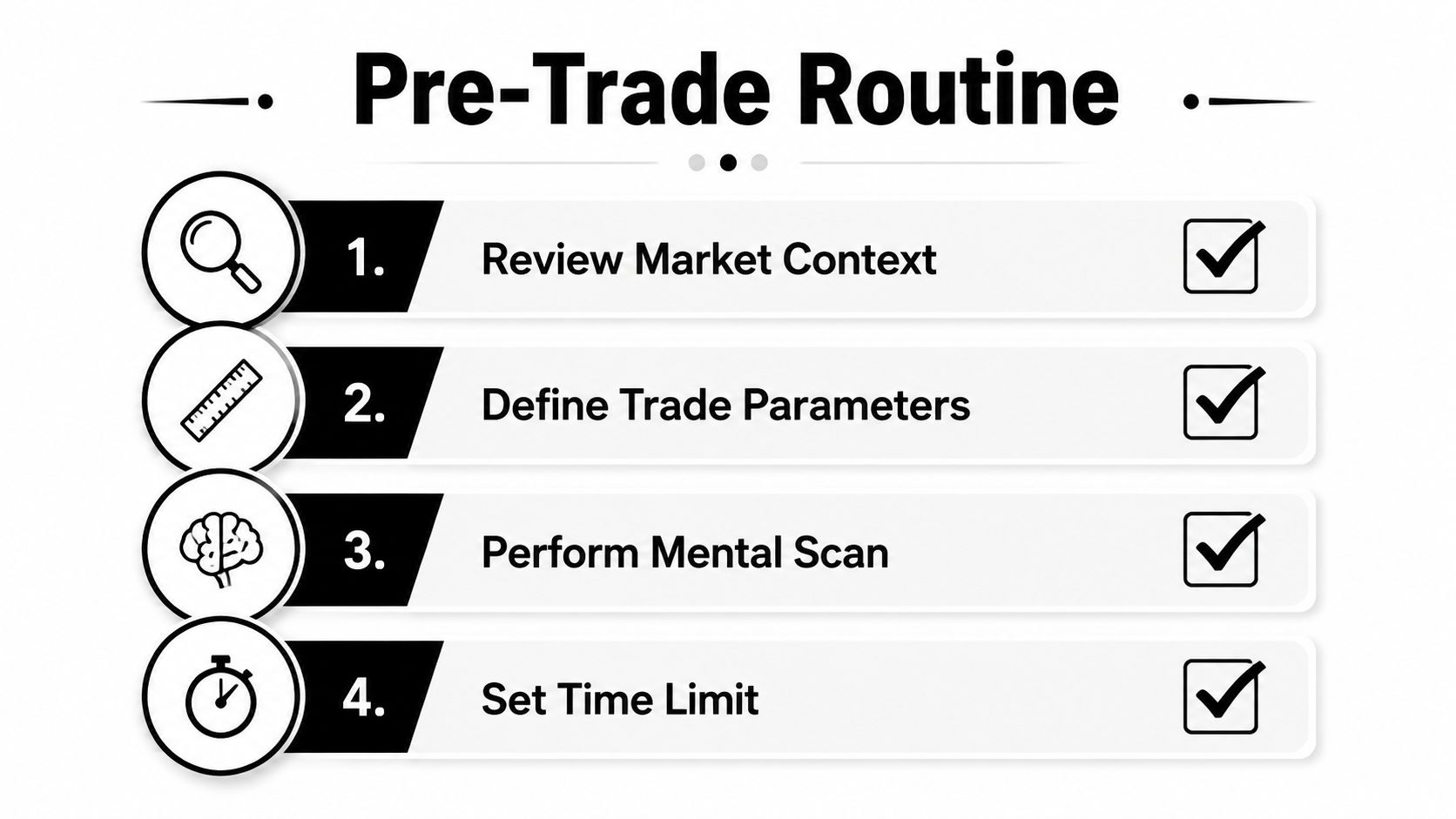
Thirty minutes before the session
Use this window to remove uncertainty you would otherwise carry into the trade.
- Review market context. Mark the higher-timeframe direction, important levels, scheduled events, and conditions that invalidate your preferred setup.
- Define trade parameters. Write the entry area, stop-loss, target logic, invalidation condition, and maximum number of attempts you will accept.
- Check your personal state. Record whether you are tired, angry, distracted, or trying to recover from a previous loss. If attention is unstable, reduce size or skip the session.
- State the risk in plain language. Say, “If price reaches my pre-defined stop, the trade is wrong for this plan and I exit.” The script separates the result from your identity.
Five minutes before entry
Read the plan again. Do not add analysis unless market conditions have changed. Ask:
- Is this the setup I prepared for?
- Has the entry triggered, or am I chasing?
- Is the stop-loss placed before the order?
- Would I still take this trade if the last trade had never happened?
- Can I accept the planned loss without moving the stop?
Set the stop-loss before entry and treat that level as a completed decision. If price reaches it, exit without renegotiating the plan (this stop-loss and reset routine).
Pre-commitment rule: If you need to debate the stop after entry, the decision was made too late.
In-the-Moment Coping Techniques That Actually Work
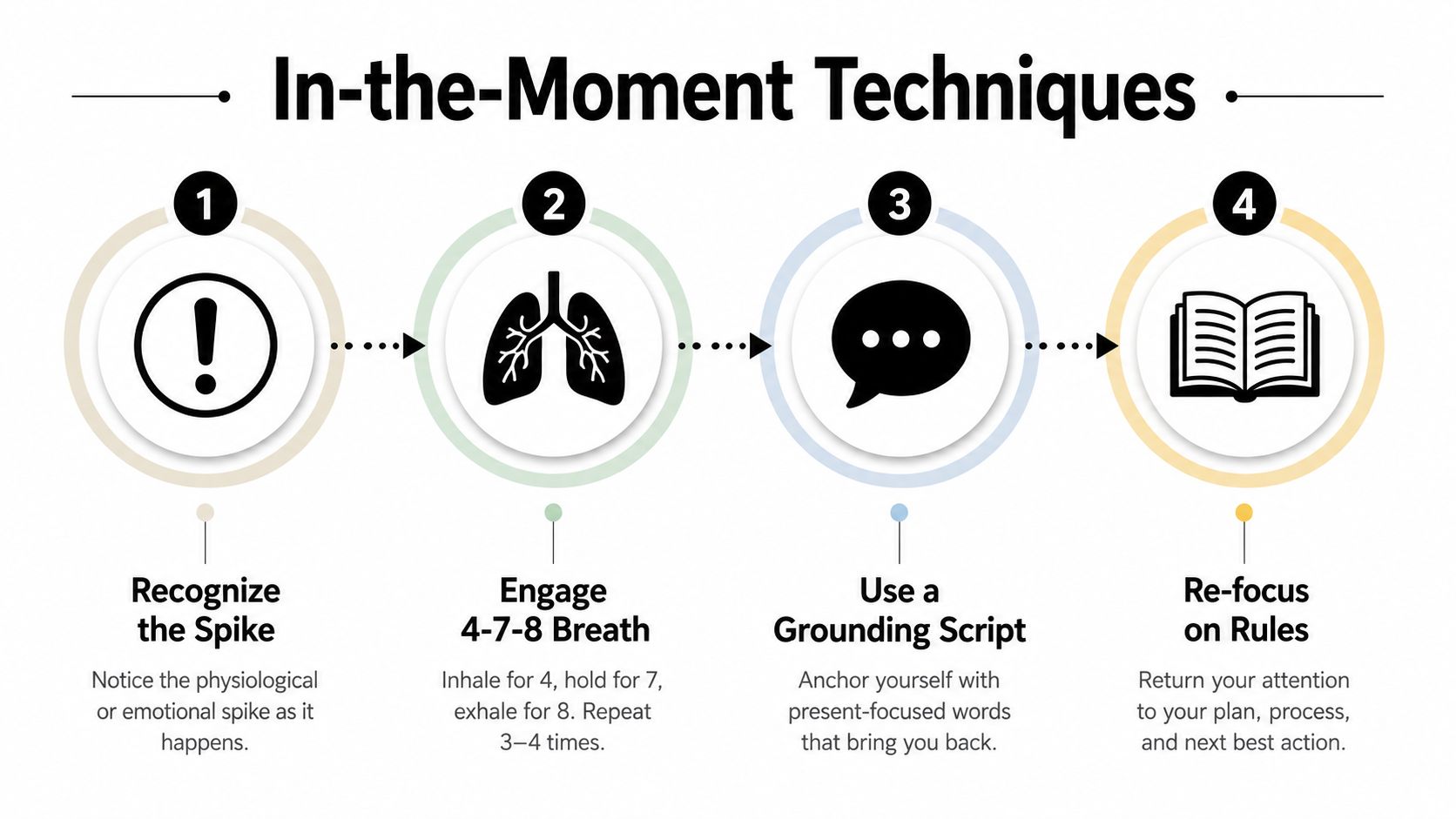
“Stay calm” is not an execution tool. When emotion spikes during an open position, you need a short procedure that interrupts the reaction before it becomes a new order, a moved stop, or a revenge trade.
Use breathing to create a pause
When your body is rushing ahead of your plan, try 4-7-8 breathing for 60 seconds:
- Inhale for four counts.
- Hold for seven counts.
- Exhale for eight counts.
- Repeat until the minute ends.
Don't use the minute to stare harder at the candle. Look away from the price ladder, keep your hands off the mouse, and let the pause create separation between sensation and action. Practice this away from active risk first, because a breathing pattern you've rehearsed is easier to access under pressure.
Grounding can add a physical interruption. Put both feet on the floor, name the setup, identify the invalidation level, and say, “I'm feeling urgency. Urgency isn't confirmation.” Resources on ways to calm an overactive mind can help you build broader techniques for interrupting mental spirals.
Reframe the event instead of suppressing it
Cognitive reappraisal has strong support in demanding decision environments. A meta-analysis covering 64 independent samples and 29,824 participants found a positive association between reappraisal and personal resilience, with r=0.47 and p<.001 (the cognitive reappraisal meta-analysis). The method is practical:
- Label the trigger. “Price moved against my entry and I'm thinking this trade must recover.”
- Generate an alternative explanation. “The move may be normal volatility, or it may show that my premise is invalid.”
- Choose a trader-relevant frame. “This is information, not failure.”
- Re-rate the emotion after 30 to 60 seconds. Use the same scale each time and check whether urgency has changed.
The mistake is trying to suppress the emotion. Suppression can leave the physiological arousal in place, while reappraisal changes the meaning assigned to the event. If the setup is invalid, exit. If it remains valid, follow the original plan. The technique doesn't decide for you. It makes room for the rules to decide.
For traders dealing with recurring FOMO, the practical distinction is covered in this explanation of FOMO in trading. FOMO isn't evidence that the missed move should be chased.
Scripts for Common Trading Scenarios
Generic advice fails because “be disciplined” doesn't tell you what to do when the urge arrives. Implementation intentions solve that problem by connecting a recognizable trigger to a pre-written response. Research on if-then planning reports a large effect compared with no-regulation instructions, d≈0.91, and a medium effect compared with simple goal intentions, d≈0.53 (the implementation-intention research).
Write the scripts before the session. Keep the response flexible enough to work across different market conditions, but concrete enough that you won't negotiate with yourself.
| Trigger Scenario | If-Then Script | Reset Time |
|---|---|---|
| Drawdown begins | If I reach my pre-defined session loss boundary, then I stop opening new trades, save the chart, and review whether the losses came from valid setups or rule breaks. | Until the next planned review |
| Winning streak creates overconfidence | If I feel certain that the next trade will win because recent trades worked, then I return to the checklist and take the next setup only if it qualifies independently. | One checklist review |
| Revenge-trading urge after a loss | If I feel the urge to win back a loss immediately, then I step away, review my checklist, and re-enter only after a fresh setup. | 10 minutes minimum |
| Missed move and FOMO | If price runs without me, then I record the missed condition and wait for my planned entry or a new setup. I don't create an entry because I feel left behind. | Until a valid setup appears |
| Loss triggers agitation | If I take a loss, then I stop and re-qualify the next trade from scratch instead of treating it as a continuation of the previous decision. | 15 to 30 minutes |
The fixed pause after a loss matters because the next trade often becomes an emotional attempt to repair the previous one. A pause of 15 to 30 minutes, followed by fresh qualification, gives you a clear reset routine rather than a vague demand to calm down (the practical loss-reset guidance).
The main failure is writing a trigger that's too narrow, such as “if I lose two trades.” Your actual trigger may be faster clicking, checking unrealized profit repeatedly, or feeling your shoulders tense. Use the earliest observable signal, and allow more than one acceptable response when conditions differ.
Tracking Your Emotional Patterns with Data
A trading journal that records only entry, exit, and profit misses the part that determines whether you can repeat the process. Track what happened before, during, and after the trade.
You don't need a complicated app. A spreadsheet, Notion page, or journal platform can capture enough information to reveal patterns. Use the same fields every time so your review compares sessions rather than isolated memories.
Record the decision, not just the result
Add these fields to each trade:
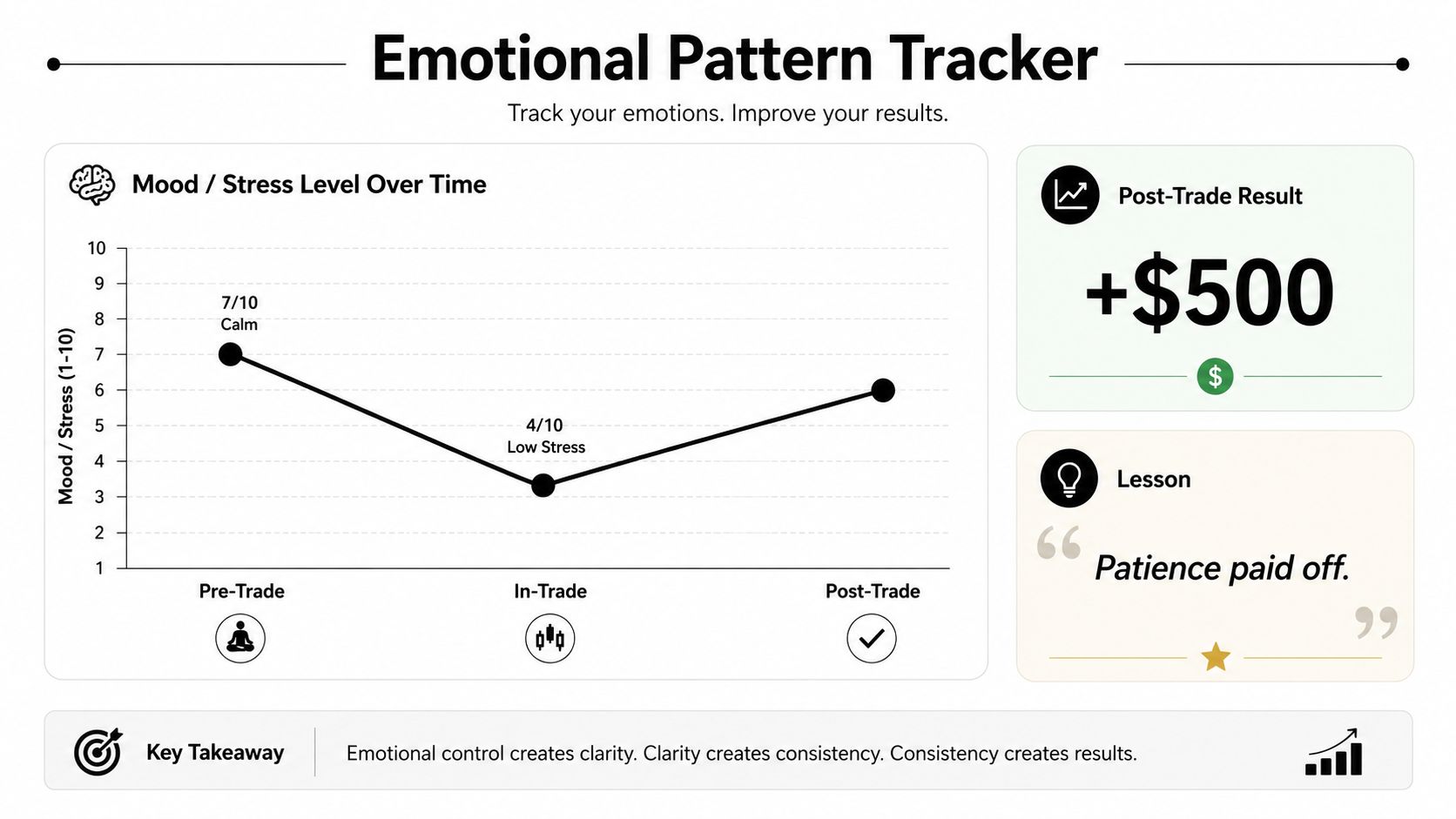
- Pre-trade mood: Rate calm, anxiety, frustration, or confidence on a consistent 1 to 10 scale.
- Trigger: Name the setup, market condition, prior result, or personal circumstance that changed your state.
- In-trade behavior: Note whether you moved the stop, closed early, added impulsively, or followed the plan.
- Time context: Record the time of day and whether discipline weakened during a particular session.
- Physical state: Note sleep quality, hunger, distraction, or screen fatigue without turning the journal into a diary.
- Post-trade lesson: Write one sentence about the process, not a dramatic judgment about yourself.
A simple entry might read: “Calm 7/10 before entry. Stress rose after a fast retracement. Stop stayed fixed. Exited according to plan. Patience paid off.” The purpose isn't to prove that every controlled trade makes money. It's to distinguish a good decision from a favorable outcome.
Review the log consistently
At the end of your review period, sort the journal by emotion intensity, setup type, time, and rule violations. Identify your top three emotional triggers, then attach one intervention to each. If FOMO appears most often after missed breakouts, use the missed-move script. If losses produce immediate re-entry, make the pause visible beside your platform.
Use lists that reduce overwhelm when your review produces too many possible improvements. Pick the smallest useful change, test it, and compare your behavior in later sessions. A focused trading journal should tell you whether your routines changed execution, not merely whether they made the session feel more comfortable.
Closing the Gap Between Knowing and Doing
Many traders know the correct response and still fail to use it under pressure. This emotion-regulation ability–achievement gap explains why reading about discipline rarely fixes impulsive execution. Knowledge lives in the calm part of the day. The trade happens when anxiety, frustration, or excitement narrows attention.
Build a workflow that moves control earlier:
- Before the session: Define conditions, risk, invalidation, and pause rules.
- Before entry: Confirm that the trade matches the prepared setup.
- During the trade: Label the emotion, breathe, reframe, and return to the checklist.
- After a loss: Step away, then re-qualify the next trade from scratch.
- After the session: Log the trigger and one behavior to adjust.
Not every uncomfortable feeling requires you to leave the screen. Productive discomfort can accompany a valid trade that follows your plan. Step away when you want to override a stop, increase risk to repair a loss, chase a missed move, or continue trading solely because you feel compelled to recover. Emotional control means selecting the right response, not forcing yourself to look calm.
Trading involves risk of loss, and no routine can remove that risk. MyFundedCapital offers Instant Funding and 1-Step or 2-Step Challenge programs with simulated account sizes from $5K to $100K, scaling paths up to $500K, defined loss limits, and profit splits that can reach 100%, according to its publisher information. If your process is stable enough to test under structured conditions, those parameters give you a framework for assessing discipline rather than relying on confidence alone.
Frequently Asked Questions
How can I manage emotions while trading?
Start before entry. Predefine the setup, stop-loss, invalidation point, and response to a loss. During the trade, use a short pause, label the emotion, reappraise the event, and return to the written rules instead of trying to suppress the feeling.
Should I stop trading after every loss?
A fixed pause after a loss can prevent immediate revenge trading. The practical guidance referenced above recommends 15 to 30 minutes, followed by re-qualifying the next trade from scratch. If you still want to violate your plan after the pause, end the session.
Is emotional control the same as staying calm?
No. Calmness isn't the only acceptable state for a trader. Emotional control means noticing fear, frustration, greed, or FOMO and choosing a rule-based response without forcing false composure.
What should I track in an emotional trading journal?
Track your emotional intensity, trigger, time of day, physical state, setup type, in-trade behavior, and whether you followed the plan. Review those entries for repeated patterns, then assign a specific script or pause routine to your most common trigger.
If you're ready to test your routines under defined risk parameters, explore MyFundedCapital and compare its Instant Funding, 1-Step, and 2-Step Challenge options. Choose an account structure that fits your process, then treat the evaluation as a test of consistent execution, not a shortcut to guaranteed profits.
