

 AR
AR
 NL
NL
 FR
FR
 DE
DE
 ES
ES
 IT
IT
 PL
PL
 SV
SV
 PT
PT

You're probably in the familiar spot where a strategy looks solid on chart replay, but you still aren't sure it'll hold up when spreads widen, trades get messy, or a prop-firm rule kicks in at the worst possible moment. A free FX trial is useful only if you treat it like a test bench, not a toy. Used properly, it helps you validate platform fit, rule discipline, and trade management before real money or a funded evaluation is on the line.
What a Free FX Trial Actually Gives You
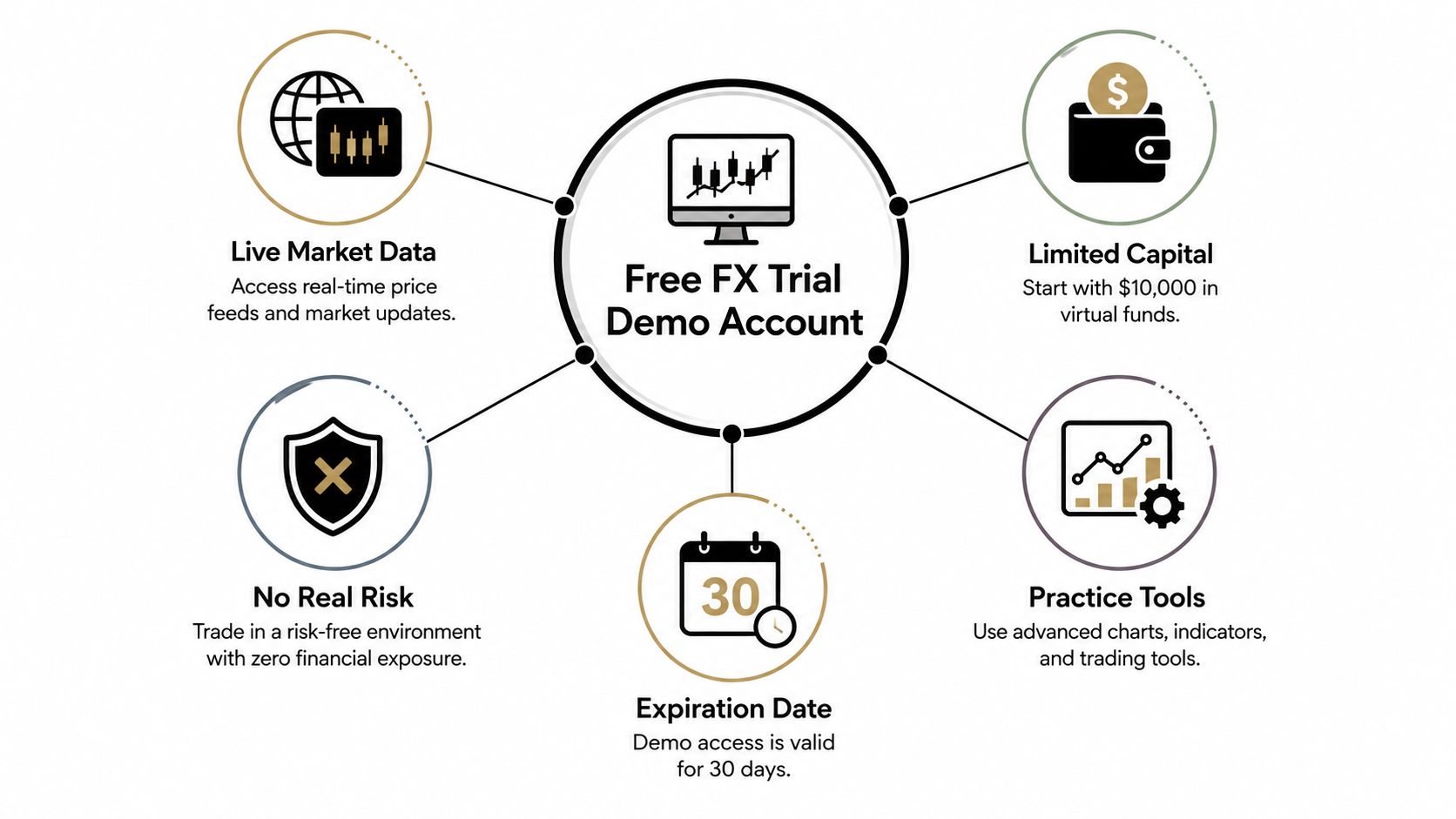
A free FX trial usually gives you access to a trading environment with live or near-live prices, a virtual balance, and the platform tools you need to place trades, manage orders, and review charts. Some trials are short by design, and that matters. FX Replay advertises a 5-day free trial, while FXMacroData offers a 14-day free trial for its Individual plan, which shows how often these offers are built around a short validation window rather than open-ended access. FX Replay trial details
What you do not get is the pressure of real capital at risk. Demo and trial environments can reproduce market data and workflow mechanics, but they can't fully reproduce the stress of watching a real account move against you. FXCM's demo, for example, uses live prices and $20,000 in virtual currency, while FOREX.com says its demo has no capital at risk and is meant for risk-free strategy testing. FXCM demo account features
What a trial can prove
A trial can tell you whether your platform feels usable, whether your order workflow makes sense, and whether your strategy logic behaves the way you expect across different sessions. It's also good for confirming whether you can tolerate the pacing of a platform before you commit to a paid account or a prop-firm challenge.
Practical rule: if you can't describe what you're testing before you open the account, you'll probably end the trial with opinions instead of evidence.
That's the dividing line. A trial validates process, not character. It can show that your entries, exits, alerts, and chart setup work. It can't prove that you'll stay disciplined under actual loss pressure, because the emotional stakes are different.
Demo Trading vs Live Trading Environments
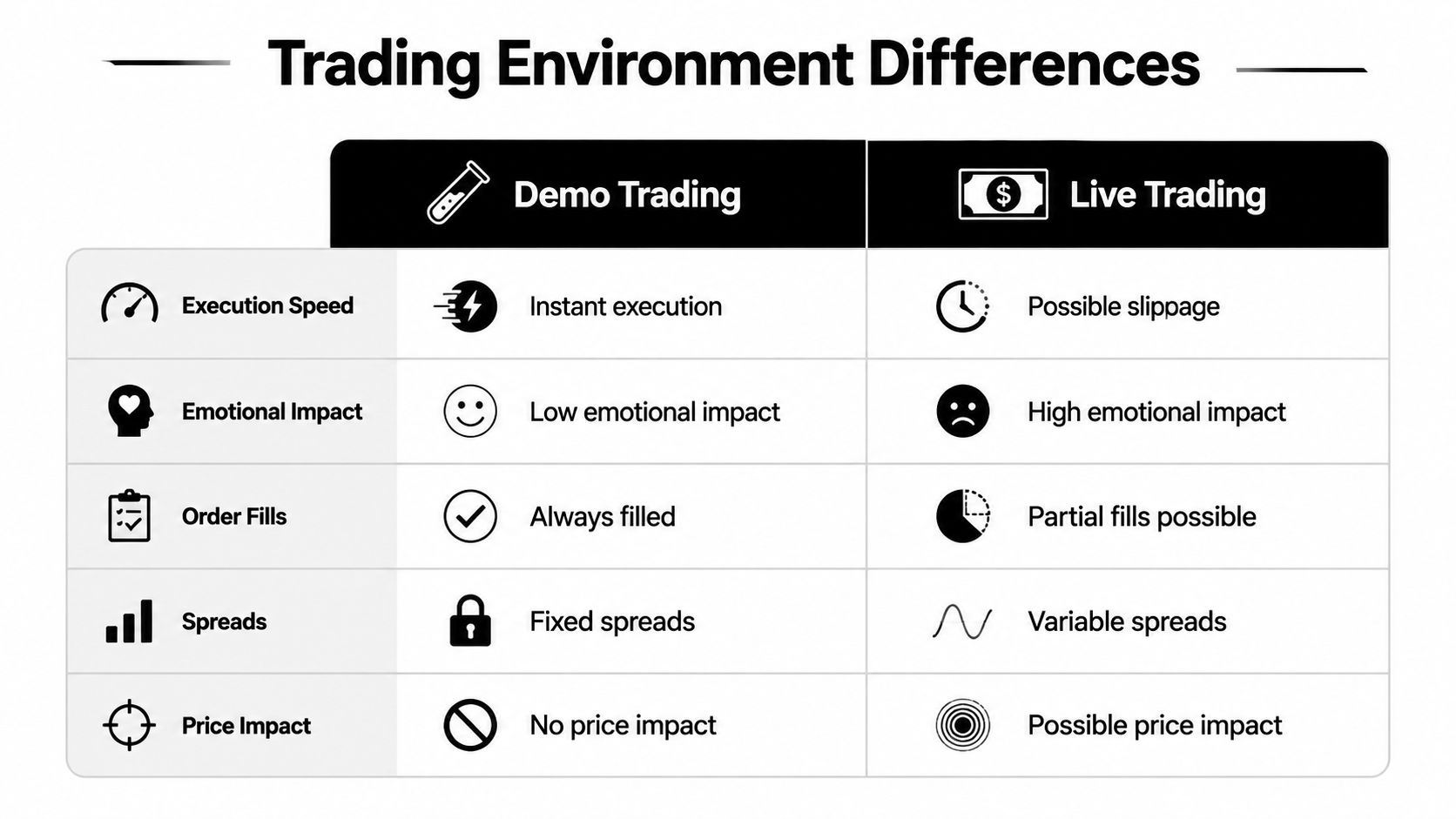
The biggest mistake traders make is assuming demo success transfers cleanly into live conditions. It doesn't. A demo can execute quickly and cleanly, but live trading can introduce slippage, variable spreads, partial fills, and price movement between the moment you click and the moment your order lands.
A demo also strips out the psychological cost of being wrong. That matters more than people admit. A strategy that looks calm and repeatable on virtual money can fall apart once a trader starts defending real capital, especially if they're not used to monitoring drawdown in real time. The MyFundedCapital demo currency trading environment is useful to think about in this context because the whole point of a demo is evaluation, not illusion.
Where demo results stay useful
Demo still has real value when you use it for the right questions:
- Platform mechanics: Can you enter, modify, and close trades without hesitation?
- Order types: Do stops, limits, and market orders behave the way you expect?
- Strategy logic: Does your setup trigger under the conditions you trade?
- Session behavior: Do your trades behave differently in one market session than another?
Live trading is different because execution quality changes when liquidity changes. Demo can make almost everything look smoother than it is. That's why a clean demo run should never be treated as proof that a funded account will feel the same.
Demo tells you whether your method is mechanically sound. Live trading tells you whether your nerves can stay out of the way.
How to Structure Your Free FX Trial for Maximum Value
Start with a written objective before you place the first trade. If the goal is to test a strategy, define the setup, the session, the pair, and the exit rule. If the goal is to prepare for a prop challenge, mirror the account style you plan to trade instead of wandering through random pairs and timeframes.
A clean structure works better than long, unfocused screen time. I like to split the trial into three phases.
Phase one platform familiarization
Spend the first part learning the platform without forcing trades. Test chart layout, watchlist organization, hotkeys, order placement, and trade management. If you need a framework for that prep work, the guide on how to backtest trading strategies fits naturally here because the trial should confirm what the backtest already suggested.
Phase two strategy execution
After the interface feels familiar, trade only the setup you came to test. Don't broaden the sample because boredom pushed you into random entries. If your method is supposed to work during London hours, don't spend most of the trial trading a completely different window.
Phase three stress testing
Once the base case looks stable, push the setup a little harder. Trade a correlated pair, test your rules during choppier conditions, or run the strategy during a news-adjacent period if that's part of your real workflow. If you're evaluating a prop-firm path, simulate the same restrictions you'll face later. A trial becomes far more useful when you trade it like a rules-based assessment instead of a sandbox.
Key Metrics to Track During Your Trial Period
A trial only helps if the journal is honest. Win rate by itself isn't enough, and neither is one great week. You need a small but consistent dataset that shows how your system behaves across different conditions, not just on your best day.
Build a simple trade journal
Track every trade the same way. I'd keep it simple:
- Entry reason: What setup triggered the trade?
- Risk per trade: How much did you place at risk?
- Exit reason: Target, stop, manual exit, or rule violation?
- Session: London, New York, or another trading window
- Outcome quality: Clean, late, rushed, or emotional
The point is to separate good process from lucky outcomes. If you want a visual way to think through the progression of equity behavior, the equity curve simulator is a useful mental model because smooth equity matters less than repeatable decision-making.
Essential Trial Performance Metrics
| Metric | What It Measures | Readiness Benchmark |
|---|---|---|
| Win rate | How often your trades close profitably | Consistent enough to support your system |
| Average risk-to-reward ratio | How much you aim to gain compared with what you risk | Stable across the same setup |
| Maximum drawdown | The worst equity decline during the trial | Controlled and within your own rule set |
| Profit factor | Gross wins versus gross losses | Strong enough to justify repetition |
| Expectancy per trade | The average value of each trade over time | Positive and repeatable |
Don't obsess over one metric in isolation. A strategy can have a modest win rate and still work if the payoff structure is clean. The question is whether your numbers stay stable across sessions and whether your decisions match the plan you wrote before the trial began.
Common Trial Mistakes That Create False Confidence
The most dangerous trial mistake is overleveraging because virtual money feels soft. Traders who would never size that way in a live account suddenly act fearless on demo, then interpret the results as skill. That isn't skill, it's distortion.
Another trap is ignoring costs that your trial doesn't force you to respect. If spreads, fill quality, or timing friction are glossed over, the trial can flatter a fragile strategy. A setup that depends on perfect fills will look much cleaner on demo than it does in a live market.
The habits that distort your read
- Overtrading: Taking every minor setup because the account feels disposable.
- Cherry-picking: Only trading during the easiest conditions and skipping difficult sessions.
- Rule drift: Ignoring the same drawdown or sizing rules you'd use in a funded environment.
- Trial hopping: Repeating free periods instead of making a decision from the data you already have.
The last mistake is the one that wastes the most time. A trader can spend months collecting surface-level comfort without ever facing a real standard. That creates the illusion of progress while the actual decision, whether the strategy is ready, never gets made.
If a rule matters in a prop challenge, it should matter in the trial too.
Connecting Your Trial to Prop Firm Challenge Preparation
A free FX trial becomes far more valuable when you use it to rehearse the structure of a funded evaluation. That means behaving as if the account rules already apply. If your target path involves a 5% daily loss limit, a 10% maximum drawdown, and an 8% profit target, those numbers should shape your demo decisions before you ever pay for a challenge.
MyFundedCapital runs evaluations on simulated environments with real market quotes, and that setup makes the transition from trial to challenge more relevant than a casual demo ever will. The firm also offers paths like 1-Step Challenge, 2-Step Challenge, and Instant Funding, so the trial should help you decide whether you're ready for an evaluation or better suited to immediate trading after validation.
Match the trial to the challenge
Use the same instruments you plan to trade later, whether that's forex pairs, indices, crypto, or commodities. Keep the same platform habits too, especially if you'll be using DXtrade or cTrader. The point is to reduce surprises after the first live-style evaluation trade.
For traders who already know their method, Instant Funding can make sense after the trial confirms process stability. For traders who still need proof, a challenge path gives the trial a clear purpose. Either way, the trial is the proving ground, not the finish line.
Your Trial Readiness Checklist and Next Steps
Before you move from a free FX trial into a funded evaluation, check for repeatability, not excitement. You want enough trade history to see whether the method works under ordinary conditions, not just during one clean stretch of market behavior.
Readiness checklist
- Trade count: You've executed enough trades to judge your setup.
- Risk control: You've respected your own sizing and drawdown rules.
- Platform comfort: Order placement and trade management feel automatic.
- Journal quality: Your notes clearly show what you did and why.
- Emotional stability: Your log doesn't show repeated impulse trades.
- Process consistency: The strategy can be repeated without improvising every time.
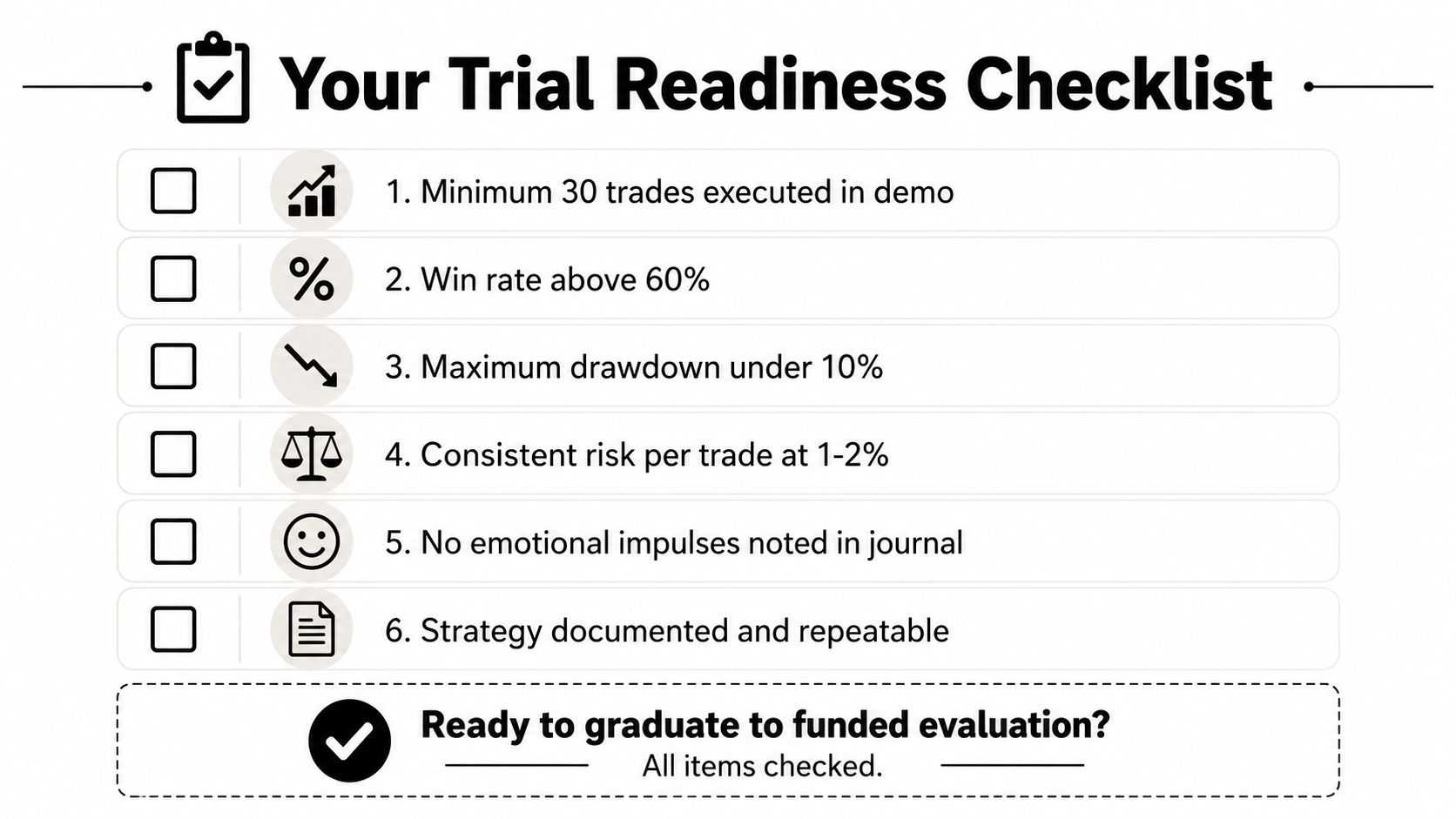
If the checklist is mostly unchecked, stay in trial mode and fix the process. If it's mostly clean, move to the smallest challenge size that matches your current behavior. That gives you a real bridge between practice and pressure instead of a blind jump.
MyFundedCapital gives traders a structured next step after trial validation, with funding paths designed for different levels of readiness. If your free FX trial shows discipline, consistency, and platform comfort, visit MyFundedCapital to compare account types and choose between 1-Step, 2-Step, or Instant Funding based on how you traded.
