

 AR
AR
 NL
NL
 FR
FR
 DE
DE
 ES
ES
 IT
IT
 PL
PL
 SV
SV
 PT
PT

Algo-driven volume in U.S. equities rose from about 15% in 2003 to over 70% by 2010 and then stayed around 70% to 80%. That matters for beginners because algorithmic trading for beginners isn't about chasing a niche, it's about learning to operate in a market where automation already dominates execution source.
That reality changes the learning curve. You're not just building a strategy, you're learning how to define rules, test them thoroughly, control risk, and keep an algorithm stable once real money is on the line.
What Algorithmic Trading Actually Is
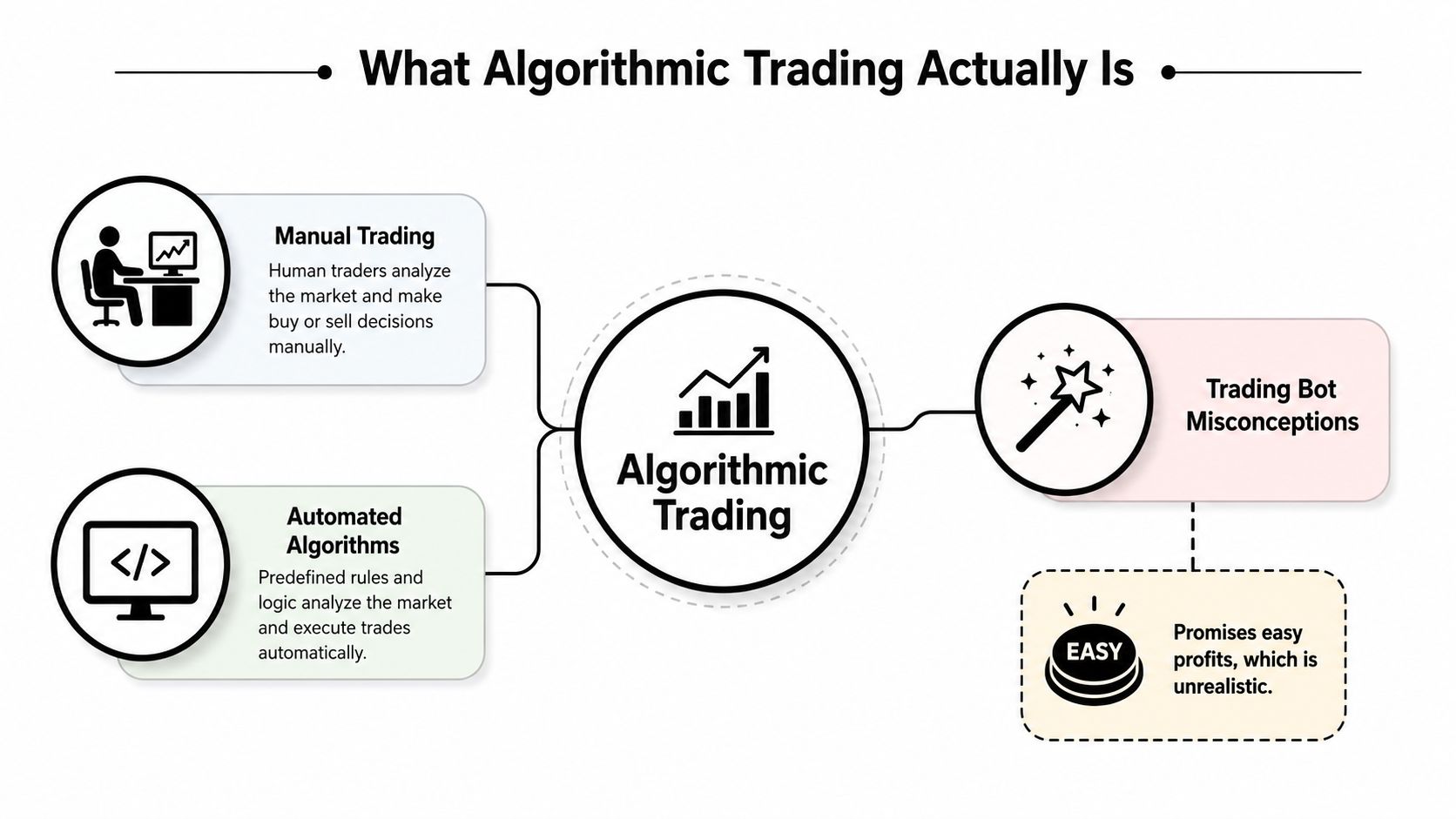
Algorithmic trading is a computer program that follows a defined set of instructions to place trades. Those instructions usually use inputs like time, price, and volume, which means the trader decides the logic first and the software handles execution after that source.
Manual judgment versus rule-based execution
A manual trader looks at a chart, interprets the setup, and clicks the order. An algorithm does the same kind of decision-making, but only after you've written the logic in advance. That matters because the program doesn't get impatient, chase a move, or change its mind halfway through a rule.
Practical rule: if you can't explain the entry, exit, and risk rules in plain English, you're not ready to automate it.
The market already runs this way in many places. In major developed markets, algorithmic trading has been estimated to generate roughly 60% to 75% of total trading volume across U.S. equities, European markets, and major Asian capital markets source. For a beginner, that means the core question isn't whether algos matter. It's whether you understand how to build one responsibly.
What a bot can and can't do
A trading bot can help with discipline, speed, and consistency. It can't remove market risk, and it can't turn a weak idea into a strong one. If the rules are bad, the bot just applies bad rules more efficiently.
That's why beginners should treat automation as a process skill, not a shortcut. The edge comes from testing, monitoring, and improving a repeatable system, not from hoping software will solve the hard part for you.
Core Strategy Types Every Beginner Should Know
Most beginners overcomplicate this part. They jump straight to machine learning or exotic ideas, when the best place to start is with strategies you can describe and debug.
The five mechanics worth learning first
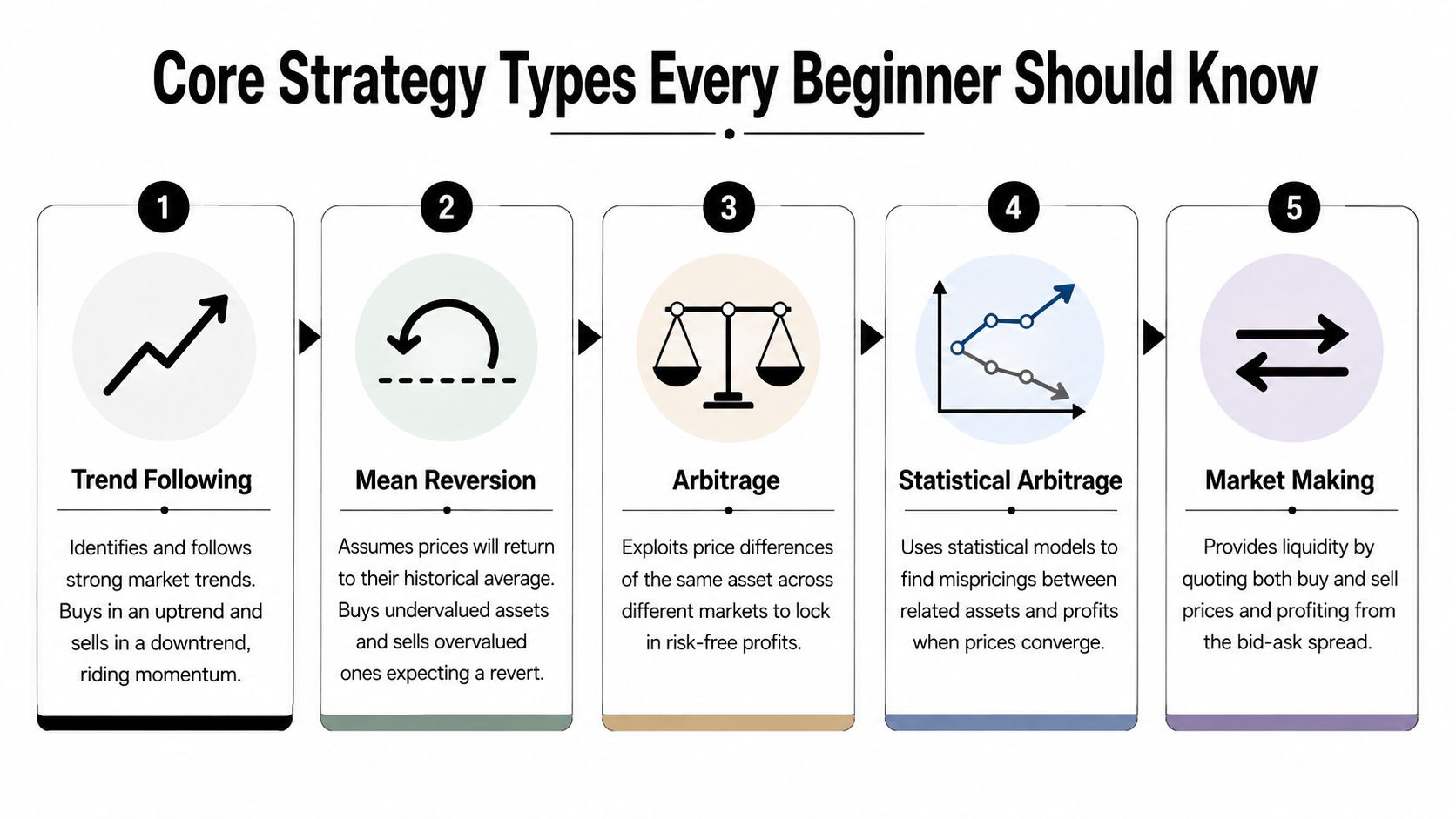
Trend following buys strength and sells weakness. A simple version might enter when price closes above a moving average and exit when that trend weakens. It works best when markets keep moving in one direction for long enough to cover costs.
Mean reversion assumes stretched moves often snap back. A basic example is a buy signal after price falls far below a short-term average, then a sell when it returns toward normal. It's easier to understand on range-bound markets than in strong breakouts.
Arbitrage tries to profit from price differences between related instruments or venues. Beginners usually hear the word before they understand the execution demands, but the key idea is simple, buy where something is cheaper and sell where it's richer. In practice, slippage and latency matter a lot.
Index fund rebalancing is less about prediction and more about order flow. Funds must adjust holdings when compositions change, and algorithms can help manage that process efficiently. For a beginner, it's useful because it shows that not every algorithmic strategy is about “forecasting” direction.
VWAP and TWAP are execution algorithms, not prediction engines. VWAP aims to trade around volume patterns, while TWAP spreads orders evenly through time. Both are useful examples of how algos reduce market impact rather than trying to call the next candle.
For a deeper breakdown of structured strategy ideas, this strategy reference for algo traders is useful once you've got the basics down.
Indicators that turn price into signals
Beginners usually do better with simple, explainable inputs such as moving averages, RSI, Bollinger Bands, MACD, and ATR source. These indicators convert raw price and volume into trend, momentum, and volatility signals.
Keep the first version boring. If you can't explain why the signal exists, you won't know what broke when it stops working.
If you want a practical comparison while learning platform workflows, the browse COINS – Bot data page can help you see how automated trading products are presented in the market. Don't treat that kind of page as a signal source. Use it as a reminder that execution and tool choice matter as much as the idea itself.
Choosing Your Tools and Trading Platform
A beginner doesn't need the fanciest stack. You need a setup you can debug when something breaks at 2 a.m. That usually means one language, one backtesting workflow, and one platform you understand well enough to trust.
Start with the language and data layer
Python is the most beginner-friendly place to start because it's widely used for data work and strategy prototyping. Traders who stay close to the platform often also use MQL5 or C#, depending on the environment they're building for. The choice matters less than whether you can read your own code six months later.
Historical and live data quality matter just as much as the code. Bad data creates fake confidence, and fake confidence is expensive when live execution starts exposing gaps.
Compare platforms on fit, not hype
Here's a simple comparison frame for choosing a platform:
| Platform | Languages Supported | Best For | Key Advantage |
|---|---|---|---|
| cTrader | cAlgo, C# | Discretionary and semi-automated traders | Clean interface and strong automation support |
| DXtrade | Platform-native automation options | Traders who want a prop-friendly environment | Flexible execution and modern workflow |
| MetaTrader 5 | MQL5 | Classic retail algo development | Huge community and lots of examples |
If you're comparing MT platforms, this MT4 versus MT5 guide is worth reading before you commit to a workflow. MT5 generally makes more sense for newer algo traders because it's the more current environment.
Build a practical tool list
A lean starter stack usually includes:
- A scripting language for strategy logic.
- A backtesting tool for historical testing.
- A broker or platform API for order execution.
- Reliable market data for both history and live feeds.
- A note-taking system to log every change you make.
If you're still learning the coding side, it helps to master Python for data science before you try to automate trades. Clean data handling and clear structure matter more than clever code.
Building Your First Algorithm Step by Step
A first strategy should be simple enough to test, but strict enough to rule out guesswork. The point is to build a process you can repeat, not to invent a masterpiece on day one.
The five gates that matter
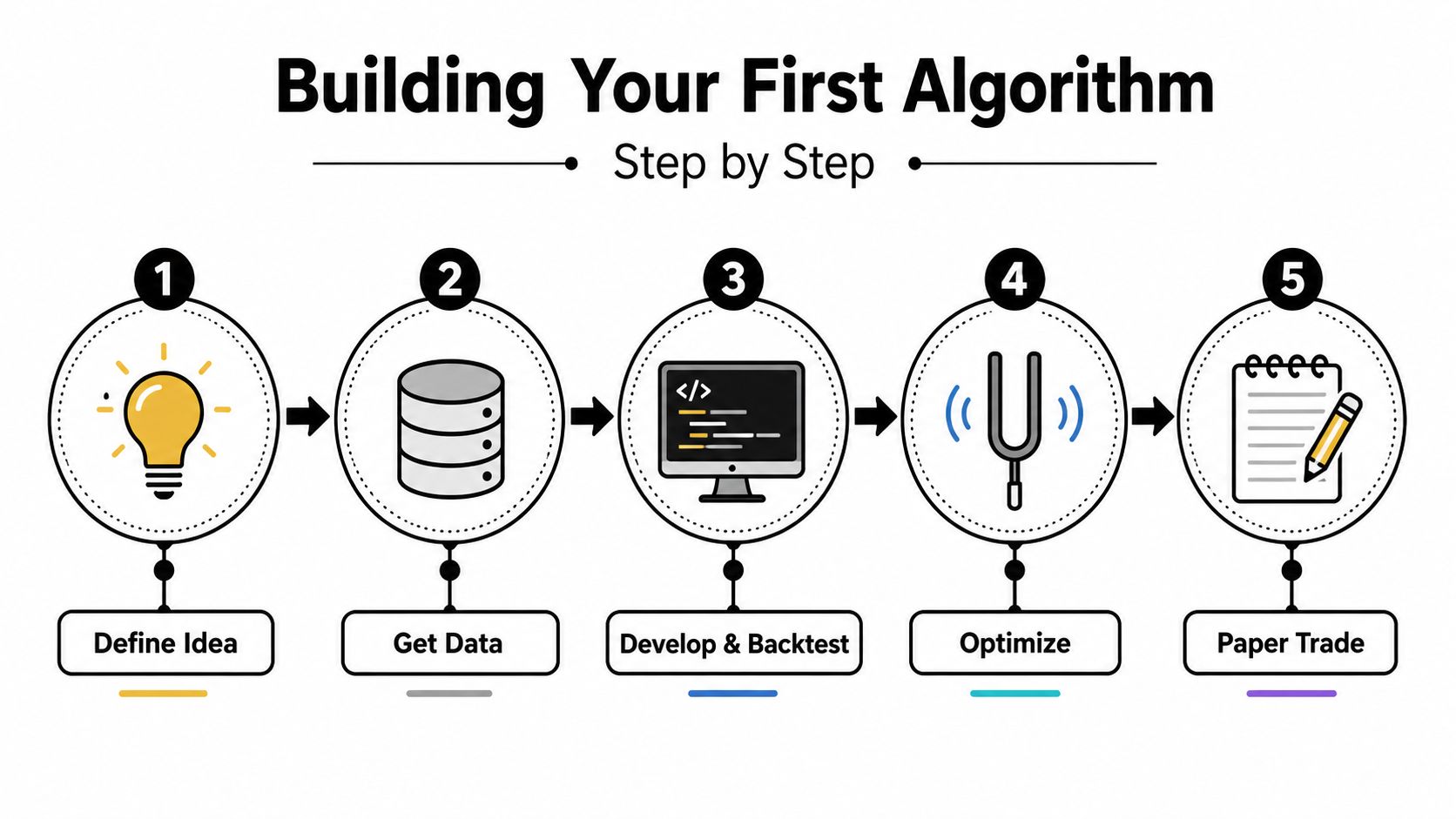
Define the idea. Write the entry, exit, and stop rules in plain language. If you can't express the logic without jargon, the strategy isn't ready.
Get the data. Clean your historical prices, remove obvious errors, and make sure the timeframe matches the strategy. A rule that trades on hourly bars needs clean hourly data, not a messy blend of sources.
Develop and backtest. Run the rules on historical data with realistic assumptions. Expert guides recommend using at least 2 years of data, ideally 5 years, and validating on a period not used in development to reduce overfitting risk source.
Optimize carefully. Change one variable at a time. If you tweak ten things and the curve looks better, you probably fitted noise.
Paper trade. Test the strategy in live market conditions without risking capital. That last step catches execution issues that historical charts never reveal.
The biggest mistake is skipping the validation stage because the backtest “looks good enough.” It usually isn't.
A quick checklist before you move on
- Entry rule: Can you state exactly when the trade opens?
- Exit rule: Is the exit defined by time, price, or signal change?
- Risk rule: Do you know where the stop belongs?
- Test window: Did you keep one period out of development?
- Paper record: Did you log live-simulated trades before risking money?
If you need a more structured framework for testing, the backtest software overview is a practical place to compare workflows.
Risk Management and Performance Metrics That Matter
A backtest can show a profit curve and still leave you with a strategy that is too fragile to trade. That is a common and costly lesson for new algorithmic traders who focus only on backtest returns.
Measure risk, not just profit
The metrics that matter most are Sharpe ratio, drawdown, and win rate source. A Sharpe ratio over 2 is often cited as a strong benchmark for beginner-focused strategies, though the right target depends on the strategy type and the market it trades in. That matters because a strategy that makes money with wide swings can be harder to keep running than one that grows more steadily.
Drawdown deserves close attention because it shows how much equity the account can lose before the strategy recovers. Win rate matters too, but only in context. A high win rate with small gains and occasional large losses can still produce a weak system, while a lower win rate can be fine if the average winner is large enough.
Real trading costs can change the picture quickly. For equities, institutional-style strategies should assume at least 5 to 10 basis points per trade in costs and slippage source. If the edge disappears after fees and slippage, the idea is not ready for live capital.
A clean backtest only matters if it survives friction, fees, and bad fills.
Use controls that stop bad days from becoming bad months
Position sizing should be small enough that one broken trade does not damage the account. Daily loss limits keep a model from spiraling when conditions change. A kill-switch is even better, because it lets you shut the system down automatically if it starts misbehaving.
Useful controls include:
- Maximum position size
- Maximum daily loss
- Maximum open exposure
- Manual approval for unusual trades
- Automatic shutdown on feed or execution errors
A good backtest can still break in live trading if the model is too concentrated or too reactive. Split capital carefully, keep part of it in reserve, and treat the first live deployment as a proof stage. If the strategy cannot stay stable under small size and strict limits, it is not ready for larger capital, whether that capital comes from you or later from a prop firm.
Beginners often keep arguing with the market instead of checking whether the controls are doing their job. That habit is expensive, because a model that needs constant rescue is not a stable trading system.
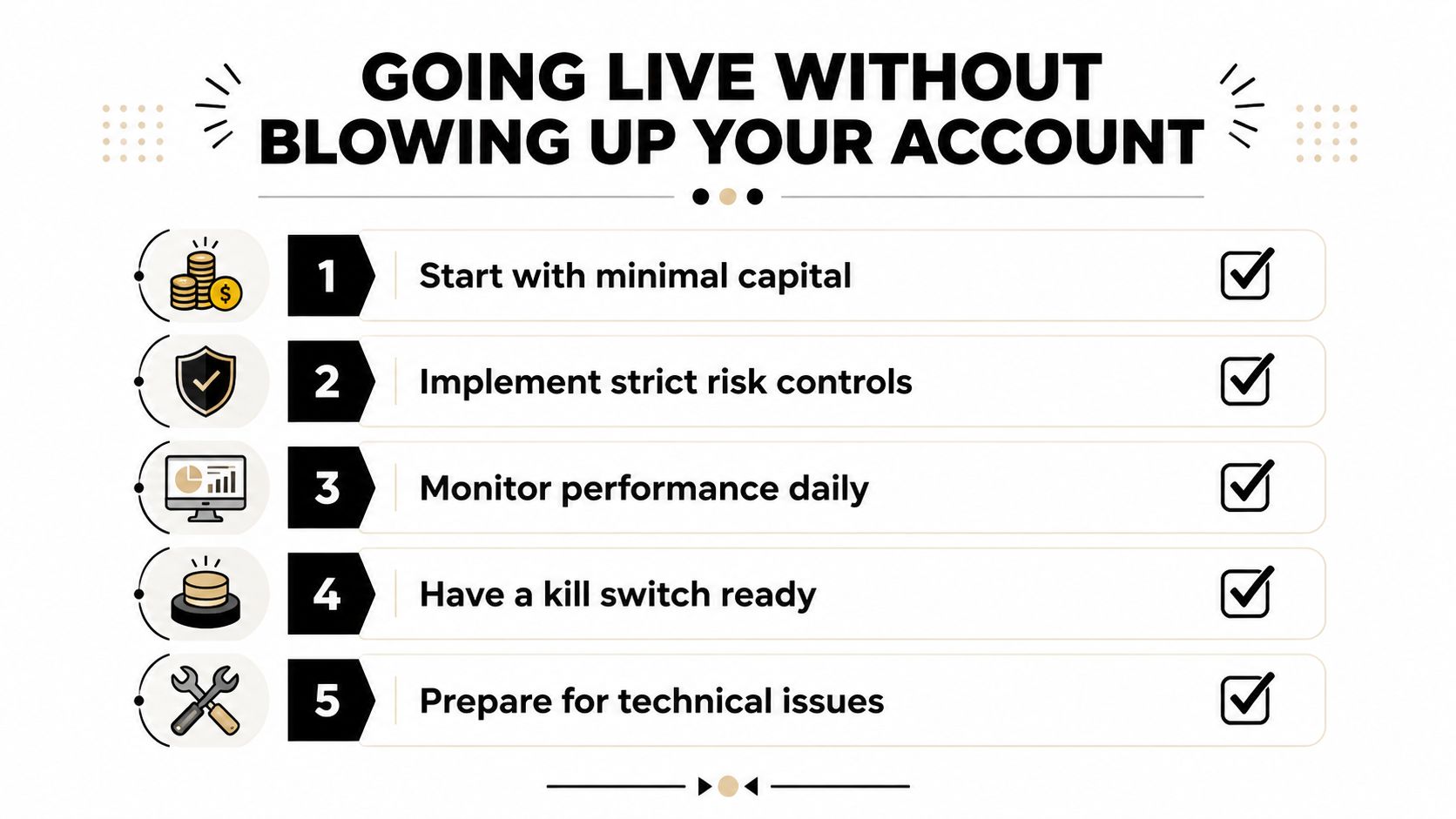
Going Live Without Blowing Up Your Account
The live account is where theory meets slippage, disconnects, and changes in market mood. A strategy that survives historical data can still stumble on day one if the execution stack is not steady.
Start smaller than you think
One beginner guide suggests watching a stable algo daily for the first 30 days, then weekly after it shows stable behavior source. That same guidance recommends starting live with only 10% to 25% of intended capital along with kill-switches and position caps source. The lesson is simple. The first live trades are for verification, not confidence theater.
A sensible deployment rhythm looks like this:
- Week 1: Watch every trade and compare fills with the plan.
- Weeks 2 to 4: Track execution quality, missed signals, and data issues.
- After stability appears: Move to weekly review, not constant tinkering.
That cadence gives you enough contact with the system to spot drift without turning every small fluctuation into a redesign project. It also keeps the account small enough that a bad fill, feed hiccup, or logic error is a lesson instead of a blowup.
Know what breaks live trading
Execution glitches happen. Data feed interruptions happen. Regime shifts happen. A strategy tuned to one kind of market can look fine for months, then fail when volatility or liquidity changes.
For a useful side reference on live-market behavior and signal context, the practitioner's sentiment analysis guide is a helpful reminder that market conditions can shift faster than a static model expects. You do not need sentiment for every strategy, but you do need a process for noticing when the environment has changed.
Live trading asks for a documented review process, a kill-switch, and the discipline to pause when the system no longer behaves as tested. The goal is not to argue with the market. It is to protect the account while you confirm whether the edge is still there.
Scaling Your Trading with Funded Prop Firm Accounts
Once a strategy is stable, the next problem is capital efficiency. A good system running on too little capital can still be frustrating, especially if you've proven the process but can't scale the payout meaningfully.
Why prop firm capital fits algorithmic trading
Funded proprietary trading firms give skilled traders access to simulated capital and a profit-sharing setup after evaluation. For algorithmic traders, that structure makes sense because the goal is already rule-based discipline. If your system respects risk limits and executes consistently, the evaluation framework can become a natural next step.
MyFundedCapital offers 1-Step and 2-Step Challenges plus Instant Funding, with account sizes from $5K to $100K and scaling paths up to $500K. Its risk framework includes a 5% daily loss limit and up to 10% maximum drawdown, with profit splits starting at 80/20 and upgrade paths to 90/10 or even 100%. Payouts can run every 7 to 14 days or on demand, depending on the setup.
What to check before you use a prop account
Not every platform supports the same execution style. MyFundedCapital supports algorithmic trading on DXtrade and cTrader, with MT5 coming soon. That matters because your strategy should fit the platform before you even think about the challenge.
The best prop setups reward traders who already work like operators:
- They predefine risk.
- They test before they size up.
- They watch execution quality, not just P&L.
- They scale only after stability is visible.
That's why prop capital can be a logical bridge from self-funded trading. It doesn't replace discipline. It amplifies it.
Frequently Asked Questions About Algorithmic Trading
Is algorithmic trading legal for retail traders?
Yes, it's generally legal for retail traders as long as you follow your broker's and platform's rules. The bigger issue is whether your strategy is reliable and whether your execution setup matches those rules.
Do I need to be a programmer?
Not to understand the basics, but some coding helps a lot. If you can learn simple Python workflows, you can build and test much of a beginner system without becoming a full-time developer.
How much money do I need to start?
Start with less than you think, then prove the process in paper trading before you scale. The point is not to maximize size immediately, it's to protect your learning curve.
How long does it take to build a usable algorithm?
Long enough to test properly. If you skip validation, you're not building a strategy, you're gambling with code.
If you're ready to take the next step, explore MyFundedCapital and compare the challenge formats, account sizes, and platform options that fit your trading style. If your algorithm is already tested and stable, a funded account can be a practical way to scale it without overcommitting your own capital.
