

 AR
AR
 NL
NL
 FR
FR
 DE
DE
 ES
ES
 IT
IT
 PL
PL
 SV
SV
 PT
PT

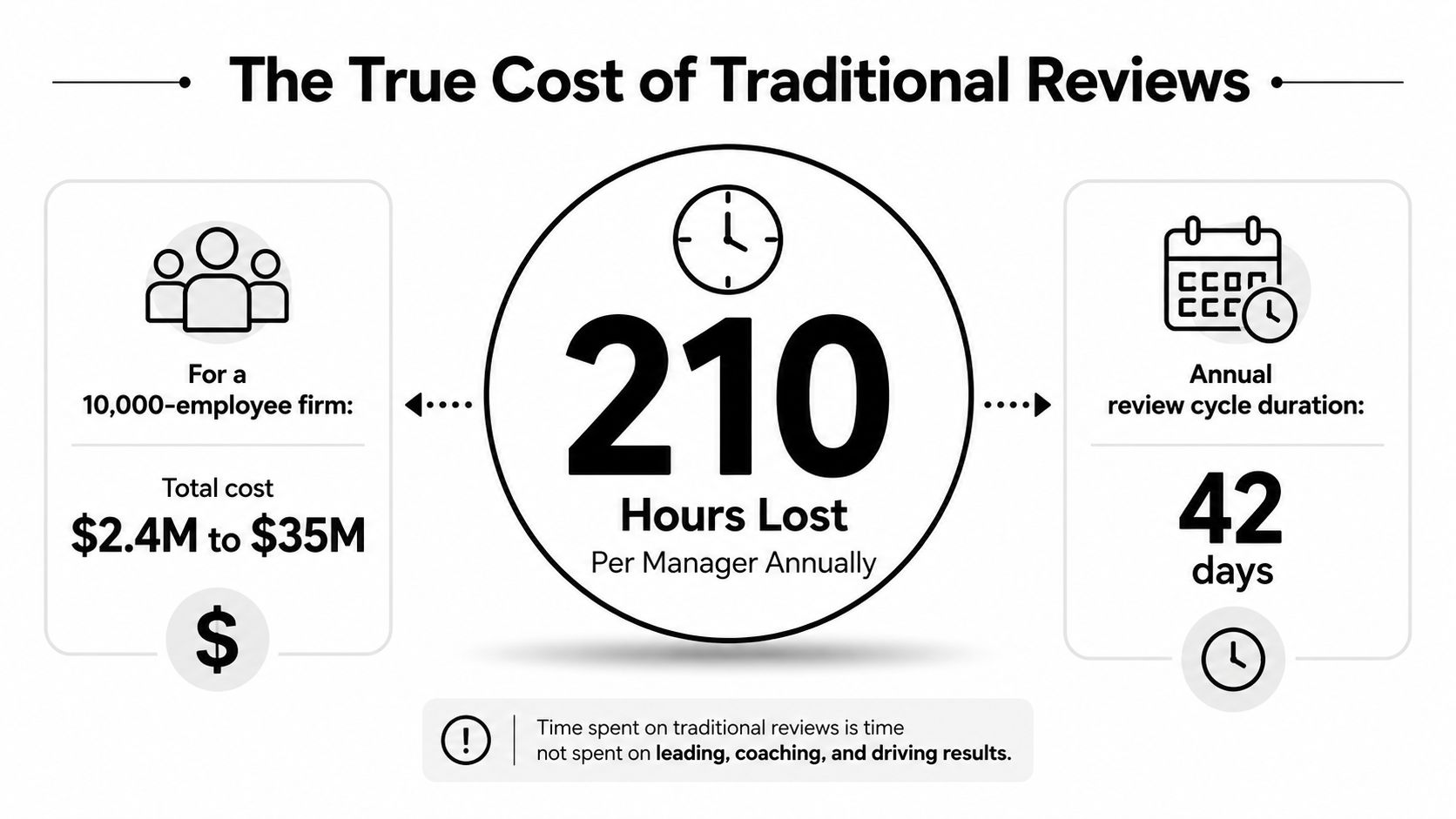
Traditional performance review systems can cost a 10,000-employee company between $2.4 million and $35 million, and managers can spend 210 hours a year on performance-management work, which is more than five workweeks before anyone even counts employee self-reviews or calibration meetings. That's why the core issue isn't the review form, it's whether your performance review process collects evidence well enough to justify the time, money, and judgment involved.
The hidden cost most managers never calculate is the hours lost to weak preparation, not just the meeting itself.
A useful process should do three jobs at once, measure performance, develop people, and support decisions. If it can't do all three, it's just paperwork with a calendar invite. For teams that want a defensible system, the answer is less about annual ritual and more about building a repeatable evidence loop that managers can sustain.
I've seen the difference between a review cycle that creates clarity and one that burns time with little payoff. The first one produces cleaner compensation calls, better coaching conversations, and fewer surprises. The second one creates churn, bias, and manager fatigue.
For a broader HR framing, the UK performance appraisal process is a helpful companion read because it shows how the same fundamentals travel across different organizations. And if manager discipline is the weak link in your company, this guide to staying disciplined is worth keeping close, because consistency is what makes review data usable.
Why the Performance Review Process Matters More Than the Form
A polished template doesn't fix a weak performance review process. If the company is collecting vague opinions once a year, the form is just a nicer wrapper around bad judgment. The value comes from the evidence behind the review, and from whether that evidence supports compensation, promotion, coaching, or corrective action.
The process has to do three different jobs
The first job is measurement. Managers need enough evidence to compare performance against role expectations, not against memory or office politics. MIT's guidance is useful here because it ties review work to job descriptions, written self-assessments, multi-rater feedback, documentation, and scheduled conversations that connect to salary decisions.
The second job is development. Good reviews don't just grade the past, they point to what should change next. Nationwide's guidance is direct on this point, the written review should compare work to pre-determined goals and expectations, list accomplishments, discuss strengths and improvement areas, and give direction for the next period.
The third job is decision support. Without a defensible record, pay and promotion calls feel arbitrary even when managers mean well. That's where evidence matters more than sentiment, because the review should tell a coherent story, not force HR to reverse-engineer one after the fact.
Practical rule: if a manager can't explain a rating with examples, the process isn't ready for compensation decisions.
The cost framing matters because review cycles don't scale gracefully. Gallup's estimate, as summarized by Zensai, puts a traditional process for a 10,000-employee organization at $2.4 million to $35 million, and managers spend 210 hours per year on performance-management activities, which is a lot of time to spend on a process that still leaves people confused if it's poorly run. That's why the better question isn't whether reviews are annoying. It's whether they produce enough useful data to justify their cost.
If you want the process to earn its keep, treat it like operations, not ceremony. That means cleaner criteria, fewer surprises, and a clearer path from feedback to action.
What the Performance Review Process Actually Is
The performance review process is the structured workflow a company uses to set expectations, gather evidence, evaluate work, and act on the result. It's not the meeting itself. It's the chain of decisions and inputs that make the meeting meaningful.
Think dashboard, not verdict
A review should function more like a dashboard than a courtroom. A dashboard shows direction, risk, and trend lines, while a verdict pretends the past can be summarized in a single dramatic moment. That distinction matters because the best process supports alignment, development, calibration, accountability, and documentation at the same time.
Different organizations choose different rhythms because the work itself changes at different speeds. Traditional annual reviews still exist, but many teams use semi-annual or quarterly cycles, project-based reviews for deliverable-heavy work, 360-degree reviews when peer context matters, and continuous feedback models when work moves quickly or managers don't see everything directly. If you're looking for a usable starting point, a better annual performance review can be adapted into a more modern cycle without throwing away structure.
The adoption reality is still stubborn. Zensai's summary says 80% of businesses use traditional reviews to some degree, which tells you two things at once, the model is firmly embedded, and most companies haven't fully solved the replacement problem. So the choice isn't usually between reviews and no reviews. It's between an old cadence that's expensive to maintain and a more continuous system that is easier to justify.
Match the format to the work
A review format should fit the operating cadence of the team. Fast-moving product, engineering, and trading environments usually benefit from more frequent evidence capture, while stable roles can sometimes use less frequent formal moments if the manager is still documenting along the way. The point is consistency, not novelty.
The right question is simple, what cadence gives managers enough signal without turning the process into noise?
The End-to-End Workflow From Preparation to Follow-Up
A usable performance review process is a loop with four distinct phases. Each phase has a different job, and mixing them together is where teams lose clarity.
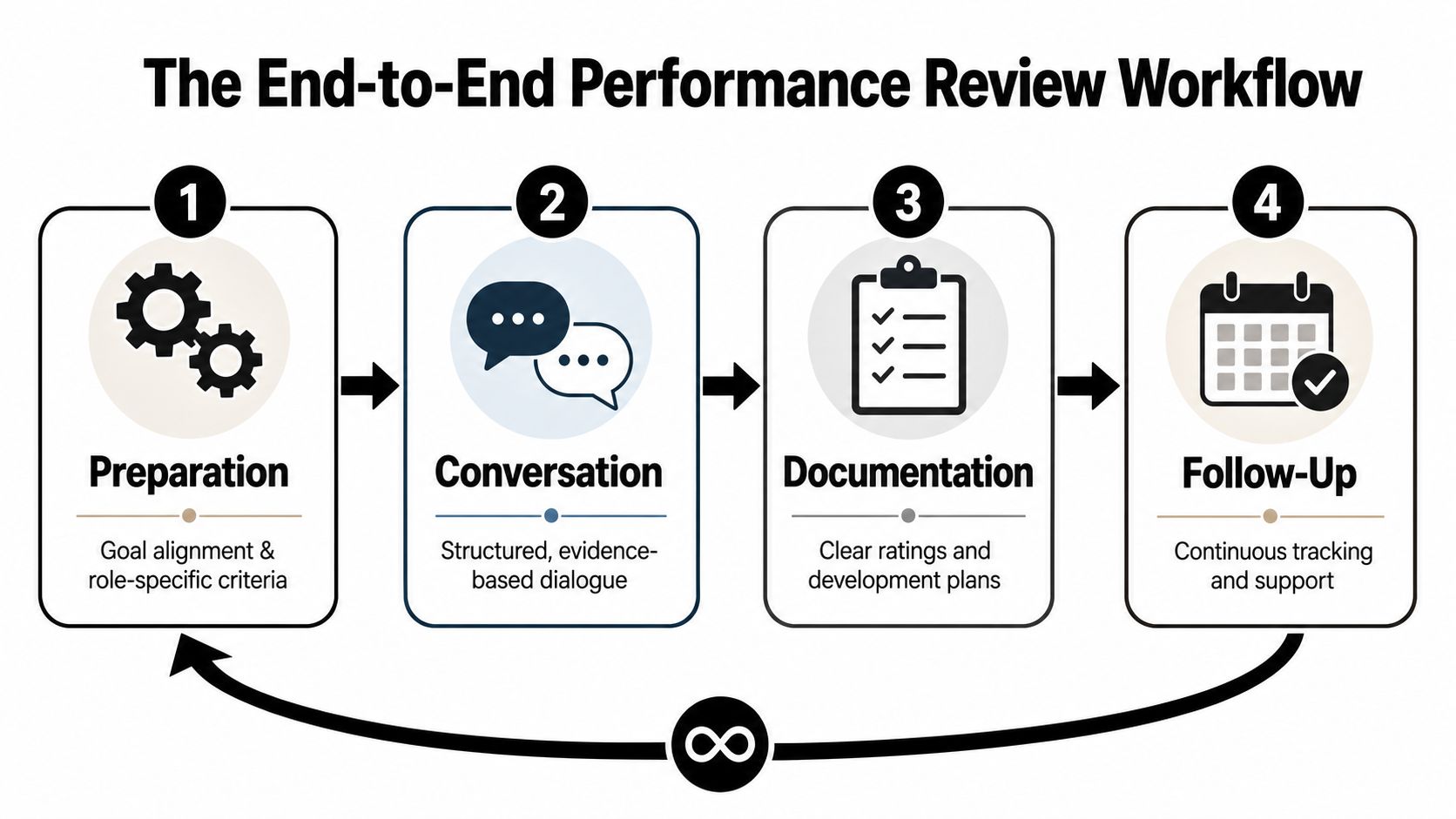
Preparation sets the quality of everything that follows
Preparation starts with role expectations, goal alignment, and the evidence list. Lattice's data shows the median review cycle is 12 days, and the middle 50% of cycles last one to three weeks, so a modern cycle needs to be tight and organized, not dragged out for a month. In that same cycle, peer, self, and upward feedback collection usually takes one to two weeks, which is why you need to know who is contributing before the review opens.
Managers should enter preparation with three documents, current goals, role-specific criteria, and a running log of performance evidence. That's the point where many teams fail, because they try to build the review after the cycle is already over. If the evidence isn't there yet, the conversation will drift toward memory and impressions.
Conversation should be structured, not improvised
The review conversation works best when it follows the evidence already collected. Self-review, manager review, and multi-rater input all belong here, along with the actual discussion of strengths, gaps, and next steps. The meeting should not try to discover performance from scratch.
A useful habit is to send the agenda in advance and keep the conversation anchored to examples. That keeps the employee from feeling ambushed and gives the manager a way to defend the rating without overexplaining. It also leaves less room for vague impressions to hijack the conversation.
Calibration turns individual ratings into company-wide consistency
Calibration is where managers compare notes across teams. Without it, one manager's “meets expectations” can be another manager's “needs improvement,” and the company ends up with inconsistent ratings for similar work. That's especially risky in distributed teams where direct observation is uneven.
The goal isn't to force identical outcomes. It's to make the standards legible across leaders so ratings mean roughly the same thing everywhere. That's also why I'd rather see a short, disciplined calibration meeting than a long one that tries to resolve every disagreement on the spot.
Follow-up is where the process proves itself
Follow-up converts the review into action. That means development plans, pay decisions where relevant, and next-cycle goals that are specific enough to track. If nothing changes after the review, the organization has just created expensive documentation without operational value.
A good test is simple, can the manager and employee point to the next concrete behavior, project, or metric that should change before the next cycle begins?
A secure performance review prep resource can help teams organize the evidence and documents before the meeting opens, which is usually where the process becomes messy. The better the preparation, the less the conversation has to compensate for missing records.
Best Practices That Make Reviews Defensible and Useful
A defensible performance review process is built on evidence collected throughout the cycle, not on memory at the end. That one habit does more to improve fairness than many realize, because it reduces the chance that recency bias or a loud final week will distort the result.
Build around role-specific evidence
The strongest review systems use defined, role-specific metrics rather than generic impressions. MIT's guidance makes that explicit, and it's especially important in technical roles where delivery and quality need to be considered together. Engineering reviews get more useful when the evidence includes pull-request history, code-review participation, cycle time, deployment frequency, defect rates, and change failure rates, because those signals show whether the work is both fast and stable.
That principle applies outside engineering too. A sales manager shouldn't use the same evidence set as a product designer, and a support lead shouldn't be judged like a finance analyst. The review gets stronger when the criteria match the work.
Use a running log, not a year-end memory dump
The single most impactful habit a manager can build is a running log of accomplishments, misses, and context. HRMorning's guidance emphasizes continuous documentation, clear criteria, and expectations that don't stretch past 12 months, which is exactly the right shape for better recall. If the notes are there, the review can be specific. If they're missing, the meeting turns into a guessing game.
I've found the best managers keep the log simple.
- Document wins as they happen: Add the project, outcome, and why it mattered.
- Record misses with context: Note what slipped, what was controllable, and what support was missing.
- Capture peer input early: Write down feedback before it gets blurred by time.
- Tie notes to expectations: Keep each entry linked to the role criteria the employee can influence.
A good internal standard is to make documentation useful enough that another manager could read it and understand the rating without a long verbal explanation.
Documentation should make the review easier to defend, not harder to read.
For teams building their own operations stack, the risk assessment tool is a useful model for how structured inputs can reduce avoidable mistakes. The logic is the same, clearer inputs produce better decisions.
Use self-reviews and multi-rater feedback carefully
Self-assessments are useful when they're evidence-based, not self-promotional. Multi-rater feedback helps when the employee's work is observed by people the direct manager doesn't see every day. Both tools work best when they're gathered against the same standards, not tossed in as a ceremonial extra.
A disciplined process usually includes a mid-year conversation and an annual conversation tied to compensation decisions. That cadence keeps performance from becoming a surprise event. It also gives the manager enough checkpoints to course-correct before the cycle ends.
Traditional vs Continuous Reviews for Remote and Hybrid Teams
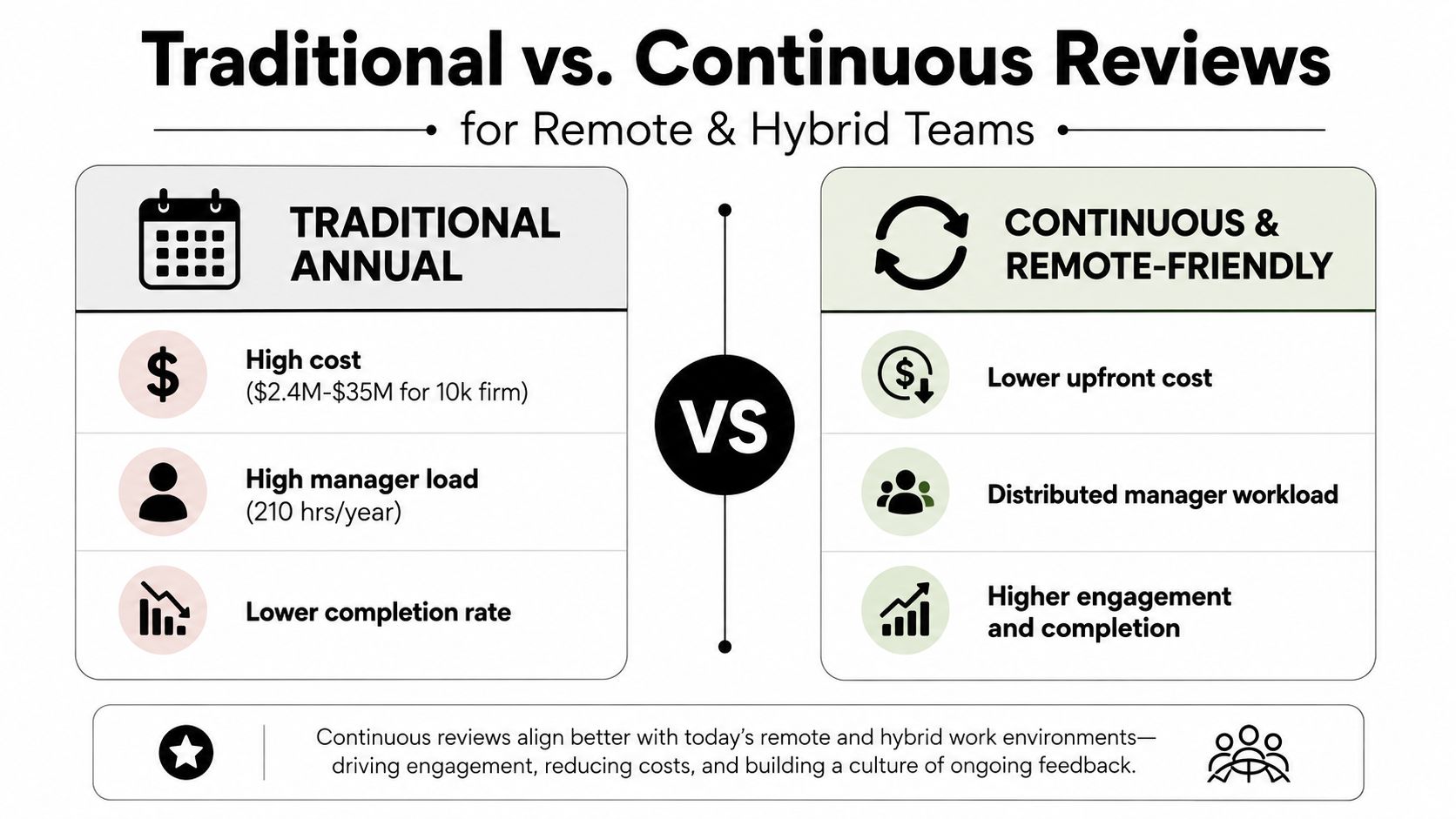
The biggest format decision is whether to run a traditional annual review or a more continuous model. For remote and hybrid teams, that choice affects cost, workload, and fairness more than the wording in the template.
Traditional reviews are familiar, but they concentrate the pain
Traditional annual reviews are easier to explain, but they often pile evidence gathering, scoring, and compensation conversations into one tight window. That creates a lot of manager work at once, and it makes the review more vulnerable to recency bias because the final weeks loom larger than the rest of the year. The work is also harder to observe in remote settings, which means the manager's memory can carry too much weight.
The upside is administrative simplicity. Everyone knows when the cycle happens, and that can be helpful for payroll, budgeting, and formal documentation. The downside is that the process can become stale and expensive if it's the only time people talk about performance in any structured way.
Continuous models fit remote work better, but they demand discipline
Continuous and remote-friendly systems spread feedback across the year, which lowers the pressure on any single meeting. They also fit teams that work asynchronously, because evidence can be captured as work happens instead of reconstructed later. That usually makes the process feel more current and more fair.
The trade-off is manager overhead. If the documentation is fragmented across tools and conversations, the process gets harder to defend even if it feels more modern. Short cycles only work when the evidence is organized.
Lattice's completion data is a good benchmark for what well-run systems can do, with a median completion rate of 89% and a 75th percentile of 96%. That tells you high completion is possible when the workflow is designed well, not just when people are reminded more often. Lattice also found that peer reviews were included in 41% of companies between April 2019 and April 2020, then 32% in the following year, which suggests many organizations are refining multi-rater input rather than expanding it everywhere.
A practical decision rule
Use a more continuous model if the work changes often, managers can't observe everything directly, or your teams are distributed. Stick with a formal annual anchor only if you can still collect evidence continuously and use the review as a summary, not a discovery session. If neither is true, the process will feel performative no matter how polished the form looks.
Common Pitfalls and How to Reduce Bias Without Box-Ticking
The hardest part of the performance review process is balancing structure with judgment. Too much structure and the review turns into box-ticking. Too much discretion and bias leaks in through the side door.
The bias problems are predictable
Harvard Business Review points to the usual distortions, recency effects, halo effects, and similarity bias. Those problems don't disappear because a company says it values fairness. They disappear when the company uses clear standards, written evidence, and manager calibration instead of intuition alone.
A process can also fail by becoming mechanically rigid. If the rubric is so narrow that it erases context, managers stop trusting it and start working around it. That's how “fair” systems become empty systems.
| Common Performance Review Pitfalls and Concrete Mitigations | ||
|---|---|---|
| Pitfall | What It Looks Like | Mitigation |
| Recency bias | The final month dominates the rating | Keep a running log and document evidence throughout the cycle |
| Halo effect | One strong trait inflates the whole review | Separate criteria for delivery, quality, collaboration, and growth |
| Similarity bias | Managers favor people who feel familiar | Use written standards and calibration sessions across teams |
| Vague criteria | Ratings sound polished but aren't explainable | Anchor the review to role-specific expectations |
| Box-ticking | The form gets completed, but the judgment is shallow | Keep the conversation evidence-based and focused on next actions |
Reduce bias without stripping out context
Structured evidence capture is the best first line of defense. Written criteria help because they force managers to explain what each rating means. Multi-rater feedback helps when the direct manager doesn't see the full picture. Calibration meetings help teams compare standards before ratings get locked.
The trade-off is this, standardization improves consistency, but it can also flatten judgment if you push it too far. Individual managers still need room to explain context, especially when one employee's performance was shaped by constraints another employee didn't face. The goal is not to remove manager judgment. The goal is to make judgment visible, specific, and defensible.
Fairness improves when managers can point to evidence, not just preference.
A clean review season doesn't mean everyone gets the same outcome. It means every outcome can be defended with a consistent standard and a clear paper trail.
Templates, KPIs, and a Practical Checklist to Start With
A lightweight performance review process can work at 10 people or 1,000 if the inputs are consistent. Start with a short template, a manager checklist, and a few KPIs that show whether the process is running.
A simple self-review template
Keep the self-review short enough that people will complete it.
- Goal recap: List the top goals from the cycle and the result for each one.
- Evidence list: Add the key projects, deliverables, and feedback that support the self-assessment.
- Development ask: State what support, opportunity, or skill the employee wants next.
- Reflection: Note one thing that went well and one thing that should change.
A manager template and KPI bundle
The manager review should anchor on role-specific criteria and documented examples. It should also connect directly to the next cycle, so the conversation ends with action rather than vague encouragement.
Use a simple KPI bundle to keep the process honest, completion rate, calibration drift, goal attainment, and feedback turnaround time. If those measures start slipping, the system is probably becoming too heavy, too vague, or too late in the cycle.
For teams that want a concrete next step, the trading plan template is a helpful example of how disciplined planning works when the rules matter and the evidence has to be visible. That's the same mindset a strong review process needs.
Final checklist
- Do collect evidence throughout the cycle.
- Do write criteria that match the role.
- Do calibrate ratings across managers.
- Don't rely on memory at review time.
- Don't use a review to discover performance for the first time.
- Don't confuse completion with quality.
Trading involves risk of loss, and good process won't remove that risk. The point is discipline, evidence, and repeatability, not guarantees. The same logic applies to performance reviews, and it's the reason the best systems stay practical instead of theatrical.
If you want to see how disciplined evaluation works in a real prop trading environment, MyFundedCapital offers funding programs and account types designed around clear rules, structured evaluation, and transparent risk limits. Visit their site to compare account options and choose the path that fits your trading style.
