

 AR
AR
 NL
NL
 FR
FR
 DE
DE
 ES
ES
 IT
IT
 PL
PL
 SV
SV
 PT
PT

You finish the week with a green day, two red days, and a flat day. Your account moved, but you can’t clearly explain why. One trade followed your plan, one was a revenge click, one worked for the wrong reason, and now you’re staring at a balance curve that hides more than it reveals.
That’s where a trading journal stops being a chore and starts becoming a professional tool. If you’ve been asking what is a trading journal, the short answer is simple. It’s the record that turns vague trading memories into something you can review, measure, and improve. For anyone trying to trade consistently, and especially for anyone aiming to pass a prop evaluation, that distinction matters.
Introduction
A lot of traders think they know how their week went. Then they sit down on Friday and realize they’re working from fragments. They remember the big winner, the annoying stop-out, and the trade they shouldn’t have taken. They don’t remember the pattern.
That gap is expensive. Without a journal, every lesson feels emotional, random, and temporary. With one, each trade becomes part of a dataset you can use.
A proper journal tracks more than entries and exits. It captures context, discipline, and decision quality. It shows whether your edge is real, whether your risk is controlled, and whether your behavior holds up under pressure. Trading involves risk of loss, and this article is for educational purposes only, not financial advice.
What a Trading Journal Is (And Is Not)
A trading journal is the record serious traders use to audit decisions under live pressure. In prop trading, that matters even more because one good setup can still become a failed evaluation if it breaks a daily drawdown rule, pushes size too hard, or comes from a trade you were never supposed to take.

A broker statement records fills. A journal records the decision, the setup, the risk taken, the rule set in play, and the conditions around the trade. That is the difference between having receipts and having a process you can test.
For discretionary traders, that usually includes the setup, entry trigger, stop location, target logic, session, market condition, and any execution error. For prop firm candidates, the journal also needs to track rule exposure. Daily loss limit, trailing drawdown, max position size, lot consistency, news restrictions, and whether the trade fit the challenge plan. If you are trying to pass a firm like MyFundedCapital, journaling has to answer a harder question than "Did this trade win?" It has to answer "Did this trade help me stay fundable?"
That standard also applies to platform-specific execution. On cTrader or DXtrade, a useful journal can include manual trades, copied trades, and algorithmic entries from bots or signal routing. If part of your account activity comes from automation, log the source of the trade, the strategy ID, expected behavior, slippage, and whether execution matched the model. Otherwise, you can mistake platform friction or copy latency for a strategy problem.
What a real trading journal contains
A useful journal combines hard data with review notes you can act on later.
That usually means:
- Date and time
- Instrument or market traded
- Long or short direction
- Entry, stop, and exit levels
- Position size and risk per trade
- Setup or playbook tag
- Screenshot before and after execution
- Market context, such as trend, range, or news
- Rule compliance, especially drawdown and evaluation limits
- Trader notes on execution quality and discipline
The point is simple. If a trade loses, you should be able to tell whether the loss came from valid edge, bad timing, oversized risk, emotional interference, or a direct rule breach.
What weak journaling looks like
Many retail traders log P&L and call it journaling. That habit misses the part that is key to improving performance.
A list of wins and losses will not show that you keep increasing size after two green trades. It will not show that your copied trades perform differently from your manual entries on DXtrade. It will not show that your worst days start with one rule break, then turn into three more because you were trying to recover quickly. If fear of missing out keeps pushing you into late entries, that pattern usually becomes obvious once you start tracking the setup trigger and emotional state. This breakdown of what FOMO in trading looks like connects that behavior to the kind of low-quality entries a journal should catch early.
The opposite mistake is writing long emotional notes with no trading data attached. Feelings matter, but only when tied to behavior you can measure. "Felt off today" is vague. "Ignored the plan, entered after the candle closed too far from the level, and cut the trade early because I was protecting open P&L" gives you something to fix.
A real trading journal is a performance review system. It should make rule breaks easy to spot, sizing errors hard to justify, and repeatable setups easier to trust. That is why professionals keep one and amateurs avoid it. One group wants evidence. The other wants reassurance.
Why Every Serious Trader Needs a Journal
Most traders don’t lose because they lack opinions. They lose because they can’t separate a repeatable edge from random outcomes.
That’s why journaling matters. It gives you enough structure to stop guessing. One established principle, cited by tastylive’s discussion of trading journals, says that failing to maintain a thorough journal creates an information gap identical to analyzing a stock without price charts. That’s a blunt comparison, but it’s accurate.
It exposes patterns you won’t see in memory
Memory is selective. It gives too much weight to dramatic trades and not enough weight to repeat behaviors.
A journal catches the stuff that slowly undermines performance:
- Inconsistent sizing when confidence is high
- Stop-loss drift after a losing streak
- Premature profit taking on valid setups
- Revenge entries after a frustrating miss
- FOMO trades after watching price run without you
If FOMO keeps showing up in your notes, it’s worth understanding the behavior in plain language. This guide on what FOMO in trading looks like connects that emotional impulse to the kind of undisciplined entries journals often uncover.
It turns psychology into something you can work with
Most traders know emotions matter. Fewer traders track them well enough to do something about them.
That’s where the journal becomes useful. Once emotions are logged consistently, they stop being vague. You can start asking practical questions:
- Was I calm before entry or already agitated?
- Did I size differently after two winners?
- Did I force trades when I felt behind on the day?
- Did boredom create low-quality setups?
Those answers help because they connect behavior to outcomes. That’s different from saying “I need better discipline.” It shows where discipline breaks.
Practical rule: If a behavior keeps appearing in your losing trades, treat it like a system flaw, not a personality quirk.
It separates amateurs from funded professionals
Prop firms don’t care how confident you sound after a good day. They care whether you can trade within rules, hold risk steady, and repeat process under pressure.
That’s why serious traders treat journaling as infrastructure. It enforces accountability. It creates proof. It gives you a basis for adjusting size, timing, market selection, and execution standards without making random changes every week.
Journaling also reduces a common mistake among developing traders. They change strategy too quickly because they haven’t documented enough detail to know whether the issue is the setup, the market condition, or their own execution.
The traders who last are rarely the ones chasing novelty. They’re usually the ones reviewing hard evidence and making fewer, cleaner adjustments.
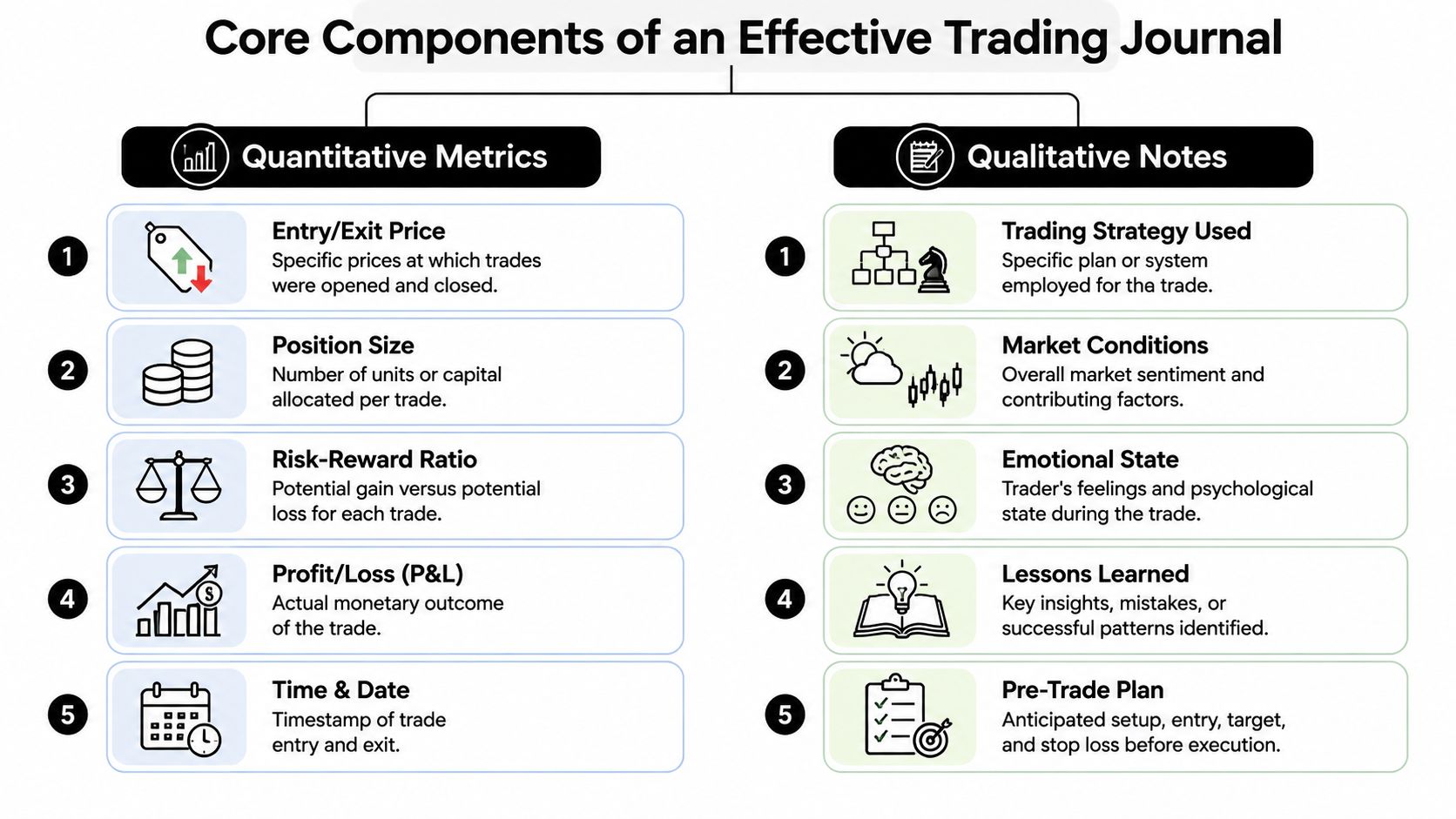
Core Components of an Effective Trading Journal
A useful journal has to answer one question fast: why did this trade make money, lose money, or break process?
If the entry is too thin, review turns into guesswork. If it is bloated, traders stop filling it in after three days. The right structure is tight enough to maintain every day and detailed enough to expose patterns that matter for performance, drawdown control, and rule compliance.
The cleanest build has three parts: trade data, decision context, and rule tracking.
The core data points
Start with the fields every trade needs. Without them, the rest of the journal becomes opinion.
| Journal area | What to record | Why it matters |
|---|---|---|
| Trade identity | Date, time, instrument, account, platform, direction | Lets you sort by session, product, challenge account, and execution venue |
| Execution | Entry, exit, stop, target, position size | Shows whether the trade matched the planned risk and structure |
| Outcome | P&L, R-multiple, fees, slippage | Separates a good trade from a lucky result |
| Context | Market condition, volatility, news proximity, session | Explains where the setup tends to perform or degrade |
| Compliance | Rule followed, drawdown impact, max loss exposure | Matters most for prop firm evaluations and funded accounts |
| Review | Setup label, mistake tag, lesson | Makes weekly analysis fast and specific |
For traders trying to pass a prop challenge, add two fields that retail traders often ignore: starting equity for the day and lowest equity reached during the trade. That makes daily drawdown and trailing drawdown visible instead of something you check only after damage is done. On firms with hard limits, including accounts like MyFundedCapital, that field is often more important than the trade outcome itself.
Quantitative metrics to log every time
These fields make the journal usable in review instead of just readable:
- Date and time: Needed to isolate strong sessions, weak sessions, and trades taken outside plan hours.
- Instrument traded: Useful if results differ sharply between indices, forex, metals, or crypto.
- Account or challenge phase: Separate practice trades, evaluation trades, and funded trades.
- Platform used: cTrader and DXtrade can produce different execution behavior, especially if you run copied or automated flows.
- Position size: Inconsistent sizing is one of the fastest ways to fail a challenge.
- Setup label: Name the actual pattern or model, not just "long" or "short."
- Entry, stop, and exit details: Include price and time for each.
- P&L and R-multiple: Currency result matters, but R shows whether the trade was efficient relative to risk.
- Drawdown impact: Log peak adverse excursion or the largest unrealized dip if challenge rules are tight.
One extra tag improves review a lot. Use labels such as "A setup," "late entry," "news overlap," "copied trade," or "EA trade." Those tags help separate strategy edge from execution noise.
Decision notes that expose repeat mistakes
A good journal does more than store trade history. It records why the trade existed in the first place.
Keep the notes short, but force precision:
- Why the setup qualified: What condition made this a valid entry?
- What market condition was present: Trend, range, expansion, compression, or event-driven movement.
- What invalidates the trade: The price level or condition that proves the idea is wrong.
- Why size was chosen: Full risk, reduced risk, or scaled entry.
- Whether the trade was discretionary, algorithmic, or copied: This matters a lot when you review cTrader cBots or DXtrade copy execution.
- What happened operationally: Missed fill, manual override, latency, spread expansion, partial close, or rule breach.
- What to repeat or remove: One sentence only.
Short notes win here. A line like "entered before confirmation to avoid missing move" is useful. "Bad trade" is not.
Chart screenshots help too. One image before entry and one after exit is enough. For manual traders, that catches timing errors. For algorithmic or copy traders, it also reveals whether the system did what it was supposed to do or whether the problem was mapping, symbol differences, or copied size logic. If you use voice notes during active hours, the SpeakNotes system for notes is a practical way to capture observations without slowing execution.
A journal built for prop firm challenges
A standard retail journal misses the fields that decide whether you pass or fail an evaluation.
Add a challenge control block to every entry:
- Daily loss limit before the trade
- Remaining drawdown after the trade
- Open risk across all positions
- Correlation exposure
- Rule status, such as news restriction, max lot rule, consistency target, or weekend holding rule
- Challenge objective progress, including whether the trade helped the plan or only added variance
Journaling becomes risk infrastructure. A trader can be right on direction and still fail the account by stacking correlated positions or by taking a clean setup after already reaching the day's risk limit.
That is also why the journal should match your risk framework. If your entries do not reflect the limits in your prop firm trading plan template, review gets messy and rule breaches slip through.
Keep it strict enough to review weekly
The best journal format is the one you will still complete after a losing day, a rushed London open, or a week of automated execution.
For most traders, that means recording the same fields every time, tagging mistakes with the same language, and reviewing by setup, by session, and by drawdown impact. Consistency matters more than sophistication. A clean journal shows whether the problem is strategy quality, rule control, or execution drift. That distinction is what funded traders need.
How to Set Up Your Trading Journal
There are two workable paths. You can build a manual journal in a spreadsheet, or you can use software that imports and organizes trades for you. Both can work. The right choice depends on how often you trade, how many instruments you manage, and how much time you’re willing to spend on admin.

The manual approach
If you’re newer, a spreadsheet is enough. Google Sheets or Excel can handle a solid trading journal without any fancy setup.
Use columns like these:
| Column | Purpose |
|---|---|
| Date | Trade day |
| Time in | Entry timestamp |
| Time out | Exit timestamp |
| Instrument | Market traded |
| Long or short | Direction |
| Setup | Strategy label |
| Size | Position size |
| Entry | Entry price |
| Exit | Exit price |
| P&L | Trade result |
| Market condition | Trend, range, volatility, news context |
| Emotion before | Your pre-trade state |
| Emotion after | Your post-trade state |
| Rule followed | Yes or no |
| Lesson | One-line review |
That structure is enough for most manual traders.
The upside of spreadsheets is control. You can customize every field. The downside is friction. If updating the sheet feels slow, you’ll delay it, and delayed journaling turns into incomplete journaling.
A simple note-taking framework helps here. If you struggle to keep trade notes brief and consistent, the SpeakNotes system for notes is useful because it gives structure to short, repeatable logging instead of vague freeform writing.
The automated approach
Dedicated journal tools save time if you trade frequently or across multiple accounts. They’re especially helpful if you use cTrader, DXtrade, or a mix of manual and rule-based execution.
The main advantages are practical:
- Automatic importing: Less manual typing, fewer missed trades
- Cleaner filtering: Easier comparison by setup, session, or instrument
- Faster review: Better for traders who need to audit many positions
- Chart attachment and tagging: Usually smoother than spreadsheets
The trade-off is flexibility. Some tools force their own structure, which may not match how you think about setups or rule breaks.
The best journal format is the one you’ll still be using after a losing week.
How platform users should think about setup
If you trade on cTrader or DXtrade, your first job is to make sure your execution data can be exported or copied into a repeatable review process. Keep one source of truth. Don’t split your notes across screenshots, platform comments, Telegram messages, and a half-updated spreadsheet.
Manual traders usually do best with a spreadsheet plus chart screenshots stored in one folder. Algorithmic and higher-frequency traders usually need imported execution data first, then a separate notes layer on top.
If you want a planning document to sit next to your journal, use a dedicated trading plan template so your pre-trade rules stay separate from your post-trade review. That makes it easier to see whether a loss came from strategy logic or from not following your own plan.
One practical note for funded-account traders. MyFundedCapital supports manual, algorithmic, and copy trading on DXtrade and cTrader, so the journal you build should fit the style you use instead of assuming every trade is discretionary.
Advanced Journaling for Prop Firm Challenges
A prop challenge changes the job. You’re no longer just trying to find good setups. You’re proving that you can operate inside a rule set without breaking under pressure.
That means your journal needs extra fields. Standard trade notes aren’t enough.
Track rule pressure, not just trade outcome
For funded traders, journaling should include rule-awareness fields. MyFundedCapital uses a 5% daily loss limit and a 10% maximum drawdown threshold, as noted in the verified business context above. Those constraints change how you should review every trade.
Add fields like these:
- Daily loss status before entry: Were you already close to your limit?
- Open risk exposure: How much total risk was active across positions?
- Rule-break flag: Did the trade violate your own plan or challenge conditions?
- News proximity: Was a major event close to entry?
- Session condition: Was the market clean, thin, or unstable?
Bookmap’s journaling article notes that documenting market conditions at trade entry, such as volatility regime, volume spikes, and news event proximity, allows funded traders to backtest whether indicators perform better in high-volatility periods or ranging markets, which directly helps protect the 5% daily loss limit.
Use your journal to prevent challenge failure
Most failed evaluations don’t come from one mysterious market event. They come from a sequence of poor decisions under pressure.
A challenge-focused journal should help you spot early warning signs:
| Warning sign | What to log | What it tells you |
|---|---|---|
| Sizing up after losses | Position size versus prior trades | Whether frustration changes risk |
| Overtrading | Number of entries in a short span | Whether you’re forcing action |
| News-related damage | Event proximity tag | Whether you should avoid certain windows |
| Emotional acceleration | Confidence, urgency, anger | Whether behavior is degrading before the account does |
If you review these fields daily, you’ll often catch the problem before the breach.
A funded challenge rewards control first. Good entries matter, but survival and rule compliance matter every day.
If you want to improve how you test ideas before using them in an evaluation, build review around validated setup behavior and pair that with proper backtesting for trading strategies.
How to journal algorithmic and copy trading
Most generic trading journal advice falls apart. It assumes every trade is manually clicked.
If you use an EA, bot, signal copier, or rule-based execution on cTrader or DXtrade, your journal should log the system layer too:
- Strategy name or bot ID: So trades can be grouped correctly
- Version or parameter set: Useful when you change filters, timing, or risk logic
- Manual override notes: Did you interfere with the system?
- Signal source notes: If copy trading, what provider or logic generated the trade?
- Reason for parameter change: What prompted the adjustment?
Manual traders often journal decisions. System traders also need to journal changes to the decision engine.
That distinction matters because a bad week in algo trading may come from altered settings, poor market fit, or human interference, not from the strategy concept itself. Without those fields, the review stays shallow.
Frequently Asked Questions About Trading Journals
How often should I review my trading journal
Log trades as close to execution as possible. Review the journal briefly each day and more thoroughly each week. Daily review catches rule breaks while they’re still fresh. Weekly review helps you spot patterns across multiple trades instead of overreacting to one result.
What’s the biggest mistake beginners make with journaling
They treat it like record-keeping instead of analysis. Logging entry, exit, and P&L is not enough. If the journal doesn’t capture the setup, market condition, and your state of mind, it won’t explain why performance changed.
Is it okay to start simple
Yes. In fact, it’s better to start simple and stay consistent than to build a complex journal you stop using. A basic spreadsheet with a few strong fields beats an advanced template that never gets updated.
Should I journal losing trades differently from winning trades
No. Use the same structure for both. If you write detailed notes only on losses, you’ll miss what your good trades had in common. Winning trades deserve review too, especially if they were badly executed but happened to work.
Conclusion
A trading journal is not paperwork. It’s your review system, your accountability tool, and your risk-control mirror. It shows whether you have a real process or just a collection of opinions attached to chart screenshots.
That matters even more in prop trading. Funded traders need more than occasional good calls. They need repeatable execution, respect for risk parameters, and the ability to review mistakes before those mistakes become account-ending habits. A strong journal helps build all three.
Trading always involves risk of loss, and nothing in this article guarantees results. But if you want to trade at a higher standard, this is one of the clearest habits to build now.
If you’re ready to apply that discipline in a funded environment, explore the challenge and funding options at MyFundedCapital. Compare account types, review the rules carefully, and choose a path that fits how you trade.
