

 AR
AR
 NL
NL
 EN
EN
 FR
FR
 DE
DE
 ES
ES
 PL
PL
 SV
SV
 PT
PT

Only 48.48% of followers were profitable across a 90-day study of 100,236 crypto copy-trading outcomes, even though 97.04% of lead traders were personally profitable. That gap captures the challenge: copying a trader's decisions doesn't guarantee that you'll receive the same fills, costs, or risk exposure. This guide explains how copy trading crypto works, where execution losses appear, how to evaluate signal providers, and why disciplined allocation matters more than chasing a leaderboard.
What Copy Trading Crypto Actually Is
Copy trading crypto lets your account mirror another trader's positions. When a lead trader opens, modifies, or closes a trade, the platform sends a proportional order to your account. You generally choose the amount allocated, while the system scales position size according to the leader's exposure and your balance.
That doesn't mean you receive an identical result. The lead trader's order usually reaches the market first, while follower orders arrive afterward. Your fill can differ because of price movement, liquidity, account settings, and the rules used by the copy engine. You're copying execution instructions, not certainty.
The basic transaction flow
A typical setup follows this sequence:
- Select a venue or copy platform. You may use a centralized exchange, a social-trading application, or an infrastructure provider connected to your exchange account.
- Review the lead trader. Platforms commonly display historical performance, open positions, follower counts, and risk measures.
- Allocate capital. You choose how much of your account participates. The system then sizes copied trades proportionally.
- Set risk controls. Depending on the platform, these can include allocation caps, stop-copy thresholds, take-profit settings, or limits.
- Monitor the result. Your account remains exposed to market movement, execution differences, fees, and any derivatives funding costs.
Copy trading differs from a generic signal group. In a Telegram channel, a trader might post an idea and leave you to interpret and execute it. A copy system attempts to automate the order flow. It also differs from traditional stock mirror trading because crypto operates across 24-hour centralized venues, decentralized protocols, perpetual contracts, and on-chain vaults, each with different custody and settlement mechanics.
A useful operational resource for teams connecting payment rails, exchanges, and digital assets is BroLabel's overview of the fiat and crypto integration stack. Before choosing a venue, also compare how its custody, API permissions, liquidation rules, and copy controls work. A practical starting point is this guide to crypto copy-trading platforms, but platform features should never replace your own risk review.
The next distinction matters most: copy trading can run inside an exchange, through a social platform, or through dedicated replication infrastructure.
The Three Engines Behind Crypto Copy Trading
The mechanics become clearer if you follow one hypothetical trade. A lead trader opens a Bitcoin position with borrowed funds. The platform detects the order, calculates your proportional exposure, sends a follower order, and records the resulting position. The broad process looks similar across providers, but the location of each step changes the risks.
Engine one, the exchange-native module
Binance and Bybit offer examples of exchange-based copy modules. The exchange hosts the leader profiles, calculates allocation, and routes follower orders through its own trading environment. Because the copying system and matching engine sit within the same venue, the integration can be relatively direct.
That structure can simplify custody and account management. You still face the exchange's liquidity, fees, outages, margin rules, and product restrictions. If the venue's copy system limits available markets or forces a particular sizing method, you have less flexibility than you would with a custom setup.
The 90-day multi-exchange dataset illustrates why venue selection matters. Followers on Binance recorded a 66.50% win rate, compared with 43.65% on Bybit and 57.79% on MEXC, while the overall follower profitability rate was 48.48%. The figures don't prove that one exchange will always outperform another, but they show that copy-trading results can vary materially by platform. The underlying study also reported blended net follower PnL of +709,045 USDT across the three exchanges.
Engine two, the social platform
A social platform such as eToro, Bitget's copy environment, or a specialized application places a user interface between the follower and the execution venue. It may combine leader rankings, performance charts, risk metrics, allocation tools, and fee calculations in one dashboard.
The convenience comes with additional questions. Who holds the funds? Which exchange executes the order? Does the platform use an API connection, an omnibus account, or an internal allocation ledger? A social layer can make selection easier, but it may also create another counterparty and another point where delays or policy changes affect the trade.
Engine three, the infrastructure layer
Infrastructure copying uses tools such as exchange APIs, Telegram signal bots, TradingView alert webhooks, or on-chain smart-contract vaults. These tools can support custom sizing, portfolio rules, and automated trade routing.
Flexibility brings responsibility. API permissions must be limited, private keys must be protected, and smart-contract code must be reviewed before capital is committed. A bot that copies every instruction without understanding whether it's a spot order, a perpetual position, or a liquidation-sensitive adjustment can reproduce errors at machine speed.
Practical rule: Treat the copy engine as part of the strategy. Custody, latency, fees, and failure behavior can change your result even when the leader behaves exactly as expected.
Manual, Social, and Infrastructure Copy Approaches Compared
The phrase “copy trading” covers very different workflows. A manual follower might read a trader's market update and place an order independently. A social-platform user might click an allocation button and let the venue replicate positions. An infrastructure user might connect an API or smart contract that reacts automatically.
Manual copying
Manual copying gives you the most control over whether a trade enters your account. You can reject a setup, reduce size, use a different order type, or avoid a market that doesn't fit your plan.
The trade-off is speed and consistency. A delayed message, hesitation, or emotional change can produce a result that has little resemblance to the leader's. Manual copying can work as an observation and learning process, but it's a poor substitute for verified automation when the strategy depends on precise timing.
Social-platform copying
A social platform reduces the number of decisions between selection and execution. The platform publishes leader statistics, accepts your allocation, and usually applies a proportional replication rule.
You'll need to inspect the fee schedule carefully. Copied trades still incur standard exchange or broker trading fees, and platforms may charge performance fees. A commonly cited structure is a 10% to 20% profit share, often calculated using net profits or a high-water-mark method, as described in this copy-trading fee guide.
Infrastructure copying
APIs, bots, webhooks, and smart-contract vaults can reduce manual delay and enforce predetermined sizing. They're useful for traders who need repeatable rules across several accounts or venues.
They also expose you to code defects, incorrect permissions, API outages, oracle problems, and smart-contract exploits. A faster system can lose faster if the underlying instruction or risk limit is wrong.
| Approach | Control Level | Typical Fee Range | Execution Latency | Best For |
|---|---|---|---|---|
| Manual copying | High, because you approve each trade | Trading fees and any channel or platform charge | Highest and inconsistent | Traders learning a strategy or filtering signals |
| Social-platform copying | Moderate, through allocation and platform controls | Trading fees plus any platform or performance fee | Usually lower than manual copying, but venue-dependent | Users seeking a guided, integrated workflow |
| Infrastructure copying | High at the rules level, lower at the individual-trade level | Trading fees, software costs, performance fees, or protocol charges | Potentially low, but dependent on APIs, bots, and liquidity | Experienced users managing systematic replication |
If your goal is to start a crypto trading community, keep education separate from execution authority. A community can share ideas and trade journals without encouraging members to connect unrestricted API access or treat a popular signal as a substitute for risk management.
Why Most Crypto Copy Traders Lose Money
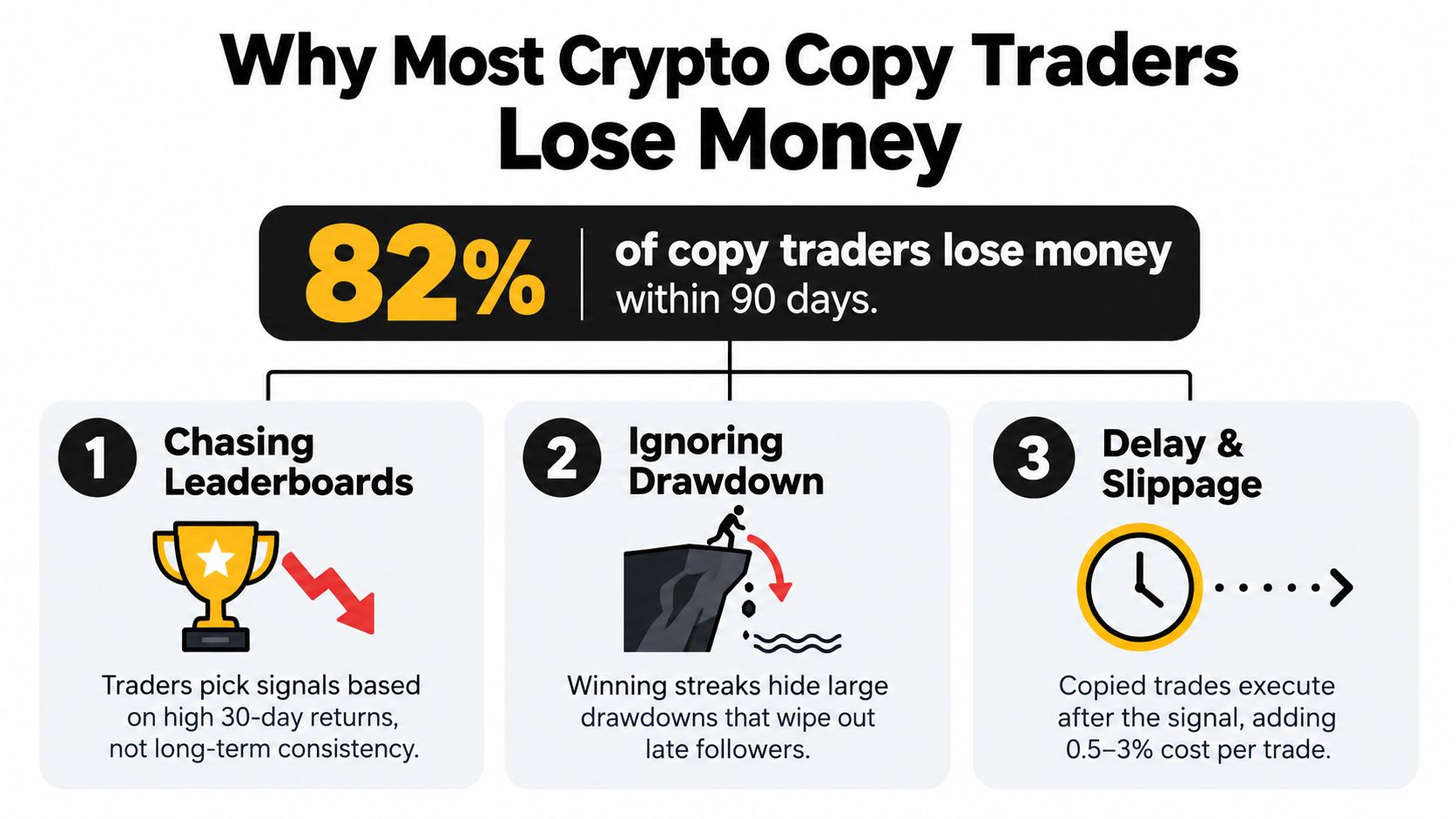
A profitable leader does not guarantee a profitable follower. The study cited earlier found a wide gap between leader and follower outcomes. Timing, allocation, fees, and follower behavior can turn a sound strategy into a poor account result.
The leaderboard trap
Many followers sort by recent return, choose the most aggressive profile, and allocate after a strong run. That process favors short-term visibility over durability. A leader may reach the top through high borrowed capital, concentration in one volatile asset, or open losses that later recover.
Maximum drawdown gives you a better starting point. It measures the fall from a peak before recovery, helping you judge whether you could stay invested through the same path. A high return paired with a severe drawdown may be unsuitable even if the account finishes profitable.
Correlation hides inside diversification
Following several leaders does not automatically diversify your portfolio. If they buy the same major coins, follow similar momentum rules, or trade during the same sessions, their positions can react to one market shock.
The correlation may be hidden because the providers have different names and performance charts. In practice, you may duplicate exposure, increase funding costs, and approach your account's loss limit without realizing that several strategies are making the same bet.
Position sizing turns a mistake into a breach
A losing copy allocation often triggers an attempt to recover quickly by increasing the next allocation. That is reactive sizing, not a risk plan. The risk rises again if the leader also increases exposure after a loss, because your account is responding to two layers of escalation.
At MyFundedCapital, copied strategies still need to fit the firm's risk rules. Excessive concentration in one leader, missing risk parameters, and reactive sizing can create evaluation problems even when individual trades appear reasonable. Set the allocation, maximum tolerable drawdown, and stop conditions before the first copied order.
Crypto trades continuously. A copy engine can act during thin liquidity, sudden liquidations, or a weekend move while you are away from the screen. The durable advantage is not finding a magic trader. It is building exposure you can keep running through ordinary losses without breaking your own limits.
Choosing a Signal Provider You Can Actually Live With
Start with the question, “Could I tolerate this trader's worst historical path?” Don't begin with the highest return. A leader's performance only becomes useful after you understand the holding period, concentration, and drawdown behind it.
A practical audit
Use a verified record covering at least 90 days before allocating meaningful capital. A short record can show whether a trader is active, but it may not reveal how the strategy behaves through different market conditions. Compare raw return with maximum drawdown, then examine Sharpe and Sortino ratios for a risk-adjusted view.
The trade log should answer practical questions:
- Holding period: Does the leader scalp rapidly, hold positions for days, or carry exposure through major market moves?
- Win-to-loss structure: Are gains generated by many small wins and occasional large losses, or by fewer trades with controlled exits?
- Exit behavior: Does the trader use stop losses, reduce risk, or add to losing positions?
- Margin and exposure: Does the strategy depend on derivatives exposure that your account can safely reproduce?
- Concentration: Does one asset or one correlated group drive most of the record?
Stress-test the record against the 2022 bear market and the 2023 ETF-approval volatility rather than treating one favorable period as proof of skill. Past performance can't predict future results, but a longer record can reveal whether the provider's process changes dramatically when conditions shift.
| Metric | What to Look For | Red Flag |
|---|---|---|
| Maximum drawdown | A loss path that fits your allocation and tolerance | Deep declines hidden behind strong total ROI |
| Sharpe ratio | Returns achieved with comparatively controlled variability | High return with unstable risk-adjusted performance |
| Sortino ratio | Downside-adjusted performance | Frequent harmful volatility below the target |
| Trade history | Consistent entries, exits, and holding periods | Sparse records or unexplained gaps |
| Win-to-loss ratio | A payoff structure you understand | Small wins paired with oversized losses |
| Stop-loss practice | Clear, repeatable loss management | Repeated averaging down without a defined limit |
| Market exposure | Diversified or intentionally concentrated exposure | One asset or style dominates the results |
Allocate according to historical downside, not upside. A provider with a large maximum drawdown may require a smaller allocation, a separate kill-switch, or no allocation at all. At a prop firm, consistency and rule compliance matter more than a brief burst of aggressive performance.
Fees, Slippage, and Latency: Where Copy Returns Leak
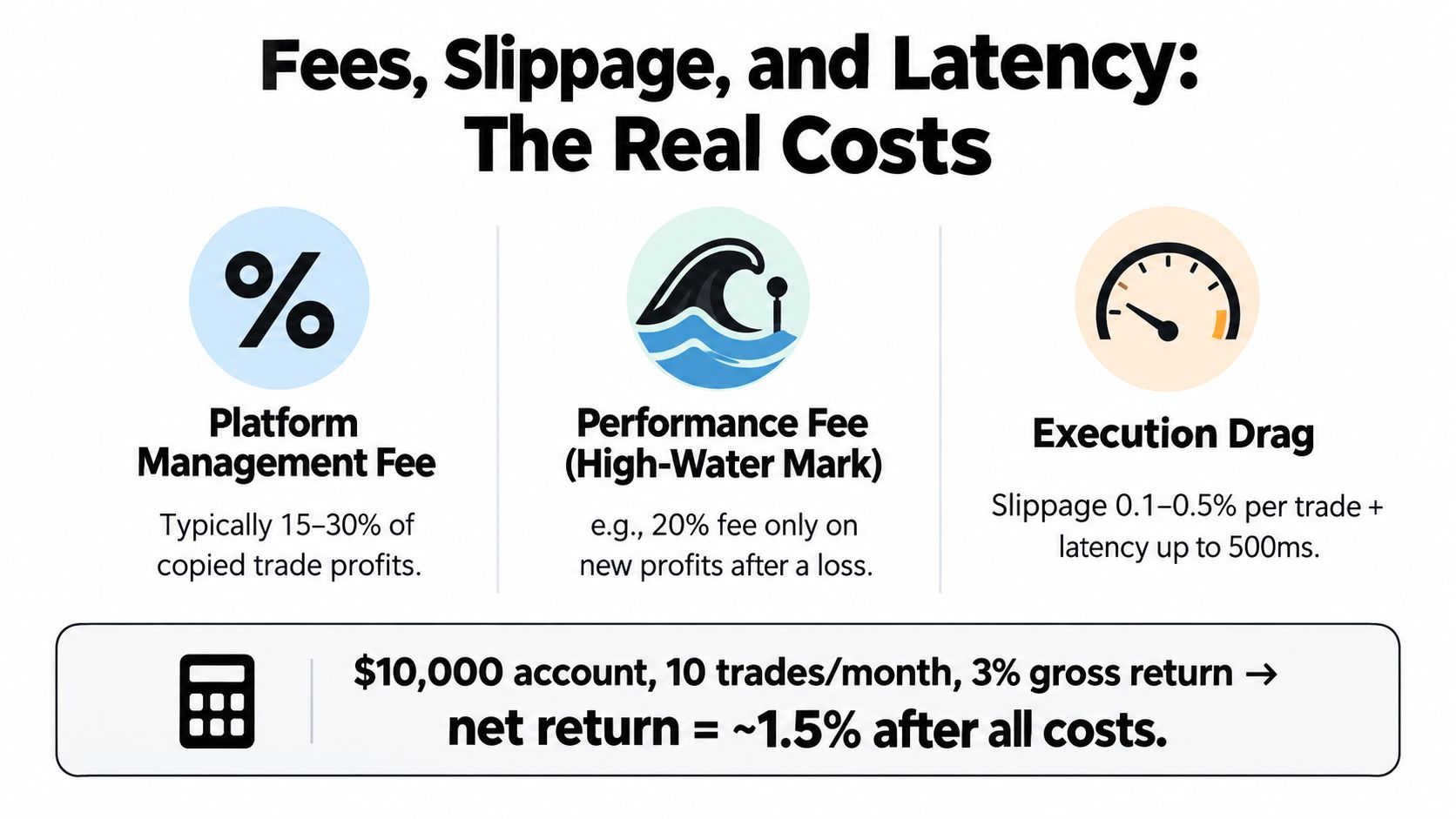
A copied trade can lose value before its gross return reaches your account. Trading fees, platform charges, performance fees, funding payments, spread, slippage, and delayed execution all reduce the result. Choosing a profitable leader matters, but the replication process determines how much of that performance you receive.
Three layers of drag
Trading and platform fees apply because your account places its own orders. A copied trade does not bypass those charges. If the platform applies a performance fee, it may calculate that fee from realized gains and use a high-water mark. The provider then receives a share only after the account rises above its previous profit peak.
Execution drag occurs when your fill is worse than the leader's. Liquidity, order sequencing, and market movement can create a gap where a leader shows 20% returns, while copiers realize 15%. This explanation of slippage in trading helps clarify why a displayed return may not match your own net result.
Latency becomes more costly in fast, thin markets. An on-chain analysis reported that a 30-second delay between an original wallet trade and its mirrored order could produce a 5% to 15% entry-price difference in volatile memecoin markets, according to Tekedia's analysis of copy-trading data. A delay of that size can remove the apparent edge before your order is filled.
A simple net-return model
Suppose a copied strategy produces a 25% gross return, with a 2% management fee and a 20% performance fee. The management charge reduces the account first. The performance fee then takes a portion of the remaining gain. Depending on the fee basis and timing, the result is roughly 19%, before further execution costs.
The example shows why the sequence of charges matters more than the headline number. A leader's dashboard may display gross performance, while your account receives different fills and pays fees at different points.
Cost check: Record gross PnL, trading fees, performance fees, funding payments, and slippage separately. That breakdown shows whether the strategy is producing returns or whether execution and account charges are consuming them.
How Prop Firms Like MFC Support Copy Trading
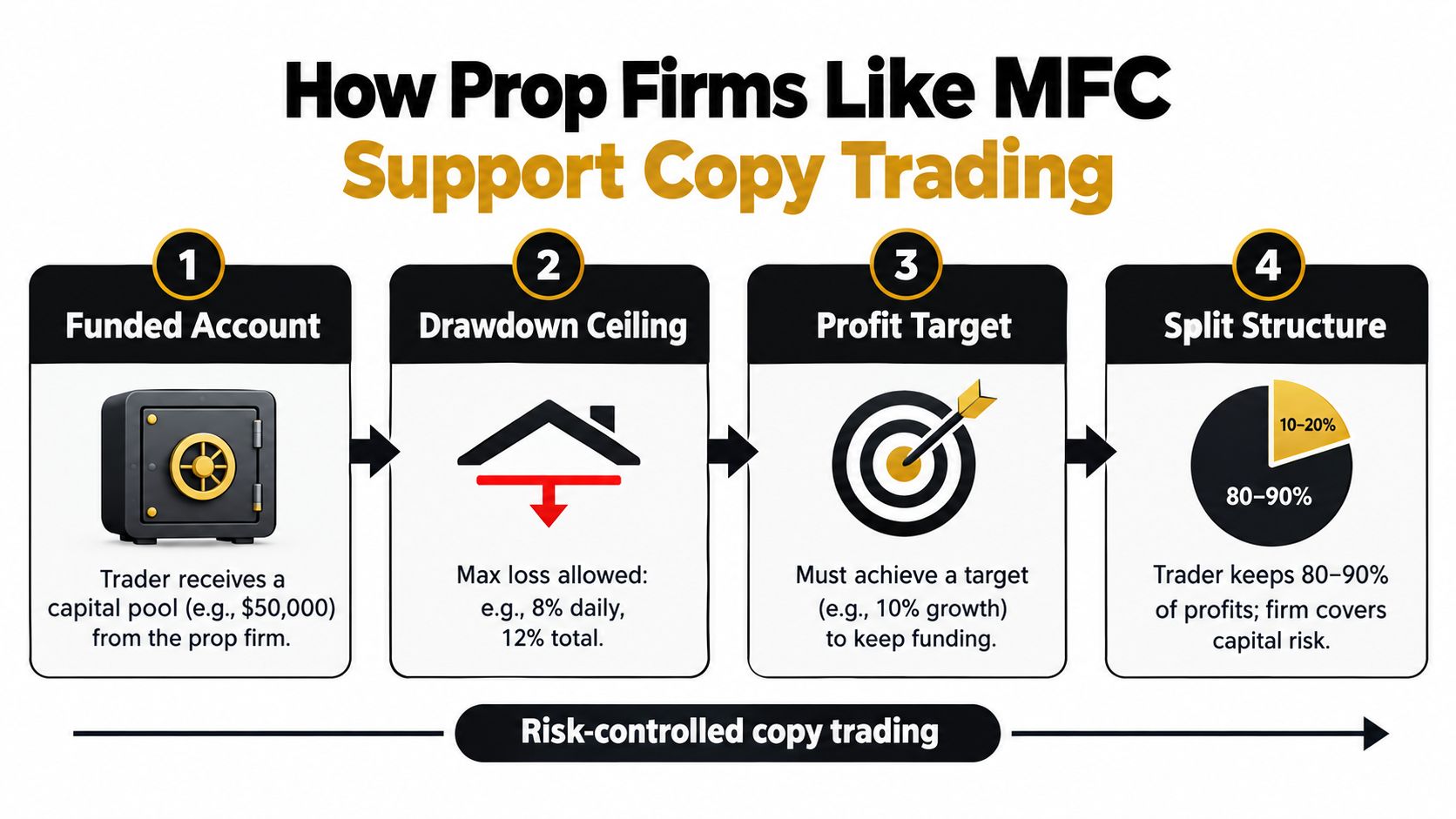
A prop-firm arrangement changes where capital and operating constraints sit, but it doesn't remove trading risk. A firm such as MyFundedCapital provides a simulated funded account, defined drawdown limits, a profit target for challenge routes, and payout procedures. The trader supplies the strategy and must operate within the account rules.
That structure differs from trading directly on an exchange. With a personal exchange account, you deposit your own capital and manage venue exposure, custody, and withdrawals yourself. With a prop-firm account, the firm defines the environment and evaluates whether your process can operate within its limits.
Rules determine whether replication fits
Before copying into an evaluation or funded account, check:
- Position-size limits: A leader's simultaneous trades may exceed the allowed lot size or exposure.
- News restrictions: A copied order can open during a restricted news window unless the account includes the relevant permission.
- Weekend holding: Crypto trades continue while traditional markets close, so weekend rules can affect open positions and automated exits.
- Drawdown measurement: Several copied positions may contribute to the same daily or total loss limit.
- Payout attribution: The dashboard should make it clear which copied trades generated the reported result.
A prop firm can absorb some infrastructure and personal-capital burden, but it can't absorb careless sizing. Profit splits, withdrawal cadence, and permitted strategies vary by provider, so read the rules before connecting a copier. MyFundedCapital's copy-trading information is one place to review how a prop-firm environment may handle this approach.
A Pre-Launch Routine and Frequently Asked Questions
Run the setup like a trading system, not a one-click subscription. Before going live, test the signal, measure the replication behavior, and define what makes you stop.
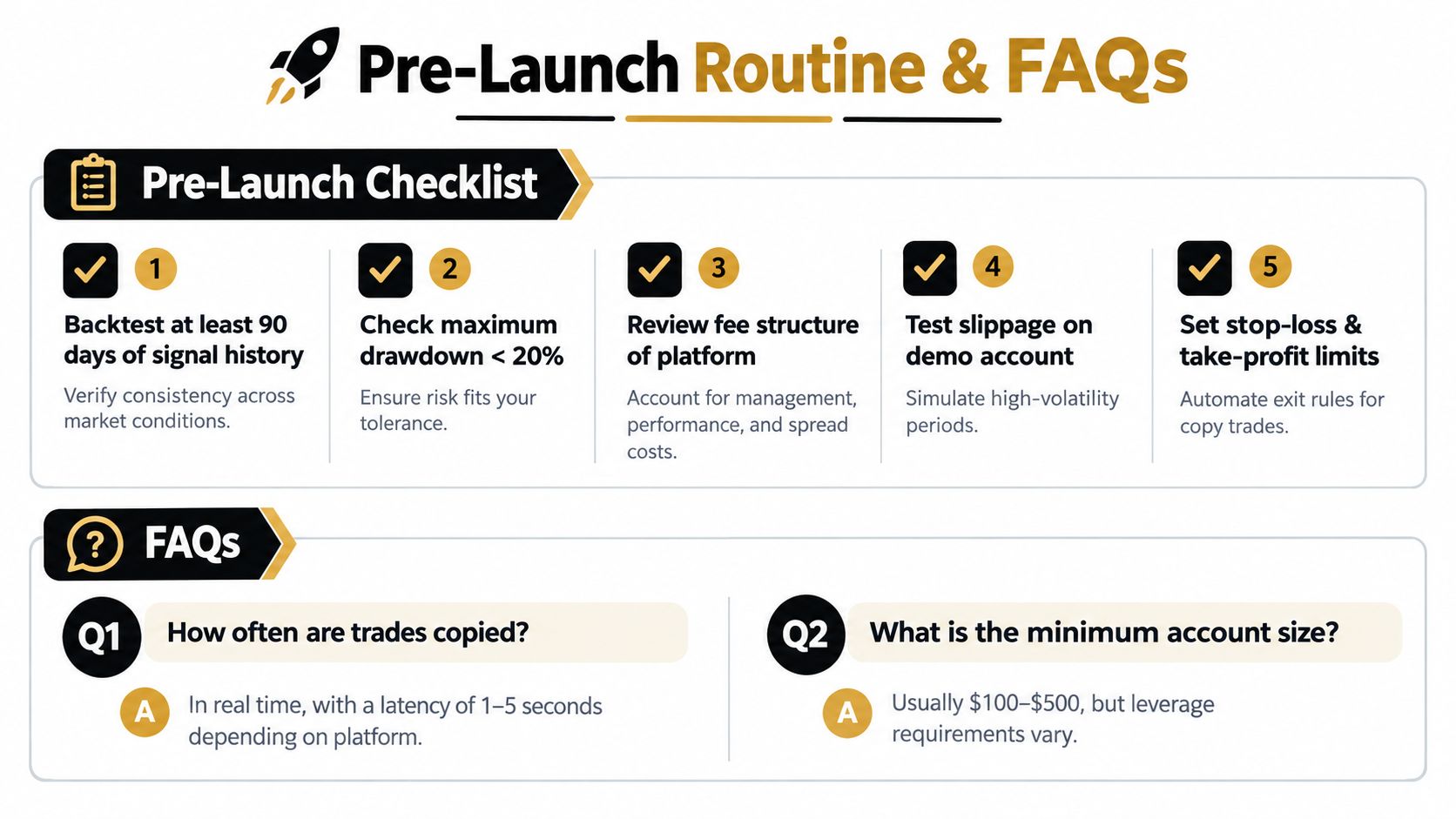
Pre-launch checklist
- Backtest at least 90 days of signal history. Check consistency across different market conditions.
- Paper-trade the copy for two weeks. Compare leader fills with simulated follower fills.
- Use fixed allocation. Size the allocation as a defined percentage of funded capital rather than increasing it after a loss.
- Set a kill-switch. Stop copying when your maximum drawdown threshold is reached.
- Log every trade. Record the entry reason, fill difference, fees, exit, and result.
Frequently asked questions
What is copy trading crypto?
It's an automated arrangement where your account mirrors a lead trader's positions proportionally. You copy exposure and execution instructions, not guaranteed outcomes.
Is crypto copy trading profitable?
It can be, but profitability depends on the provider, allocation, market conditions, execution quality, and fees. The 90-day study cited earlier found that followers were profitable overall only 48.48% of the time.
How much capital do I need?
The amount depends on the platform's minimum order, allocation rules, and whether you're using spot or margin products. Check those requirements before connecting an account.
Do prop firms allow copy trading?
Some do, subject to their risk and anti-abuse rules. Confirm whether copying is permitted, which tools are allowed, and how simultaneous positions are treated.
MyFundedCapital offers simulated funded accounts through Instant Funding and 1-Step or 2-Step Challenges, with account sizes from $5K to $100K and scaling paths up to $500K, subject to its published rules. If you want to test copy trading with defined risk parameters rather than putting personal capital on every venue, visit MyFundedCapital to compare account options and choose a suitable evaluation path.
