

 AR
AR
 NL
NL
 EN
EN
 FR
FR
 DE
DE
 ES
ES
 PL
PL
 SV
SV
 PT
PT

You're looking at an Alpha Capital challenge and wondering whether the fee, the rules, and the payout setup fit your trading style, or whether you're about to pay for a pretty sales page. That's the right question. Trading involves risk of loss, prop firms are rule-bound simulations, and the only thing that matters is whether the structure gives your strategy a fair shot.
What This Guide Actually Helps You Decide
Most prop-firm content tries to sell you on a brand. That's a waste of your time. The actual decision is simpler, where should you spend your next evaluation fee so the odds, the costs, and the payout mechanics line up with the way you already trade.
Alpha Capital Prop Firm is a useful case because it looks straightforward on the surface, then gets stricter once you read the rules closely. You need to know three things before you spend a dollar, how the challenge stack works, what it really costs after failed attempts and trading frictions, and whether the setup is better for you than a faster-payout alternative like MyFundedCapital.
Practical rule: if a prop firm's rules force you to trade smaller than your normal size, that's not a minor detail, it's the whole game.
This article is educational only and not financial advice. It won't promise profit, because no honest funded-trading guide should. It will give you a blunt read on Alpha Capital's structure so you can decide whether the evaluation fee belongs in your plan or in someone else's.
Who Alpha Capital Is and How Its Programs Are Structured
Alpha Capital Group started in the United Kingdom in late 2021, launched its first challenge in 2022, and then scaled fast enough that by 2024 to 2025 it was being described as one of the larger names in the prop space, with growth from about 1,000 monthly active users in its first year to 100,000 in its third year, and reported payouts of $80 million in performance fees, with expectations to move beyond $100 million by Q1 2025 according to the linked source on its growth story. The firm is also described by independent review sources as having over 250,000 registered traders across 180+ countries, more than $70 million in reported payouts, and a community above 300,000 across platforms, with maximum buying power up to 1:100 and scaling up to $2,000,000. Those scale markers matter, but they don't tell you whether the rules fit your style.
The three program paths traders usually compare
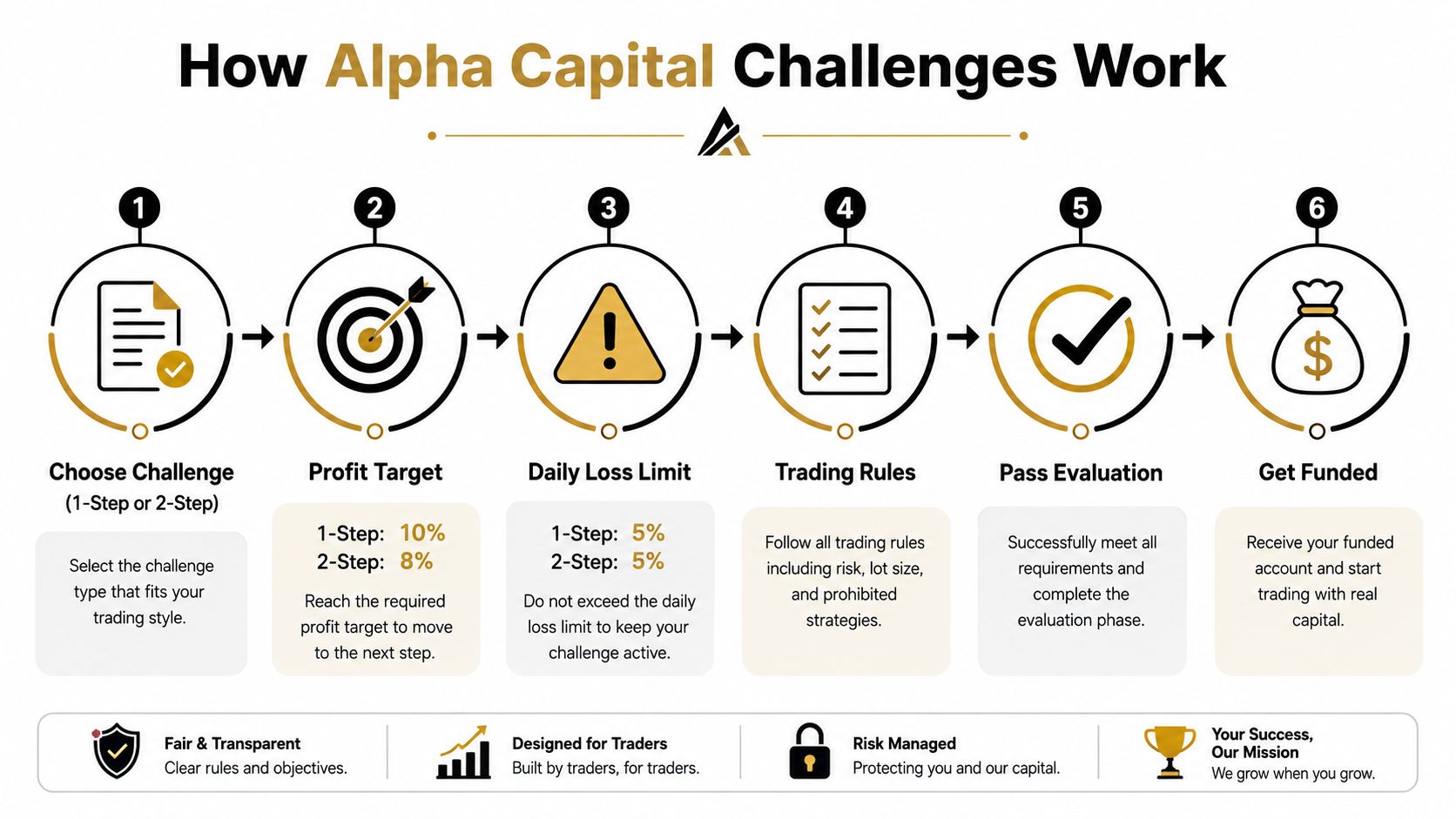
Alpha One, Alpha Pro, and Alpha Three are the names that matter. Alpha One is the cleaner single-path option, while Alpha Pro and Alpha Three are the more traditional challenge routes for traders who can work through staged evaluations. The firm's own materials frame these as simulated-fund evaluations, so you're not buying a brokerage account with investor-style protections, you're buying access to a rules-based qualification process.
The practical question is simple. If you're a beginner-intermediate trader who still needs room to learn discipline, Alpha One can feel more direct. If you're already consistent and just need funding access, Alpha Pro or Alpha Three may suit you better, but only if you can handle tighter rule discipline without blowing up on one bad session.
What the account range says about the business model
Third-party summaries describe account sizes from $5,000 to $200,000, with a combined maximum qualified allocation of $400,000 and an 80% trader split on funded accounts, plus bi-weekly payouts in some official-style summaries. That sounds generous, and in isolation it is. But the headline matters less than the path to getting paid, because the funded-account layer only matters if you can survive the evaluation without breaching the rule stack.
The clean takeaway is this. Alpha Capital is not a tiny storefront prop firm, and it isn't a pure hype machine either. It's a scaled rules platform with a strong marketing footprint, simulated trading conditions, and enough user volume that the brand has real market presence. That still doesn't make it the best fit for every trader.
How Alpha Capital Challenges Actually Work
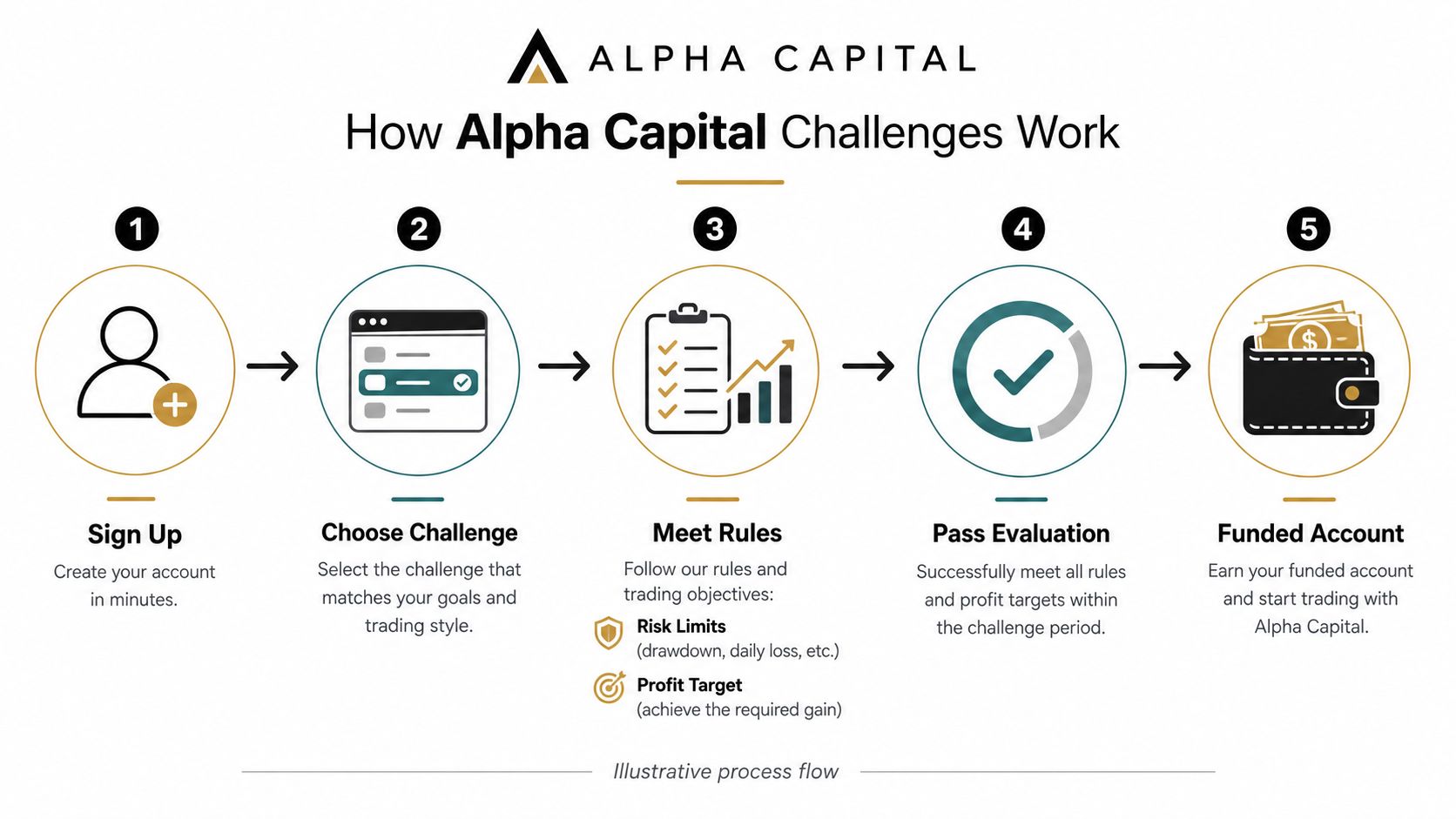
The first thing to understand is that Alpha Capital's challenge design is stricter than a simple profit-target setup. It uses a 4% daily loss limit and account-specific drawdown rules that range from 6% trailing on Alpha One to 6% to 10% static on Alpha Pro and Alpha Three, according to the risk framework summary. That combination changes behavior fast, because a trader can fail on intraday damage long before the wider ceiling is reached.
Daily loss comes first, not last
Here's the part a lot of traders miss. A daily loss limit is not a suggestion that only matters near the end of the week. It controls every entry you take from the first trade of the session, because one bad burst of volatility can end your evaluation even if the overall drawdown still looks safe on paper. That forces smaller size, tighter stops, and more selective entries as account size rises.
The hard lesson is that prop firms don't care that you were “right eventually.” They care whether you stayed inside the daily envelope. If your strategy needs wide intraday swings before it resolves, Alpha Capital's structure can punish it hard.
Trailing and static drawdown are not the same thing
Alpha One's 6% trailing drawdown means your room can shrink as the account grows. Alpha Pro and Alpha Three use 6% to 10% static drawdown, which is easier to plan around because the threshold doesn't follow every new equity high in the same way. That difference is not academic. It decides how much breathing room you have after a winning streak and how fast the account can turn fragile after a pullback.
A useful way to think about it is position size discipline. If your strategy normally leans on aggressive scaling, Alpha Capital's structure pushes you to do the opposite. The platform rewards control, not bravado.
A trader who survives prop rules is usually the one who sizes like a professional before the account feels “big enough” to relax.
For a side-by-side walkthrough of how challenge mechanics work in general, the clearest external explainer is this guide on understanding prop-firm challenges.
Real Costs, Payouts, and Profit Splits
The total cost of Alpha Capital includes more than just the challenge fee. It also covers any add-ons, the impact of spreads and commissions, and losses from unsuccessful attempts. To get a clear picture, you need to account for the entire cycle, not just the initial price.
The published material highlighted in the brief does not give us a clean fee table, so don't pretend otherwise. What you can model is the structure that drives expectancy, the 80% split referenced in third-party summaries, the staged account sizes, the payout cadence, and the fact that short-term strategies pay the most in spread and commission drag. That matters more than marketing language about “high splits.”
| Alpha Capital Cost and Payout Snapshot | ||||
|---|---|---|---|---|
| Account Size | Typical Challenge Fee | Daily Loss Limit | Overall Drawdown | Payout Cadence |
| $5,000 to $200,000 | Not specified in the verified data | 4% | 6% trailing on Alpha One, 6% to 10% static on Alpha Pro and Alpha Three | Bi-weekly payouts are cited in third-party summaries |
What your net expectancy actually depends on
Your expectancy is shaped by three things, not one. First, how many attempts you need before passing. Second, how much friction your strategy absorbs from spreads and commissions. Third, how often you can convert a funded month into a real payout without violating account rules.
That's why short-term scalpers need to be careful. If your edge is tiny and your entries are frequent, the cost of crossing the spread repeatedly can eat the account faster than a bad signal. If you trade cleaner, hold longer, and avoid overtrading, your economics improve even if the profit split headline looks similar.
Why payout speed matters more than people admit
Bi-weekly payouts are fine if you're disciplined and you don't need fast capital recycling. But they're not the same as on-demand payouts. A trader who wants faster turnover should care less about the sticker split and more about how quickly earned profits can leave the account.
For a general comparison of funding mechanics and profit-keeping rules, the closest reference point is the step-by-step explanation at Step 3 profit. Use that kind of breakdown mindset here, because the wrong mental model turns a “cheap” challenge into an expensive series of retries.
A simple cost reality check
If you pay for two attempts and only one month produces a funded payout, your true cost is already higher than the sticker price. That's not pessimism, that's math. A lot of traders lose money in prop firms not because the firm is impossible, but because they treat the challenge fee as the whole decision instead of one line in a bigger expectancy sheet.
Trust, Regulation, and What Simulated Funding Really Means
Alpha Capital's biggest blind spot is not the charting platform or the challenge format. It's regulation. The firm is a UK-based prop operation that runs evaluations on simulated capital, which is a very different product from trading with a regulated broker. You're not buying deposit protection, you're buying access to a rules-based qualification system and the chance to earn a performance share.
That distinction matters because public prop-firm marketing tends to obsess over payouts and split percentages, then glide past the uncomfortable questions. What happens if the rules change? What happens if an account is suspended? What protection do you have if the firm rewrites payout terms? Those are the questions traders should ask before they send money.
Bottom line: reputation is not regulation, and a payout screenshot is not a legal protection.
The firm's own materials emphasize simulated-fund evaluations, multiple challenge paths, and performance splits rather than investor-style safeguards. Independent review commentary, as summarized in the brief, also notes that negative experiences in this niche often revolve around rule changes and payout disputes, not trading mechanics. That's the core issue with the category. Traders often compare firms like they're brokers, when they should compare them like contract-based service providers.
For a tighter explanation of that regulatory gap, read prop firm regulation. Then ask yourself a blunt question, if the firm is mainly selling access to a simulation, what safeguard are you relying on besides reputation, community size, and payout history?
The honest answer is not very comforting. You are relying on the agreement, the firm's reputation, and your own discipline. That's enough for some traders. It's not enough for everyone.
Alpha Capital vs MyFundedCapital Side by Side
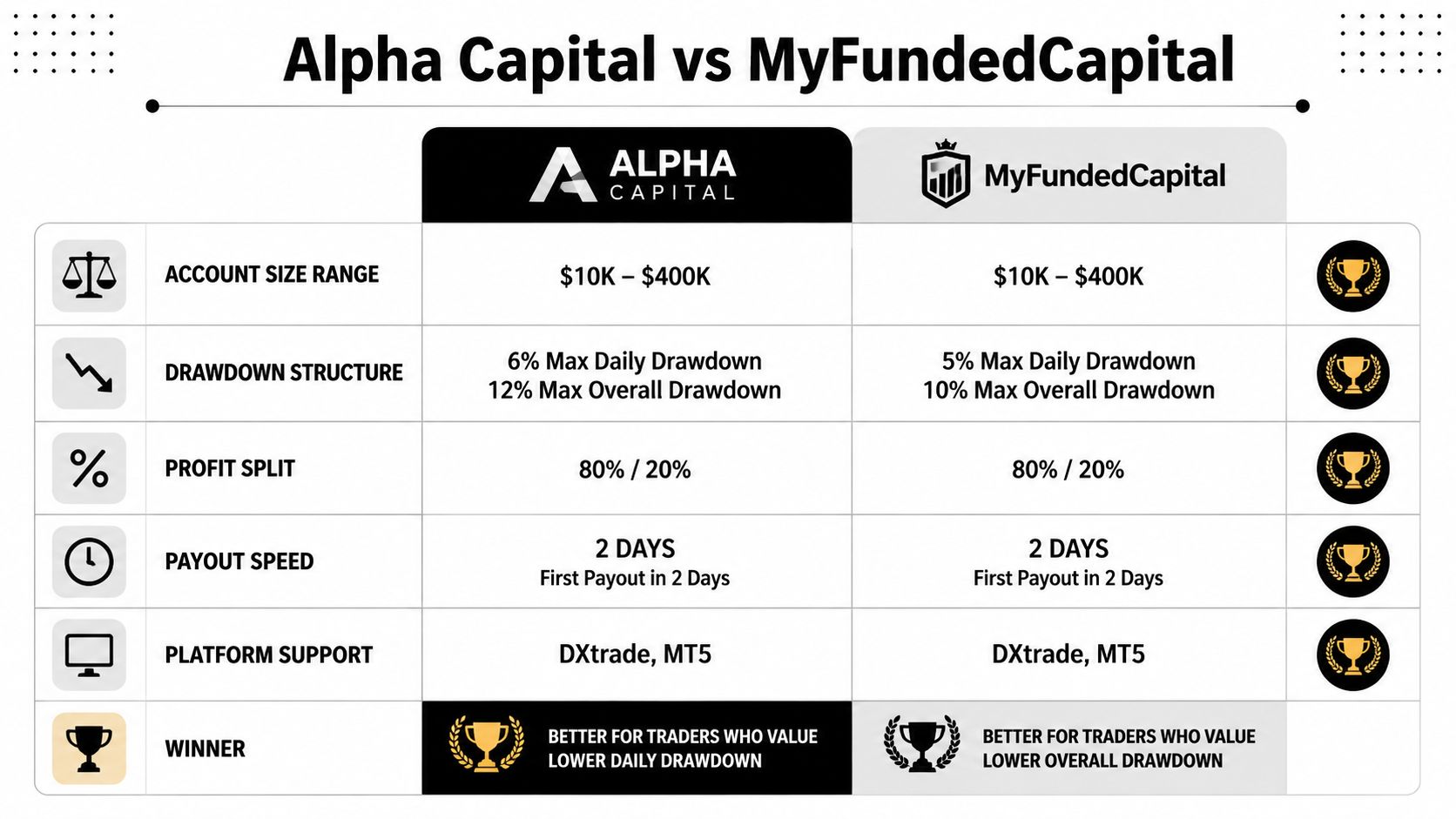
A clean comparison beats a brand-war every time. Alpha Capital has scale, a visible community, and a stricter risk model that some traders like because it forces discipline. MyFundedCapital is built around broader flexibility, faster payout mechanics, and wider platform support, which tends to suit traders who care more about execution freedom than branded challenge prestige.
Where Alpha Capital is stricter
Alpha Capital's main edge is structure. The 4% daily loss limit and the trailing or static drawdown combinations make it a better filter for traders who need firm guardrails. It's a decent fit if your problem is overtrading, sloppy risk, or letting winners turn into losers.
It's less attractive if you trade news, hold through events, or need wide platform flexibility. The marketing can sound broad, but the risk envelope is the product. That means Alpha Capital is better for traders who value rule discipline over operational convenience.
Where MyFundedCapital is more practical
MyFundedCapital offers $5K to $100K accounts, scaling up to $500K, a flat 5% daily loss limit, up to 10% maximum drawdown, profit splits from 80/20 up to 100%, and payouts every 7 to 14 days or on demand, with average processing around 2 hours. It also supports manual, algorithmic, and copy trading on DXtrade and cTrader, with MT5 coming soon, plus optional add-ons for news trading and weekend holding. That's a materially different package.
The comparison is simple. If you want more flexibility, faster cash-out cycles, and a broader trading setup, MyFundedCapital is the cleaner fit. If you want a tighter challenge that forces more conservative behavior, Alpha Capital may feel more disciplined, but that discipline comes at the cost of less room for error.
Which trader should choose which firm
Use Alpha Capital if you're the kind of trader who needs strict guardrails to stay honest. Use MyFundedCapital if you already have a stable edge and want a structure that doesn't fight your style as much. If your strategy relies on rapid iteration, weekend holding, or cleaner access to multiple platforms, the choice leans hard toward MyFundedCapital.
If you're comparing other funded models in general, it helps to ask a more basic question first, which lead generation tool fits you. That mindset, from a completely different market, is still useful because it forces you to match the tool to the use case instead of buying the loudest brand.
Tips to Pass an Evaluation and Choose the Right Firm
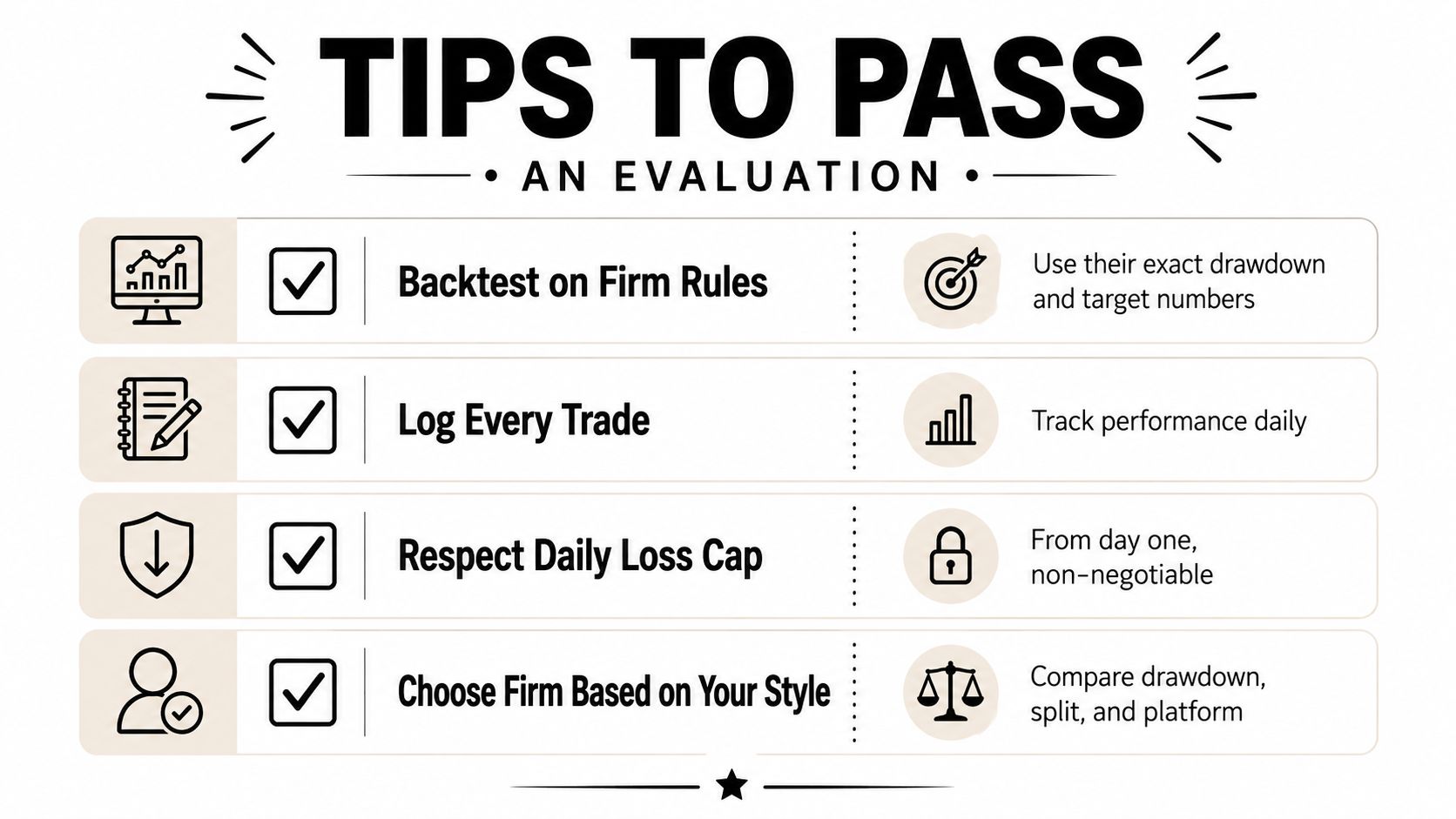
The traders who pass prop evaluations usually do boring things well. They backtest on the firm's exact rule set, log every trade, and stop pretending that “almost fit” is good enough. If your strategy can't survive the daily loss cap from day one, don't expect the fifth attempt to magically fix it.
What to do before you pay for a challenge
- Backtest on the exact rules. Use the firm's daily loss limit and drawdown numbers, not a generic backtest that ignores them.
- Log every trade. Track entry, stop, exit, and whether the trade helped or hurt your rule compliance.
- Respect the daily cap on day one. Don't “ease in” with looser sizing. That's how traders blow the account early.
- Size like the rules are permanent. If your single-trade risk is too large for the daily loss buffer, cut it.
How to choose the right firm
Choose Alpha Capital if you need tighter guardrails and you trade best when the rules are strict. Choose MyFundedCapital if you care more about payout speed, platform choice, and a more flexible operating setup. If you're uncertain, start small, run one challenge, and treat the first attempt as a compatibility test, not a final verdict.
The biggest mistake is assuming a prop firm can rescue a weak strategy. It can't. Evaluation fees, add-ons, and failed attempts are real expenses, and if your trading doesn't have edge before the challenge starts, the firm won't create it for you.
Common Questions About Alpha Capital Prop Firm
Is Alpha Capital legitimate or a scam?
It's a real UK-based prop firm with large reported user and payout figures, but that doesn't erase the simulation-based model or the need to read the fine print carefully. Reputation helps, regulation is still the key gap.
Is 1-Step easier than 2-Step?
Not automatically. A 1-Step path can be simpler on paper, but the stricter drawdown behavior can make it harder for volatile strategies. The right answer depends on how cleanly you manage risk.
What happens if I breach a rule?
In prop trading, a breach usually means the account is compromised or terminated according to the agreement. That's why you should treat every rule, especially daily loss, as absolutely mandatory.
How do I decide between Alpha Capital and a faster-payout alternative?
Use a real comparison, not a vibe check. If you want to compare another option objectively, start by reviewing which lead generation tool fits you as an example of choosing the right tool for the job, then apply the same logic to funding firms, look at rules, speed, and fit.
MyFundedCapital gives traders a cleaner way to test funded-account discipline with transparent rules, flexible account paths, and faster payout cycles. If Alpha Capital feels too rigid for your style, visit MyFundedCapital and compare the challenge paths, payout options, and account types before you pay for another evaluation.
