A lot of traders hit the same wall. They watch charts, collect random setups from social media, take a few good trades, then lose control the moment pressure shows up.
That’s where boot camps programs can help, if you pick the right one and use it the right way. A solid trading bootcamp won’t make you profitable overnight, but it can give you structure, risk discipline, and a repeatable process that lines up with what funded account evaluations demand.
What Are Trading Boot Camps Programs Really
Trading boot camps programs are short, intensive training environments built to compress learning and force consistency. They’re different from casual trading courses because they usually combine curriculum, deadlines, review, and some form of accountability.
The idea didn’t start in trading. The broader bootcamp model became legitimate because intensive skills training proved there was real demand for faster alternatives to traditional education. In tech, enrollment grew from under 20,000 in 2015 to over 100,000 by 2021, with projections of 380,000 graduates by 2026 according to Educate Me’s bootcamp market statistics. That doesn’t prove every trading bootcamp is good. It does prove the format itself is no longer fringe.
For traders, the best boot camps programs do four things well:
- Impose structure so you stop jumping from strategy to strategy
- Teach risk first instead of setup-chasing
- Create repetition through drills, journaling, and review
- Prepare you for rules-based performance, which matters if your goal is a funded challenge
A weak program does the opposite. It sells motivation, screenshots, and urgency. It tells you execution is easy and psychology is optional. That kind of training usually falls apart as soon as real drawdown shows up.
Trading bootcamp versus coding bootcamp
Coding bootcamps train people to build software. Trading bootcamps should train people to make decisions under uncertainty while protecting capital.
That distinction matters. In coding, you can often verify whether something works. In trading, a good process can still produce a losing day. So the curriculum has to teach judgment, not just pattern recognition.
That’s why I tend to prefer programs built around process and feedback, not just content libraries. If you learn well in a group setting, the cohort-based course model is worth understanding because it explains why deadlines, peer accountability, and live interaction often improve follow-through.
If you’re still unclear on the business model behind funded trading, read this breakdown of how proprietary trading firms work. It helps frame why rule-following matters as much as raw market analysis.
The four common formats
Not all boot camps programs feel the same in practice. Format affects retention, cost, flexibility, and whether you’ll finish.
| Format | Typical Cost | Schedule | Interaction Level | Best For |
|---|---|---|---|---|
| Immersive in-person workshop | Higher relative cost | Short, concentrated blocks | High | Traders who need direct supervision and fast correction |
| Flexible online course | Lower to mid-range | Self-paced or lightly structured | Low to medium | Traders with jobs or uneven schedules |
| Intensive full-time bootcamp | High time commitment | Daily sessions over several weeks | High | Traders who want rapid immersion and can protect the time |
| Personalized mentorship model | Usually premium-priced | Flexible but guided | Very high | Traders who need tailored feedback on execution and psychology |
How to choose the right format
A simple filter works better than overthinking.
- Choose in-person if you know you procrastinate alone.
- Choose online self-paced if your work schedule changes week to week.
- Choose full-time intensive if you already know trading is your main focus.
- Choose mentorship if your problem isn’t information. It’s misexecution.
Practical rule: Pick the format you’re most likely to complete under stress, not the one that sounds most impressive on a sales page.
A bootcamp is a tool. If the structure doesn’t fit your life, it won’t fix your trading.
Deconstructing a Typical Trading Bootcamp Curriculum
Most traders don’t fail because they lack indicators. They fail because they learn in the wrong order. They start with entries, skip risk, ignore review, and then wonder why nothing sticks.
Good boot camps programs don’t teach that way. They build skills in sequence. That mirrors strong data analytics training, where students start with foundational work and only move into advanced modeling after the basics are stable, as shown in Stony Brook’s data analytics bootcamp structure.
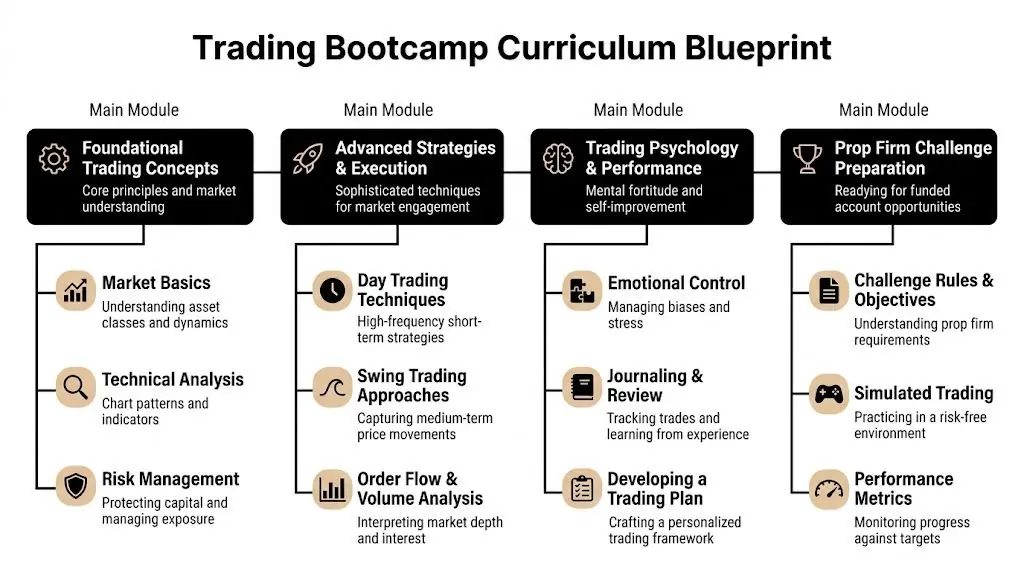
Module one builds the base
The first part of a serious trading curriculum should feel almost boring. That’s a good sign.
You should expect work on:
- Market basics such as asset classes, sessions, volatility conditions, and how different instruments behave
- Technical analysis including market structure, support and resistance, trend conditions, and invalidation
- Risk management like position sizing, stop placement, trade frequency limits, and daily loss rules
A lot of newer traders want to rush past this stage. That’s a mistake. If you can’t define risk before entry, advanced strategy work won’t save you.
A bootcamp that treats risk management as one lesson instead of a constant operating rule is teaching entertainment, not trading.
Module two moves into execution
Once the base is stable, the curriculum should shift toward applied strategy. At this stage, many weaker programs overpromise.
A proper execution module usually covers several styles rather than pretending one style fits everyone:
Day trading techniques
Fast decision-making. Session timing. Liquidity windows. Managing open risk when the market moves quickly.
Swing trading approaches
Holding through broader moves. Planning around higher time frame structure. Accepting fewer setups with longer development.
Order flow and volume work
Reading participation, imbalance, and intent. Not every bootcamp goes deep here, but stronger ones at least introduce how price movement and participation connect.
The key is progression. In the same way data students shouldn’t jump into predictive work before they can clean and structure data, traders shouldn’t jump into execution complexity before they can hold basic discipline.
Module three deals with the real problem
Most traders say they need a better setup. Many need a better response to uncertainty.
This part of the curriculum matters more than people admit. A quality bootcamp should include:
- Emotional control drills
- Trade journaling
- Daily and weekly review
- Written trading plan development
- Rules for stopping after poor execution
I’ve seen traders with average strategy logic survive because they were disciplined. I’ve also seen traders with sharp chart analysis fail because they couldn’t stop forcing trades after a loss.
Module four should prepare you for evaluation conditions
If a bootcamp claims to help traders pursue funded accounts, it should train for that environment specifically.
That means practical work on:
Challenge rules and objectives
Understanding how drawdown rules, consistency expectations, and trading restrictions affect decision-making.Simulated trading under rules
Practicing in conditions that punish overtrading and revenge trading.Performance metrics
Tracking not just wins and losses, but rule adherence, average risk taken, missed setups, and emotional mistakes.
What the weekly workload usually looks like
A bootcamp should be heavy enough to force habits, but realistic enough to finish.
| Program style | Sample weekly rhythm |
|---|---|
| Intensive | Live lesson, chart replay, execution drills, journal review, rule-based simulation, group debrief |
| Part-time | A few lessons during the week, one review session, independent chart work, weekend planning and journaling |
If the curriculum is all theory and no review, it’s incomplete. If it’s all motivation and no process, it’s worse.
How to Measure Program Quality and Calculate Your ROI
A trading bootcamp isn’t cheap just because the invoice looks manageable. If the program wastes your time, teaches sloppy habits, or pushes you toward impulsive trading, the actual cost is higher than tuition.
That’s why I evaluate boot camps programs the same way I’d evaluate any trading system. I want to see depth, rules, and evidence of process. In data engineering, stronger programs stand out because they go deep into complex areas rather than staying surface-level, as described by DataExpert’s curriculum examples. Trading education should show that same seriousness.

What quality looks like in practice
A credible program usually has clear limits. It doesn’t pretend to solve every problem in a few days.
Use this checklist before you pay for anything:
Instructor credibility
Look for teachers who can explain risk, execution, and review in detail. I care less about luxury lifestyle marketing and more about whether they can break down a losing trade without dodging responsibility.Curriculum depth
A real program should cover market structure, trade selection, position sizing, journaling, and challenge-style rule management. Extra credit if it also includes backtesting or structured replay.Feedback loop
Students need correction. That can be live review, group critique, office hours, or direct mentorship. Without feedback, most traders just reinforce bad habits.Community quality
A useful group talks process. A useless group talks payouts, account size, and shortcuts.Post-program support
Bootcamps end. Your trading doesn’t. The question is whether you get a runway for continued review after the formal training stops.
Red flags that should make you leave
Some warning signs are obvious. Others are hidden inside polished branding.
Walk away if you see this:
- Guaranteed income language
- Pressure to buy immediately
- No clear explanation of risk
- Testimonials with no substance
- A curriculum built around signals instead of decision-making
- Trainers who can’t explain what to do after a losing streak
Reality check: If a program sells certainty, it’s selling the one thing trading never gives you.
ROI is bigger than money
A lot of traders calculate ROI the wrong way. They compare tuition to possible profits and stop there.
That’s too narrow. In education, ROI often includes speed, retention, network, and behavior change. If you want a useful way to think through outcomes, these frameworks for measuring ROI are helpful because they push you beyond simplistic revenue math.
For trading, practical ROI includes:
| ROI category | What to ask |
|---|---|
| Skill acceleration | Did the program shorten the time it takes you to identify and execute your setup correctly? |
| Error reduction | Are you making fewer avoidable mistakes, especially around sizing, overtrading, and exits? |
| Process strength | Do you now have a written plan, journal routine, and review workflow? |
| Psychological improvement | Are you calmer, more selective, and less reactive after losses? |
| Opportunity readiness | Are you closer to operating under challenge rules without breaking discipline? |
A better way to judge the purchase
Ask one hard question. If you didn’t buy this program, what would your next three months look like?
For many traders, the honest answer is scattered YouTube videos, random Discord opinions, poor journaling, and inconsistent execution. In that case, a good bootcamp can be worth it because it compresses noise into process.
For other traders, the answer is different. If you already have a stable method, a complete journal, and the discipline to follow your rules, you may not need a full bootcamp. You may need targeted coaching or challenge-specific simulation instead.
Preparing for Prop Firm Challenges Like MyFundedCapital
A funded challenge is not just a test of market direction. It’s a test of whether you can operate inside hard rules without falling apart.
That’s why the best boot camps programs prepare traders for restrictions, not freedom. You’re not training to be creative all day. You’re training to make good decisions while a rule set limits your room for error.
A good example is the challenge environment many prop traders aim for. Some firms use a 5% daily loss limit on its Challenges (3% on Instant Funding) and up to 10% maximum drawdown, which means your edge has to live inside strict damage control. You can review the mechanics in this guide to understanding the prop firm challenges.
Why bootcamp structure fits challenge structure
There’s a natural overlap between serious training and funded evaluation:
- Both require rule adherence
- Both punish emotional trading
- Both reward consistency over hero trades
- Both expose sizing mistakes quickly
Many traders get blindsided. They think passing a challenge is mainly about finding high-probability setups. It isn’t. It’s about finding setups you can trade repeatedly without violating risk rules.
That changes everything.
What challenge-ready training should include
A trading bootcamp that claims to prepare you for funded evaluations should train these specific muscles.
Rule translation
You need to convert challenge rules into behavior. If there’s a daily loss cap, what does that mean for your number of attempts, your max risk per trade, and your stop-trading threshold?
Execution under pressure
Many traders can trade well in theory. They deteriorate when one more loss puts them near a limit. Bootcamp drills should simulate that pressure.
Recovery discipline
You need a plan for bad days that doesn’t involve forcing trades. The ability to stop is part of challenge performance.
Consistency mindset
A funded challenge usually rewards clean repetition more than occasional brilliance. One oversized trade can ruin several disciplined sessions.
Don’t judge a bootcamp by how exciting its strategy module is. Judge it by how well it teaches you to stay boring when the account is under pressure.
What doesn’t work
Some programs use a shock-and-hype model. They overload students, glorify aggression, and frame hesitation as weakness.
That approach often creates short-term adrenaline, not durable skill. Research on juvenile boot camps found military-style shock programs ineffective at producing long-term behavioral change, which is why the comparison matters in trading too, as summarized by the Office of Justice Programs review on juvenile boot camps. Traders don’t need a get-rich-quick environment. They need repetition, review, and sustainable discipline.
I’ve seen traders try to “power through” challenge pressure by trading harder. That usually ends the same way. They violate a rule they fully understood, then blame the market.
The mindset shift that matters most
To survive a funded evaluation, stop asking, “How fast can I pass?”
Start asking:
- Can I execute this setup the same way for weeks?
- Can I protect the account on a difficult day?
- Can I stay within limits without feeling trapped?
- Can I stop trading when my edge isn’t there?
If a bootcamp helps you answer yes to those questions, it’s useful. If it only teaches pattern spotting, it’s incomplete.
Your Post-Bootcamp Action Plan for Getting Funded
Most traders make the same mistake after finishing a program. They treat graduation like proof that they’re ready.
It isn’t. A bootcamp gives you a framework. Your job after that is to stabilize it under pressure.
The fastest way to waste a good education is to jump straight into a challenge before your routine is settled. A better path is to build a 30-60-90 day transition plan and treat it like a professional ramp-up. If your target is a funded evaluation, this guide on how to get a funded trading account helps frame the bigger process.
First 30 days
Your only objective here is clean execution in simulation.
Do this:
- Trade one core setup instead of rotating through several
- Use a fixed risk model so your data is consistent
- Journal every trade with entry reason, invalidation, emotional state, and post-trade notes
- Review rule breaks weekly and label them clearly
Don’t optimize for profit. Optimize for repeatability.
Days 31 to 60
This phase is about pressure testing your habits.
Focus on:
Psychological triggers
Identify what pushes you into bad trades. Common triggers include boredom, fear of missing out, and trying to recover a red day too quickly.Session selection
Narrow the hours you trade best. A lot of traders improve by cutting low-quality screen time.Refined trading plan
Tighten your checklist. If a setup needs too much discretion, define it better or drop it.
Execution note: If you can’t describe your setup in a few clear rules, you probably can’t trade it consistently under challenge pressure.
Days 61 to 90
Now simulate the challenge conditions as closely as possible.
Build your own testing block:
- Use the same daily and overall risk boundaries
- Trade only during your approved sessions
- Stop immediately after hitting your planned daily pain threshold
- Score yourself on rule adherence first, PnL second
- Review every near-miss, not just actual violations
By the end of this period, you should know three things with honesty:
- Whether your strategy is challenge-compatible
- Whether your psychology holds up when limits matter
- Whether you can be consistent without improvising every day
A simple readiness checklist
Before paying for any evaluation, make sure you can say yes to most of these:
- I have a written trading plan
- I know my invalidation before I enter
- I’ve tested my setup repeatedly
- I can stop trading after a poor decision
- I understand my strongest trading hours
- I’m not relying on one big trade to save the month
That’s the bridge from education to funded opportunity. Not confidence. Competence.
Common Pitfalls and Misconceptions to Avoid
The biggest lie in trading education is that intensity equals quality. It doesn’t. Some boot camps programs are disciplined, useful, and well-structured. Others are expensive noise with better branding.
One problem people ignore is access. High costs and weak financial support can keep lower-income students and students of color out of bootcamp-style education, as discussed in BestColleges’ analysis of underserved communities and coding bootcamps. In trading, that matters because high price often gets mistaken for high value.
Misconceptions that hurt traders
“If it’s expensive, it must be elite”
Not true. Sometimes you’re paying for marketing, not instruction. Expensive programs should offer better structure, better review, and better support. If they don’t, price means nothing.
“A bootcamp will make me profitable”
No program can do that for you. It can improve your process. It can shorten your learning curve. It cannot remove the risk of loss or guarantee performance.
“More strategies means more value”
Usually the opposite. Most struggling traders need fewer moving parts, not more.
Common mistakes after enrollment
These are the habits that ruin the benefit of a good program:
- Skipping the basic modules because they seem too simple
- Copying the instructor’s style instead of building your own rule set
- Ignoring journaling because it feels slow
- Taking a challenge too early before process becomes automatic
- Confusing motivation with readiness
The traders who last are usually not the most excited students. They’re the ones who keep doing the plain, repeatable work after the course ends.
What to look for instead
Look for value-driven education that teaches:
- Risk control before profit targets
- Process before prediction
- Review before scaling
- Clear rules before confidence
That’s less glamorous than social media trading culture. It’s also far closer to how durable traders are built.
Frequently Asked Questions About Trading Bootcamps
Are trading boot camps programs good for beginners
They can be, if the curriculum starts with fundamentals and doesn’t assume prior experience. Beginners usually benefit most from structure, especially around risk management, journaling, and market routine.
Can a bootcamp help me pass a funded challenge
It can improve your preparation if it trains you to follow rules, control losses, and execute consistently. It can’t guarantee that you’ll pass. Trading always involves risk of loss.
How long should I practice after a bootcamp before taking a challenge
Long enough to prove that your process is stable in simulation. For most traders, that means a period of focused practice, review, and challenge-style testing before paying for an evaluation.
What’s the biggest sign a bootcamp is low quality
Promises. If a provider implies guaranteed profits, easy funding, or fast success with little emphasis on discipline and downside control, that’s usually a bad sign.
If you want to put disciplined training into a real evaluation environment, explore MyFundedCapital and compare its funding programs, account types, and challenge paths. Keep your expectations realistic, protect your downside, and remember that trading involves risk of loss. This article is educational only and not financial advice.